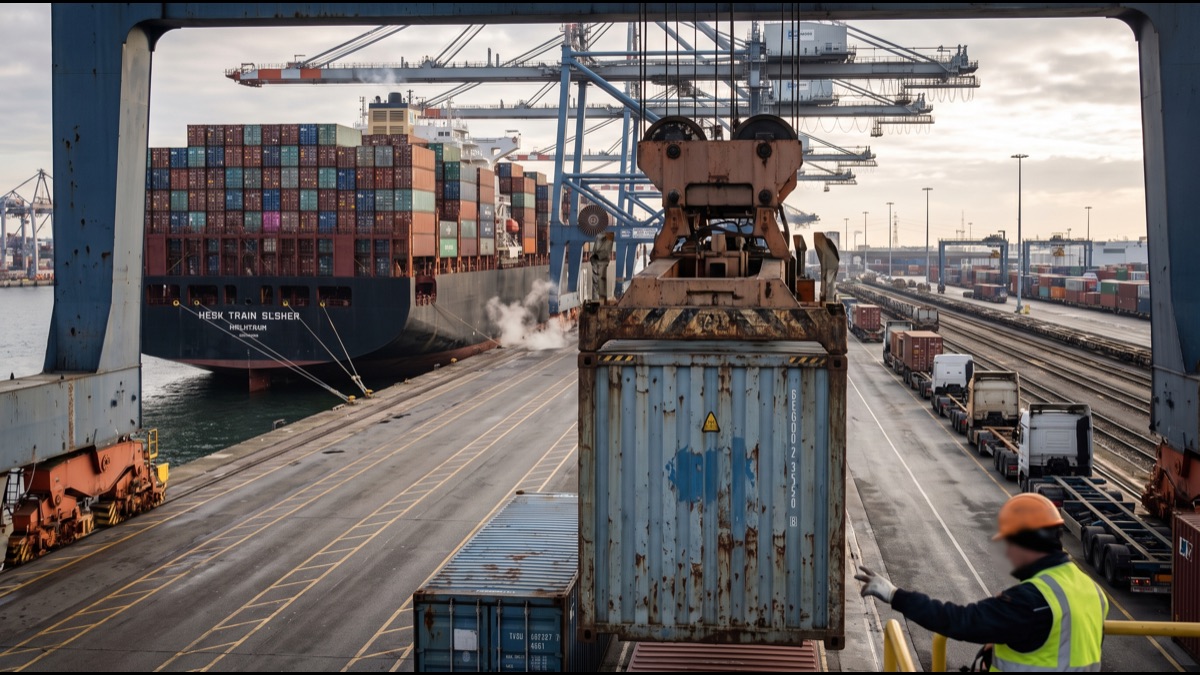
Few objects have reshaped the modern economy as thoroughly as a plain corrugated steel box, and few have received as little credit for it. The shipping container has no moving parts, embodies no sophisticated engineering, and would have been entirely buildable a century before it appeared. Its significance lies not in the object but in what standardising it made possible.
Before containerisation, moving goods between countries was slow, expensive, and unreliable enough that manufacturers generally located production close to customers because distance was genuinely costly. Once that stopped being true, the geography of production reorganised around the world. Understanding how a box achieved that clarifies a great deal about why the global economy looks the way it does.
What Shipping Looked Like Before
Cargo was historically handled as break bulk, meaning individual items were loaded piece by piece into a ship's hold by gangs of dockworkers, with sacks, barrels, crates, and bales each handled separately and stowed by hand.
This was extraordinarily labour-intensive and slow, with a ship frequently spending as long in port being loaded and unloaded as it spent at sea, meaning expensive vessels sat idle at quaysides for substantial portions of every voyage.
Handling costs consequently dominated the total, and estimates from the period suggest loading and unloading could account for a very large share of the expense of moving goods, far exceeding the cost of the ocean crossing itself.
Why Break Bulk Was So Vulnerable
Because every item was handled individually and repeatedly, cargo was exposed to damage at each transfer, with fragile goods requiring elaborate packing that added weight, volume, and cost to compensate for rough handling.
Theft was endemic and simply accepted as a cost of business, since goods sat accessible on docks for extended periods and individual items could disappear without any realistic prospect of tracing them.
Insurance reflected these realities, adding substantially to the cost of shipping anything valuable, which meant that for many products the total expense of moving them internationally exceeded any advantage from producing them somewhere cheaper.
The Core Insight Behind Containerisation
The essential idea was to stop handling goods and start handling boxes, so that cargo is packed once at origin into a sealed unit that is never opened again until it reaches its final destination.
This meant the transfer between ship, train, and truck no longer required touching the cargo itself, since the entire container simply moves as one unit, which is why the approach is described as intermodal.
The insight sounds obvious in retrospect, but implementing it required rebuilding ports, ships, trucks, cranes, and railway wagons around a common specification, which is precisely why it took decades rather than years.
Why Standardisation Mattered More Than the Box
Early container systems were proprietary, with different operators using incompatible sizes and fittings, which meant a container from one company could not be handled by another company's equipment and the network benefit was lost entirely.
International agreement on standard dimensions and corner fittings was therefore the genuinely decisive development, because it meant any container could be handled by any crane, carried by any ship, and locked onto any chassis anywhere in the world.
This is the general lesson worth extracting: the value came from the standard rather than the object, since a box is trivial to build but a global agreement on exactly which box took sustained negotiation to achieve.
How Ports Had to Be Rebuilt
Traditional ports were fundamentally unsuited to containers, having been built around warehouses, narrow finger piers, and large labour forces, none of which suited an operation requiring vast paved storage areas and heavy cranes.
Container terminals needed deep water, extensive flat land immediately behind the quay, and direct rail and road connections, requirements that many historic city-centre ports simply could not satisfy within their existing footprint.
The consequence was that maritime activity relocated, with historic docklands closing and new facilities opening on cheaper land further out, which permanently transformed the economies and geography of numerous port cities.
What Happened to Dock Labour
Containerisation eliminated the large majority of dockworker jobs, since a crane operator handling containers moves in an hour what a substantial gang would previously have moved in a day, which represented a genuine productivity transformation and a genuine social rupture.
Dockworker unions had historically been powerful precisely because ports depended on their labour, and containerisation removed that dependency, which is why the transition involved sustained industrial conflict across many countries.
The eventual settlements frequently involved substantial redundancy payments and guarantees for remaining workers, arrangements that reduced immediate hardship while doing nothing to preserve the occupation itself as a source of mass employment.
How Costs Actually Fell
The cost reduction was dramatic, with the expense of moving a given quantity of goods falling by an order that made distance a substantially smaller factor in production decisions than it had ever previously been.
Speed contributed as much as direct cost, since ships that had spent days in port now turned around in hours, which meant each vessel completed far more voyages annually and the capital tied up in shipping worked considerably harder.
Reliability mattered too, because predictable transit times allowed manufacturers to plan production schedules around deliveries with confidence, which is a precondition for the just-in-time systems that later became standard across manufacturing.
Why This Enabled Offshore Manufacturing
When transport costs are high, production must occur near consumption, because the expense of moving finished goods overwhelms any saving from producing them somewhere with cheaper labour or inputs.
Containerisation collapsed that constraint, making it economical to manufacture on one side of the world and sell on the other, which unlocked wage differentials that had previously been commercially irrelevant.
The resulting relocation of manufacturing reshaped economies on both sides, generating rapid industrial growth in some regions and prolonged industrial decline in others, with political consequences that continue to unfold decades later.
How It Made Complex Supply Chains Possible
Cheap reliable freight permitted production to be broken into stages performed in different countries, with components manufactured wherever each specific step is most efficiently done and assembled somewhere else entirely.
This fragmentation would be economically impossible under break bulk costs, since each border crossing would add substantially to the price, whereas containerised movement made crossing borders repeatedly a marginal expense.
The result is that most manufactured products now contain components that have crossed multiple borders before assembly, a structure that delivers genuine efficiency while creating the interdependence that makes disruption propagate so widely.
Why Ships Grew So Enormous
Container shipping exhibits strong economies of scale, since a larger vessel costs proportionally less per container carried in fuel, crew, and capital, which has driven continuous growth in ship size across the industry.
The largest vessels now carry container counts that would have seemed implausible when the system began, and their scale has forced corresponding investment in deeper channels, larger cranes, and expanded terminal capacity.
This creates a genuine lock-in, since ports unable to accommodate the largest ships risk losing traffic entirely, which pressures them into expensive expansion whether or not the underlying demand genuinely justifies it.
What the Empty Container Problem Is
Because trade flows are rarely balanced, containers accumulate where imports exceed exports and become scarce where the reverse applies, which means a substantial share of container movements carry nothing at all.
Repositioning empty boxes is a significant operational cost, and it explains the otherwise puzzling observation that shipping rates on the same route can differ substantially depending on direction of travel.
It also means container availability can become a binding constraint independent of ship capacity, with shortages developing in exporting regions even while empty boxes sit stacked in importing ones.
How Containers Changed What Gets Traded
The system suits standardised, durable, densely packed goods particularly well, which meant products fitting that profile became dramatically cheaper to trade while others benefited considerably less from the transition.
Refrigerated containers extended the benefit to perishables, allowing fresh produce, meat, and dairy to move intercontinentally on a routine commercial basis, which transformed what is available in supermarkets regardless of season.
Goods that do not containerise well, including bulk commodities and outsized industrial equipment, continue moving through entirely separate specialised systems, which is why the container revolution transformed some trades while barely touching others.
What the Environmental Picture Actually Is
Container shipping is remarkably efficient per unit of cargo moved, producing considerably lower emissions per tonne-kilometre than road or air freight, which means the mode itself is among the less carbon-intensive ways to move goods.
The complication is that by making distance cheap, containerisation enormously increased the total volume of goods moved, so aggregate emissions rose substantially even as efficiency per unit improved.
Fuel quality has been a further concern, since ships historically burned heavy residual fuel with high sulphur content, and regulation tightening those limits has driven genuine change while raising operating costs across the industry.
Why Security Became a Concern
The sealed container that solved theft created a different problem, since a box that nobody opens between origin and destination is also a box whose contents nobody verifies, which has obvious implications for smuggling.
Only a small fraction of containers can realistically be physically inspected given the volumes involved, so systems rely heavily on risk profiling, advance manifest data, and scanning technology rather than opening boxes.
This has produced substantial regulatory architecture requiring detailed cargo information to be submitted before loading rather than on arrival, shifting security assessment earlier in the journey where intervention remains possible.
Why the Container Is Such a Useful Example
The container is frequently cited as the clearest demonstration that transformative technology need not be sophisticated, since the object itself is trivially simple and the difficulty lay entirely in coordination rather than invention.
It also illustrates how long genuine transformation takes, since decades passed between the first container voyages and the point at which the system reshaped global manufacturing, with most of that time consumed by rebuilding infrastructure and settling standards.
Perhaps most usefully, it demonstrates that the benefits and costs of such transitions fall on entirely different people, with consumers and manufacturers gaining enormously while dockworkers and port cities bore concentrated losses they had no means to avoid.
How Containers Are Actually Tracked
Every container carries a unique identifying code following an international standard, combining an owner prefix with a serial number and a check digit that allows systems to verify the code has been read correctly rather than mistranscribed.
This identifier is what allows a specific box to be located within a system handling enormous volumes, since terminals record the precise stack position of every container and shipping lines track each unit through every stage of its journey.
Electronic tracking has expanded considerably, with sensor-equipped containers reporting location, internal temperature, and whether doors have been opened, which matters particularly for refrigerated cargo and for high-value goods where tampering is a genuine concern.
What Happens to Containers at End of Life
Containers have a working life measured in a couple of decades before accumulated damage and corrosion make them uneconomical to maintain for international shipping, at which point large numbers become available cheaply.
Many find second lives in static roles including storage units, site accommodation, workshops, and increasingly architectural applications, where their structural strength and standardised dimensions make them genuinely convenient building modules.
The remainder is scrapped for steel, and because a container contains a substantial quantity of high-grade steel, recycling is economically worthwhile rather than merely environmentally preferable, which means relatively few are simply abandoned.
Why Containers Are Lost at Sea
A number of containers are lost overboard each year, generally during severe weather when a vessel rolls heavily enough to break the lashings securing the upper tiers of a stack.
Incorrectly declared cargo weight has been identified as a contributing factor, since a stack loaded heavier than recorded shifts the vessel's centre of gravity and affects how it behaves in heavy seas, which prompted international rules requiring verified weights before loading.
Lost containers present genuine hazards, since those that float rather than sinking immediately can drift partially submerged and become effectively invisible obstacles for smaller vessels, while their contents contribute to marine pollution.
Why Empty Containers Are a Persistent Problem
Trade flows are unbalanced, so containers accumulate where goods are consumed and become scarce where goods are produced, requiring empties to be shipped back.
Repositioning empty boxes generates no revenue while consuming vessel capacity, fuel and port slots, and it represents a substantial share of total operating cost.
Operators mitigate this with leasing pools and by accepting one-way moves at a discount, though the underlying imbalance follows trade patterns that cannot be engineered away.
How Container Ships Grew So Large
Cost per container falls as vessels get bigger, which drove a sustained increase in ship size until vessels carrying over twenty thousand boxes became routine.
The savings are real but shift costs ashore, since ports must dredge deeper channels, buy larger cranes, and handle enormous cargo volumes in a single call.
Very large vessels also concentrate risk, as a single grounding or blockage can disrupt a substantial share of global capacity for weeks.
What Happens Inside a Modern Port
Terminals operate as scheduling systems rather than storage yards, with software determining where each box is stacked based on when it will be collected.
Misplacing a container is expensive because retrieving a buried box requires moving everything above it, so stacking decisions are optimised continuously.
Automation has advanced furthest in yard operations, where driverless carriers and automated cranes work in areas people no longer need to enter.
Why Customs Inspection Is Mostly Targeted
Only a small fraction of containers are physically opened, since inspecting everything would halt trade entirely and require enormous additional labour.
Selection relies on risk profiling using shipper history, route, declared contents and intelligence, supplemented by scanning that images the contents without opening.
This makes documentation accuracy the main control point, since a container's declared contents determine whether it receives attention at all.
How Standardisation Was Actually Agreed
Early container operators used incompatible sizes and fittings, which meant boxes from one line could not be handled by another line's equipment.
Agreement on standard dimensions and corner castings took years and required the original patent holder to release rights, without which the system would not have become universal.
The lesson is that the container's value came from the standard rather than the box, since an unshared design would have delivered almost none of the eventual benefit.
The shipping container required no technological breakthrough. It is a steel box, buildable long before it appeared, and its transformative power came entirely from international agreement on exactly which box everyone would use. That standardisation meant cargo could be packed once and moved between ship, train, and truck without ever being handled again, which eliminated the labour that had dominated shipping costs and the delays that had kept expensive vessels idle in port. What followed reorganised the world economy. Distance stopped being a significant factor in where things get made, wage differentials that had been commercially irrelevant suddenly mattered enormously, and production fragmented into stages performed in different countries. The gains were real and enormous, and they were distributed very unevenly: consumers and manufacturers captured most of them, while dockworkers and the cities built around traditional ports absorbed losses they had no way to prevent.
Sources
- Wikipedia — overview of containerisation history and economic effects
- United Nations Conference on Trade and Development — global maritime transport statistics and analysis
- International Maritime Organization — shipping regulation, emissions standards, and container security
- OECD — economic research on trade costs and global value chains
- World Trade Organization — data on trade volumes and supply chain fragmentation
FAQ
Why was the shipping container so transformative?
Not because of the box itself, which is simple, but because international standardisation meant any container could be handled by any crane, ship, or truck anywhere in the world.
What was shipping like before containers?
Cargo was handled piece by piece by dockworkers, so ships often spent as long in port as at sea, and handling costs dominated the total expense of moving goods.
How did containers enable offshore manufacturing?
By collapsing transport costs, they made it economical to produce on one side of the world and sell on the other, unlocking wage differentials that had previously been irrelevant.
Why do shipping rates differ by direction on the same route?
Trade flows are rarely balanced, so empty containers accumulate where imports exceed exports, and repositioning those empties is a significant cost.
Is container shipping bad for the environment?
It is efficient per tonne-kilometre compared with road or air, but by making distance cheap it hugely increased total volumes moved, so aggregate emissions rose regardless.
About the Author
We reference Wikipedia, United Nations Conference on Trade and Development, International Maritime Organization, OECD, and World Trade Organization to explain the background and current understanding of this topic.
Loved This Article?
Share it on WhatsApp → Share it on WhatsApp
Get more guides in your inbox — Subscribe to our newsletter for weekly surprising stories from Egypt, Saudi Arabia, Dubai, and beyond.