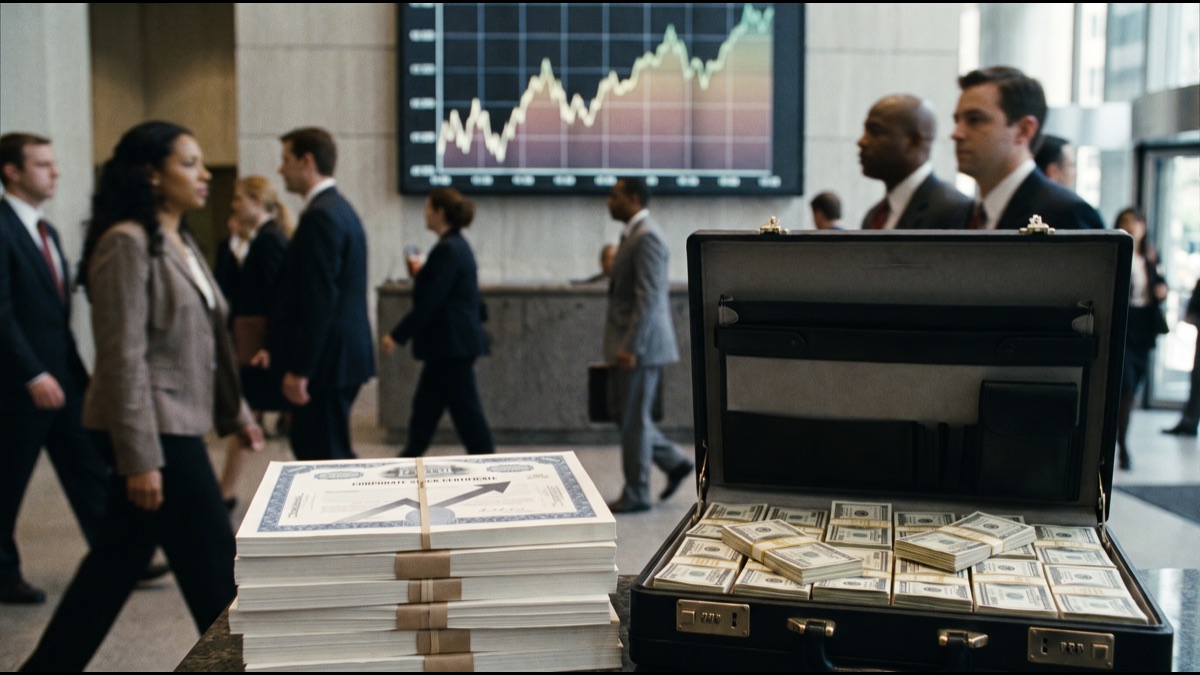
A stock buyback, formally a share repurchase, is simply a company using its own cash to purchase its own shares on the open market or through a tender offer, then typically retiring those shares so they no longer exist as outstanding stock.
What a Stock Buyback Actually Is
The practical effect is mechanical rather than mysterious. Once shares are retired, the same total company earnings and assets are divided among a smaller remaining pool of shares, which mathematically raises the value attributable to each share that is left outstanding.
This is fundamentally different from a company investing in new factories, research, or acquisitions, because a buyback returns capital to existing shareholders rather than deploying it to grow the underlying business, which is precisely why the practice generates so much debate among economists and policymakers.
Why Companies Prefer Buybacks Over Dividends
Dividends and buybacks both return cash to shareholders, but they behave very differently once started. A dividend is widely read by investors as a durable commitment, and cutting one later tends to be punished severely by the market, which makes companies cautious about raising dividends unless they are confident the higher payout is sustainable indefinitely.
A buyback carries no such implied promise. A company can repurchase shares aggressively in a strong year and simply pause the programme the following year without the same reputational cost, giving management considerably more flexibility to match cash returned to shareholders with how much surplus cash the business actually generates in a given period.
Buybacks also offer a tax advantage in many jurisdictions, since shareholders who do not sell their shares owe no immediate tax on a repurchase, whereas a cash dividend is typically taxable in the year it is received regardless of whether the investor wanted the cash at that moment.
How the Repurchase Mechanism Actually Works
In practice, a company's board first authorises a specific dollar amount that management is permitted to spend on repurchases over a defined period, though the authorisation itself does not obligate the company to actually spend that full amount or to spend it on any particular schedule.
Most repurchases then happen gradually through ordinary open-market purchases executed by brokers over weeks or months, deliberately spread out to avoid materially moving the share price through the buying pressure itself, similar to how a large investor would work an order into a market carefully.
A smaller number of buybacks happen through a tender offer, where the company publicly offers to buy a specific number of shares at a stated price, usually at a premium to the current market price, giving shareholders who want to sell a defined window and price to do so.
Why Buybacks Mechanically Raise Earnings Per Share
Earnings per share, one of the most closely watched corporate metrics, is calculated by dividing total net income by the number of shares outstanding, meaning that shrinking the denominator through retirement of repurchased shares increases the reported figure even if actual profit has not changed at all.
This mechanical effect is genuinely real and not merely an accounting illusion, since each remaining share now does represent a larger claim on the same total earnings, but it means earnings-per-share growth driven substantially by buybacks should be read differently from growth driven by the underlying business actually earning more money.
Analysts who want to isolate genuine operational performance from this effect typically also examine total net income growth and revenue growth directly, rather than relying on earnings per share in isolation, precisely because a shrinking share count can otherwise flatter a business whose underlying profitability is stagnant.
The Debate Over Buybacks Versus Investment
Critics of large-scale buyback programmes argue that cash spent repurchasing shares is cash that was not spent on research, equipment, wages, or expansion, and that companies with genuinely attractive growth opportunities available to them should generally prefer to invest in those opportunities over returning cash to shareholders.
Defenders respond that mature companies in industries without abundant high-return growth opportunities are doing shareholders a genuine favour by returning surplus capital rather than pursuing lower-quality acquisitions or expansion simply to avoid the appearance of hoarding cash, a pattern that has historically destroyed value at various companies.
The empirical evidence on this question is genuinely mixed across industries and time periods, and the honest position is that whether a specific buyback was a good use of capital depends heavily on what the company's realistic alternative uses for that cash actually were at the time.
How Executive Compensation Shapes Buyback Decisions
A meaningful share of senior executive compensation at many public companies is tied to metrics like earnings per share or stock price performance, which creates a direct financial incentive for executives personally to favour buybacks given their mechanical ability to lift exactly those figures.
This incentive structure does not automatically mean every buyback is motivated by self-interest rather than genuine capital allocation logic, but it is a factor that corporate governance researchers and shareholder advocates scrutinise closely when assessing whether a particular repurchase programme genuinely serves long-term shareholder interests.
Some companies have responded to this criticism by adjusting compensation structures to rely more heavily on metrics less directly influenced by share count, such as return on invested capital or absolute free cash flow generation, specifically to reduce the mechanical incentive toward buybacks for their own sake.
Why Buyback Timing Matters
A repurchase executed when a company's shares are genuinely undervalued relative to the business's actual worth benefits remaining shareholders meaningfully, since the company is effectively buying an asset for less than it is worth using shareholders' own collective money.
The same repurchase executed when shares are overvalued works in the opposite direction, effectively transferring value away from remaining long-term shareholders toward the departing shareholders who sold at the inflated price, a pattern documented at various companies that bought back stock heavily near market peaks.
Because companies rarely have a reliable, provable edge in judging their own share's fair value better than the broader market does, critics argue that buyback timing is frequently driven by available cash and executive incentives rather than by a genuinely disciplined valuation judgement.
How Buybacks Affect Company Financial Flexibility
Cash spent on repurchases is no longer available as a cushion during an economic downturn, a consideration that became highly visible when a number of companies that had spent heavily on buybacks in preceding years found themselves needing emergency financing or state support during subsequent economic shocks.
Some companies fund buybacks partly through borrowing rather than solely from existing cash reserves, which increases financial leverage and can leave the company more vulnerable to rising interest rates or a credit downgrade, a practice that ratings agencies monitor closely when assessing corporate debt.
Prudent capital allocation frameworks at well-governed companies generally treat buybacks as a lower priority than maintaining adequate liquidity reserves and funding committed growth investment, reserving repurchases specifically for genuinely surplus cash rather than for cash that might be needed under stress.
The Regulatory History of Buybacks
Large-scale open-market share repurchases were considerably more legally constrained in many markets until regulatory changes in the early nineteen eighties provided a clearer safe harbour protecting companies from allegations of market manipulation when conducting properly structured buyback programmes.
Since that regulatory clarification, buyback volume has grown enormously across major stock markets, becoming one of the dominant mechanisms by which large public companies return capital to shareholders, alongside and in many cases now exceeding traditional dividend payments in total dollar terms.
Some jurisdictions have subsequently introduced specific excise taxes or disclosure requirements targeting buybacks directly, reflecting continued policy debate about whether the practice should be actively discouraged relative to dividends or genuine reinvestment, without those measures eliminating the practice.
How Buybacks Differ From Dividends for Individual Investors
A shareholder who does not sell any shares during a buyback programme experiences no direct cash inflow at all, unlike a dividend which arrives as cash regardless of whether the shareholder wants it, meaning the practical benefit of a buyback to a non-selling holder is entirely indirect, through the improved per-share value of continued ownership.
This makes buybacks somewhat more tax-efficient for long-term holders who do not need current income, since the value accrues without triggering an immediate taxable event, while investors who genuinely need periodic cash income from their holdings may still prefer companies with a reliable dividend policy instead.
Index funds and other large diversified holders are generally indifferent between buybacks and dividends in aggregate terms across their whole portfolio, though the distinction still matters considerably to individual holders with specific tax situations or income needs.
Why Buyback Announcements Often Move Share Prices
Markets frequently react positively to a newly announced buyback authorisation, partly because it signals management's confidence that the company's own shares represent a good use of capital, and partly because the reduced future share count is understood to support per-share metrics going forward.
This reaction is not automatic or universal, and a buyback announced by a company facing weak growth prospects or already carrying substantial debt can instead be read negatively, as a signal that management sees no better use for cash than returning it, which is itself sometimes an implicit admission of limited growth opportunity.
Sophisticated investors generally look past the announcement itself to the underlying justification, distinguishing between a buyback funded from genuine surplus free cash flow at a business with an otherwise healthy balance sheet and one that appears primarily aimed at propping up a struggling share price.
How Buybacks Interact With Employee Stock Compensation
Many technology and growth companies issue substantial stock-based compensation to employees, which by itself increases the total share count over time, and some of these companies use ongoing buyback programmes specifically to offset that dilution rather than to meaningfully shrink the share count below its prior level.
In these cases, the buyback functions less as a genuine return of surplus capital to outside shareholders and more as a mechanism absorbing the cost of employee compensation, which analysts examining these companies typically account for separately when assessing whether shareholders are genuinely benefiting from the repurchase activity.
This distinction, between offsetting dilution and genuinely shrinking the share count, is one of the more commonly overlooked nuances when evaluating whether a company's buyback programme is actually delivering the per-share value improvement that headline repurchase figures might suggest.
What Critics Say About Buybacks and Inequality
Because share ownership is concentrated more heavily among wealthier households in most economies, critics argue that large-scale buyback programmes disproportionately benefit those households relative to workers who hold little or no equity in the companies employing them, contributing to a broader debate about corporate capital allocation and inequality.
Some labour advocates and policymakers have specifically proposed linking permission for large buyback programmes to conditions around minimum wage levels, worker benefits, or reinvestment commitments, arguing that companies should demonstrate adequate investment in their workforce before returning large sums to shareholders.
Corporate defenders counter that shareholders, including pension funds and retirement accounts that indirectly represent a very broad section of the population, are the legal owners of surplus corporate cash, and that restricting buybacks does not automatically redirect that same cash toward wages or investment.
How to Read a Company's Buyback Activity as an Investor
A useful starting point is comparing the dollar amount actually spent on repurchases in recent periods against the company's genuine free cash flow, since a buyback programme funded comfortably from surplus cash generation is a materially different signal than one funded through new borrowing during a period of weak cash generation.
It is also worth checking whether the outstanding share count has genuinely fallen over a multi-year period, rather than merely staying flat, since a company might be repurchasing shares primarily to offset new stock-based compensation issuance without delivering the per-share value improvement a naive reading of the buyback dollar figure might suggest.
Finally, comparing buyback timing against the company's own share price history over the same period offers a rough, imperfect check on whether management has historically bought opportunistically during weakness or simply spent steadily regardless of valuation, which speaks to the discipline behind the capital allocation decision.
How Buybacks Are Disclosed to the Public
Public companies are generally required to disclose the size of board-authorised repurchase programmes and to report actual purchase activity on a regular basis, giving investors visibility into how much of an authorised amount has genuinely been spent rather than merely announced for headline effect.
This disclosure matters because an authorisation itself is only a ceiling on potential spending, not a commitment, and companies sometimes announce large authorisations partly for the immediate positive market reaction without necessarily intending to execute the full amount within any specific timeframe.
Investors who want a genuinely accurate picture of a company's capital return activity generally look at actual quarterly repurchase spending reported in financial filings rather than relying on the original headline authorisation figure alone.
Stock buybacks are neither the villain nor the automatic virtue that different sides of the public debate sometimes present them as. Mechanically, they are a straightforward tool for returning surplus cash to shareholders by shrinking the outstanding share count, and their real-world value to remaining shareholders depends heavily on whether the cash spent was genuinely surplus, whether the shares were repurchased at a reasonable valuation, and what the company's realistic alternative use of that cash actually was.
Reading a specific company's buyback activity honestly means looking past the headline repurchase figure to free cash flow coverage, actual share count trends net of new issuance, and the discipline evident in purchase timing, rather than treating every announced authorisation as automatically good or bad news.
Sources
- Wikipedia — overview of share repurchase mechanics and history
- U.S. Securities and Exchange Commission — regulatory framework and disclosure rules governing buybacks
- U.S. Federal Reserve — research on corporate capital allocation and financial stability
- OECD — cross-country analysis of corporate payout policy
- International Monetary Fund — macroeconomic analysis of corporate cash distribution trends
FAQ
Are stock buybacks the same as dividends?
No — a dividend pays cash directly to all shareholders, while a buyback repurchases and retires shares, benefiting remaining holders indirectly through a smaller share count rather than a cash payment.
Do buybacks guarantee a higher share price?
No — they mechanically raise per-share metrics like earnings per share, but the market price still depends on overall investor sentiment and the company's genuine business performance.
Why do critics dislike large buyback programmes?
Critics argue cash spent on buybacks could instead fund wages, research, or expansion, and that buybacks disproportionately benefit wealthier shareholders relative to workers.
Can a company borrow money to fund buybacks?
Yes — some companies fund repurchases partly through debt rather than only cash reserves, which increases financial leverage and can raise risk during downturns.
Do stock-based employee compensation and buybacks offset each other?
Often yes — many companies use buybacks partly to offset new shares issued to employees as compensation, which limits how much the outstanding share count actually shrinks.
About the Author
We reference Wikipedia, U.S. Securities and Exchange Commission, U.S. Federal Reserve, OECD, International Monetary Fund to explain the background and current understanding of this topic.
Loved This Article?
Share it on WhatsApp → Share it on WhatsApp
Get more guides in your inbox — Subscribe to our newsletter for weekly surprising stories from Egypt, Saudi Arabia, Dubai, and beyond.