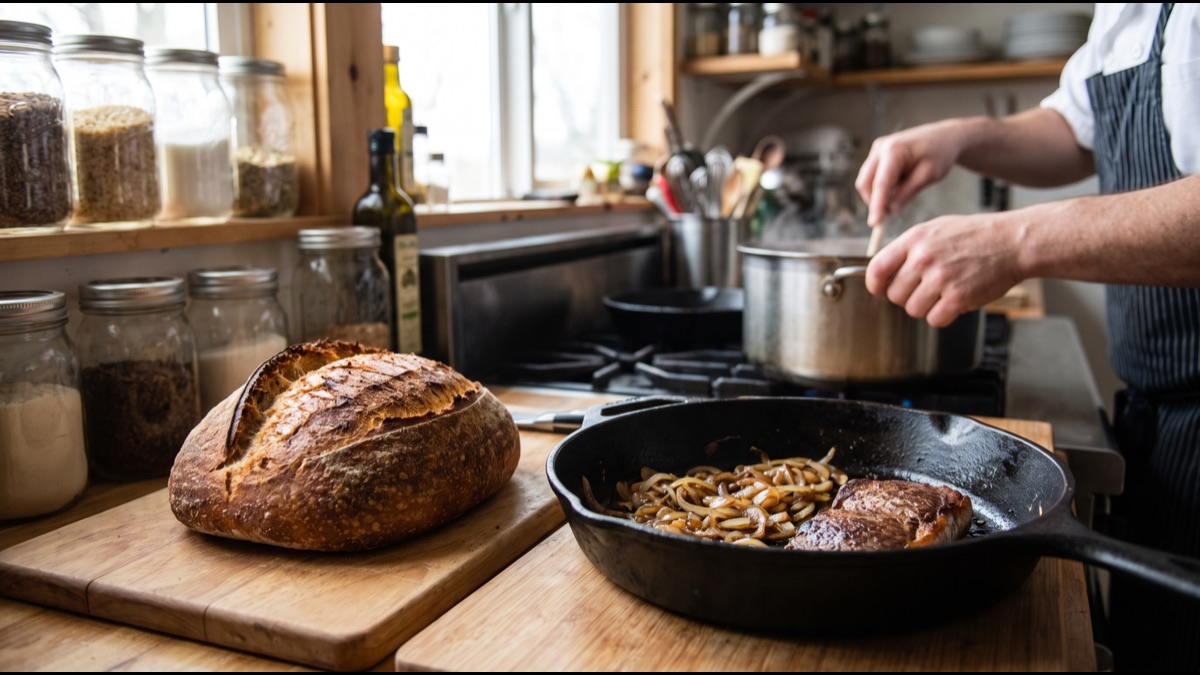
Seared steak, toasted bread, roasted coffee, and golden French fries share almost nothing in ingredients. One is muscle protein, one is baked wheat dough, one is a roasted seed, and one is fried potato, yet all four owe their characteristic brown color and their deep, complex, savory-sweet flavor to the exact same chemical process happening at their surface: the Maillard reaction.
Understanding what actually happens during this reaction explains an enormous amount of everyday cooking wisdom that otherwise seems arbitrary, including why searing requires genuinely high heat, why patting meat dry matters so much, and why boiling a piece of meat, no matter how long, will never produce the flavor that a hot pan produces in minutes.
What the Maillard Reaction Actually Is
The Maillard reaction is a chemical reaction between amino acids, the building blocks of proteins, and reducing sugars, a category of simple sugars present in nearly all raw food, that occurs when the two are heated together on a food's surface. Rather than being a single reaction, it is actually a complex cascade of hundreds of interlinked chemical reactions happening nearly simultaneously.
The initial step involves an amino acid's nitrogen-containing amine group reacting directly with a sugar molecule's carbonyl group, forming an unstable intermediate compound that then rearranges and breaks down through numerous different pathways, ultimately producing the brown pigments called melanoidins along with hundreds of distinct volatile flavor and aroma compounds unique to whichever specific amino acids and sugars happened to be present in that particular food.
Why It Needs Heat, Protein, and Sugar Together
All three ingredients, protein-derived amino acids, sugar, and sufficient heat, must be present simultaneously for the reaction to proceed at a meaningful rate, which is why foods lacking any one of these three components brown poorly or not at all regardless of cooking time or temperature.
Pure fat, for instance, contains essentially no amino acids or reducing sugars and therefore cannot undergo Maillard browning by itself, no matter how hot it gets, which explains why oil alone in a pan never browns the way meat or bread does; the browning chefs observe when frying always comes from the food itself rather than the cooking fat.
Why Boiling Food Never Produces Browning
The Maillard reaction proceeds extremely slowly at temperatures below roughly 140 to 150 degrees Celsius and accelerates dramatically as temperature climbs above that threshold, a temperature range entirely inaccessible to any food cooked in water, since water's boiling point caps liquid water-based cooking methods at 100 degrees Celsius at standard atmospheric pressure.
This single physical constraint explains why boiled, steamed, or poached meat, however thoroughly cooked and tender, never develops the deep savory crust and complex aroma of a seared or roasted piece of the same cut, and why professional kitchens routinely finish braised or boiled meats with a quick sear specifically to introduce Maillard flavor that the primary cooking method could never produce on its own.
How Hundreds of New Flavor Compounds Form
Food scientists have identified well over a thousand distinct volatile compounds generated through Maillard pathways across different foods, spanning categories including pyrazines, which contribute nutty and roasted notes, furans, which contribute caramel-like sweetness, and various sulfur compounds responsible for the deep savory, meaty character associated with well-browned protein.
Which specific compounds dominate in any given food depends heavily on the exact amino acids and sugars present in that food's raw composition, meaning the Maillard reaction does not produce one universal "browned" flavor but rather a food-specific signature flavor profile determined by each ingredient's underlying chemistry, which is why seared beef, toasted bread, and roasted coffee all smell and taste recognizably different despite undergoing fundamentally the same chemical process.
Researchers studying flavor chemistry have found that even subtle differences in pH, moisture content, and the specific ratio of amino acids to sugars in a food can dramatically shift which of the hundreds of possible reaction pathways dominate, which is one reason identical recipes can produce noticeably different flavor results depending on small variations in ingredient freshness or preparation technique that seem unrelated to flavor at first glance.
Why the Maillard Reaction Is Not Caramelization
Caramelization and the Maillard reaction are frequently confused because both produce browning and both occur at elevated cooking temperatures, but they are chemically distinct processes involving different starting materials and different reaction pathways entirely, despite the visual similarity of their end results.
Caramelization involves only sugar breaking down under heat with no protein or amino acids required at all, which is why pure sugar syrup can caramelize and brown on its own, while the Maillard reaction specifically and necessarily requires amino acids reacting together with sugars, meaning a food containing sugar but no protein, like plain sugar candy, can only caramelize and can never undergo true Maillard browning regardless of how it is heated.
Why Wet Meat Refuses to Sear Properly
Surface moisture on meat must fully evaporate before the meat's actual surface temperature can climb past water's 100-degree boiling point into the 140-plus-degree range where Maillard chemistry genuinely begins, meaning any water sitting on a food's surface acts as a temperature ceiling that actively delays browning until it has completely boiled away.
This is precisely why professional cooking technique emphasizes patting meat thoroughly dry with paper towels before searing, and why overcrowding a pan with too much food at once causes steaming rather than searing, since the accumulated moisture released by multiple pieces of food raises humidity around the food and delays the surface from ever reaching true browning temperature.
How Chefs Exploit the Reaction on Purpose
Professional kitchens deliberately manipulate every controllable variable feeding into Maillard chemistry, including surface dryness, pan temperature, fat selection, and even adding a small pinch of baking soda to raise a food's surface pH, since Maillard reactions proceed measurably faster in a more alkaline environment, a technique commonly used to accelerate browning on foods like stir-fried meat or roasted vegetables.
Techniques like dry-brining meat well in advance of cooking, or deliberately searing at very high heat in a barely-smoking pan rather than a moderately warm one, exist specifically to maximize surface dryness and heat transfer so the Maillard reaction can proceed as quickly and completely as possible before the food's interior overcooks.
Why Coffee Roasting Depends Entirely on This Chemistry
Green, unroasted coffee beans are pale, grassy-smelling, and bear almost no resemblance in flavor to finished coffee, and the entire transformation into the deeply aromatic, bitter-sweet flavor associated with roasted coffee happens through an intense Maillard reaction occurring during roasting, when beans are heated to temperatures well above 200 degrees Celsius for several minutes.
Roast masters control roasting time and temperature precisely because different roast levels push the Maillard reaction, and the related but distinct process of sugar pyrolysis that follows at even higher temperatures, to different points along the reaction pathway, which is why light, medium, and dark roasts of the exact same raw coffee bean can taste dramatically different from one another despite starting from identical raw material.
Home cooks trying to replicate restaurant-quality searing often overlook how much heat is lost the instant food touches a pan, which is why professional kitchens preheat pans far longer than most home recipes suggest and use heavier cookware specifically because it retains more thermal mass and recovers surface temperature more quickly after food is added, keeping the pan within the Maillard-favorable temperature range throughout cooking rather than dropping below it.
How Bread Crust Gets Its Color and Aroma
Bread dough contains both amino acids from wheat protein and reducing sugars either naturally present in flour or produced by yeast fermentation breaking down starch, providing everything the Maillard reaction needs once the loaf enters a hot oven and its exterior surface temperature climbs well past the reaction's threshold.
The distinctive aroma of freshly baked bread comes substantially from Maillard-generated compounds concentrated specifically in the crust, which is why crust and interior crumb of the same loaf taste and smell noticeably different, since the interior crumb never reaches Maillard-triggering temperatures during baking, remaining insulated below the boiling point of the moisture trapped inside the loaf throughout the entire bake.
The French Chemist Who First Described It
French physician and chemist Louis-Camille Maillard first described the reaction between amino acids and sugars in a 1912 scientific paper, though his original research was actually focused on understanding protein chemistry and had nothing to do with cooking or food science whatsoever, and his specific contribution to food chemistry went largely unrecognized during his own lifetime.
It was not until several decades later, particularly through the work of food chemist John Hodge, who published an influential 1953 paper mapping out the reaction's detailed chemical pathway, that the Maillard reaction's central importance to food flavor and color became fully appreciated and formally named in Maillard's honor by the broader scientific community studying food chemistry.
Fermentation itself changes what happens later in the oven, since yeast metabolism during a long, slow bread fermentation gradually generates additional reducing sugars and free amino acids from the flour's starch and protein, which is one reason bakers who use extended cold fermentation, sometimes called retarding, often report noticeably deeper crust color and more complex crust aroma compared to a loaf baked from a quickly risen dough using an identical baking temperature and time.
Why the Reaction Can Also Turn Harmful
The same chemistry responsible for desirable flavor and color can, at excessive temperatures or with prolonged overcooking, also generate compounds of genuine health concern, most notably acrylamide, a compound classified as a probable human carcinogen that forms specifically in starchy foods like potatoes and bread when cooked at very high temperatures for extended periods.
Food safety authorities in several countries have specifically advised consumers to avoid excessively dark, heavily browned starchy foods like very dark toast or deeply browned fries, illustrating that the same reaction prized by chefs for flavor exists on a spectrum where moderate browning is desirable and excessive, prolonged high-heat browning can shift the balance toward compounds worth minimizing in a typical diet.
How Food Manufacturers Engineer Maillard Flavors
The commercial food and flavoring industry has learned to produce specific Maillard reaction products deliberately under controlled laboratory conditions, heating particular combinations of amino acids and sugars to generate targeted flavor compounds used in savory snack seasonings, instant soup bases, and meat-flavored products without necessarily cooking any actual meat at all.
This industrial application of Maillard chemistry explains why many processed savory snacks achieve a convincingly roasted or grilled flavor profile through carefully engineered seasoning blends rather than through any actual high-heat cooking of the base ingredient, since the same chemical reaction responsible for a steak's crust can be triggered in a controlled reactor to produce a concentrated flavor additive.
Home bakers and cooks trying to reduce acrylamide exposure without sacrificing flavor entirely are generally advised to aim for a golden-yellow rather than deep brown color on starchy foods, since acrylamide formation increases sharply in the final stages of browning, meaning most of the desirable flavor development happens well before the point where the health-relevant risk becomes significant, giving cooks a reasonably wide practical margin to work within.
Why the Same Reaction Tastes Different in Every Food
Because the specific mix of amino acids and sugars varies enormously between different raw foods, the same underlying Maillard chemistry produces an almost limitless variety of resulting flavors, meaning there is no single "Maillard flavor" in the way there might be a single dominant flavor compound behind, say, the smell of vanilla or cinnamon.
This variability is precisely why the reaction remains so central to cooking across every culinary tradition worldwide, from Middle Eastern grilled meats to French pan sauces to East Asian stir-frying techniques, since it offers cooks a nearly universal tool for building complex, food-specific flavor through nothing more than the deliberate application of dry heat to a food's surface, regardless of what that surface happens to be made of or which particular cuisine's traditional techniques happened to put that heat to use first, centuries before anyone understood the chemistry behind it. Once a cook internalizes the reaction's basic requirements, dry surface, sufficient heat, and the presence of amino acids and sugars, the seemingly mysterious difference between a bland dish and a genuinely flavorful one often comes down to nothing more exotic than whether that simple chemistry was actually given the conditions it needed to happen.
Sources
- Wikipedia — chemistry, history, and food science overview of the Maillard reaction
- European Food Safety Authority — acrylamide formation and food safety guidance on high-heat browning
- U.S. Food and Drug Administration — acrylamide in food and dietary guidance
- Encyclopaedia Britannica — background on food chemistry and cooking science
- Specialty Coffee Association — coffee roasting chemistry and roast development
FAQ
What is the Maillard reaction?
The Maillard reaction is a chemical reaction between amino acids and reducing sugars that occurs when food is heated, producing hundreds of new flavor compounds along with the characteristic brown color of seared, baked, or roasted food.
Why does the Maillard reaction need high heat?
The reaction proceeds very slowly below roughly 140 to 150 degrees Celsius, which is why boiling or steaming food, both capped near 100 degrees Celsius by water's boiling point, cannot produce Maillard browning.
Is the Maillard reaction the same as caramelization?
No — caramelization involves only sugar breaking down under heat, while the Maillard reaction specifically requires both amino acids from protein and reducing sugars reacting together, producing a distinct and much wider range of flavor compounds.
Why is it hard to sear wet meat?
Surface moisture must fully evaporate before the meat's surface temperature can climb past water's boiling point into the range where the Maillard reaction actually occurs, which is why patting meat dry before searing produces a better crust.
Who discovered the Maillard reaction?
French chemist Louis-Camille Maillard first described the reaction between amino acids and sugars in 1912, though its central role in food flavor and color was not fully appreciated by food scientists until decades later.
About the Author
We reference Wikipedia, the European Food Safety Authority, the U.S. Food and Drug Administration, Encyclopaedia Britannica, and the Specialty Coffee Association to explain the background and current understanding of this topic.
Loved This Article?
Share it on WhatsApp → Share it on WhatsApp
Get more guides in your inbox — Subscribe to our newsletter for weekly surprising stories from Egypt, Saudi Arabia, Dubai, and beyond.