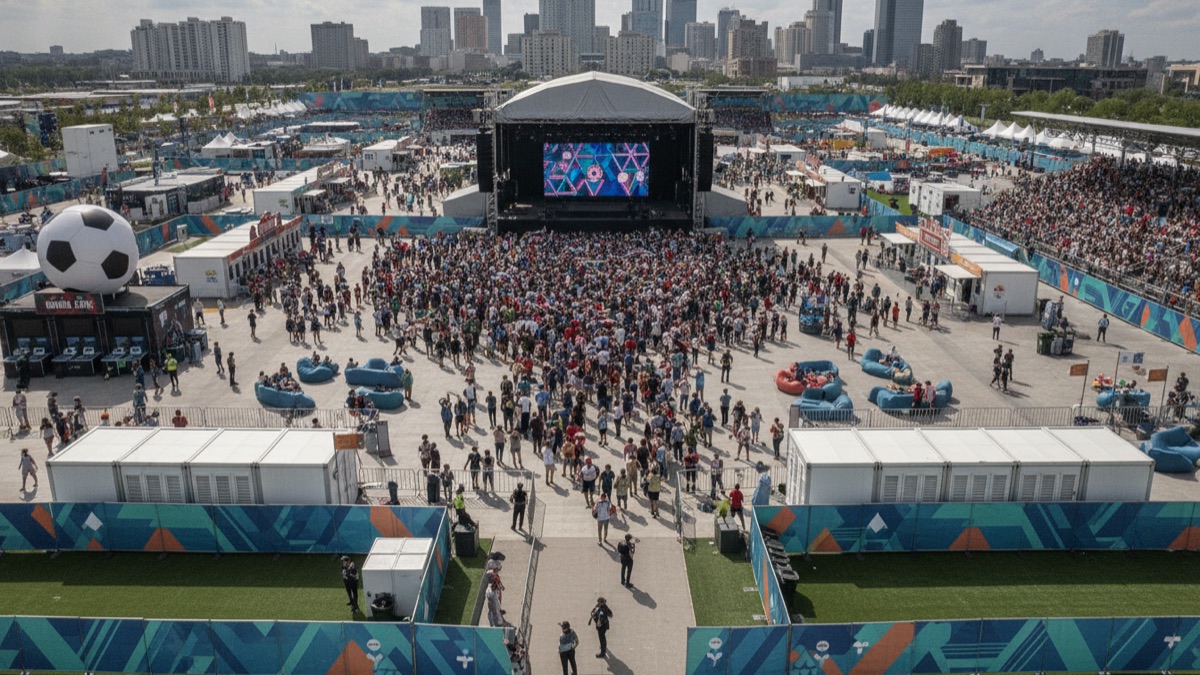
A World Cup fan zone looks simple from the outside, a big screen, some food trucks, a stage for a pre-match band, but the version FIFA and host cities are building across the United States, Canada, and Mexico for the 2026 tournament is a genuinely complex piece of temporary civic infrastructure, closer in planning terms to a recurring outdoor festival with stadium-level security than to a casual public viewing party. Because the 2026 tournament spans three countries and sixteen host cities, each with its own police jurisdiction, permitting process, and civic infrastructure, fan zone planning is being handled largely at the city level within a shared FIFA framework rather than through one single centralized operation. Understanding how these zones are actually sited, secured, staffed, and paid for explains both what fans should expect on the ground and why the experience will genuinely differ from one host city to the next.
What a Fan Zone Actually Is
An official FIFA Fan Festival, the formal name for what most fans casually call a fan zone, is a designated public viewing site where supporters without match tickets can watch games on large broadcast screens, typically supplemented with live entertainment, food and beverage vendors, and licensed tournament merchandise.
Fan zones exist specifically because match-day stadium capacity, even across sixteen host cities, represents only a small fraction of the total number of people in a host city who want to experience World Cup atmosphere, and FIFA has increasingly treated fan zones as a core part of the tournament experience rather than an afterthought.
The concept was formalized and scaled significantly during the 2006 Germany World Cup, and has since become a standard expectation for host nations, with FIFA setting baseline operational and branding requirements that individual host cities then implement according to their own local venues, laws, and civic priorities.
Who Actually Plans and Pays for a Fan Zone
Fan zone planning for the 2026 tournament involves a layered set of stakeholders, including FIFA itself, the relevant national football federation, the host city's local organizing committee, municipal government agencies, and, in many cases, private sponsors whose branding appears throughout the site.
Funding for fan zone construction, staffing, and operations typically comes from a combination of host city and municipal budgets, sponsorship revenue tied to the tournament, and in some cases direct FIFA contributions, with the exact funding split varying considerably by host city depending on local government capacity and sponsor interest.
Host cities generally view fan zone investment as justified by expected tourism revenue, hospitality spending, and international media exposure during the tournament, a calculation that has driven some cities to invest considerably more in fan zone infrastructure and programming than FIFA's own baseline requirements strictly demand.
Choosing the Physical Site Inside Each Host City
Selecting a fan zone location involves balancing several competing factors: the site needs enough open space to hold tens of thousands of people safely, proximity to public transit to manage arrival and departure crowds, and a location central enough to be genuinely accessible without disrupting the city's ordinary daily function for weeks at a time.
Many host cities have chosen waterfront parks, downtown plazas, or existing large public event spaces specifically because that infrastructure, including permanent power connections, drainage, and emergency vehicle access, already exists rather than needing to be built entirely from scratch for a temporary event.
Site selection also has to account for how a location will function outside of match hours, since a genuinely successful fan zone needs to remain usable and welcoming across an extended daily schedule that includes both marquee evening kickoffs and quieter daytime hours between matches, rather than only functioning during peak broadcast windows.
The Screens, Sound, and Broadcast Infrastructure
Fan zone broadcast setups use large LED video walls rather than projection screens for outdoor daytime visibility, since LED technology maintains readable brightness and contrast even in direct sunlight, a genuine technical requirement given how many World Cup matches kick off during daylight hours across different time zones.
Audio systems at large fan zones are engineered specifically for outdoor crowd environments, using distributed speaker arrays positioned to maintain consistent, intelligible sound quality across a large open space rather than a single central sound source that would create uneven audio experience for fans standing at different distances.
Broadcast feed reliability is treated as a genuine operational priority, with major fan zones typically running redundant signal paths and backup power systems specifically to prevent the video wall from going dark during a critical match moment, a failure that would represent a significant reputational and crowd-management problem for organizers.
Crowd Capacity Planning and Why It Matters
Fan zone capacity limits are calculated using established crowd safety engineering standards that account for available square footage per person, the number and width of entry and exit points, and the specific egress time needed to safely clear the site in an emergency scenario.
Organizers typically plan for a tiered capacity model, where anticipated attendance for marquee matches involving popular teams or the host nations themselves is expected to run considerably higher than for lower-profile group stage fixtures, requiring flexible staffing and screening capacity that can scale up or down by match day.
When a fan zone reaches its safe capacity limit, organizers generally implement a one-in-one-out entry policy or temporarily pause new admissions entirely, a crowd management approach that requires real-time headcount tracking at entry points rather than a fixed schedule-based admission system.
Security Screening at Fan Zone Entrances
Entry screening at major fan zones typically mirrors stadium-level security protocols, including bag checks, walk-through or handheld metal detection, and restrictions on prohibited items like glass containers, weapons, and in many cases professional camera equipment or large flags on poles.
This stadium-equivalent screening standard reflects the reality that fan zones during marquee matches can draw crowds numbering in the tens of thousands, comparable in scale to many of the tournament's actual stadiums, meaning the security risk profile is treated similarly despite fan zones technically being free, ticketless public events.
Security screening capacity is planned specifically around peak arrival surges before high-demand matches, since a screening bottleneck that leaves large crowds queuing outside a fan zone creates its own separate crowd safety concern that organizers have to actively manage alongside the screening process itself.
Coordinating Fan Zone Security With Local Police
Local police departments in each host city work directly with FIFA-appointed security coordinators and private security contractors to develop a layered security plan that covers perimeter security, screening checkpoints, internal crowd monitoring, and rapid response protocols for medical emergencies or security incidents.
This coordination typically also involves federal-level agencies, particularly in the United States, where large public events of this scale routinely involve coordination with federal law enforcement and homeland security resources alongside municipal police, reflecting the genuinely elevated security planning standard applied to World Cup-scale events.
Cross-border and cross-agency coordination is a distinctive feature of the 2026 tournament specifically, since security planning frameworks, legal authorities, and standard operating procedures differ meaningfully between the United States, Canada, and Mexico, requiring host cities in each country to adapt a shared FIFA security framework to their own distinct legal and law enforcement context.
Staffing a Fan Zone: Volunteers, Contractors, and Stewards
Fan zones rely on a mixed staffing model combining paid private security contractors for screening and perimeter roles, professional event management staff for technical and logistical operations, and, in many host cities, a substantial volunteer workforce recruited specifically for the tournament.
Volunteer programs, a well-established tradition at major international sporting events, typically involve months of advance recruitment, background checks, and training before the tournament begins, with volunteers generally assigned to guest services, wayfinding, and general crowd assistance roles rather than security-critical positions.
Staffing scale at a major fan zone during marquee match days can run into the hundreds of personnel across combined security, hospitality, technical, and volunteer roles, reflecting the genuine operational complexity of running what functions as a temporary outdoor venue at festival scale for the tournament's full multi-week duration.
Food, Vendors, and Local Business Integration
Fan zone vendor programs typically combine official tournament sponsors, whose branded activation spaces are contractually guaranteed prominent positioning, with local food and beverage vendors selected through a city-run application process intended to showcase regional cuisine and support local small businesses during the tournament.
Host cities have generally emphasized local vendor inclusion specifically as a way to extend tournament economic benefit beyond large national sponsors and hospitality chains, a deliberate policy choice reflecting lessons from previous host nations where local businesses reported feeling excluded from direct tournament revenue.
Health and safety permitting for fan zone food vendors follows standard municipal food service regulations in each host city, meaning vendors must meet the same licensing and inspection requirements as any other public event food operation, adapted only for the compressed, high-volume nature of match-day service.
Across Three Countries: Coordinating the US, Canada, and Mexico
The 2026 tournament's three-country hosting format means fan zone planning standards, while sharing a common FIFA baseline, are ultimately implemented under three distinct national legal, security, and municipal permitting systems, each with its own established approach to large public event management.
FIFA has worked to establish shared branding, signage, and baseline operational standards across all host cities regardless of country specifically to maintain a recognizably consistent tournament identity for traveling fans, even as the underlying security and logistics execution varies by national jurisdiction.
This tri-national structure also means fans attending matches in multiple host cities across different countries during the tournament should expect genuinely different practical experiences, from currency and mobile connectivity to specific security procedures, even at fan zones that look visually similar and carry the same official branding.
How Fan Zones Handle Extreme Weather
Given that the 2026 tournament runs during North American summer, several host cities face genuine extreme heat risk, prompting fan zone planners to incorporate shaded rest areas, free water distribution points, and medical staff specifically trained to recognize and treat heat-related illness among large outdoor crowds.
Weather contingency planning also covers severe storm scenarios, with fan zones in regions prone to sudden thunderstorms or high wind developing evacuation and temporary shelter protocols specifically for outdoor crowds gathered around large screen and stage infrastructure that itself poses a hazard in high wind conditions.
Organizers have generally treated heat safety as one of the most operationally significant planning challenges specific to the 2026 tournament compared to recent World Cups held in cooler climates or, in Qatar's case, during winter specifically to avoid extreme heat, making North American summer heat a genuinely distinctive planning factor this cycle.
Accessibility Planning for Fans With Disabilities
Major fan zones are required to include accessible viewing platforms, wheelchair-accessible pathways throughout the site, and accessible restroom facilities, generally meeting or exceeding local disability access regulations in each host country rather than treating accessibility as an optional add-on.
Some host cities have also incorporated sensory-friendly viewing areas designed for fans who may be sensitive to the crowd noise and visual intensity of a packed fan zone during a marquee match, an accommodation that has become increasingly standard at major sporting events over the past decade.
Accessibility planning extends beyond the physical site itself to include accessible transportation coordination and advance information resources, since fans with mobility or sensory needs generally benefit most from being able to plan their fan zone visit around clearly published accessibility information rather than discovering accommodations only upon arrival.
What Arab Fans Traveling Should Actually Expect
Fan zones in host cities with large Arab diaspora communities, including several major US and Canadian metro areas, are likely to develop organic group viewing traditions and cultural programming around matches involving Arab national teams, similar to patterns seen during the 2022 Qatar World Cup and 2018 Russia tournament.
Arab fans traveling to the 2026 tournament should treat visa and entry requirements as a genuinely separate planning track from match tickets, since United States, Canadian, and Mexican entry requirements differ meaningfully by nationality and require advance planning well before the tournament, a point our companion piece on World Cup ticket pricing addresses in more detail.
Fan zones can serve as a genuinely practical option for fans who were unable to secure stadium tickets for a specific match involving their national team, since demand for matches featuring Arab teams has historically run high relative to available stadium capacity, making free public viewing sites a meaningful part of the overall fan experience rather than a fallback option.
Lessons Carried Over From Qatar 2022
The 2022 Qatar World Cup, discussed in more detail in our companion coverage of that tournament, demonstrated both the scale of demand for large public viewing infrastructure in a region with strong football passion and some of the crowd management challenges that come with concentrated, high-demand fan zones.
Organizers for the 2026 tournament have publicly referenced lessons from Qatar's fan zone crowd management, particularly around capacity planning and phased entry systems, as direct inputs into planning for North American host cities expecting similarly intense demand for matches involving popular teams.
The three-country, sixteen-city format of 2026 also represents a meaningfully different planning challenge than Qatar's single, geographically compact host country, since North American fan zones are far more spread out and cannot rely on the kind of centralized, tightly integrated transportation and security planning that Qatar's smaller geographic footprint allowed.
What Success Actually Looks Like for a Fan Zone
A successful fan zone, from an organizer's perspective, delivers a safe, high-capacity viewing experience without major security incidents, serious crowd-crush risk, or significant public complaints about access, cost, or crowding, while also generating positive local economic activity and international media coverage for the host city.
Less visible but equally important success metrics include smooth coordination between the many different agencies and contractors involved, an ability to adapt daily operations to actual attendance patterns rather than only projected estimates, and genuinely functional accessibility and weather contingency systems that are rarely noticed by fans specifically because they worked as intended.
The truest test of fan zone planning comes during marquee matches involving host nations or historically popular football nations, when attendance surges hardest and the layered security, capacity, and staffing systems built months in advance face their most demanding real-world stress test of the entire tournament.
World Cup 2026 fan zones are best understood as genuinely complex temporary civic infrastructure projects rather than simple public viewing parties, involving layered funding arrangements, stadium-equivalent security screening, cross-agency and in some cases cross-national coordination, and detailed capacity and accessibility planning built months in advance of a single ball being kicked. Because the tournament spans sixteen host cities across three countries, fans should expect genuinely different practical experiences from one fan zone to the next, even as FIFA works to maintain a consistent tournament identity across all of them. For Arab fans traveling specifically, treating fan zones as both a genuine viewing option and a place where organic community gathering around national team matches is likely to emerge makes them a meaningful part of the overall 2026 World Cup experience.
Sources
- FIFA — Official tournament information on the FIFA World Cup 26 host cities and fan experience programming.
- FIFA World Cup 26 — Host city and event planning details for the 2026 tournament.
- U.S. Department of Homeland Security — Federal security planning guidance for major public events in the United States.
- Canadian Heritage — Government coordination on major international sporting events hosted in Canada.
FAQ
Are World Cup 2026 fan zones free to enter?
Most official FIFA Fan Festival zones are free to enter, though some host cities have introduced timed entry registration or capacity-controlled access for peak matches, and some premium viewing areas within larger fan zones may carry a separate paid ticket.
Do I need a match ticket to attend a fan zone?
No, fan zones are specifically designed for supporters without match tickets to watch games on large screens, and many fans without stadium tickets treat fan zones as their primary way of experiencing tournament atmosphere.
How many fan zones will there be across the 2026 World Cup host countries?
Each of the sixteen host cities across the United States, Canada, and Mexico is expected to operate at least one official fan zone, with several larger host cities planning multiple viewing sites to spread attendance across different neighborhoods.
What security screening should fans expect at a fan zone?
Fans should expect bag checks, walk-through or handheld metal detection, and restrictions on prohibited items similar to stadium-level security, since fan zones during marquee matches can draw crowds comparable in size to the stadium itself.
Should Arab fans traveling to the 2026 World Cup plan around fan zones specifically?
Yes, especially for matches involving Arab national teams, since fan zones in cities with large diaspora communities are likely to host organized group viewing and cultural programming, and checking each host city's specific visa and entry requirements in advance remains essential.
About the Author
We reference FIFA, the official FIFA World Cup 26 tournament resources, the U.S. Department of Homeland Security, and Canadian Heritage to explain the background and current understanding of this topic.
Loved This Article?
Share it on WhatsApp → Share it on WhatsApp
Get more guides in your inbox — Subscribe to our newsletter for weekly surprising stories from Egypt, Saudi Arabia, Dubai, and beyond.