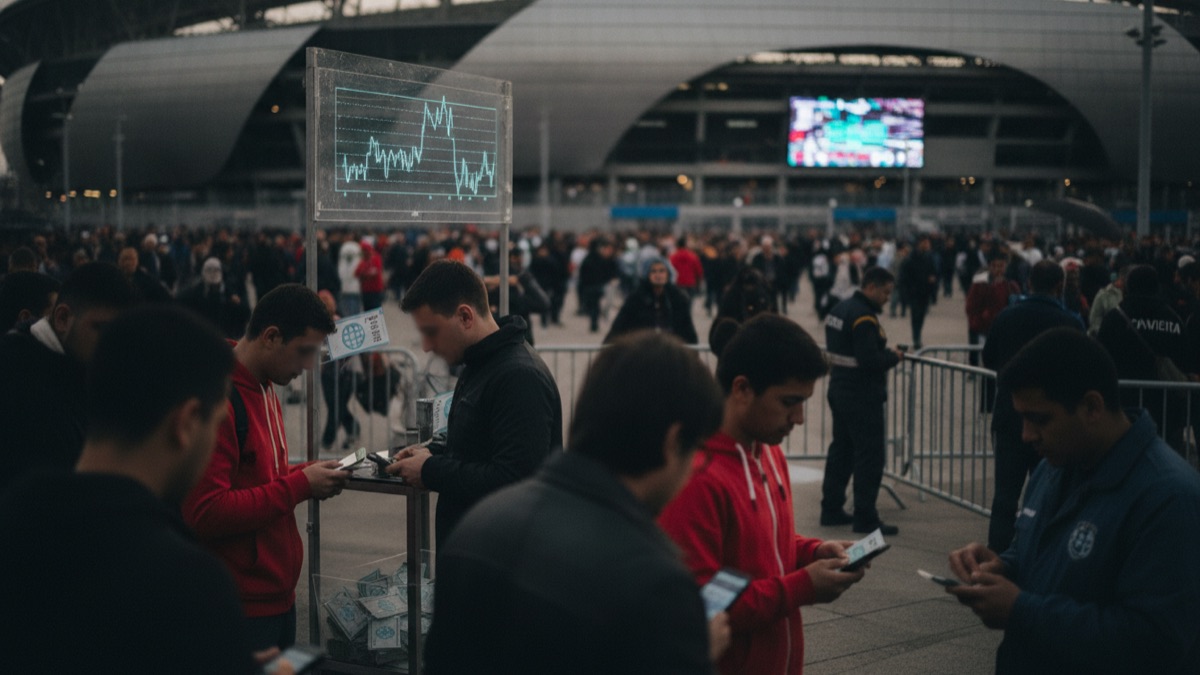
A World Cup final ticket with a face value of a few hundred dollars can resell for tens of thousands within hours of the draw. Behind that gap sits a deliberately engineered system of personalized tickets, identity checks, and a single sanctioned resale channel that FIFA and host-country authorities built specifically to blunt the secondary market — with only partial success.
Why World Cup Tickets Became a Target for Scalpers
Demand for World Cup tickets vastly exceeds supply for marquee matches, particularly the final, semifinals, and any fixture involving a host nation or a traditional powerhouse. Stadium capacity is fixed years in advance, while the pool of fans willing to pay almost any price for a once-in-a-generation seat keeps growing as the tournament approaches and travel plans firm up.
This mismatch is exactly the condition that makes scalping profitable: a reseller only needs to acquire a ticket below what a desperate buyer will eventually pay, and the spread on a final can be enormous. Because FIFA sells the large majority of tickets months before kickoff, while genuine demand peaks in the final weeks, there is a long window for speculative buying to happen before real fans are even in the market.
Professional touting operations understand this timing gap well, and some approach World Cup ticket acquisition with the same systematic mindset used for concert or premium sporting event resale in other industries: applying for tickets across multiple accounts, tracking which matches are likely to sell out fastest based on the draw, and positioning inventory ahead of demand spikes that follow a host nation's progress through the knockout rounds.
How FIFA's Official Ticketing Platform Actually Works
FIFA sells World Cup tickets almost exclusively through its own digital platform, moving in stages: an initial random-draw sales phase where more applicants than tickets typically apply, followed by first-come-first-served sales for whatever inventory remains, and finally a late sales window closer to the tournament as travel plans solidify.
Every purchase requires an account tied to a real identity, and in most sales phases a buyer is limited to a small number of tickets per match, explicitly to prevent any single buyer from acquiring blocks of inventory to resell. This is a deliberate design choice rather than a technical limitation — FIFA could easily sell unlimited quantities to a single account, but chooses not to.
What Personalization and ID-Matching Do to Prevent Resale
Most World Cup tickets are personalized, meaning the name of the attendee is printed on or digitally attached to the ticket itself, and turnstile entry increasingly requires matching that name against a government-issued ID or the FIFA ID system used for accreditation and entry.
This directly undermines the classic scalping model, where a physical, anonymous ticket can simply change hands for cash with no record of who is entitled to use it. A personalized digital ticket cannot be quietly handed over at the stadium gate without either transferring it through an authorized channel first or risking the original buyer's name being checked against an ID that does not match the person presenting it.
How the Official Resale Platform Functions
Recognizing that legitimate buyers sometimes cannot attend a match they purchased tickets for, FIFA operates an official resale platform where ticket holders who cannot use their tickets can list them for other verified fans to purchase, with the transaction processed entirely through FIFA's own systems rather than a private handshake.
Crucially, resale through this channel is generally capped at or near the original face value, which removes the profit incentive that drives scalping in the first place. A reseller using the official channel cannot simply name whatever price the market will bear; they can only recover close to what they originally paid, which makes it useful for genuine fans with a change of plans but useless as a speculative investment vehicle.
Why Face-Value Caps Exist and How They're Enforced
The face-value cap on official resale is the single most important anti-scalping mechanism in the entire system, because it directly targets the profit motive rather than merely making unauthorized resale logistically harder. Enforcement relies on the fact that this is the only channel where a transferred ticket remains valid for stadium entry with a clean identity match.
A ticket sold far above face value through an unofficial channel technically still exists in FIFA's database under the original buyer's name, meaning the buyer of that overpriced ticket is taking on real risk that entry will be refused unless the transfer is properly processed through the sanctioned platform, which will not process a transfer at a price above the cap.
This design mirrors anti-scalping approaches other major sporting and entertainment events have adopted over the past decade, where the industry consensus has shifted from trying to ban resale outright — which pushed activity into completely unregulated channels — toward providing a sanctioned, price-capped alternative that gives fans a legitimate option while making unauthorized resale comparatively riskier and less convenient by contrast.
How Secondary Markets Operate Outside Official Channels
Unauthorized resale nonetheless persists through informal networks, social media marketplaces, and specialist ticket brokers operating in a legal gray zone that varies significantly by jurisdiction. Some of this activity involves genuinely transferable tickets being sold above face value with the buyer accepting entry risk; some of it is outright fraud involving tickets that do not exist or have already been used.
Host cities and FIFA typically run public-awareness campaigns before and during the tournament specifically warning fans against buying from unverified sources, precisely because the personalized, ID-matched nature of modern tickets means an unauthorized purchase carries a much higher risk of being turned away at the gate than it did in earlier, less digitized tournaments.
What Happens When a Resold Ticket Gets Flagged
When stadium turnstile systems detect a mismatch between the name on a ticket and the identification presented, or flag a ticket that has already been scanned once that day, the holder is typically denied entry and directed to a resolution desk rather than simply turned away outright, since legitimate errors and family transfers do occur.
Genuine cases can sometimes be resolved on-site with additional verification, but a ticket that was clearly purchased through an unauthorized reseller at an inflated price, with no legitimate transfer record in FIFA's system, is very unlikely to be honored, leaving the buyer with an expensive and unusable ticket and essentially no recourse against the seller.
How Host Country Law Enforcement Gets Involved
Host nations frequently pass specific ticket-touting legislation ahead of major tournaments, since existing consumer protection or fraud statutes do not always cleanly cover unauthorized resale of event tickets at scale. These laws typically target organized resellers operating at volume rather than an individual fan reselling a single spare ticket to a friend.
Some jurisdictions cap the legal resale price of any event ticket at a fixed percentage above face value regardless of the event, while others focus specifically on prohibiting the use of automated software — commonly called bots — to purchase large quantities of tickets faster than a human could manage during a public sale, since bot-driven bulk buying has historically been a major source of the inventory that later appears on unauthorized secondary markets.
Enforcement varies considerably by country and has historically been inconsistent, with organized touting operations often reappearing under new identities after being shut down, and cross-border resale — where a broker in one country sells tickets for a match in another — creating jurisdictional complications that slow enforcement further.
Why Corporate Hospitality Packages Follow Different Rules
A meaningful share of premium World Cup seating is sold not as individual tickets but as hospitality packages bundling entry with lounge access, catering, and other premium services, sold by FIFA's official hospitality partners rather than through the standard ticketing platform.
These packages are priced far above standard ticket face value from the outset and legitimately so, since they include genuinely additional services, which means the resale-cap logic applied to standard tickets does not straightforwardly apply. This creates a separate, less transparent secondary market for hospitality access that operates under different oversight than the fan-facing ticketing system.
How Digital Ticketing and Mobile Passes Changed Scalping
The shift from printed tickets to mobile digital passes has meaningfully changed the economics of scalping. A physical ticket could be photographed, sold as a fraudulent duplicate to multiple buyers, or simply handed over in person with no trace; a mobile pass tied to a specific account and device is considerably harder to duplicate convincingly.
This has not eliminated fraud — screenshots of mobile passes are still sometimes sold to unsuspecting buyers who discover only at the gate that the pass has already been used or was never valid — but it has shifted much of the low-effort scalping activity toward more sophisticated (and riskier, for the buyer) forms of fraud rather than simple ticket duplication.
What Happens to Confiscated or Voided Tickets
Tickets identified as fraudulently obtained, resold above the permitted cap through unauthorized channels, or otherwise in violation of FIFA's terms of sale can be voided in the system entirely, meaning they simply will not scan at the turnstile regardless of who presents them or what price was paid.
FIFA reserves the right to void tickets discovered to have been resold in violation of its terms even before matchday, and enforcement teams do actively monitor major resale marketplaces and social media for listings above the permitted price, though the sheer volume of informal peer-to-peer activity makes comprehensive enforcement genuinely difficult.
How Fans Can Verify a Ticket Is Legitimate
The only fully reliable way to guarantee a valid ticket is purchasing directly from FIFA's official platform or its official resale marketplace, since both maintain the identity-matched chain of custody that stadium entry systems check against. Any ticket obtained outside these two channels carries some degree of entry risk, regardless of how convincing the seller or listing appears.
Fans considering a resale purchase from an unfamiliar source are generally advised to treat the price itself as a warning sign: a listing significantly above face value is, by definition, being sold outside the sanctioned system, since the official resale platform will not process a transfer above the cap in the first place.
Payment method also matters for recourse: purchases made by credit card generally carry chargeback protection that a buyer can invoke if a ticket turns out to be invalid, whereas payments made through informal channels such as direct bank transfer or cash offer essentially no path to recovering funds if the ticket fails to scan at the gate. Consumer advocates consistently recommend traceable payment methods for exactly this reason when any resale purchase does occur.
Why Scalping Persists Despite These Systems
Even with personalization, ID-matching, price caps, and legal deterrents, unauthorized resale has never been fully eliminated at a World Cup, largely because the profit incentive for the final and other marquee matches remains enormous, and because enforcement resources are finite relative to the scale of informal secondary-market activity across dozens of countries and languages.
Determined resellers also continually adapt, moving activity to newer social platforms, using intermediaries to obscure original purchaser identity within the rules of what counts as a legitimate transfer, or targeting hospitality and other less tightly controlled ticket categories where the standard cap does not apply.
The economics also work against total elimination: even a modest percentage of tickets successfully diverted into the unauthorized secondary market, across a tournament selling millions of tickets total, still represents a large absolute number of transactions and a meaningful profit pool, which keeps the incentive for new entrants into informal resale alive no matter how tightly the official system is run.
What World Cup 2026's Expanded Format Changes
The 2026 tournament's expansion to 48 teams and a longer schedule across three host countries multiplies the number of matches, venues, and ticket categories that need policing simultaneously, which meaningfully increases the operational burden on anti-scalping enforcement compared with earlier, single-host tournaments.
At the same time, the tri-national hosting arrangement introduces genuinely new jurisdictional complexity, since a ticket-touting operation could in principle be based in one host country while targeting buyers or matches in another, requiring closer coordination between host-country law enforcement agencies than any prior tournament has needed.
Fans travelling across the three host countries for multiple matches also face a logistical wrinkle that earlier single-host tournaments did not: verifying that a ticket purchased for a match in one country will actually be honored at that country's specific venue systems, since technical integration between three separate national stadium networks and FIFA's central ticketing database adds another layer of complexity where legitimate transfers could, in principle, be delayed or mishandled even without any fraud being involved.
The underlying architecture — personalized digital tickets, a single sanctioned resale channel capped near face value, and active monitoring of unofficial marketplaces — remains the core defense, and its effectiveness in 2026 will largely depend on how well three separate national enforcement systems can coordinate against a global secondary market that has consistently adapted to prior tournaments' controls.
Sources
- Wikipedia — overview of ticket resale markets and anti-scalping mechanisms
- FIFA — official World Cup ticketing terms, sales phases, and resale policy
- Wikipedia — 2026 FIFA World Cup format and host arrangements
- U.S. Federal Trade Commission — consumer guidance on event ticket fraud
- INTERPOL — cross-border ticket fraud enforcement context
FAQ
Can I legally resell a World Cup ticket I can't use?
Yes, through FIFA's official resale platform, but only at or near the original face value — the platform will not process a transfer priced above that cap.
Why do resold World Cup tickets sometimes get rejected at the stadium?
Most tickets are personalized and matched against ID at entry, so a ticket bought outside official channels can fail if the name on it doesn't match the holder or the transfer was never processed by FIFA.
Are corporate hospitality packages covered by the resale price cap?
No — hospitality packages are sold separately by official partners at prices reflecting bundled services, and the standard face-value resale cap that applies to normal tickets does not straightforwardly apply to them.
Does buying a screenshot of a digital ticket work?
It's highly risky — mobile passes are tied to a specific account, and a screenshot can be a duplicate of one already used or one that was never valid in the first place.
Why hasn't scalping been eliminated despite all these controls?
The profit incentive on marquee matches remains large, enforcement resources are limited relative to the scale of informal global resale activity, and resellers continually adapt to new controls.
About the Author
We reference Wikipedia, FIFA, the U.S. Federal Trade Commission, and INTERPOL to explain the background and current understanding of this topic.
Loved This Article?
Share it on WhatsApp → Share it on WhatsApp
Get more guides in your inbox — Subscribe to our newsletter for weekly surprising stories from Egypt, Saudi Arabia, Dubai, and beyond.