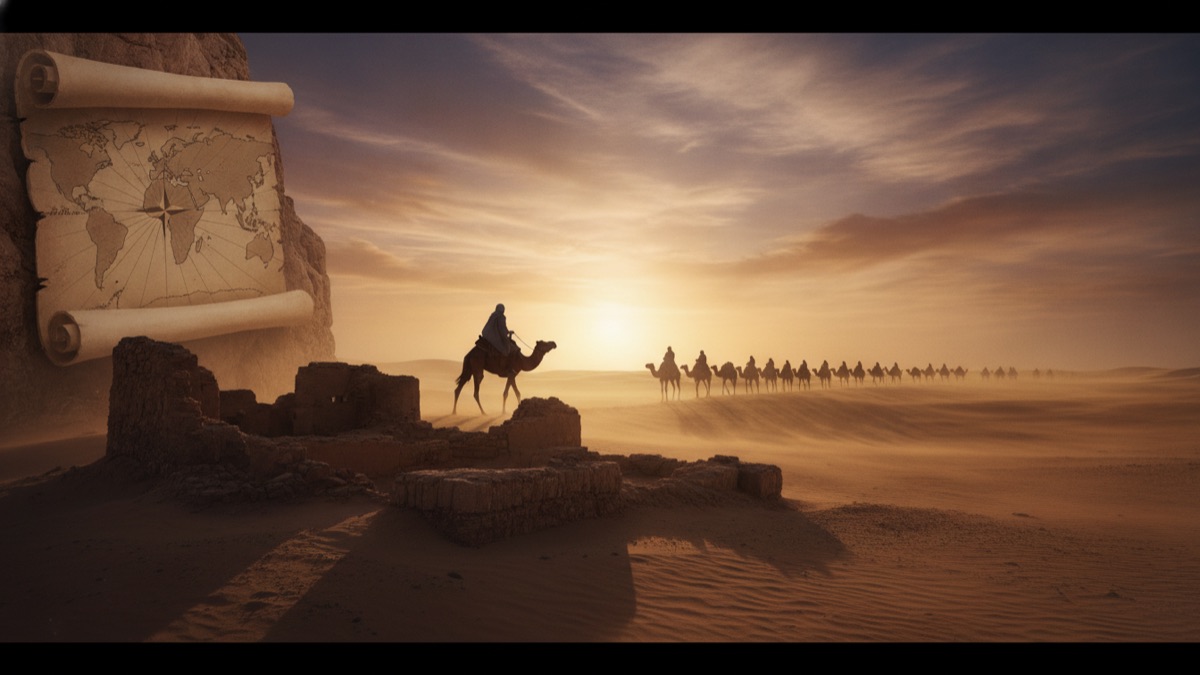
Introduction
Ibn Battuta, born in Tangier, Morocco in 1304, is widely considered history's most extensively traveled pre-modern explorer, journeying an estimated 117,000 kilometers over roughly three decades, crossing territory equivalent to more than 40 modern countries across North Africa, the Middle East, East Africa, South and Central Asia, and China, a scope of travel that remained essentially unmatched until the age of steam-powered transportation centuries later.
Unlike many famous medieval European travel accounts, Ibn Battuta's journey was not originally intended as exploration for its own sake; it began as a religious pilgrimage that gradually expanded into one of history's most remarkable and extensive travel careers, documented in exceptional detail in his famous travelogue, the Rihla.
How the Journey Began: A Pilgrimage That Never Really Ended
Ibn Battuta departed Tangier in 1325 at age 21, intending to complete the Hajj pilgrimage to Mecca, a journey that would traditionally take committed pilgrims about a year and a half round trip in that era. Instead, driven by what he described as a strong personal desire to see new lands and, according to his own account, a wish to avoid retracing routes he had already traveled, he continued exploring far beyond his original religious destination.
This pattern — completing an immediate goal, then choosing to continue onward into unfamiliar territory rather than returning home — defined his travels for nearly three decades, taking him to regions across the medieval Islamic world and well beyond its borders, sustained largely by the hospitality customs and scholarly networks connecting Islamic communities across an enormous geographic span.
Major Regions and Destinations He Visited
Beyond Mecca, Ibn Battuta's travels eventually took him across an extraordinary range of territories: East Africa (including Mogadishu and the Swahili coast cities of Mombasa and Kilwa), Anatolia and the Byzantine Empire (including Constantinople), Central Asia and Persia, India (where he served for years as a judge in the Delhi Sultanate under Sultan Muhammad bin Tughluq), the Maldives, Sri Lanka, and, according to his account, China, though some historians have debated the precise extent and details of his Chinese travels.
He also traveled extensively within West Africa later in life, providing one of the most detailed and historically valuable eyewitness accounts of the medieval Mali Empire under Mansa Suleyman, describing its governance, wealth, and Islamic scholarly culture in detail that remains an invaluable primary historical source for researchers studying medieval West African history.
The Rihla: His Remarkable Travel Account
Upon finally returning to Morocco around 1354, the Sultan of Morocco commissioned scholar Ibn Juzayy to record Ibn Battuta's travels in detail, producing the work now known as the Rihla (meaning 'The Journey'), a detailed travelogue describing the geography, customs, rulers, and daily life of the dozens of societies Ibn Battuta encountered across his decades of travel.
The Rihla provides historians with an invaluable, richly detailed primary source documenting medieval Islamic civilization's remarkable geographic reach and interconnectedness during this period, offering firsthand observations of governance systems, religious practices, trade networks, and cultural customs across regions for which few other comparably detailed contemporary written accounts survive.
Why Ibn Battuta's Journey Still Matters
Ibn Battuta's total documented travel distance is often estimated to exceed that of his younger, more famous European contemporary Marco Polo by a significant margin, though Ibn Battuta received considerably less recognition in Western historical narratives for centuries, partly because the Rihla wasn't translated into major European languages until the 19th century, well after Marco Polo's account had already become widely known in Europe.
Today, historians and geographers widely recognize Ibn Battuta as one of history's greatest travelers, and his detailed observations remain an essential primary source for understanding the geography, governance, trade networks, and daily life of the medieval Islamic world and its extensive connections across Africa, Asia, and the broader medieval world during the 14th century.
Sources
- Encyclopaedia Britannica — Biography of Ibn Battuta and overview of his documented travels
- World History Encyclopedia — Historical background on the Rihla and medieval Islamic travel literature
- Library of Congress — Reference material on Ibn Battuta's travels and their historical significance
FAQ
How far did Ibn Battuta travel in total?
Ibn Battuta is estimated to have traveled roughly 117,000 kilometers over about three decades, crossing territory equivalent to more than 40 modern countries, a distance widely considered to exceed that of contemporaries like Marco Polo.
Why did Ibn Battuta's journey start?
He departed Tangier in 1325 at age 21 intending to complete the Hajj pilgrimage to Mecca, but continued traveling far beyond his original destination, driven by a stated desire to see new lands rather than retrace familiar routes.
What is the Rihla?
The Rihla, meaning 'The Journey,' is Ibn Battuta's detailed travelogue, recorded by scholar Ibn Juzayy upon his return to Morocco around 1354, describing the geography, rulers, and customs of the societies he encountered.
Did Ibn Battuta really travel to China?
According to his own account, yes, though some historians have debated the precise extent and details of his Chinese travels, since certain descriptions in the Rihla have raised scholarly questions.
Why is Ibn Battuta less famous in the West than Marco Polo?
Partly because the Rihla wasn't translated into major European languages until the 19th century, well after Marco Polo's account had already become widely known and established in European historical narratives.
About the Author
doyouknow.app Editorial Team — We reference historical scholarship and primary source translations to trace Ibn Battuta's remarkable documented travels.
Loved This Article?
Share it on WhatsApp → Share on WhatsApp
Get more guides in your inbox — Subscribe to our newsletter for weekly surprising stories from Egypt, Saudi Arabia, Dubai, and beyond.