Introduction
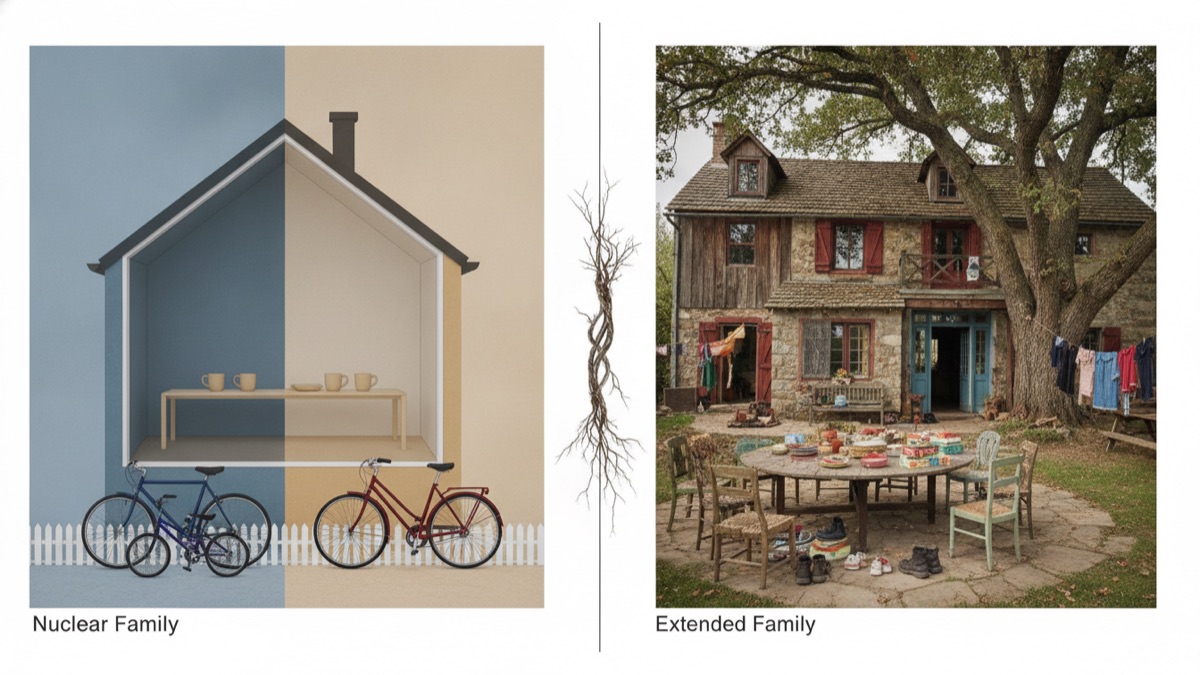
A nuclear family refers to a household unit consisting of two parents and their children living independently, while an extended family refers to a broader household or close-living arrangement that also includes other relatives, such as grandparents, aunts, uncles, or cousins, either living together or maintaining very close, regularly involved daily contact and mutual support.
While the nuclear family is often described in Western popular culture, particularly in the United States, as the 'traditional' family structure, sociologists and historians generally note this framing is somewhat historically and culturally specific, since extended family living arrangements have actually been, and often remain today, the more common family structure across much of human history and in many world regions and cultures.
The Actual History of Family Structures
Sociological and historical research generally finds that extended family households were considerably more common than isolated nuclear family units throughout most of human history and across most traditional societies worldwide, since extended, multi-generational family arrangements historically provided practical economic advantages, particularly in agricultural societies, including shared labor, childcare, and eldercare responsibilities distributed across a larger family unit.
The nuclear family's rise to particular cultural prominence in the West, especially in the United States, is generally linked by sociologists to specific historical developments, including industrialization and urbanization, which often required smaller family units to relocate for employment opportunities in ways less practical for large extended households, alongside the mid-20th century post-World War II suburban housing boom, which specifically constructed housing designed around and marketed to nuclear family units.
Significant Cultural Variation in Family Structure
Extended family living arrangements remain considerably more common today in many regions worldwide, including much of Asia, the Middle East, Africa, and Latin America, where multigenerational households are frequently considered not merely economically practical but culturally and often religiously valued in their own right, reflecting different underlying cultural values around family obligation, elder care, and intergenerational connection than the more individually and nuclear-family-oriented values common in much of Western culture.
Even within countries where the nuclear family has been culturally dominant, research shows the actual prevalence of extended or multigenerational household living has fluctuated considerably over time and varies substantially by specific community, immigrant background, and economic circumstance, with US Census Bureau data, for example, showing a notable and continuing increase in multigenerational US households over recent decades, partly driven by economic factors like housing costs and partly by demographic shifts including growing immigrant populations from cultures where extended family living is more culturally normative.
What Research Says About Outcomes for Children
Family research generally finds that specific household structure alone, whether nuclear or extended, is a considerably less reliable predictor of child developmental outcomes than other factors, including family stability, relationship quality, economic resources, and consistent, responsive caregiving, meaning neither structure is inherently superior in isolation from these more directly influential underlying factors.
Some specific research has found potential benefits associated with extended family involvement, including additional emotional support and practical caregiving resources for parents, and grandparent involvement specifically has been linked in some studies to certain positive child outcomes, though researchers generally caution that these associations, like those found for nuclear family structures, likely reflect the quality and consistency of relationships and available support within a given family system more than the specific structural arrangement itself.
Modern Trends Blurring the Distinction
Contemporary family structures increasingly blur any strict distinction between purely nuclear and purely extended arrangements: many families that maintain physically separate nuclear-family households nonetheless function with extensive practical extended-family involvement, including regular childcare support from grandparents, frequent close contact, and significant mutual financial or practical assistance, representing something of a functional hybrid between the two traditional categories.
This trend, alongside rising costs of living, childcare expenses, and eldercare needs in many countries, has contributed to renewed interest in and gradual normalization of more extended or multigenerational living arrangements even within cultures where the nuclear family has been the historically dominant cultural ideal, suggesting family structure preferences continue evolving in response to genuine practical economic and social needs rather than remaining fixed to any single historically dominant model.
Sources
- US Census Bureau — Demographic data on nuclear and multigenerational household trends
- Pew Research Center — Research on family structure trends and cultural variation
- American Psychological Association — Family psychology research on household structure and child developmental outcomes
FAQ
What is the difference between a nuclear family and an extended family?
A nuclear family consists of two parents and their children living independently, while an extended family includes other relatives like grandparents, aunts, or uncles, either living together or maintaining very close, regularly involved daily contact.
Was the nuclear family always the 'traditional' family structure?
No. Sociologists note extended family households were actually considerably more common throughout most of human history and across most traditional societies worldwide, with the nuclear family's Western cultural prominence linked to specific historical developments like industrialization.
Are extended family arrangements still common today?
Yes, considerably more common in many world regions, including much of Asia, the Middle East, Africa, and Latin America, where multigenerational households are frequently considered culturally and often religiously valued, not merely economically practical.
Does family structure alone determine child developmental outcomes?
No. Research generally finds specific household structure is a considerably less reliable predictor of child outcomes than factors like family stability, relationship quality, economic resources, and consistent, responsive caregiving.
Is multigenerational living increasing in the United States?
Yes. US Census Bureau data shows a notable and continuing increase in multigenerational US households over recent decades, driven partly by economic factors like housing costs and partly by demographic shifts.
About the Author
doyouknow.app Editorial Team — We reference US Census data and sociological family research to explain the real history and cultural variation of family structures.
Loved This Article?
Share it on WhatsApp → Share on WhatsApp
Get more guides in your inbox — Subscribe to our newsletter for weekly surprising stories from Egypt, Saudi Arabia, Dubai, and beyond.