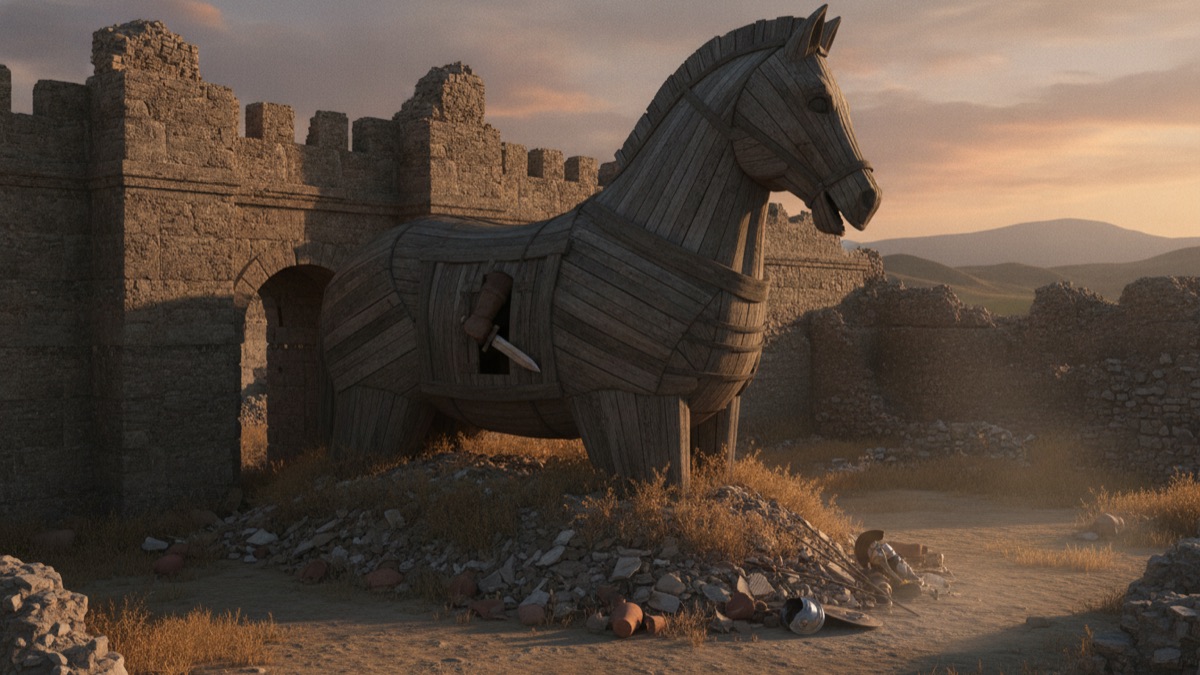
The Trojan Horse is the legendary device the Greeks used to finally end their decade-long siege of Troy, according to ancient Greek and Roman mythology. Unable to breach the city's walls by force, the Greek warrior Odysseus supposedly devised a plan: build a massive hollow wooden horse, hide a select group of soldiers inside it, and leave it outside Troy's gates as an apparent peace offering while the rest of the Greek fleet sailed away, pretending to abandon the siege.
Believing the war finally over and the horse a gift to the gods, the Trojans dragged it inside their own walls to celebrate, ignoring warnings from the priest Laocoön and the prophetess Cassandra, both of whom insisted the horse was a trick. That night, the hidden Greek soldiers climbed out, opened the city gates for their returning army, and Troy fell.
A Gift the Trojans Couldn't Resist
A Story Homer Never Actually Told in Full
Oddly, Homer's Iliad, the primary surviving epic about the Trojan War, ends before the horse ever appears — it stops with the death of the Trojan hero Hector. The fullest ancient account of the horse itself actually comes from the Roman poet Virgil's Aeneid, written centuries later, along with briefer references in Homer's own Odyssey and other now-lost Greek epic poems.
Archaeologists have never found physical evidence of an actual wooden horse, and most historians treat the story as legend layered onto whatever real conflict inspired the broader Trojan War myth. The phrase "Trojan horse" has nonetheless outlived the literal story, surviving today as shorthand for any trick, gift, or piece of malicious software that hides a threat inside something that looks harmless.
Sources
- Wikipedia — overview of the Trojan Horse legend and its ancient sources
- World History Encyclopedia — historical background on the Trojan War and the horse legend
- Britannica — reference on the Trojan War and its literary sources
FAQ
Does Homer describe the Trojan Horse in the Iliad?
No — the Iliad actually ends before the horse appears, closing with Hector's death and funeral; the fullest ancient account of the horse comes from Virgil's Aeneid, written by a Roman poet centuries later.
Is there archaeological proof the Trojan Horse was real?
No physical evidence of a wooden horse has ever been found, and most historians consider it a legendary embellishment layered onto a real or semi-real ancient conflict at the site now identified as Troy in modern Turkey.
Why is "Trojan horse" still used today?
The phrase survives as shorthand for any trick that hides a threat inside something that appears harmless or beneficial, including a well-known category of deceptive computer malware named directly after the legend.
About the Author
We reference Wikipedia, World History Encyclopedia, and Britannica to explain the background and current understanding of this topic.
Loved This Article?
Share it on WhatsApp → Share it on WhatsApp
Get more guides in your inbox — Subscribe to our newsletter for weekly surprising stories from Egypt, Saudi Arabia, Dubai, and beyond.