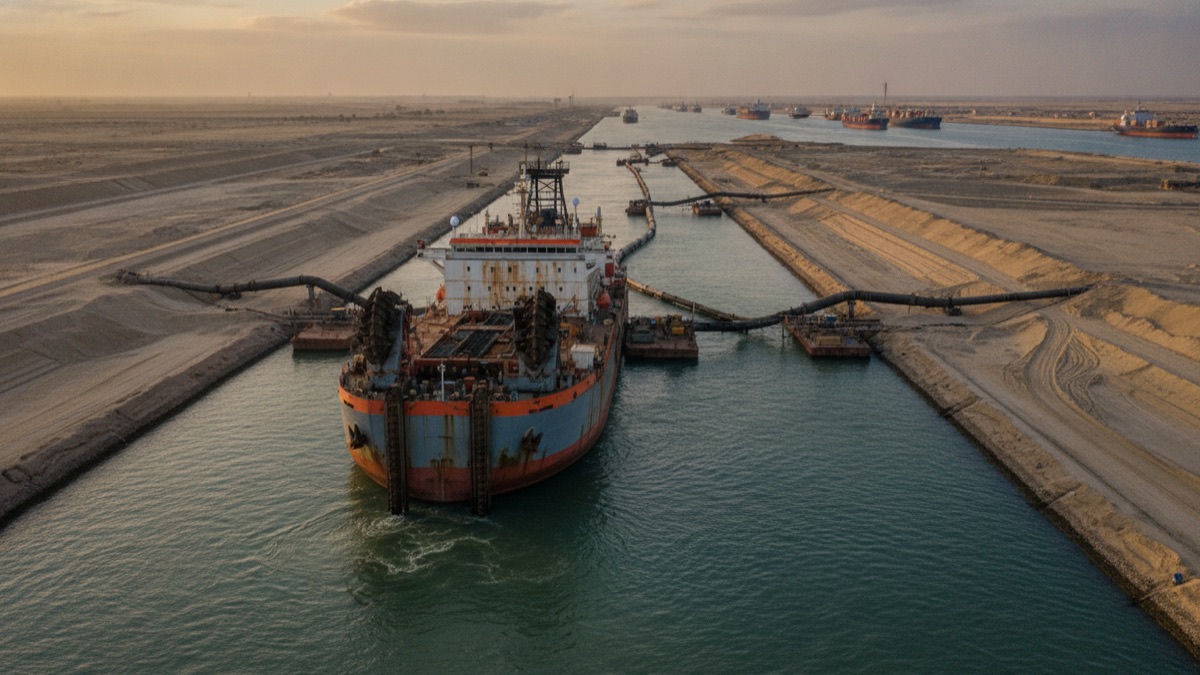
For most of its history, the Suez Canal operated as a single navigable channel, which meant ships could only move through certain stretches in one direction at a time, with vessels queuing in designated waiting areas until it was their turn to pass. In 2015, Egypt completed a major expansion project, often referred to as the New Suez Canal, that dug a new parallel channel alongside a significant portion of the original route, along with deepening and widening other sections, specifically to allow two-way traffic and dramatically increase the canal's shipping capacity. Understanding how this expansion was engineered, and why Egypt undertook such an enormous and expensive project, reveals a lot about the ongoing strategic importance of one of the world's most critical shipping chokepoints, and about the very real limits that even a expanded canal still faces, as the 2021 Ever Given grounding would later demonstrate in dramatic fashion.
Why the Original Canal Had a Traffic Problem
The original Suez Canal, opened in 1869, was built as essentially a single navigable waterway for most of its length, meaning ships traveling in opposite directions could not simply pass each other along most of the route the way traffic moves on a two-lane road. Instead, convoys of ships moved through in one direction, then waited in designated bypass areas or lakes along the route while the opposing convoy passed.
This convoy system worked for well over a century, but it inherently limited how many ships could transit the canal per day, since vessels heading northbound and southbound had to take turns rather than moving simultaneously along most of the route. As global shipping volumes grew substantially over the decades, particularly with the rise of much larger container ships, this one-directional bottleneck became an increasingly significant constraint on the canal's total capacity.
Egypt had made incremental improvements to the canal over the decades, including some widening and deepening projects, but by the early 2010s it was clear that a more substantial structural change was needed to meaningfully increase transit capacity rather than simply optimizing the existing single-channel convoy system further.
The Scale of the 2015 Expansion Project
The expansion project centered on digging an entirely new parallel channel alongside roughly a third of the canal's total length, specifically along one of the sections that had previously been most constrained by one-directional traffic, allowing ships to pass in both directions simultaneously along that stretch for the first time in the canal's history.
Beyond the new parallel channel, the project also included deepening and widening significant portions of the existing waterway elsewhere along the route, intended to accommodate larger, deeper-draft vessels that had become increasingly common in global shipping fleets, including some of the largest container ships and tankers in operation.
The Egyptian government set an unusually compressed timeline for the project, announcing and completing the core construction work in about one year, a pace that required an enormous mobilization of dredging equipment, engineering personnel, and construction resources operating simultaneously across multiple sections of the project rather than sequentially.
The Dredging Operation Itself
Digging a new shipping channel of this scale primarily involves dredging, the process of excavating and removing vast quantities of earth, sand, and rock from underwater or low-lying terrain to create a navigable waterway of sufficient depth and width for large commercial vessels.
The project required moving an enormous volume of material, involving a large fleet of specialized dredging vessels, some capable of excavating and relocating material continuously around the clock, working alongside conventional land-based excavation equipment for portions of the route that weren't already underwater.
Coordinating this scale of earth-moving work within a compressed timeline required careful sequencing and substantial redundancy in equipment, since a single dredger's mechanical failure or slower-than-planned progress in one section could have created bottlenecks that risked delaying the entire project's ambitious completion schedule.
Why Two-Way Traffic Actually Increases Capacity So Much
The core engineering logic behind the expansion is straightforward but powerful: allowing ships to transit in both directions simultaneously along the previously constrained section effectively removes one of the most significant scheduling bottlenecks in the entire canal system, since northbound and southbound convoys no longer need to wait for each other to clear that stretch before proceeding.
This change didn't simply double capacity in a naive sense, since other sections of the canal, docking facilities, and the broader logistics of coordinating convoy scheduling still impose their own limits, but it did meaningfully reduce a specific structural constraint that had been forcing ships to wait, sometimes for many hours, purely because of the single-channel bottleneck rather than any capacity limit elsewhere in the system.
Reducing this bottleneck also improved schedule predictability for shipping companies, since convoy waiting times became less variable once ships heading in opposite directions no longer had to be sequenced through the same narrow stretch of channel one after another.
The Economic Case Egypt Made for the Project
Egypt's government presented the expansion as both a direct economic investment in canal transit revenue, a major source of foreign currency earnings for the country, and as a broader signal of national engineering and economic ambition, with the project financed substantially through domestic investment certificates marketed to Egyptian citizens rather than relying primarily on foreign loans.
The stated economic rationale centered on projections that increased capacity and reduced transit times would attract additional shipping traffic and allow the canal authority to raise transit fees over time, ultimately increasing the canal's total revenue contribution to the Egyptian economy well beyond what the original single-channel system could sustainably generate.
Alongside the shipping channel itself, Egypt also announced plans for a broader economic development zone along the canal's banks, intended to attract industrial and logistics investment that would benefit from proximity to one of the world's busiest shipping routes, extending the economic ambitions of the project beyond transit fees alone.
How the Expansion Fits Into Suez's Strategic History
The Suez Canal has held outsized strategic and economic importance since its original 1869 opening, providing a direct maritime shortcut between the Mediterranean and Red Seas that eliminates the need for ships traveling between Europe and Asia to sail around the entire African continent, a detour that can add well over a week to a voyage depending on the specific route and vessel speed.
This strategic importance has made the canal a recurring flashpoint in regional and global geopolitics over the decades, including its nationalization and the resulting international crisis in the 1950s, periods of closure during regional conflicts, and ongoing careful management of the balance between Egyptian sovereignty over the waterway and the broader international shipping industry's dependence on reliable access.
The 2015 expansion should be understood within this longer strategic context: Egypt has consistently treated the canal not just as infrastructure but as a core pillar of national economic and geopolitical significance, which helps explain why the government was willing to commit such substantial resources and an unusually compressed timeline to the expansion project.
What the Expansion Did Not Fully Solve
Despite its scale, the 2015 expansion did not create two-way traffic along the canal's entire length, only along the specific new parallel section, meaning significant portions of the route still operate under a modified version of the original convoy system, with ships scheduled in groups moving in coordinated sequence rather than freely passing each other at any point.
The expansion also did not eliminate the fundamental physical constraint that the canal remains, even after widening, a comparatively narrow channel by the standards of open ocean navigation, meaning it still requires precise navigation, particularly for the largest vessels in the global shipping fleet, and remains vulnerable to disruption from any single vessel losing control within the channel.
This residual vulnerability became internationally visible in dramatic fashion in March 2021, when a large container ship ran aground and became wedged diagonally across a section of the canal, completely blocking traffic in both directions for roughly a week and disrupting a meaningful portion of global shipping traffic until specialized dredging and tugboat operations, combined with a favorable high tide, finally freed the vessel.
How the 2021 Blockage Tested the Expanded System
The 2021 incident occurred in a single-channel section of the canal rather than the newer, expanded two-way stretch, which meant the grounding of one vessel was sufficient to completely halt all traffic through that section, since there was no parallel channel available for other ships to route around the blockage.
This incident highlighted an important nuance often lost in public discussion of the 2015 expansion: the new parallel channel improved capacity and scheduling flexibility specifically along the section where it was built, but it did not make the entire canal immune to single-point-of-failure disruptions, since large portions of the route remain effectively single-channel even after the expansion.
In the aftermath, Egypt's canal authority announced further plans to extend two-way sections of the canal and continue widening and deepening additional portions of the route, explicitly citing the 2021 blockage as part of the justification for continued investment in reducing the canal's remaining chokepoint vulnerabilities.
The Broader Trend of Growing Ship Sizes
Part of what drove both the original expansion and the continued pressure for further improvements is a long-running trend in global shipping toward progressively larger vessels, particularly container ships, which have grown substantially in both length and cargo capacity over recent decades as shipping companies pursue economies of scale.
This trend creates an ongoing engineering challenge for major shipping chokepoints like Suez and Panama, since infrastructure built or expanded to accommodate the largest vessels of one era can find itself constrained again within a decade or two as shipbuilders continue pushing vessel dimensions further, creating a recurring cycle of infrastructure investment chasing vessel-size growth rather than permanently solving capacity constraints once and for all.
This dynamic means the 2015 expansion, while substantial, was never intended or presented as a final, permanent solution to Suez's capacity limitations, but rather as one significant step in an ongoing, multi-decade process of incrementally expanding the canal's capabilities to keep pace with the broader trajectory of global shipping.
Comparing Suez to Other Major Canal Expansions
The Suez expansion invites natural comparison to the roughly contemporaneous expansion of the Panama Canal, completed in 2016, which similarly involved a major engineering project specifically designed to accommodate larger vessels and increase transit capacity, though through a different technical approach involving new, larger lock systems rather than a parallel channel.
Both projects reflect the same underlying economic pressure, growing global shipping volumes and vessel sizes outpacing the capacity of critical infrastructure built decades or in Suez's case over a century earlier, but the different geography and engineering constraints at each canal led to meaningfully different technical solutions to a broadly similar underlying problem.
Studying these projects alongside each other offers useful insight into how major infrastructure serving global trade gets modernized: not through a single permanent fix, but through periodic, capital-intensive expansion projects timed to keep pace with the evolving demands of the shipping industry each faces.
What the Expansion Means for Global Trade Today
For shipping companies and the broader global trade system, the practical impact of the expansion has been a measurable reduction in average transit times through the canal and somewhat greater scheduling predictability, benefits that, while real, are also inherently difficult to fully separate from other simultaneous changes in global shipping patterns, fuel costs, and vessel traffic volumes over the same period.
The 2021 blockage served as a stark, highly visible reminder that despite the expansion, Suez remains a genuine chokepoint in global trade, one whose disruption, even for roughly a week, was enough to noticeably affect global shipping schedules and cargo availability, underscoring why continued investment in the canal's capacity and resilience remains a live strategic priority rather than a solved problem.
For Egypt specifically, the canal continues to represent one of the country's most significant and strategically important sources of foreign currency revenue, which is part of why the expansion project, and the continued investment that has followed it, has remained a consistent national priority across changes in the country's broader economic and political circumstances.
Why Dredging at This Scale Is So Difficult
Excavating a new parallel channel through desert terrain adjacent to an operating waterway is a fundamentally different engineering challenge than building a canal from scratch, since the work has to proceed without interrupting the continuous flow of ship traffic through the existing channel that generates the country's canal revenue.
Large fleets of dredging vessels, some of the largest cutter-suction and trailing-suction dredgers in the world, operated around the clock in overlapping shifts to move an enormous volume of sand and rock within the compressed construction window, a logistical undertaking that required careful sequencing to avoid interfering with live shipping lanes just meters away.
The soil conditions along the route varied significantly, from soft sand that could be moved relatively quickly to harder rock formations requiring different equipment and slower progress, meaning the project's timeline depended heavily on how the geology cooperated across different segments of the new channel, not just on the scale of equipment deployed.
The Political Urgency Behind the Timeline
The expansion's remarkably compressed one-year construction timeline was not purely an engineering decision; it carried significant political weight domestically, with the project framed as a national source of pride and economic renewal at a moment when the country was seeking large, visible achievements after a period of political upheaval.
This political dimension meant the project moved with unusual urgency compared to typical infrastructure timelines of similar scale, with round-the-clock construction and an accelerated schedule that surprised many international observers who had expected a multi-year build based on comparable global dredging projects.
Whether the accelerated timeline was the most cost-efficient path or whether a longer schedule might have reduced overall expense is a question that has been debated by economists and engineers since completion, though the symbolic and political value of finishing quickly was clearly treated as a priority alongside the purely engineering considerations.
How the Expansion Actually Works in Practice
The expansion did not create a second channel along the canal's entire length; it added a parallel channel along a specific stretch of roughly half the canal's total distance, while other segments retained the single-channel, one-way convoy system that had defined canal operations for most of its history.
This means the practical benefit is concentrated: ships can now pass each other simultaneously along the expanded stretch, reducing the waiting time that previously required vessels to travel in scheduled convoys and wait at designated bypass points, but the single-channel sections elsewhere along the route still require sequential, convoy-based transit.
Canal authorities have described the expansion as reducing average transit time and increasing the total number of vessels that can pass through in a given period, framing it as a capacity and efficiency upgrade rather than a complete redesign of how the canal functions along its full length.
What the Ever Given Incident Revealed About Remaining Risk
The 2021 grounding of a large container vessel that blocked the canal for roughly a week occurred in a single-channel section of the waterway not covered by the earlier expansion, and the incident became a widely cited illustration of how a chokepoint carrying a significant share of global trade remains vulnerable even after major capacity investment.
The blockage caused substantial delays to global shipping schedules and highlighted how few realistic alternative routes exist for the volume of trade that depends on the canal, since the main alternative — sailing around the southern tip of Africa — adds significant time and fuel cost to a voyage between Asia and Europe.
In the aftermath, canal authorities announced further expansion and dredging work targeting additional stretches of the waterway, explicitly citing the incident as justification for continuing to widen single-channel sections, suggesting the 2015 expansion was understood even by canal management as an important but incomplete step in reducing the waterway's structural vulnerability.
How the Expansion Was Financed
Rather than relying primarily on international loans, the expansion was substantially financed through domestically issued investment certificates offered to Egyptian citizens, a financing approach that was itself framed as part of the project's national ownership narrative, encouraging broad public participation in funding a piece of national infrastructure.
This domestic financing strategy meant the project carried less immediate external debt exposure than a comparably sized infrastructure project financed primarily through international borrowing might have, though it also meant the fundraising timeline and public messaging around the project were closely intertwined with its political framing from the outset.
The certificates offered a fixed return over a set term and were reportedly oversubscribed relatively quickly after their launch, reflecting the strong domestic public interest in participating in a project positioned as a source of national pride, separate from the purely commercial calculus that would typically govern a project financing decision of this scale.
How the Expansion Affects Insurance and Trade Economics
Reduced transit times and greater scheduling predictability from the expansion have measurable knock-on effects for shippers beyond the canal transit itself, including tighter, more reliable delivery windows for time-sensitive cargo and reduced exposure to the kind of costly delays that ripple through global supply chains when transit is unpredictable.
Maritime insurers and freight forwarders factor canal reliability directly into risk pricing for routes that depend on it, meaning improvements or disruptions to canal capacity translate into measurable shifts in shipping costs across a large share of global trade routes connecting Asia, Europe, and the eastern seaboard of the Americas.
The Suez Canal expansion was, at its core, an attempt to solve a specific engineering bottleneck, the inability of ships to pass each other along most of the canal's length, through a genuinely large-scale dredging and construction project completed on an unusually compressed timeline. It succeeded in meaningfully improving capacity and scheduling flexibility along the section where the new parallel channel was built, and it reflected Egypt's longstanding strategic commitment to the canal as both an economic asset and a matter of national significance. But the 2021 Ever Given blockage, occurring in an unexpanded single-channel section, offered a sobering reminder that expanding one part of a critical chokepoint doesn't eliminate the vulnerabilities that remain elsewhere along the route, and that the ongoing global trend toward ever-larger ships means projects like this one function less as a final solution and more as one step in a continuous, multi-decade effort to keep vital shipping infrastructure ahead of the vessels it was built to serve.
Sources
- Suez Canal Authority — Official Egyptian government authority overseeing canal operations and expansion projects.
- Wikipedia — Suez Canal — General historical and technical background on the canal, including its 2015 expansion.
- Wikipedia — 2021 Suez Canal Obstruction — Background on the Ever Given grounding and its impact on global shipping.
- UNCTAD — Transport and Trade Logistics — United Nations body tracking global shipping trends, vessel sizes, and trade route chokepoints.
FAQ
When did the Suez Canal expansion happen?
Egypt completed the core expansion project, often called the New Suez Canal, in 2015, with construction finished in roughly one year from its announcement.
Does the expanded canal allow two-way traffic along its entire length?
No. The new parallel channel covers roughly a third of the canal's total length; the rest still operates under a modified version of the original one-way convoy system.
Why did the 2021 Ever Given blockage still happen after the expansion?
The grounding occurred in a single-channel section of the canal that wasn't part of the 2015 expansion, so there was no parallel route available for other ships to bypass the blockage.
How was the Suez Canal expansion funded?
Egypt financed a substantial portion of the project through domestic investment certificates marketed to Egyptian citizens, alongside government funding, rather than relying primarily on foreign loans.
How does the Suez expansion compare to the Panama Canal expansion?
Both were completed around the same period (Panama's finished in 2016) to accommodate larger vessels and increase capacity, but Panama achieved this mainly through new, larger lock systems, while Suez added a parallel channel for two-way traffic.
About the Author
We reference Suez Canal Authority, Wikipedia — Suez Canal, Wikipedia — 2021 Suez Canal Obstruction, and UNCTAD — Transport and Trade Logistics to explain the background and current understanding of this topic.
Loved This Article?
Share it on WhatsApp → Share it on WhatsApp
Get more guides in your inbox — Subscribe to our newsletter for weekly surprising stories from Egypt, Saudi Arabia, Dubai, and beyond.