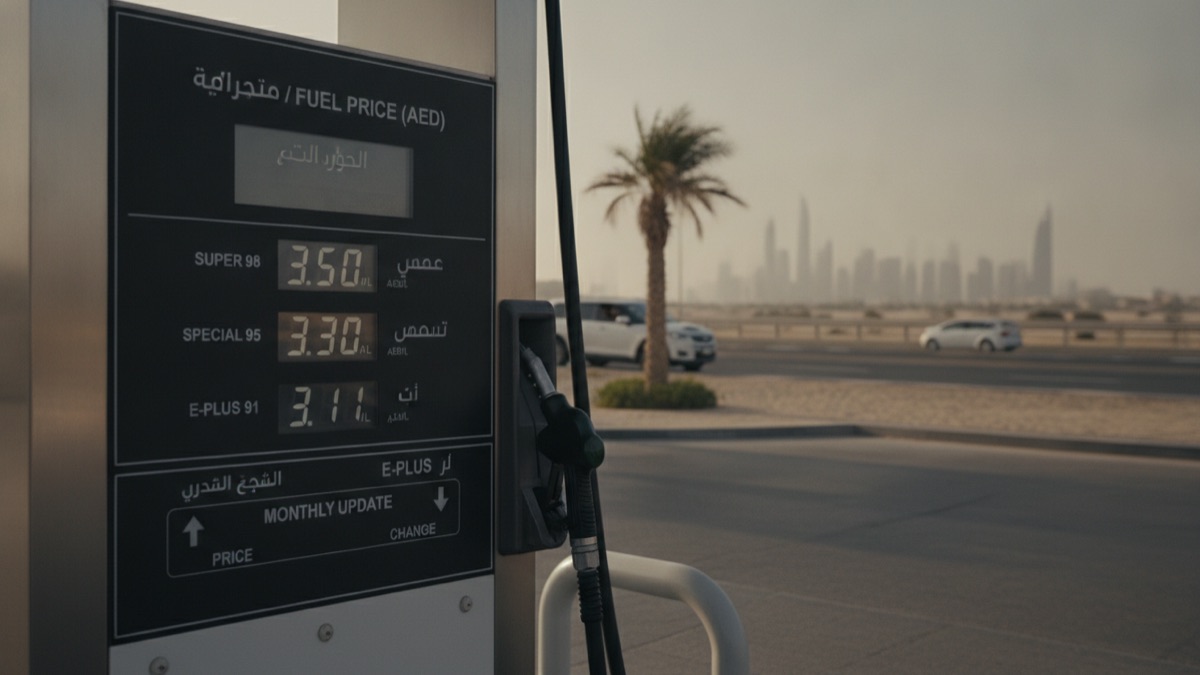
Why Fuel Prices Make Monthly Headlines
UAE fuel prices are one of the country's most reliable monthly news stories: in the final days of every month, the UAE Fuel Price Committee announces the pump prices that will apply from the first day of the following month, and millions of drivers adjust their budgets accordingly. In July 2026, for example, the committee set E-Plus 91 at AED 3.21 per litre, Special 95 at AED 3.29, Super 98 at AED 3.40, and diesel at AED 3.60 — a noticeable drop from June.
Behind that one-line announcement sits a whole system worth understanding: a deregulated pricing policy introduced in 2015, a direct link to global oil markets, and a set of fuel grades that confuse many first-time visitors at UAE pumps. This guide explains how the monthly cycle works, why prices rise and fall, what the grades mean, and what drivers can realistically do to manage fuel costs. Prices quoted here were current in July 2026 and change monthly, so always check the latest announcement before budgeting.
The Monthly Price Cycle
The UAE deregulated fuel prices in August 2015, ending an era of government-set subsidised rates. Since then, retail prices have been reviewed monthly by the Fuel Price Committee, which announces new rates near the end of each month through official channels including the Emirates News Agency (WAM). The new prices take effect on the first day of the following month at every station in the country.
The mechanism is deliberately transparent: the committee reviews international market movements, refining and distribution costs, and local operating expenses, then publishes a single national price list. There are no regional surprises — the price on the sign at an ADNOC station in Abu Dhabi is the same as at an ENOC or EPPCO station in Dubai, Sharjah, or any other emirate.
Announced prices are retail prices per litre and include 5% VAT. Because the review happens monthly, pump prices move in steps rather than continuously: a global price spike in the middle of a month shows up at UAE pumps only after the next committee announcement, and the same applies to price drops.
How Global Oil Moves Local Prices
The single biggest driver of UAE pump prices is the international oil market. The committee's formula tracks global benchmarks for refined products — shaped by crude markers such as Brent, WTI, and the UAE's own Murban crude — together with the cost of refining, shipping, and distributing fuel to stations.
Currency plays a quieter role. Because the dirham is pegged to the US dollar at about AED 3.67 per dollar, and oil is priced in dollars, UAE drivers do not see the exchange-rate swings that move pump prices in countries with floating currencies. What you pay is essentially the global market price plus logistics and local costs, with no currency noise added.
Geopolitics is the wildcard. During the regional escalation of spring 2026 — when conflict disrupted shipping through the Strait of Hormuz, a corridor for roughly a fifth of the world's oil — UAE pump prices climbed sharply from March through June, with diesel briefly exceeding AED 4.60 per litre, before easing again in July as markets stabilised. Episodes like that are a reminder that the monthly mechanism passes global volatility through to consumers in both directions, up and down.
Petrol and Diesel Grades at UAE Pumps
UAE stations sell three petrol grades and diesel. The grades differ by octane rating, which measures resistance to engine knocking, not fuel "quality" or cleanliness:
| Grade | Octane | Typical use | July 2026 price (AED/litre) |
|---|---|---|---|
| E-Plus 91 | 91 | Fleets, older and standard engines | 3.21 |
| Special 95 | 95 | Most modern sedans and SUVs | 3.29 |
| Super 98 | 98 | High-performance and turbocharged engines | 3.40 |
| Diesel | — | Trucks, buses, some SUVs and pickups | 3.60 |
The right grade is the one your manufacturer specifies — check the owner's manual or the sticker inside the fuel flap. Using a higher octane than required does not add power or efficiency; it just costs more. Using a lower octane than required can cause knocking and long-term engine wear. Special 95 covers the needs of most modern cars on UAE roads.
Diesel is a different fuel entirely, mainly for commercial vehicles, buses, and some SUVs. Never put diesel into a petrol car or petrol into a diesel car; misfuelling repairs are expensive and not covered by warranty. In the UAE, diesel sometimes costs more than petrol — as it did through much of 2026 — because its price tracks a different global market shaped by freight and industrial demand.
What Drivers Can Actually Control
You cannot negotiate the monthly price, but you can control how much fuel you burn. The basics still matter most: keep tyres at the recommended pressure, accelerate gently, remove roof racks when unused, service the engine on schedule, and plan errands into single trips instead of several short ones. Navigation apps that route around congestion also save fuel in city traffic.
Timing helps at the margin. Because new prices apply from the first of the month, filling your tank in the last days of a month in which prices are about to rise saves a few dirhams per tank — worth doing, not worth queuing an hour for. The announcement lands in the final days of the month, so watching it once is enough.
Vehicle choice dwarfs every other factor. A fuel-efficient sedan can use half the fuel of a large SUV over a year of commuting, and hybrid and electric options are increasingly practical in the UAE as charging infrastructure expands. If you are weighing a purchase, our Dubai driving and car ownership guide covers total ownership costs, and our guide to saving money in Dubai puts transport costs in the context of a full household budget. For some commutes, the Dubai Metro beats driving on both cost and time.
Sources
- Emirates News Agency (WAM) — Official channel for the UAE Fuel Price Committee's monthly price announcements.
- Gulf News — July 2026 fuel price announcement with per-litre rates and month-on-month comparisons.
- Khaleej Times — April 2026 price announcement with context on the 2015 deregulation and global oil drivers.
- Emirates News Agency (WAM) — Another official Fuel Price Committee announcement detailing the monthly pricing mechanism.
Frequently Asked Questions
When are UAE fuel prices announced?
The UAE Fuel Price Committee announces new rates in the final days of each month, and they take effect on the first day of the following month at stations nationwide.
Are fuel prices the same in every emirate?
Yes. Pump prices are set at the national level and are identical across all seven emirates and across station brands such as ADNOC, ENOC, and EPPCO.
Why do UAE fuel prices change every month?
Since deregulation in 2015, local rates are reviewed monthly to track international oil and refined-fuel markets, plus refining and distribution costs, rather than staying fixed by subsidy.
Which petrol grade should I use in the UAE?
Use the octane your manufacturer recommends. Special 95 suits most modern cars, E-Plus 91 fits fleets and older engines, and Super 98 is for high-performance engines that require it.
Do UAE pump prices include VAT?
Yes. The announced per-litre prices are retail prices that include 5% VAT.
About the Author
The doyouknow.app Editorial Team writes practical resident guides for the UAE using official sources, local context, and plain-language decision support — verified against the references listed above before publication.
Loved This Article?
Share it on WhatsApp → Share on WhatsApp
Get more UAE guides in your inbox — Subscribe to our newsletter.