Why Speeding Fines Are in the News
UAE speeding fines made headlines in July 2026 when Dubai Police announced the arrest of a driver clocked at more than 230 km/h on a Dubai highway. According to police, the motorist had deliberately removed his number plates to evade smart traffic systems; AI-supported monitoring still identified the grey Nissan Patrol, the vehicle was impounded, and the case fell under Dubai's impound rules that can demand up to AED 50,000 to release a seized car.
Extreme cases like that one are rare, but the machinery behind them works every day: a published schedule of fines, black points, and impound periods that applies to every driver in the country. This guide explains the evergreen part of the story — how speed limits work, how the fine tiers stack up, what black points do to your licence, and how the most serious cases are handled. Figures reflect the most recently published federal schedule and police guidance as of mid-2026; traffic rules are updated from time to time, so confirm current amounts through official channels before relying on them. For the wider picture — parking, Salik, red-light and phone-use fines — see our companion guide to Dubai traffic fines.
Speed Limits and How Enforcement Works
Posted limits in the UAE typically range from 40 km/h on residential streets to 60–80 km/h on urban arterial roads and 100–120 km/h on major highways, with certain Abu Dhabi highways signed as high as 140 km/h. The number on the sign is the legal maximum for that stretch of road, and it can change from one segment to the next — highway limits often step down near exits, tunnels, and construction zones.
One detail confuses many drivers: the enforcement margin. Dubai's radars have historically been set to trigger above the posted limit, a buffer often cited at around 20 km/h, while Abu Dhabi removed its speed buffer in 2018 — there, the posted number is the enforced number. Margins and camera settings can change without much publicity, and they vary by road and vehicle class, so the only safe rule is to treat the sign itself as the limit.
Enforcement is handled by fixed radars, mobile units, average-speed systems on some corridors, and increasingly by smart systems that use AI to read plates and spot risky behaviour. The July 2026 case showed that removing plates does not make a vehicle invisible: police said their systems tracked the car across multiple locations before the driver was summoned. Some highways also carry minimum speeds, so crawling far below the flow of traffic on a fast road can itself draw a fine.
Speeding Fine Tiers, Black Points and Impound
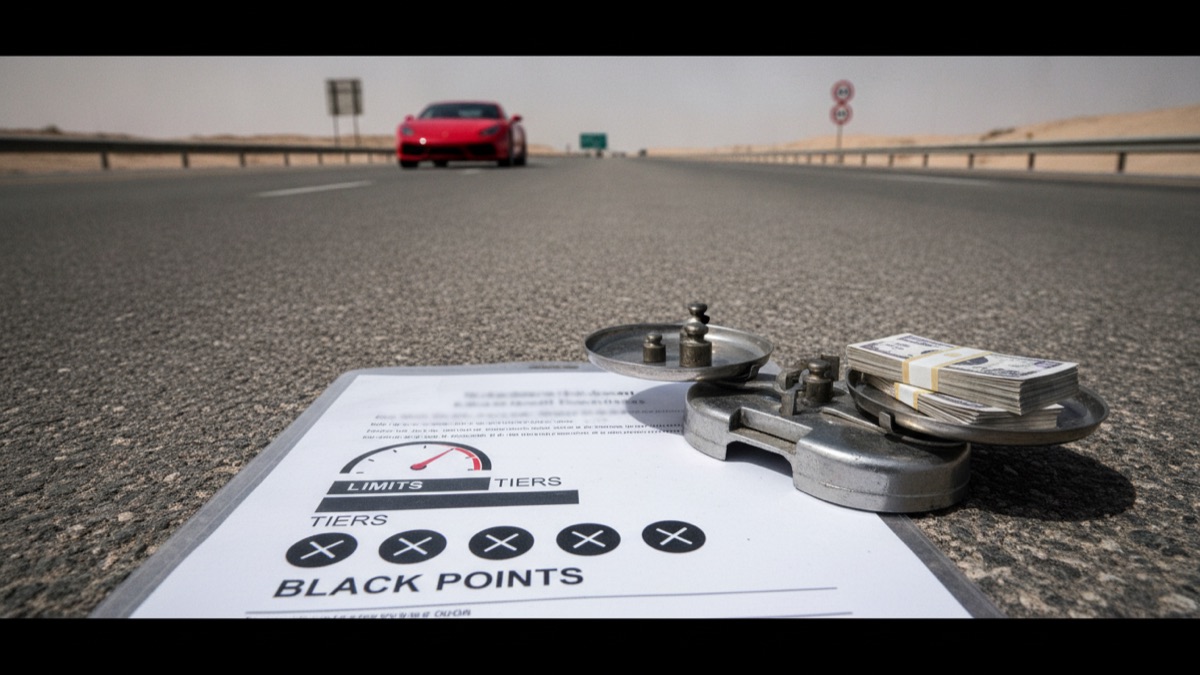
The federal traffic schedule sets speeding penalties by how far you exceed the posted limit. The commonly published tiers for light vehicles are:
| Exceeding the limit by | Fine (AED) | Black points | Vehicle impound |
|---|---|---|---|
| Up to 20 km/h | 300 | — | — |
| Up to 30 km/h | 600 | — | — |
| Up to 40 km/h | 700 | — | — |
| Up to 50 km/h | 1,000 | — | — |
| Up to 60 km/h | 1,500 | 6 | 15 days |
| More than 60 km/h | 2,000 | 12 | 30 days |
| More than 80 km/h | 3,000 | 23 | 60 days |
Amounts and impound periods can be revised, and individual emirates may add local measures on top of the federal schedule, so treat this table as a reliable orientation rather than a legal quote.
Black points are the part that follows you. They attach to your driving licence rather than to a single payment, and reaching 24 points within 12 months can lead to licence suspension — with longer suspensions for repeat accumulation. Points generally expire after a year, and some emirates allow drivers to reduce them through accredited awareness courses.
Speeding is not the only behaviour in this schedule: reckless driving, jumping a red light, and racing carry their own heavy combinations of fines, points, and impoundment, and the most dangerous cases can be referred to prosecutors rather than settled as simple fines.
Extreme-Speed Cases and Dubai Decree No. 30
The July 2026 Dubai case is a clear illustration of the top end of the system. Dubai Police said the driver exceeded 230 km/h on a highway — more than 100 km/h above typical highway limits — and had removed the car's plates in an attempt to avoid smart enforcement. Brigadier Jumaa Salem bin Suwaidan, Director of the General Department of Traffic, noted that excessive speed cuts reaction time, stretches stopping distance, and turns small errors into fatal crashes, which is why such cases are treated as public-safety threats rather than paperwork.
On the financial side, Dubai's Decree No. 30 of 2023 governs vehicle impoundment: motorists who commit serious offences may have to pay up to AED 50,000 to release an impounded vehicle, and the gravest categories — such as illegal road racing — can cost even more. The impound release fee comes on top of the underlying traffic fine, the black points, and any court outcome.
Tampering with or removing number plates is itself a serious offence in the UAE, separate from the speeding violation. Combined with extreme speed, it is the kind of behaviour that moves a case from the fine schedule toward prosecution. The evergreen lesson from the viral story is simple: enforcement technology now identifies vehicles in multiple ways, and the financial and legal exposure of an extreme-speed run dwarfs any fine most drivers will ever see.
How to Check and Pay Speeding Fines
You can check fines through the Dubai Police app and website, the RTA channels in Dubai, the MOI UAE app and website for federal coverage, or the Emirates Vehicle Gate. Have your plate number, licence number, or traffic-file number ready. Rental-car drivers usually hear about fines from the rental company first — expect an administration fee on top — but you can ask for the official violation detail and verify it yourself.
Dubai and other emirates periodically offer settlement discounts, including early-payment reductions on eligible fines. These campaigns are time-bound and conditional, so check the current status inside the official app rather than relying on social media posts. Unpaid fines can block vehicle registration renewal and complicate selling or exporting a car.
If you drive regularly, it is worth reading our guides to driving and car ownership in Dubai, converting a foreign licence, and parking in Dubai — most repeat fines come from a handful of everyday situations, and knowing the system is cheaper than learning it from your fine history.
Sources
- Dubai Police — Official site for traffic services, fines inquiry, and road-safety announcements.
- UAE Ministry of Interior — Traffic Violations Payment — Federal service for checking and paying traffic fines across the emirates.
- Roads and Transport Authority (RTA) Dubai — Dubai's roads authority for limits, licensing, and fine-payment channels.
- Gulf News — Report on the July 2026 case of a driver caught above 230 km/h and the Decree No. 30 of 2023 impound rules applied.
Frequently Asked Questions
What is the fine for speeding in the UAE?
Under the published federal schedule, speeding fines start at AED 300 for exceeding the limit by up to 20 km/h and rise to AED 3,000 with 23 black points and a 60-day impound for exceeding it by more than 80 km/h.
Is there a buffer above the speed limit before cameras flash?
Dubai radars have historically allowed a margin of around 20 km/h above the posted limit, while Abu Dhabi removed its buffer in 2018 so the posted number is the enforced number. Margins can change, so treat the sign as the real limit.
How many black points suspend a driving licence?
Reaching 24 black points within 12 months can lead to licence suspension, with the suspension period set by the traffic court and lengthening for repeat cases.
What happens in an extreme-speed case like 230 km/h?
Extreme speeding falls in the highest tier: heavy fines, 23 black points, impoundment, and — in Dubai — an impound release fee of up to AED 50,000 under Decree No. 30 of 2023, plus possible referral to prosecutors.
How do I check my speeding fines in the UAE?
Use the Dubai Police or MOI UAE apps and websites, the RTA channels in Dubai, or the Emirates Vehicle Gate, with your plate, licence, or traffic-file details.
About the Author
The doyouknow.app Editorial Team writes practical resident guides for the UAE using official sources, local context, and plain-language decision support — verified against the references listed above before publication.
Loved This Article?
Share it on WhatsApp → Share on WhatsApp
Get more UAE guides in your inbox — Subscribe to our newsletter.