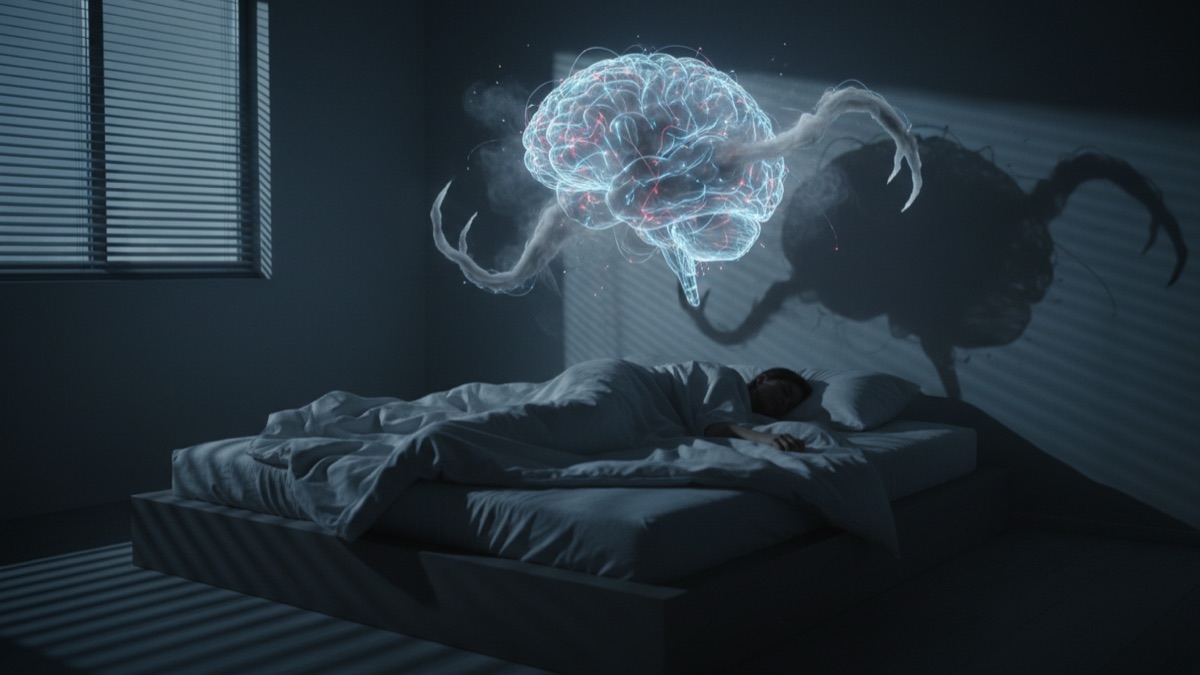
For anywhere from a few seconds to roughly two minutes, a fully conscious brain can find itself trapped inside a body that will not move, unable to speak, unable to call out, while a nightly safety mechanism that normally works perfectly continues running a few moments too long. Sleep paralysis is not a malfunction of the mind so much as a timing error between two systems that are each doing exactly what they are supposed to do, just not quite in sync with each other.
The muscle paralysis itself, formally called REM atonia, is a completely normal and in fact protective feature of every healthy sleep cycle, present in essentially everyone every single night without ever being noticed. What makes an episode of sleep paralysis frightening is not the paralysis mechanism malfunctioning but consciousness switching back on before that mechanism has finished switching off, leaving a fully aware mind stuck inside a body still obeying the rules of dream sleep.
This mismatch has been documented, described, and mythologized across essentially every culture with a written record, long before neuroscience had any language for REM sleep or brainstem circuitry. The universality of the experience, waking paralysis, a sense of pressure on the chest, and a distinct feeling of a malevolent presence in the room, is itself one of the strongest pieces of evidence that something specific and biological is happening rather than something supernatural or purely psychological.
Understanding what is actually happening in the brain during an episode means tracing the entire sequence: the mechanism that paralyzes the body every night, the specific timing failure that allows awareness to intrude on it, the brainstem circuitry responsible, why hallucinations so reliably accompany the experience, what raises or lowers the odds of it happening, and when it is a harmless isolated quirk of sleep timing versus a signal of something like narcolepsy that genuinely warrants medical attention.
The Nightly Muscle Lockout That Makes Sleep Paralysis Possible
During REM sleep, the stage of the sleep cycle most closely associated with vivid dreaming, the brain actively suppresses signals to most of the body's skeletal muscles, a state called REM atonia that leaves a sleeping person essentially unable to physically act out whatever their brain is simultaneously generating in a dream. This is not an incidental side effect of dreaming; it is an actively maintained, deliberately engineered state the brain produces on purpose, every single night, in every ordinary sleep cycle.
The evolutionary logic behind this mechanism is straightforward: dreams frequently involve running, fighting, falling, or otherwise physically dramatic scenarios, and without active suppression of motor output, a sleeping body would attempt to physically perform those actions, creating a genuine risk of injury to the sleeper and to anyone sleeping nearby. REM atonia functions essentially as a nightly safety lock, disconnecting the brain's motor-planning activity from the muscles that would otherwise carry it out.
Breathing muscles and eye muscles are notable exceptions to this general shutdown, which is precisely why rapid eye movement, the feature that gives REM sleep its name, remains visible even while virtually every other voluntary muscle group goes slack, and why a sleeping person continues breathing normally throughout a dream rather than being paralyzed into suffocation.
What Happens When Consciousness Returns Before the Body Unlocks
Under normal circumstances, REM atonia switches off in careful coordination with the rest of the waking process, so that by the time a person becomes consciously aware of being awake, muscle control has already been fully restored and the transition feels seamless. Sleep paralysis happens specifically when this coordination breaks down: cortical arousal, the brain circuitry responsible for conscious awareness, switches on slightly ahead of the brainstem circuitry responsible for releasing muscle paralysis.
The result is a genuinely unusual hybrid state: a person is unmistakably awake and aware, capable of processing their surroundings, forming thoughts, and often opening their eyes, while the body remains governed by the same paralysis mechanism that was protecting a dreaming, unconscious sleeper only moments earlier. Because the paralysis mechanism does not distinguish between a sleeping brain and a suddenly awake one, it simply continues running until its own separate shutdown process completes.
This mismatch is generally brief precisely because the underlying systems are not actually broken, only temporarily desynchronized; REM atonia was always going to switch off on its own regardless of whether consciousness arrived early, which is why episodes reliably end within roughly a few seconds to two minutes rather than persisting indefinitely.
The Brainstem Circuitry That Actually Controls REM Atonia
REM atonia is generated and controlled by circuitry located primarily in the brainstem, particularly regions within the pons that regulate the transition into and out of REM sleep and that signal specific inhibitory neurotransmitters, including glycine and GABA, to actively suppress motor neuron activity in the spinal cord during REM periods.
This brainstem circuitry operates largely independently of the higher cortical regions responsible for conscious thought and sensory awareness, which is precisely why the two systems can become misaligned in the first place: cortical arousal circuitry and brainstem atonia circuitry are controlled by different, only loosely coordinated neural networks, meaning one can genuinely switch states slightly ahead of the other under the right conditions.
Researchers studying sleep paralysis specifically point to this brainstem-based, largely automatic nature of the mechanism as the reason conscious effort typically cannot immediately override an episode; because the paralysis is being actively generated by inhibitory brainstem signaling rather than by any voluntary process, simply trying harder to move does not meaningfully speed up the moment the mechanism finally switches off.
Why Hallucinations So Often Accompany an Episode
Sleep paralysis episodes are frequently accompanied by vivid, often frightening hallucinations, commonly involving a sensed presence in the room, pressure or weight on the chest, and less commonly full visual or auditory hallucinations of a specific figure, and researchers generally attribute this to the brain remaining partially in a dream-generating state even as waking awareness has already switched on.
Because the brain regions responsible for generating dream imagery are closely tied to REM sleep itself, and because an episode of sleep paralysis by definition involves lingering REM-associated brain activity persisting into a waking state, dream content and waking perception can genuinely overlap for the duration of the episode, producing what researchers sometimes describe as a hybrid or intrusion state rather than a pure hallucination unrelated to sleep architecture.
The specific sensed-presence hallucination, a strong, often terrifying feeling that another entity is in the room, watching or approaching, appears across sleep paralysis accounts from wildly different cultures and eras with striking consistency, which researchers generally interpret as evidence that this particular hallucination pattern reflects something about shared human brain architecture rather than any single cultural narrative being independently invented over and over.
The Specific Triggers That Make an Episode More Likely
Sleep deprivation is among the most consistently documented triggers for sleep paralysis, since insufficient or fragmented sleep disrupts the normal, carefully sequenced transitions between sleep stages that otherwise keep cortical arousal and REM atonia properly synchronized, making the specific desynchronization behind an episode meaningfully more likely to occur.
An irregular sleep schedule, including shift work, jet lag, or simply going to bed and waking up at inconsistent times, produces a similar destabilizing effect on sleep architecture, and researchers frequently note that people whose sleep timing changes frequently, rather than remaining fixed, report a higher incidence of episodes than people who maintain a stable, consistent sleep schedule.
Elevated stress and anxiety are also commonly reported alongside sleep paralysis, both as a plausible contributing trigger and as a consequence of having experienced frightening episodes previously, creating a feedback loop in which anxiety about future episodes can itself contribute to the poor sleep quality and irregular sleep timing that make another episode more likely.
How Common Sleep Paralysis Actually Is
Large-scale reviews of sleep paralysis research generally estimate that a genuinely substantial share of the general population, commonly cited in a rough range around thirty to forty percent depending on the specific study population and how an episode is defined, experiences at least one episode of sleep paralysis at some point in their life, making it considerably more common than public awareness of the phenomenon might suggest.
Recurrent, frequent episodes affect a meaningfully smaller subset of that population, and researchers generally distinguish between isolated sleep paralysis, an occasional one-off episode with no other associated symptoms, and recurrent isolated sleep paralysis, a pattern of repeated episodes occurring outside the context of narcolepsy or another diagnosed sleep disorder.
Rates also vary somewhat across different populations and life circumstances, with several studies noting higher reported prevalence among students, shift workers, and people already experiencing significant psychological stress or anxiety, a pattern generally consistent with sleep deprivation and irregular sleep timing functioning as genuine contributing factors rather than coincidental correlations.
How Cultures Across History Explained the Same Experience
Long before REM atonia had a scientific name, cultures across the world independently developed remarkably similar explanations for the same physical experience, most centered on a malevolent entity visiting a sleeper and physically pinning them down, a pattern of explanation researchers now generally attribute to different societies each attempting to explain an identical underlying neurological event using the supernatural vocabulary available to them.
In English-speaking folklore, the experience was historically attributed to the "Old Hag," a witch-like figure believed to sit on a sleeper's chest, a folk explanation directly reflected in the term "hag-ridden" and closely related to the modern medical term "nightmare," whose etymology traces back to a "mare" or spirit believed to sit on a sleeper during the night.
Across much of the Middle East and broader Islamic world, similar experiences have historically been attributed to jinn, while in Newfoundland folklore the phenomenon is called the "Old Hag" as well, and in parts of Southeast Asia it has been attributed to various locally specific spirit figures, with the recurring cross-cultural themes, chest pressure, a sensed malevolent presence, and inability to move or cry out, appearing with striking consistency despite these cultures having had no meaningful contact with one another when the explanations first developed.
When Sleep Paralysis Signals Narcolepsy Rather Than a Benign Episode
While an occasional, isolated episode of sleep paralysis is generally considered a benign and fairly common quirk of sleep timing rather than a medical condition in its own right, sleep paralysis is also one of several core symptoms associated with narcolepsy, a neurological disorder affecting the brain's regulation of sleep-wake cycles and REM sleep intrusion into waking states.
The distinguishing feature that generally prompts a narcolepsy evaluation is not the sleep paralysis itself but its combination with other specific symptoms, particularly excessive, difficult-to-control daytime sleepiness and, in many though not all cases, cataplexy, a sudden, temporary loss of muscle tone triggered by strong emotion, a strikingly similar mechanism to sleep paralysis but occurring during full wakefulness rather than at the sleep-wake boundary.
Sleep specialists generally advise seeking a proper clinical evaluation, which may include an overnight sleep study, specifically when sleep paralysis occurs frequently, is accompanied by pronounced daytime sleepiness, or co-occurs with episodes of sudden muscle weakness, since these combined symptoms meaningfully raise the likelihood of an underlying, treatable sleep disorder rather than an isolated, otherwise harmless timing glitch.
Why REM Rebound and Sleep Deprivation Make Episodes More Likely
Following a period of significant sleep deprivation, the brain tends to compensate with what researchers call REM rebound, a temporary increase in both the amount and intensity of subsequent REM sleep, and this rebound effect is itself associated with a measurably higher likelihood of experiencing sleep paralysis, since more REM activity generally means more opportunities for the timing mismatch behind an episode to actually occur.
This connection helps explain why sleep paralysis is disproportionately reported following specific disruptive events like an all-nighter, a period of significantly shortened sleep, or a sudden and substantial shift in sleep schedule, since each of these circumstances tends to produce the kind of REM rebound that meaningfully raises episode likelihood in the nights immediately following.
Napping, particularly longer daytime naps that allow the brain to enter REM sleep, has also been specifically associated with a somewhat elevated likelihood of sleep paralysis in some research, plausibly because daytime REM sleep occurs outside the body's usual, well-practiced overnight sequencing of sleep stages, making the precise coordination between cortical arousal and REM atonia somewhat less reliable.
How Sleep Position Actually Influences Episode Frequency
Sleeping on the back, known clinically as the supine position, has been specifically and repeatedly associated with a higher reported likelihood of sleep paralysis across multiple studies, though researchers have not fully settled on a single definitive explanation for exactly why this particular position carries elevated risk compared to side or stomach sleeping.
Several plausible mechanisms have been proposed, including the supine position's association with a higher likelihood of mild airway obstruction and disrupted breathing during sleep, which could itself contribute to more fragmented, unstable sleep architecture and, in turn, more opportunities for the cortical-brainstem timing mismatch behind sleep paralysis to occur.
Because of this documented association, several sleep specialists specifically recommend side sleeping as a simple, low-cost behavioral adjustment for people experiencing recurrent episodes, not as a guaranteed prevention method but as one of the more consistently replicated, genuinely actionable pieces of advice to emerge from sleep paralysis research to date.
What Actually Happens Physiologically While an Episode Is Underway
During an active episode, a person's eyes may be able to move and, in many cases, open, since eye muscles are among the exceptions to REM atonia's general suppression, while heart rate and breathing rate frequently increase noticeably, largely as a physiological response to the fear and distress an episode typically provokes rather than as a direct feature of the paralysis mechanism itself.
The sensation of chest pressure or breathing difficulty commonly reported during episodes appears to result primarily from this fear-driven physiological arousal, elevated heart rate, shallow or rapid breathing, and general sympathetic nervous system activation, rather than from any actual external pressure or genuine breathing obstruction, meaning the felt severity of an episode is frequently disproportionate to any real physiological danger.
Episodes end the same way they begin, through a shift in underlying brain state rather than through any conscious action a person can reliably take to force the ending, with muscle control typically returning within a couple of minutes as REM atonia's own independent shutdown process finally completes and fully catches up with the consciousness that arrived early.
Practical Ways to Actually Reduce How Often Episodes Occur
Because sleep deprivation and irregular sleep timing are among the most consistently documented triggers, maintaining a stable, sufficiently long sleep schedule, going to bed and waking at roughly the same time daily, is generally considered the single most evidence-supported step available for reducing how often episodes occur for people who experience them recurrently.
Addressing elevated stress and anxiety through general stress-management approaches, along with avoiding sleeping on the back when possible, represent two further behavioral adjustments frequently recommended by sleep specialists, neither of which guarantees complete prevention but both of which are supported by the same underlying triggers research has consistently identified.
For people whose episodes are frequent, distressing, or accompanied by other symptoms like excessive daytime sleepiness or muscle weakness triggered by emotion, a clinical sleep evaluation is generally recommended over self-directed lifestyle changes alone, since an underlying condition like narcolepsy, when actually present, typically responds far better to targeted medical treatment than to sleep hygiene adjustments alone.
Why the Fear Response Makes Episodes Feel Far Worse Than They Are
Because sleep paralysis combines genuine physical immobility with vivid, often frightening hallucinated content, the subjective experience of an episode is frequently described as far more distressing than its actual physiological stakes would suggest, since the underlying mechanism itself, a brief, self-resolving mismatch in brain-state timing, carries no direct physical danger despite feeling, in the moment, like a genuine emergency.
Sleep researchers and clinicians generally emphasize that understanding this mechanism, specifically knowing that the episode will end on its own within a short, predictable window regardless of any struggle to move, is itself one of the more effective tools available for reducing the fear response during an active episode, since panic and struggle tend to prolong the felt intensity of an episode without actually shortening its physiological duration.
This is precisely why sleep paralysis, despite being a completely benign and typically harmless neurological quirk in the overwhelming majority of cases, has generated such a rich, consistent body of frightening folklore across every culture that has documented it: the raw subjective experience genuinely does feel like an external attack, even though what is actually happening is nothing more than two ordinary brain systems briefly falling out of step with one another.
Sources
- Wikipedia — overview of sleep paralysis, its mechanisms, prevalence, and cultural interpretations
- National Institute of Neurological Disorders and Stroke — clinical background on REM sleep, narcolepsy, and related sleep disorders
- Sleep Foundation — general public health guidance on sleep architecture, REM atonia, and sleep hygiene
- National Health Service (NHS) — patient-facing clinical guidance on sleep paralysis symptoms and when to seek care
FAQ
What causes sleep paralysis in the brain?
It happens when conscious awareness switches on slightly before REM atonia, the muscle paralysis mechanism active during REM sleep, has finished switching off, leaving an awake mind temporarily unable to move.
Why do people often hallucinate during sleep paralysis?
Because the brain regions that generate dream imagery remain partially active even after waking awareness has switched on, allowing dream-like perceptions, including a sensed presence, to intrude into the waking state.
How long does a typical episode of sleep paralysis last?
Generally anywhere from a few seconds to about two minutes, ending once REM atonia's independent shutdown process completes regardless of any struggle to move during the episode.
Does sleeping on your back cause sleep paralysis?
Back sleeping is repeatedly associated with higher reported rates of sleep paralysis across studies, and side sleeping is a commonly recommended, low-cost adjustment, though it is not a guaranteed prevention method.
Is sleep paralysis a sign of narcolepsy?
An isolated episode usually is not, but frequent sleep paralysis combined with excessive daytime sleepiness or sudden muscle weakness triggered by emotion warrants a clinical sleep evaluation for possible narcolepsy.
How can I reduce how often sleep paralysis happens?
Maintaining a stable, sufficient sleep schedule, avoiding sleep deprivation, managing stress, and avoiding back sleeping are the most consistently recommended, evidence-supported steps for people with recurrent episodes.
About the Author
We reference Wikipedia and other authoritative sources to explain the background and current understanding of this topic.
Loved This Article?
Share it on WhatsApp → Share it on WhatsApp
Get more guides in your inbox — Subscribe to our newsletter for weekly surprising stories from Egypt, Saudi Arabia, Dubai, and beyond.