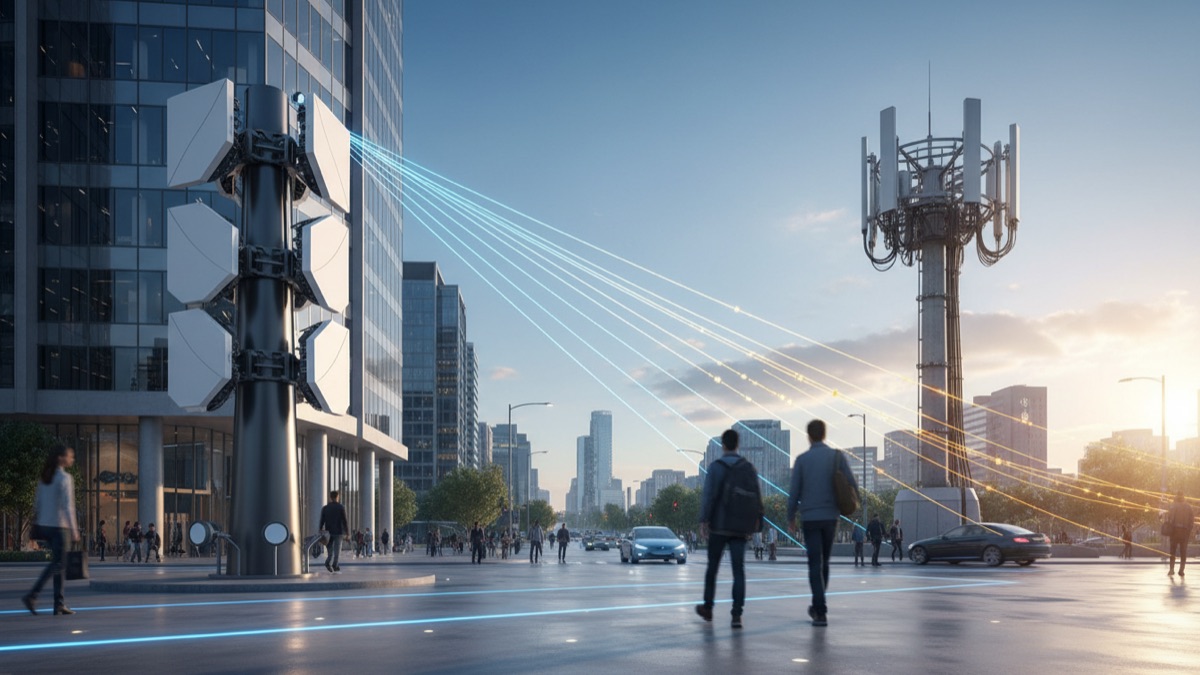
5G is the fifth generation of mobile network technology, succeeding 4G, designed to deliver significantly faster data speeds, lower latency, meaning less delay between sending and receiving data, and the ability to connect far more devices simultaneously within the same area.
Much of 5G's speed improvement comes from using higher-frequency radio waves than previous generations, including a range called millimeter wave, which can carry more data but travels shorter distances and is more easily blocked by buildings and other obstacles.
Faster Speeds and Lower Latency
New Frequencies Bring New Trade-Offs
To work around millimeter wave's limited range, 5G networks require significantly more, smaller cell towers and antennas placed closer together than older networks needed, which is part of why widespread 5G rollout has taken considerable infrastructure investment.
Beyond faster phone browsing, 5G's lower latency and higher device capacity are expected to support technologies that need near-instant response times and dense connectivity, including autonomous vehicles, remote surgery, and large-scale smart city sensor networks.
Sources
- Wikipedia — overview of 5G technology and its capabilities
- International Telecommunication Union — technical standards background on mobile network generations
- GSMA — industry data and background on global 5G deployment
FAQ
Is 5G always significantly faster than 4G in practice?
It can be, especially on millimeter wave frequencies, though actual speeds vary widely depending on network coverage, device, and location.
Why does 5G need more cell towers than 4G?
Higher-frequency millimeter wave signals used in 5G travel shorter distances and are more easily blocked, requiring more, closer-together towers to maintain coverage.
What kinds of technology could benefit most from 5G's low latency?
Technologies requiring near-instant response times, such as autonomous vehicles, remote surgery, and dense smart city sensor networks, are expected to benefit significantly.
About the Author
We reference Wikipedia, International Telecommunication Union, and GSMA to explain the background and current understanding of this topic.
Loved This Article?
Share it on WhatsApp → Share it on WhatsApp
Get more guides in your inbox — Subscribe to our newsletter for weekly surprising stories from Egypt, Saudi Arabia, Dubai, and beyond.