Introduction
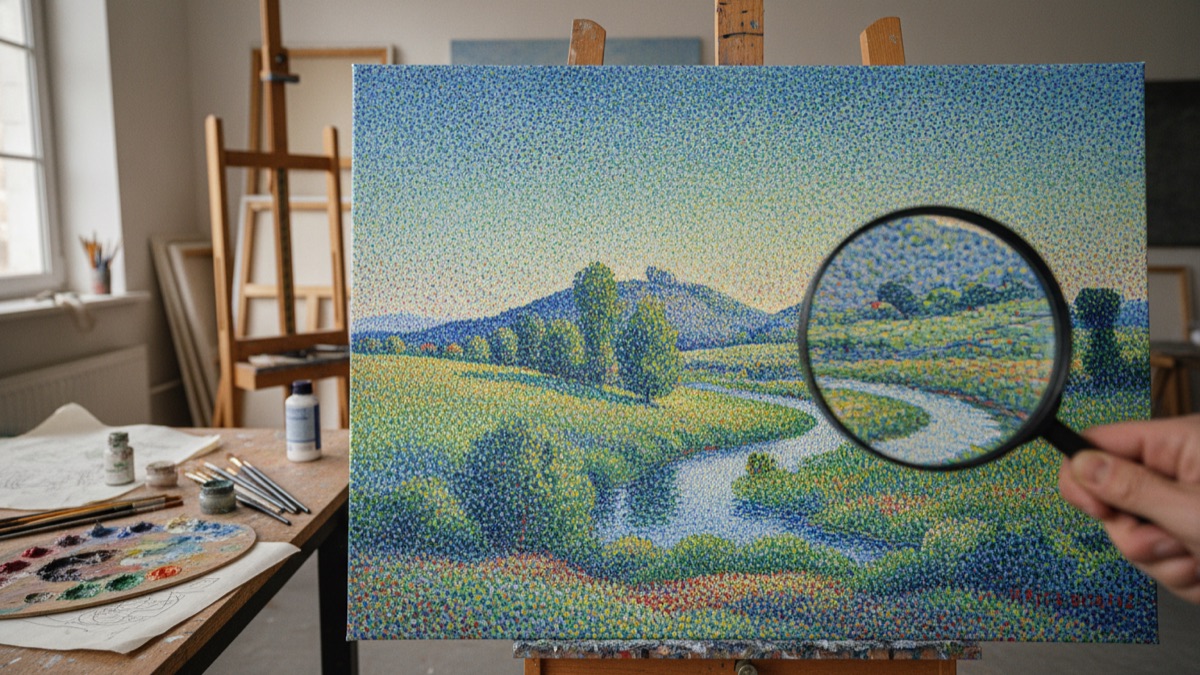
Stand close to a Pointillist painting and you see chaos: thousands of tiny, separate dots of red, blue, yellow, and green. Step back a few meters and the chaos snaps into focus — a riverbank, strolling figures, a sunny afternoon. The colors were never mixed on a palette. They are being mixed right now, inside your eye.
This is Pointillism, the technique invented in 1880s Paris by Georges Seurat, who believed painting could be rebuilt on scientific foundations. It produced some of the most famous canvases ever made, and its core insight — that perception happens in the viewer, not on the canvas — still shapes how we think about images, from printing to the pixels on your screen.
Seurat and the Birth of Pointillism
Georges Seurat was a quiet, methodical young painter who trained at the École des Beaux-Arts in Paris and devoured scientific treatises on color. In 1884 he exhibited 'Bathers at Asnières,' and then spent two years, 1884 to 1886, on his masterpiece: 'A Sunday Afternoon on the Island of La Grande Jatte,' a canvas roughly 2 by 3 meters covered in millions of hand-placed dots. It now hangs in the Art Institute of Chicago.
When the painting was shown at the final Impressionist exhibition in 1886, critics did not know what to make of it. One mocked the dotted technique as 'pointillism,' and the insult became the name. Seurat himself rejected it — he preferred Divisionism or 'Chromoluminarism,' terms that emphasized the science of dividing color rather than the dots themselves. His closest follower, Paul Signac, carried the technique forward after Seurat's death.
The Science Behind the Dots
Pointillism rests on real nineteenth-century color science. French chemist Michel Eugène Chevreul, in his 1839 law of simultaneous contrast, showed that adjacent colors change how we perceive each other. American physicist Ogden Rood's 1879 book 'Modern Chromatics' demonstrated that placing small touches of pure color side by side lets the eye fuse them at a distance — a mixture that stays brighter than pigments blended on a palette, which subtract light from each other and grow muddy.
This is called optical mixing. A Pointillist orange is not orange paint; it is red dots and yellow dots that your retina averages into orange, with a luminous shimmer that premixed paint cannot match. Seurat also used complementary contrasts — orange against blue, red against green — placing them in adjacent dots so each color intensified the other. The same principle of additive mixing at small scale is exactly how your phone screen builds every image from red, green, and blue subpixels.
Technique, Decline, and Legacy
The technique was brutally labor-intensive: every square centimeter of canvas had to be built dot by dot, and La Grande Jatte took Seurat around two years and dozens of preparatory studies. In 1891, while working on 'The Circus,' Seurat died suddenly of an infection — probably diphtheria — at just 31, leaving the canvas unfinished and the movement without its founder.
As a strict practice, Pointillism faded within a decade; even Signac loosened his dots into larger mosaic-like strokes. But its influence was enormous. Van Gogh experimented with dotted brushwork during his Paris years, the Fauves learned their fearless color partly from Seurat's palette, and the Italian Futurists borrowed Divisionist technique wholesale. A century later, the Ben-Day dots of Pop Art and the pixels of every digital screen carry the same core idea Seurat proved in 1886: an image can be assembled entirely from discrete points of pure color.
Sources
- Tate — definition of Pointillism, its history, and its relationship to Divisionism
- Encyclopaedia Britannica — overview of the Pointillist technique, Seurat, and the color theory behind it
- Art Institute of Chicago — Seurat's A Sunday on La Grande Jatte, the movement's defining masterpiece
FAQ
What is Pointillism in simple terms?
Pointillism is a painting technique that uses small, distinct dots of pure color applied in patterns, so that the viewer's eye blends them from a distance instead of the artist mixing paints on a palette.
Who invented Pointillism?
Georges Seurat developed the technique in Paris around 1884 to 1886, working closely with Paul Signac. Critics coined the name 'Pointillism' in 1886; Seurat preferred the terms Divisionism and Chromoluminarism.
What is the difference between Pointillism and Divisionism?
Divisionism is the broader theory of separating color into individual strokes or patches for optical mixing. Pointillism is the specific version that uses small dots. Seurat considered his method Divisionism; 'Pointillism' was originally a mocking label.
Why did Seurat use dots instead of normal brushstrokes?
Because of color science: separate touches of pure pigment are fused by the eye at a distance, producing brighter, more luminous color than pigments physically mixed on a palette, which dull each other.
Where can I see the most famous Pointillist painting?
Seurat's A Sunday Afternoon on the Island of La Grande Jatte (1884 to 1886) is on permanent display at the Art Institute of Chicago. Other key works hang in the Musée d'Orsay in Paris and the National Gallery in London.
About the Author
doyouknow.app Editorial Team — We reference museum collections and color-theory scholarship to explain how Pointillism turned science into painting.
Loved This Article?
Share it on WhatsApp → Share on WhatsApp
Get more guides in your inbox — Subscribe to our newsletter for weekly surprising stories from Egypt, Saudi Arabia, Dubai, and beyond.