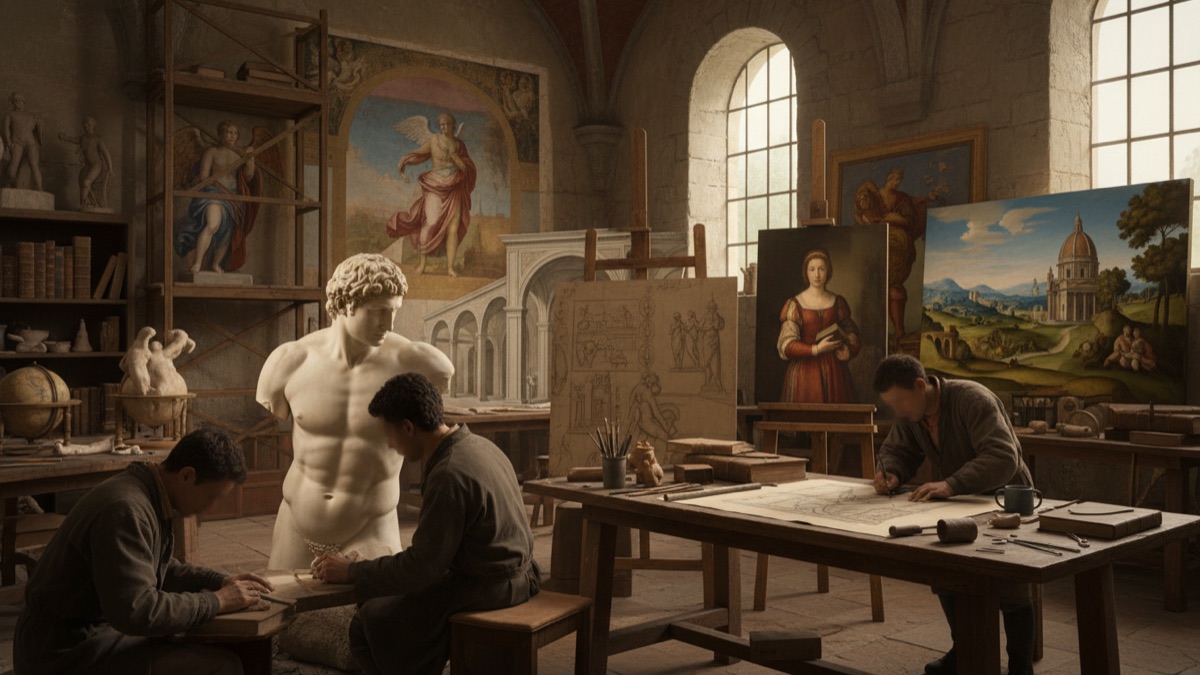
A "Rebirth" Beginning in Italy
The Renaissance, a French word meaning "rebirth," refers to a cultural movement that began in Italy in the 14th century and gradually spread across Europe over the following centuries, marked by renewed interest in the art, literature, and philosophy of ancient Greece and Rome.
In art specifically, the period represented a dramatic shift away from the more stylized, symbolic imagery common in medieval European art, toward a focus on realism, proportion, and the natural world.
The Rise of Linear Perspective
One of the movement's most significant technical developments was the systematic use of linear perspective, a mathematical technique for creating a convincing illusion of three-dimensional depth on a flat surface, credited largely to Florentine architect Filippo Brunelleschi.
This innovation, combined with closer study of human anatomy and a greater use of light and shadow, allowed Renaissance artists to depict figures and scenes with far more lifelike accuracy than earlier periods.
Major Figures and Lasting Influence
Artists such as Leonardo da Vinci, Michelangelo, and Raphael became central figures of the High Renaissance, producing works still widely studied and recognized today, from the Mona Lisa to the Sistine Chapel ceiling.
The movement's techniques and ideals, particularly its emphasis on realism, proportion, and human-centered subject matter, remained foundational to Western art education for centuries afterward.
Sources
- The Metropolitan Museum of Art — curatorial background on Renaissance art
- Encyclopaedia Britannica — an academic overview of the Renaissance movement
- Uffizi Galleries — a leading museum of Renaissance-era art
FAQ
What does the word Renaissance mean?
It is a French word meaning "rebirth," referring to renewed interest in classical Greek and Roman art, literature, and philosophy.
What technical innovation defined Renaissance painting?
The systematic use of linear perspective, credited largely to Filippo Brunelleschi, allowed for convincing three-dimensional depth on a flat surface.
Who are some major Renaissance artists?
Leonardo da Vinci, Michelangelo, and Raphael are among the most recognized figures of the High Renaissance.
About the Author
We reference The Met, Encyclopaedia Britannica, the Uffizi Galleries to explain the background and current understanding of this topic.
Loved This Article?
Share it on WhatsApp → Share it on WhatsApp
Get more guides in your inbox — Subscribe to our newsletter for weekly surprising stories from Egypt, Saudi Arabia, Dubai, and beyond.