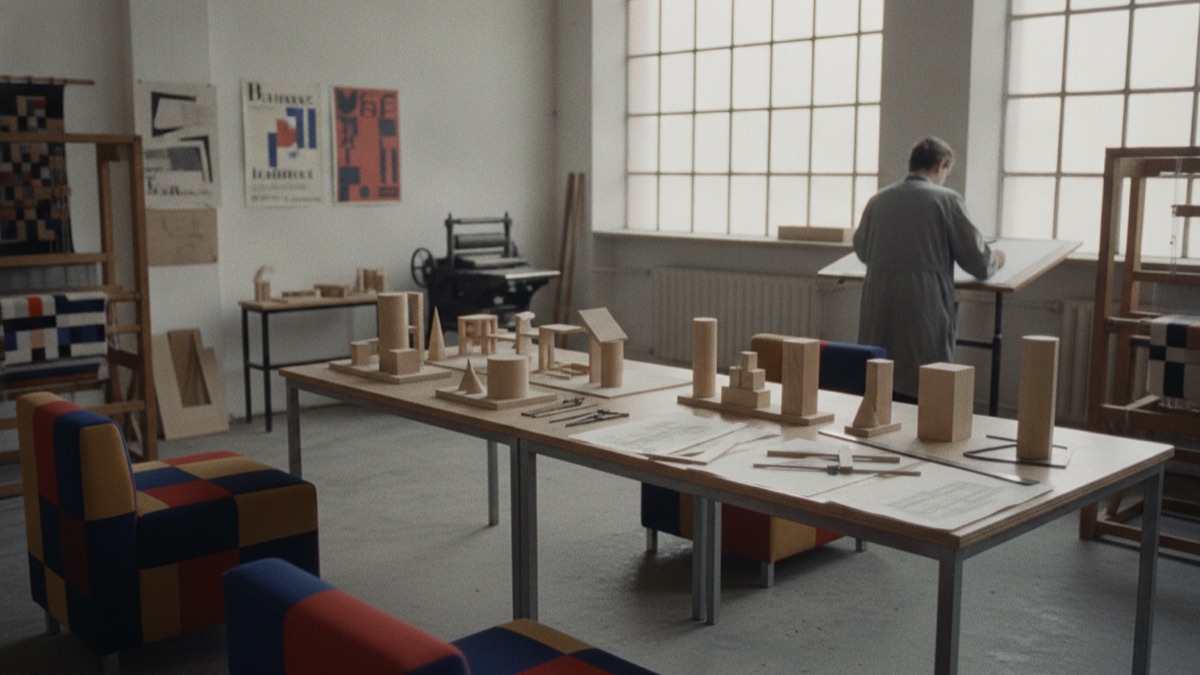
The Bauhaus was a German school of art and design founded in 1919 in the city of Weimar by architect Walter Gropius. It aimed to break down the traditional divide between fine art and applied craft, training students across disciplines from painting to furniture-making to typography.
The school later relocated to Dessau and then Berlin, before closing in 1933 amid pressure from the Nazi government, which viewed its modernist, internationally oriented outlook with hostility.
Merging Art, Craft, and Industry
A Legacy That Shaped Modern Design
Teaching at the Bauhaus combined hands-on workshops in materials like textiles, metal, and wood with theoretical courses on color, form, and design principles, encouraging students to think of everyday objects, from chairs to teapots, as functional works of design rather than purely decorative items. Geometric shapes and primary colors became closely associated with its visual language.
After the school closed, many of its faculty emigrated, notably to the United States, carrying Bauhaus teaching methods and aesthetics to new institutions and helping spread its influence into modernist architecture, industrial product design, and graphic design worldwide.
Sources
FAQ
Who founded the Bauhaus?
The Bauhaus was founded in 1919 by German architect Walter Gropius in the city of Weimar.
Why did the Bauhaus close?
It closed in 1933 under pressure from the Nazi government, which was hostile to its modernist, internationally minded approach.
Is Bauhaus a style or a school?
Technically it was a school, though the term "Bauhaus style" is commonly used to describe the geometric, functional aesthetic it became known for.
About the Author
We reference Bauhaus-Archiv Berlin, The Museum of Modern Art (MoMA) to explain the background and current understanding of this topic.
Loved This Article?
Share it on WhatsApp → Share it on WhatsApp
Get more guides in your inbox — Subscribe to our newsletter for weekly surprising stories from Egypt, Saudi Arabia, Dubai, and beyond.