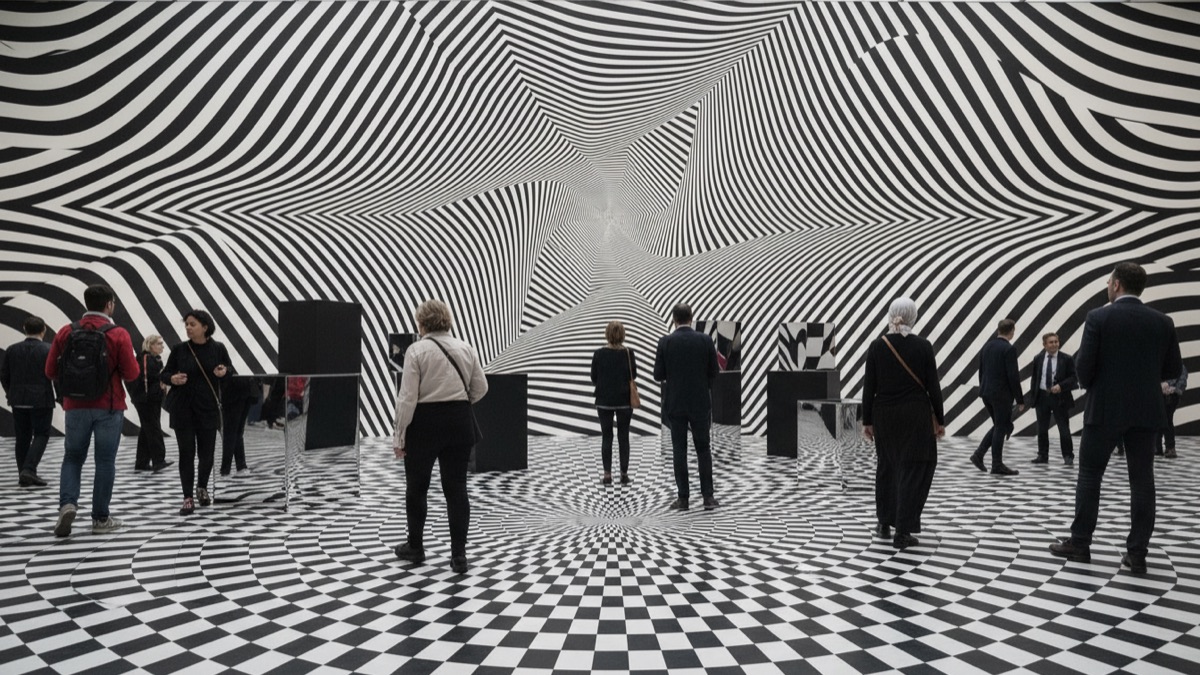
Op Art, short for "optical art," is a movement that uses precise geometric patterns, repetition, and strong contrast to trick the eye into perceiving motion, vibration, or depth that does not physically exist on the flat surface of the work.
The movement gained wide public attention through the 1965 exhibition "The Responsive Eye" at New York's Museum of Modern Art, which introduced many viewers to the style and helped cement its place within twentieth-century art history.
How the Illusions Are Created
Key Artists and the Movement's Peak
The illusions typically rely on techniques such as tightly spaced parallel lines, moiré patterns created when two grids overlap, and carefully calibrated color or tonal contrasts that make the eye perceive shimmering or pulsing effects even though nothing on the canvas is actually moving.
British artist Bridget Riley and Hungarian-French artist Victor Vasarely are among the movement's best-known figures, known respectively for high-contrast black-and-white compositions and vividly colored geometric works. Op Art also spread quickly into commercial design, influencing fashion and textile patterns during the 1960s.
Sources
FAQ
Is Op Art the same as psychedelic art?
They are related but distinct; Op Art focuses on precise geometric optical illusions, while psychedelic art draws more broadly on vivid color and imagery associated with 1960s counterculture.
Who are the movement's most famous artists?
Bridget Riley and Victor Vasarely are among the best known, alongside other artists who explored optical effects during the same period.
Does Op Art use color or just black and white?
Both; while many early, high-contrast works used black and white, other Op artists, including Vasarely, worked extensively in vivid color.
About the Author
We reference Tate, The Museum of Modern Art (MoMA) to explain the background and current understanding of this topic.
Loved This Article?
Share it on WhatsApp → Share it on WhatsApp
Get more guides in your inbox — Subscribe to our newsletter for weekly surprising stories from Egypt, Saudi Arabia, Dubai, and beyond.