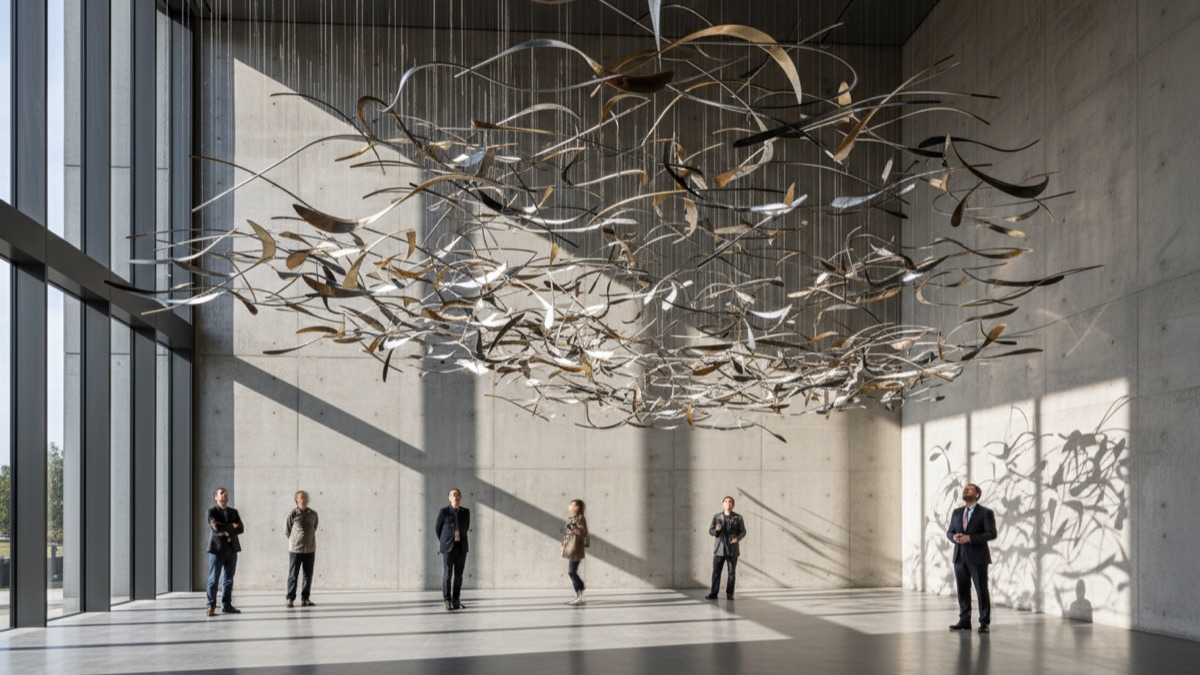
Kinetic art is art that incorporates real movement — whether powered by motors, wind, magnets, viewer touch, or gravity — as an essential part of the artwork itself.
It turns motion into the medium rather than just depicting it on a static canvas.
Origins and Key Pioneers
The term gained wide use in the early 20th century as artists moved beyond representing motion, like Futurist paintings, toward literally building it.
Alexander Calder's hanging mobiles from the 1930s, driven by air currents, became some of the most recognized kinetic sculptures; Marcel Duchamp's 1913 "Bicycle Wheel" is often cited as an early conceptual precursor, and by the 1950s-60s artists like Jean Tinguely built elaborate motorized machines, some designed to self-destruct as performance art.
How It Differs From Static Sculpture
Traditional sculpture is fixed and viewed from changing angles by a moving viewer, while kinetic art changes independently of the viewer — the artwork itself transforms over time, meaning no two viewings look exactly the same.
This made kinetic art closely tied to ideas about chance, unpredictability, and the passage of time as artistic elements.
Sources
- Wikipedia — overview of kinetic art history
- MoMA collection notes — museum background on kinetic sculpture
- Encyclopaedia Britannica — background on kinetic art movement
FAQ
Who is considered the father of kinetic art?
Alexander Calder is widely credited with popularizing kinetic sculpture through his wind-powered mobiles starting in the 1930s, though earlier artists explored related ideas.
Does kinetic art always use motors?
No — it can be powered by wind, water, magnets, viewer interaction, or gravity; motorized movement is just one method among several.
Is kinetic art still made today?
Yes — contemporary artists continue creating kinetic works, often incorporating digital technology, sensors, and programmable movement.
About the Author
We reference Wikipedia and MoMA's collection notes and Encyclopaedia Britannica to explain the background and current understanding of this topic.
Loved This Article?
Share it on WhatsApp → Share it on WhatsApp
Get more guides in your inbox — Subscribe to our newsletter for weekly surprising stories from Egypt, Saudi Arabia, Dubai, and beyond.