Introduction
Around 1907, Pablo Picasso and Georges Braque began painting objects not as they appear from one angle, but as fragmented shapes assembled from multiple viewpoints at once. The result looked like nothing before it, and it became known as Cubism, one of the most influential art movements of the 20th century.
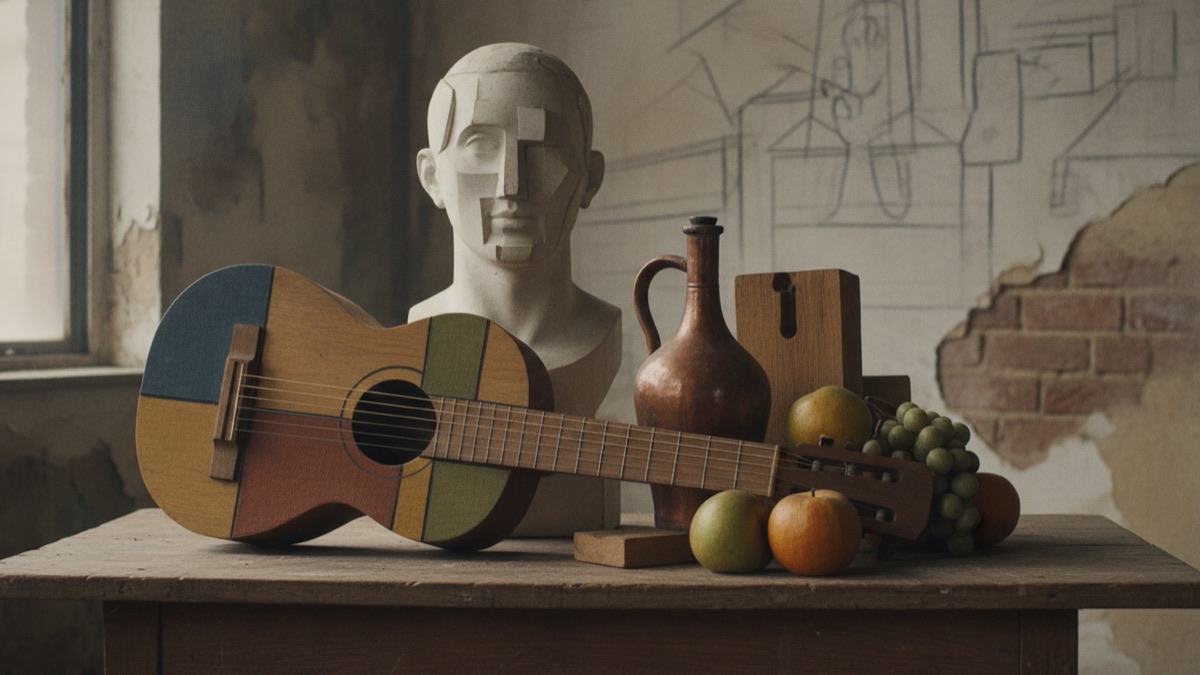
Instead of a single fixed perspective inherited from the Renaissance, Cubist paintings show a face, a guitar, or a bowl of fruit as if seen simultaneously from the front, side, and above — flattened and reassembled into overlapping geometric planes.
Origins: Picasso, Braque, and Africa
Picasso's 1907 painting Les Demoiselles d'Avignon is widely considered the movement's spark, its fractured female figures influenced partly by Iberian sculpture and African masks Picasso encountered in Paris ethnographic collections. Braque soon began experimenting in parallel, and the two artists worked so closely between 1908 and 1914 that some of their paintings from this period are hard to tell apart.
The name itself came from a dismissive critic: in 1908, French critic Louis Vauxcelles described Braque's landscapes as reducing everything to 'little cubes,' and the label stuck.
Analytic and Synthetic Cubism
Early Analytic Cubism (roughly 1908–1912) broke subjects into a nearly monochrome maze of overlapping facets, prioritizing structure over color to the point that paintings became almost abstract. Viewers had to piece together a guitar or a human face from fragments rather than seeing it whole.
Synthetic Cubism, which followed after 1912, reintroduced color, simpler shapes, and a radical new technique: collage. Picasso and Braque began gluing newspaper clippings, wallpaper, and other everyday materials directly onto canvas, treating ordinary objects as legitimate artistic material for the first time.
Why Cubism Still Matters
Cubism dismantled the assumption that a painting must represent a single, stable viewpoint — an idea European art had followed since the Renaissance discovery of linear perspective. That break opened the door to abstract art, and its influence spread quickly into sculpture, architecture, and even fashion design through the 1910s and 1920s.
Later movements from Futurism to abstract art trace a direct line back to Cubism's fragmented forms, and the collage technique it popularized remains a standard tool in graphic design and contemporary art a century later.
Sources
- Museum of Modern Art (MoMA) — overview of Cubism's history and key artists
- Wikipedia — detailed history of Analytic and Synthetic Cubism
- Encyclopaedia Britannica — origins of the term and its critical reception
FAQ
What is Cubism in simple terms?
Cubism is an early 20th-century art movement, pioneered by Pablo Picasso and Georges Braque, that depicts subjects as fragmented geometric shapes viewed from multiple angles at once, rather than from one fixed perspective.
Who invented Cubism?
Pablo Picasso and Georges Braque developed Cubism together between about 1907 and 1914, working so closely that art historians sometimes struggle to attribute individual paintings from that period to one artist alone.
What is the difference between Analytic and Synthetic Cubism?
Analytic Cubism (roughly 1908–1912) used near-monochrome, heavily fragmented compositions that emphasized structure over color. Synthetic Cubism, after 1912, reintroduced color and simpler shapes and introduced collage, gluing real materials like newspaper directly onto the canvas.
Why is it called Cubism?
The name came from critic Louis Vauxcelles, who in 1908 described Georges Braque's landscape paintings as reducing everything to "little cubes." The dismissive label was later adopted as the movement's official name.
About the Author
We reference Museum of Modern Art collection notes, Encyclopaedia Britannica, and art-historical sources on Picasso and Braque to explain the origins and phases of Cubism.
Loved This Article?
Share it on WhatsApp → Share on WhatsApp
Get more guides in your inbox — Subscribe to our newsletter for weekly surprising stories from Egypt, Saudi Arabia, Dubai, and beyond.