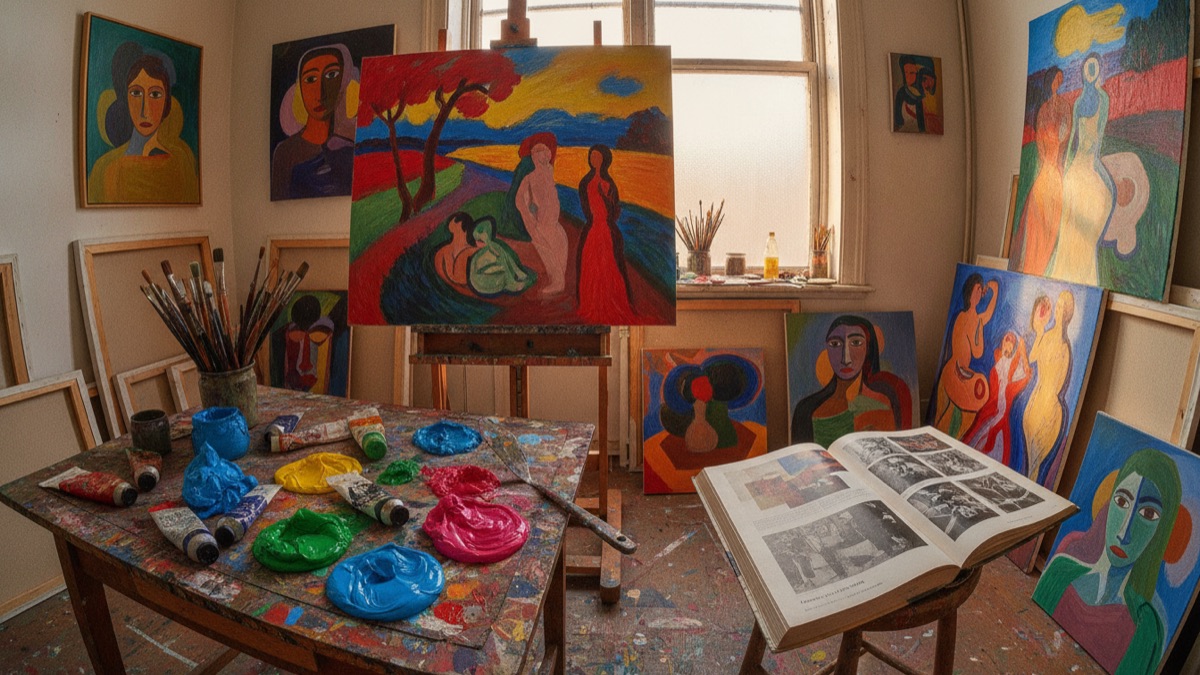
Fauvism was an early-20th-century art movement built around using intense, non-naturalistic color straight from the tube, applied in bold, loose brushstrokes, rather than the muted, realistic palettes painters had traditionally relied on. A tree could be painted red, a face green, a sky orange, with no attempt to match how the scene actually looked.
The name came from a jab, not a manifesto. At the 1905 Salon d'Automne exhibition in Paris, critic Louis Vauxcelles saw a roomful of these radically colorful paintings surrounding a more traditional bronze sculpture and remarked that it looked like 'Donatello among the wild beasts,' or fauves in French — and the label stuck as the movement's name.
Color Detached From Reality
A Short-Lived Movement With a Long Influence
Henri Matisse led the group, alongside André Derain and Maurice de Vlaminck, and their paintings prioritized emotional intensity and decorative flatness over the accurate depth and lighting that academic painting had prized for centuries. Matisse's 1905 painting Woman with a Hat, with its patchwork of unrelated colors across the sitter's face, became one of the movement's defining, most controversial works.
Fauvism itself burned out fast, largely fading by around 1910 as its leading artists moved toward other styles. But its core idea — that color could carry emotional and structural weight independent of realistic depiction — fed directly into German Expressionism and influenced painters for decades afterward, making it far more influential than its brief three-to-five-year run would suggest.
Sources
- Wikipedia — overview of the Fauvist movement, its artists, and its techniques
- The Met — Metropolitan Museum of Art's history of Fauvism
- MoMA — reference on Fauvism and its key works
FAQ
Where does the name "Fauvism" come from?
A critic at the 1905 Salon d'Automne compared the artists to fauves, French for "wild beasts," because of how radically unnatural their colors looked next to a traditional sculpture in the same room, and the nickname became the movement's official name.
Who were the main Fauvist painters?
Henri Matisse is considered the leading figure, alongside André Derain and Maurice de Vlaminck, with other artists like Raoul Dufy and Georges Braque also associated with the movement early on.
How long did Fauvism actually last?
It was remarkably brief, generally dated from around 1905 to 1910, before most of its key artists moved on to other styles such as Cubism and Expressionism.
About the Author
We reference Wikipedia, The Met, and MoMA to explain the background and current understanding of this topic.
Loved This Article?
Share it on WhatsApp → Share it on WhatsApp
Get more guides in your inbox — Subscribe to our newsletter for weekly surprising stories from Egypt, Saudi Arabia, Dubai, and beyond.