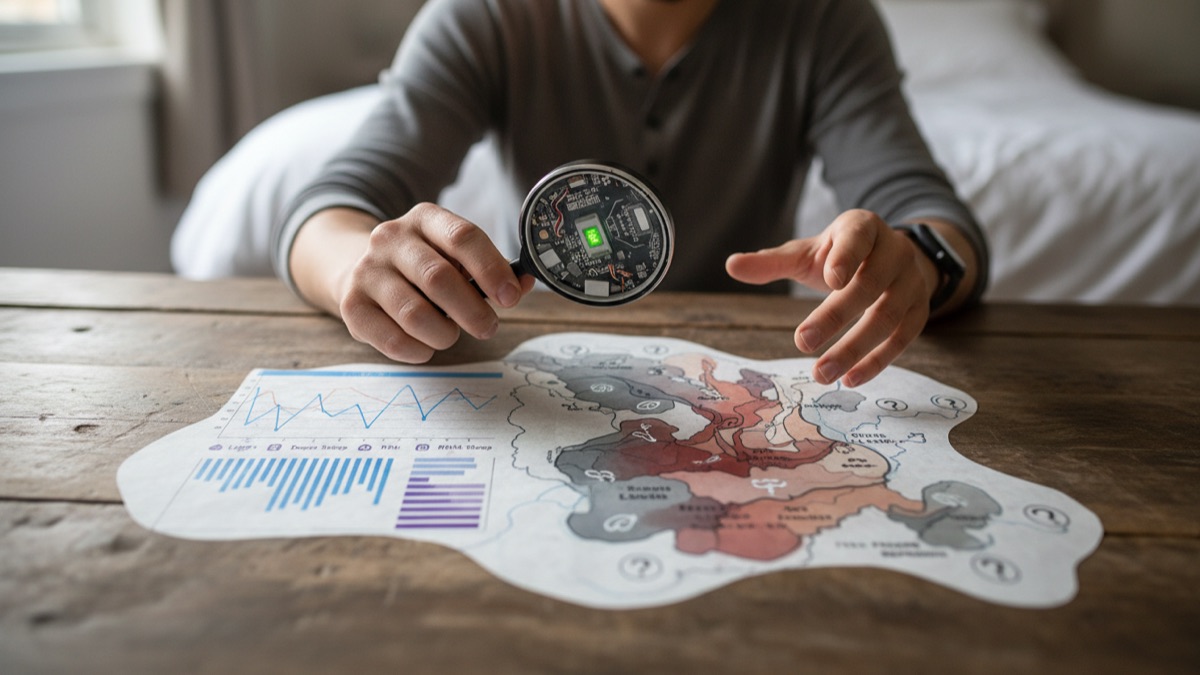
Millions of people now wake up and check a sleep score before they check anything else, a number generated overnight by a ring, watch, or bedside sensor that claims to know how much deep sleep, REM sleep, and light sleep they got. That data feels precise, often broken down to the minute, but the underlying technology is fundamentally an estimate built from indirect physical signals, not a direct measurement of what is actually happening inside the brain. Understanding exactly what these devices are sensing, and what they're inferring from that sensing, makes it much easier to know how much to trust the number on the screen each morning.
What Sleep Trackers Are Actually Measuring
No consumer sleep tracker measures sleep directly, because directly confirming sleep requires recording brain wave activity, which almost no wearable device does. Instead, virtually every ring, watch, and bedside sensor on the market infers sleep from a combination of physical proxies: body movement, heart rate, heart rate variability, and in some newer devices, skin temperature and blood oxygen saturation.
These proxies correlate reasonably well with sleep in general, since the body reliably becomes still and heart rate reliably slows during genuine sleep, which is precisely why the basic approach works as well as it does for the broad question of whether you're asleep or awake. The trouble starts when devices are asked to go further, using those same indirect signals to classify not just sleep versus wakefulness but specific, more subtle sleep stages.
It's worth being clear about this distinction upfront, because marketing language around sleep trackers rarely draws it explicitly: the device is not reading your brain, it's making a statistical inference from your body's peripheral signals, and that inference is considerably more reliable for some questions than for others.
Accelerometers: Movement as a Proxy for Sleep
The foundational sensor in nearly every sleep tracker is an accelerometer, the same type of motion sensor used to count steps, which detects even small movements of the wrist, finger, or body throughout the night, an approach with decades of research behind it under the clinical name actigraphy.
Actigraphy research, conducted in sleep labs since well before consumer wearables existed, established that periods of minimal movement correlate strongly with sleep and periods of more frequent movement correlate strongly with wakefulness, a relationship solid enough that actigraphy devices have long been used as a legitimate, if imperfect, research and clinical tool in their own right.
The core limitation is that movement is a coarse signal: a person can lie perfectly still while fully awake, which actigraphy-based systems can misread as sleep, and conversely, someone can shift position during genuine sleep in a way that briefly resembles a wake period, which is part of why movement data alone tends to overestimate total sleep time somewhat compared with clinical measurement.
Heart Rate and Heart Rate Variability Add a Second Signal
Most modern sleep trackers combine accelerometer data with continuous heart rate monitoring, typically using an optical sensor that shines light through the skin and measures blood volume changes, plus a derived metric called heart rate variability, the small variation in time between individual heartbeats.
Heart rate variability tends to shift in fairly characteristic ways across different physiological states, generally rising during deep, restorative sleep stages and settling into different patterns during lighter sleep and REM sleep, giving trackers a second data stream to combine with movement when attempting to classify what stage of sleep someone might be in at a given moment.
Combining these two signals meaningfully improves accuracy over movement alone, which is why virtually every consumer sleep tracker released in the past decade includes optical heart rate sensing rather than relying purely on an accelerometer, but the combination still falls well short of directly observing brain activity, the actual basis for clinical sleep staging.
How Trackers Estimate Sleep Stages
To produce the familiar light sleep, deep sleep, and REM sleep breakdown shown in a morning summary, consumer devices run the combined movement and heart rate data through a proprietary algorithm, typically built using machine learning models trained by comparing wearable sensor data against actual polysomnography recordings from volunteer study participants.
These algorithms essentially learn statistical patterns: given this particular combination of movement level, heart rate, and heart rate variability, what sleep stage did volunteers wearing both a consumer device and clinical equipment tend to actually be in, then apply that learned pattern to new users' data going forward.
Because the algorithm is trained on population-level patterns and then applied to an individual, its accuracy for any specific person depends heavily on how representative that person's physiology is of the original training population, which is part of why sleep-stage accuracy varies more between different people, and different devices, than total-sleep-time accuracy does.
Polysomnography: The Real Gold Standard
Polysomnography, the sleep study conducted in a dedicated sleep lab or clinic, remains the actual clinical gold standard for measuring sleep, recording electroencephalography, or EEG, to directly capture brain wave activity, alongside eye movement, chin muscle tone, heart rhythm, breathing effort, and blood oxygen, all simultaneously overnight.
Because polysomnography directly records the brain wave patterns that formally define each sleep stage under internationally standardized clinical scoring criteria, a trained technician can classify sleep stages with a level of certainty no wrist- or finger-worn consumer device can currently match, since those devices have no direct access to brain electrical activity at all.
Polysomnography is expensive, logistically demanding, and typically limited to one or two nights in an unfamiliar clinical environment, which introduces its own distortion, since people frequently sleep somewhat differently in a lab hooked up to wires than they do in their own bed, a limitation researchers openly acknowledge even while treating polysomnography as the reference standard.
Where Consumer Trackers Agree With Polysomnography
Multiple independent validation studies comparing popular consumer wearables against simultaneous polysomnography have found reasonably strong agreement on the most basic sleep question: whether a person is asleep or awake at a given moment, with many devices achieving sensitivity for detecting sleep in the range of roughly 90 percent or higher.
This strong sleep-versus-wake performance extends reasonably well to overall total sleep time and approximate sleep onset, meaning the time it took someone to fall asleep, and approximate final wake time, all of which tend to track fairly closely with polysomnography-derived figures across most validation studies published in recent years.
This level of agreement is genuinely useful for the everyday questions most people actually care about, roughly how long did I sleep and roughly when did I fall asleep and wake up, which is arguably the core value proposition sleep trackers deliver reliably even when their more detailed claims deserve more skepticism.
Where Consumer Trackers Diverge Significantly
The same validation studies consistently find much weaker agreement once the comparison moves to detecting brief nighttime awakenings, which consumer devices frequently miss entirely if the person doesn't move much during them, and to distinguishing light sleep from deep sleep from REM sleep, where agreement with polysomnography drops substantially compared with the simple sleep-versus-wake question.
Researchers describe this pattern as an expected consequence of the underlying sensing approach rather than a flaw specific to any one brand: movement and heart rate genuinely correlate less tightly with the fine-grained distinctions between sleep stages than they do with the broader distinction between being asleep and being awake, so no amount of algorithm refinement using only these input signals can fully close that gap.
This divergence tends to be largest specifically for deep sleep detection, where several published validation studies have found consumer devices both overestimating and underestimating deep sleep duration depending on the specific device and study population, a genuinely inconsistent pattern across the wearable market as a whole.
Why Total Sleep Time Is Usually the Most Reliable Metric
Total sleep time is comparatively reliable across most validated consumer devices mainly because it only requires the algorithm to make one binary classification, repeated many times through the night, asleep or awake, rather than the much harder four- or five-way classification required for detailed sleep staging.
Binary classification problems are inherently easier for a machine learning model to get right than multi-class problems, especially when the underlying input signals genuinely do differ quite clearly between sleep and wakefulness but differ much more subtly between individual sleep stages, a pattern that shows up consistently across the sleep tracker validation literature.
This is a useful practical takeaway for anyone using a tracker day to day: treating the total sleep duration and rough sleep and wake timing as reasonably trustworthy, while treating the detailed stage percentages as a loose, sometimes inaccurate estimate rather than a clinical-grade measurement, reflects the actual state of the underlying science reasonably well.
Why Sleep Stage Breakdown Is the Least Reliable Metric
Deep sleep and REM sleep each have genuine, well-established physiological importance, deep sleep for physical restoration and REM sleep for memory consolidation and emotional processing, which is exactly why sleep tracker companies emphasize these breakdowns so heavily in their marketing and app interfaces despite the measurement challenge involved.
The core technical problem is that heart rate variability and movement patterns during light sleep, deep sleep, and REM sleep genuinely do overlap significantly between individuals and even within the same individual on different nights, meaning the underlying physical signals a wearable can access simply don't separate as cleanly as the labeled categories on a sleep app dashboard suggest.
Sleep researchers who have studied this gap generally recommend treating night-to-night changes in a device's stage percentages, rather than the absolute numbers themselves, as somewhat more informative, since a consistent tracking error would still show up as a meaningful relative shift even if the absolute deep sleep percentage reported isn't itself clinically precise.
Skin Temperature, Blood Oxygen, and Newer Sensors
Newer generations of sleep-tracking rings and watches have added skin temperature sensors and pulse oximetry, which estimates blood oxygen saturation, expanding the range of physiological signals available beyond the original movement-and-heart-rate combination used by earlier devices.
Skin temperature tends to track reasonably well with certain physiological patterns, including phases of the menstrual cycle and general illness onset, giving these newer sensors legitimate secondary uses even where their direct contribution to sleep stage accuracy specifically remains modest and still under active research.
Blood oxygen sensing has attracted particular clinical interest because meaningful, repeated overnight drops in blood oxygen are a hallmark sign of sleep apnea, and several device makers have begun using this data, sometimes combined with regulatory clearance in certain markets, to flag patterns that may warrant a proper clinical evaluation, representing one of the more medically consequential directions consumer sleep tracking has moved toward.
Orthosomnia: When Tracking Data Hurts Sleep
Sleep clinicians coined the term orthosomnia to describe a pattern they began seeing with increasing frequency after consumer sleep trackers became widespread: patients becoming anxious, sometimes significantly so, about achieving a "good" sleep score, in a way that itself interferes with actually sleeping well.
The underlying mechanism is straightforward and well understood in sleep medicine more broadly: pre-sleep anxiety and excessive monitoring of one's own sleep, sometimes called sleep effort, are known contributors to insomnia symptoms independent of any wearable device, meaning a tracker that induces this kind of anxious self-monitoring can actively work against the sleep quality it's trying to measure.
Sleep clinicians generally advise patients who notice this pattern in themselves to reduce how frequently they check detailed sleep data, sometimes recommending removing the device or hiding the app's detailed breakdown entirely for a period, treating the psychological effect of the data as a genuine clinical consideration in its own right rather than a minor side issue.
How Different Devices Compare
Smart rings, which sit close to blood vessels in the finger, generally report somewhat more stable heart rate and heart rate variability signal quality than wrist-worn devices, since the wrist experiences more movement artifact and looser, more variable skin contact during sleep, a difference multiple independent validation studies have documented.
Wrist-worn smartwatches remain the most widely used category overall and have improved substantially in validation accuracy over successive hardware generations, though study results still vary meaningfully by specific brand and model, meaning a general statement about "smartwatch accuracy" understates real differences between individual products on the market.
Under-mattress and bedside radar or sonar-based sleep sensors, which don't require wearing anything at all, use a different sensing approach entirely, detecting subtle body movement and sometimes breathing patterns through the mattress or from a distance, and generally perform comparably to wrist-worn devices for basic sleep-versus-wake detection while facing the same fundamental limitations for detailed stage classification.
What Sleep Trackers Are Actually Good For
Despite their real limitations, consumer sleep trackers genuinely excel at revealing long-term patterns and trends that would otherwise be nearly impossible for most people to notice or remember accurately, including gradual shifts in sleep duration, consistency of bedtime and wake time, and how specific behaviors like late caffeine, alcohol, or exercise correlate with a person's own subsequent sleep.
This trend-tracking use case sidesteps much of the night-to-night measurement noise discussed throughout this article, because even an imperfect but consistently biased measurement can still reveal a genuine underlying trend over weeks or months, which is a fundamentally different and considerably more defensible use of the data than treating any single night's detailed stage breakdown as clinically precise.
Sleep researchers increasingly view consumer wearables as a legitimate, if imperfect, population-level research and screening tool precisely because of this trend-detection strength, generating far larger datasets across far more real-world nights than any lab-based polysomnography study realistically could, even while individual-night, individual-stage precision remains a genuine and openly acknowledged limitation.
Common Misconceptions About Sleep Tracker Accuracy
A common misconception treats a sleep tracker's stage breakdown, the exact minutes of deep, light, and REM sleep, as a clinically precise measurement equivalent to a hospital sleep study; in reality, published validation research consistently shows this specific metric as the least reliable output these devices produce.
Another misconception assumes newer, more expensive devices with more sensors are automatically proportionally more accurate; while additional sensors like blood oxygen and skin temperature do add genuinely useful data streams, validation accuracy for core sleep-stage classification has improved only incrementally across device generations, constrained fundamentally by the indirect nature of the underlying signals rather than sensor count alone.
A third misconception assumes a single unusually low sleep score reported after one night reflects a meaningful health problem; sleep researchers generally recommend paying more attention to sustained patterns across several weeks than to any single night's number, given the documented night-to-night measurement variability inherent in how these devices work.
Sleep trackers occupy a genuinely useful, if narrower than commonly assumed, role: reasonably trustworthy for tracking overall sleep duration and long-term patterns, but meaningfully less reliable, according to the published validation literature, for the detailed stage-by-stage breakdown most apps foreground in their interface. None of this makes the technology useless, since even an imperfect nightly estimate, tracked consistently over weeks and months, can reveal real and actionable patterns in a person's sleep behavior. It does mean the smartest way to use a sleep tracker is to treat the big-picture trend as the primary signal and the nightly stage percentages as a loose approximation, rather than the other way around.
Sources
- American Academy of Sleep Medicine — Clinical standards for polysomnography and sleep stage scoring.
- National Sleep Foundation — Consumer education on sleep tracking technology and sleep health.
- National Heart, Lung, and Blood Institute — Research on sleep physiology and sleep-related health conditions.
- National Center for Biotechnology Information, PubMed Central — Peer-reviewed validation studies comparing wearable sleep trackers with polysomnography.
FAQ
How accurate are consumer sleep trackers?
Consumer sleep trackers are generally reasonably accurate at estimating total sleep time and roughly when you fell asleep and woke up, but they are considerably less reliable at distinguishing specific sleep stages like deep sleep and REM sleep compared with clinical polysomnography.
What is polysomnography?
Polysomnography is the clinical gold-standard sleep study that records brain waves via EEG, eye movements, muscle activity, heart rhythm, and breathing simultaneously overnight, allowing technicians to classify sleep stages directly rather than estimating them from movement or heart rate alone.
Can a sleep tracker detect sleep apnea?
Some newer wearables with blood oxygen sensors can flag patterns suggestive of possible sleep apnea and are increasingly used for population-level screening, but they are not diagnostic tools and cannot replace a clinical sleep study for an actual diagnosis.
What is orthosomnia?
Orthosomnia is a term used by sleep clinicians to describe anxiety or preoccupation with achieving a perfect sleep tracker score, which can paradoxically worsen sleep quality by increasing pre-sleep stress and encouraging people to distrust how they actually feel in favor of a device's number.
Which sleep metric is most reliable from a wearable?
Total sleep time and overall sleep versus wake detection are generally the most reliable metrics from consumer wearables, since they rely on relatively straightforward movement and heart rate signals, whereas detailed sleep stage breakdowns are the least reliable metric.
About the Author
We reference the American Academy of Sleep Medicine, the National Sleep Foundation, the National Heart, Lung, and Blood Institute, and peer-reviewed studies indexed on PubMed Central to explain the background and current understanding of this topic.
Loved This Article?
Share it on WhatsApp → Share it on WhatsApp
Get more guides in your inbox — Subscribe to our newsletter for weekly surprising stories from Egypt, Saudi Arabia, Dubai, and beyond.