Introduction
Whole grains and refined grains both originate from the exact same grain kernel, but differ fundamentally in how much of that original kernel remains in the final food product after processing, a distinction with substantial documented nutritional consequences that major health organizations consistently emphasize in dietary guidelines.
Understanding the actual structural difference between these two grain categories, rather than just recognizing marketing terms like 'whole wheat' or 'multigrain' on packaging, helps clarify why nutrition guidelines consistently recommend prioritizing whole grains over refined alternatives whenever practically possible.
The Three Parts of a Grain Kernel
Every grain kernel, whether wheat, rice, oats, or corn, naturally consists of three distinct anatomical parts: the bran (the fiber-rich outer protective layer, also containing significant B vitamins, antioxidants, and minerals), the germ (the nutrient-dense inner core containing healthy fats, vitamin E, B vitamins, and various other beneficial plant compounds), and the endosperm (the starchy inner portion providing primarily carbohydrates and modest amounts of protein, but comparatively few other nutrients relative to the bran and germ).
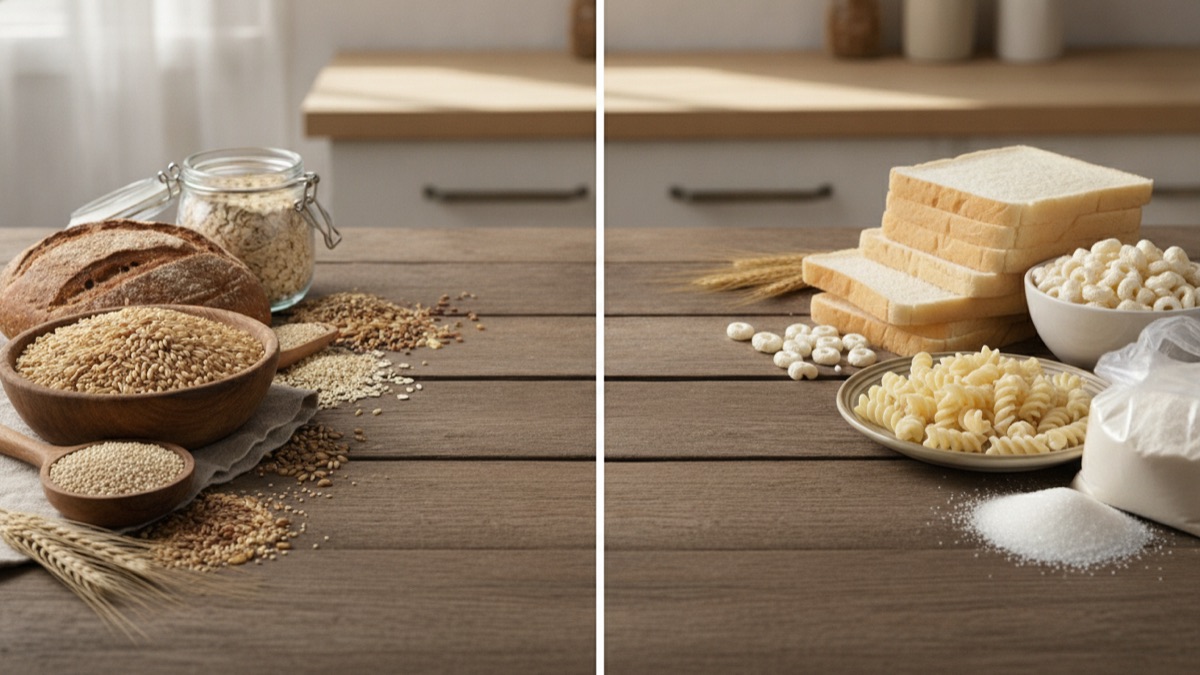
A genuine whole grain retains all three of these original anatomical components, either fully intact (as with brown rice or steel-cut oats) or ground into flour while still including all three parts (as with genuine whole wheat flour), meaning the complete original nutritional package remains present in the final food product.
What Refining Actually Removes
Refining is the industrial milling process that removes both the bran and the germ, leaving only the starchy endosperm portion, a process originally developed and popularized partly because removing these components extends the resulting flour's shelf life significantly (since the healthy fats present in the germ can turn rancid over time) and produces a finer, softer texture and lighter color that historically became culturally associated with more refined, higher-status food products.
This refining process removes a substantial portion of the grain's original fiber, along with significant amounts of B vitamins, vitamin E, iron, magnesium, and various beneficial plant compounds called phytonutrients, which is precisely why many refined grain products in numerous countries are legally required to be 'enriched,' meaning specific nutrients (typically B vitamins and iron) are added back after processing, though enrichment generally doesn't fully restore the complete original nutritional profile, particularly fiber content, which isn't typically added back through standard enrichment processes.
What Research Shows About Health Outcomes
Substantial epidemiological research has consistently linked higher whole grain consumption to measurably reduced risk of cardiovascular disease, type 2 diabetes, and certain cancers, along with generally improved digestive health, associations researchers generally attribute to whole grains' combined fiber content, which supports healthy digestion and gut bacteria, along with their retained micronutrients and beneficial plant compounds working together rather than any single isolated nutrient.
Refined grains, by contrast, are digested and absorbed more rapidly than whole grains due to their lower fiber content, producing a faster, more pronounced rise in blood sugar, and research has found diets high in refined grains and other refined carbohydrates are associated with increased risk of insulin resistance and type 2 diabetes over time, an effect substantially mitigated when the same grain is consumed in its whole form specifically because of fiber's blood-sugar-moderating effect.
How to Actually Identify Genuine Whole Grain Products
Nutrition educators generally caution that packaging terms like 'multigrain,' 'made with whole grains,' '100% wheat,' or products with a brown color from added molasses or coloring can be genuinely misleading, since these terms don't necessarily indicate a product is made predominantly or entirely from whole grains, meaning the most reliable way to identify genuine whole grain products is checking the specific ingredients list.
The most reliable practical approach involves checking that a whole grain ingredient (such as 'whole wheat flour,' 'whole oats,' or 'brown rice') appears as the first ingredient listed, since ingredients are legally required to be listed in descending order by weight, and additionally checking the fiber content on the nutrition facts panel, since genuine whole grain products generally contain meaningfully more fiber per serving than their refined counterparts, providing a practical, verifiable cross-check beyond potentially misleading front-of-package marketing claims alone.
Sources
- Harvard T.H. Chan School of Public Health — Nutrition science reference on whole versus refined grain health effects
- US Department of Agriculture MyPlate — Official dietary guidance on whole grain versus refined grain recommendations
- American Heart Association — Clinical guidance on whole grains and cardiovascular health outcomes
FAQ
What are the three parts of a grain kernel?
Every grain kernel consists of the bran (fiber-rich outer layer), the germ (nutrient-dense inner core with healthy fats and vitamins), and the endosperm (the starchy inner portion providing mainly carbohydrates).
What does the refining process actually remove?
Refining removes both the bran and germ, leaving only the starchy endosperm, which removes a substantial portion of the grain's original fiber, B vitamins, vitamin E, iron, magnesium, and beneficial plant compounds.
Why are refined grain products often labeled 'enriched'?
Many countries legally require refined grain products to be enriched, meaning specific nutrients like B vitamins and iron are added back after processing, though enrichment generally doesn't restore fiber content or the complete original nutritional profile.
Does eating whole grains actually reduce disease risk?
Yes. Substantial epidemiological research consistently links higher whole grain consumption to measurably reduced risk of cardiovascular disease, type 2 diabetes, and certain cancers, along with improved digestive health.
How can you tell if a product is genuinely made from whole grains?
Check that a whole grain ingredient like 'whole wheat flour' appears first in the ingredients list, and check the fiber content on the nutrition facts panel, since terms like 'multigrain' can be misleading without these checks.
About the Author
doyouknow.app Editorial Team — We reference Harvard nutrition science and official USDA dietary guidance to explain the structural and health differences between whole and refined grains.
Loved This Article?
Share it on WhatsApp → Share on WhatsApp
Get more guides in your inbox — Subscribe to our newsletter for weekly surprising stories from Egypt, Saudi Arabia, Dubai, and beyond.