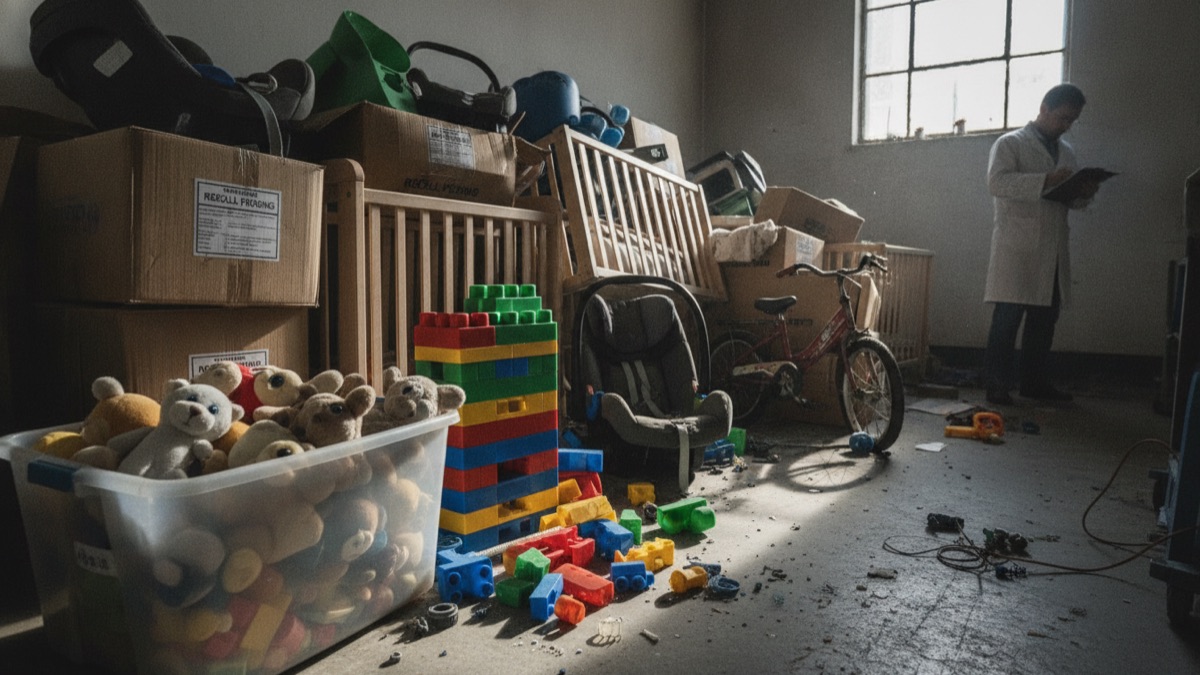
It can feel like a new children's product recall appears in the news every few weeks — a squishy toy pulled for a chemical smell, a stroller recalled over a folding hinge, a batch of baby bottles withdrawn for a coating defect. This steady drumbeat of recalls isn't evidence that children's products are unusually dangerous compared to everything else on shelves. It's largely a sign that the safety bar for anything a child might use, chew, or climb into is set deliberately higher than for adult goods, and that the reporting and testing systems built to catch violations of that bar are more active and more public than most people realize. Understanding how a recall actually gets triggered explains both why they're common and why that frequency is closer to a safety system working than one failing.
Why Children's Products Face a Higher Bar
Regulators in most major markets apply stricter mandatory standards to children's products than to comparable adult goods, covering things like choking-hazard dimensions, chemical content limits for anything likely to be mouthed, and structural strength requirements for items a child might climb on, sit in, or pull down.
This higher bar exists because children interact with products in ways adults typically don't — putting small parts in their mouths, applying unpredictable force to furniture, or lacking the judgment to recognize an obviously unsafe situation — so a hazard that would be a minor inconvenience for an adult can be genuinely dangerous for a young child.
Because the bar itself is stricter, more products fail to meet it during testing, and more previously-approved products get re-flagged when standards are periodically tightened in response to new injury data, which mechanically produces more recalls than a less strict adult-product regime ever would.
How a Recall Actually Gets Triggered
Recalls rarely start with a regulator inspecting a product cold. Most begin with an incident report — a parent, doctor, or hospital reporting an injury or near-miss to a consumer safety agency — which then gets investigated, compared against similar reports, and escalated if a pattern involving the same product model emerges.
Manufacturers themselves are usually legally required to report known safety defects to regulators within a strict window once they become aware of them, whether through customer complaints, internal testing, or a lawsuit, which means many recalls are technically initiated by the company rather than forced by a regulator from the outside.
Random and routine sampling also plays a role: safety agencies test products pulled directly from retail shelves on an ongoing basis, independent of any reported incident, specifically to catch violations before an injury pattern has had a chance to build up.
The Small Parts and Choke Test
Many jurisdictions require children's products intended for young children to pass a small-parts cylinder test — if a piece of the product fits inside a cylinder sized to approximate a young child's throat, that piece fails, regardless of how unlikely it seems that the piece would actually detach.
This test is deliberately conservative because choking is one of the leading causes of injury death in young children, and the cost of being overly cautious about a component that seems unlikely to break off is far lower than the cost of missing one that does.
Products that pass the test when new can still be recalled later if real-world use — chewing, dropping, washing — is found to cause parts to detach in ways the original lab test didn't anticipate, which is a common trigger for recalls on products that were compliant at launch.
Why Chemical Limits Are So Much Stricter
Chemical content limits for children's products, covering things like lead in paint or coatings, phthalates in soft plastics, and certain flame retardants, are typically set far below the limits applied to adult products, because children absorb some chemicals more readily relative to body weight and are more likely to mouth objects.
Testing methods for these limits have also become more sensitive over time, meaning a product manufactured under an older, looser standard, or from a supplier not properly tested, can fail a modern re-test even without any change to the product itself, purely because detection capability improved.
A number of high-profile children's product recalls in recent years, including the kind of soft toy incidents that make headlines, have specifically involved chemical odor complaints that triggered testing and confirmed levels above the permitted threshold, rather than a structural or choking hazard.
Global Supply Chains Make Full Recalls Difficult
A recall notice from a national regulator only reaches consumers who registered their purchase, saw the news coverage, or happen to check a recall database — which means a meaningful share of a recalled product's actual owners never learn about the recall at all, especially for lower-cost items bought without any registration step.
Because many children's products are manufactured by third-party suppliers and sold under multiple brand names or through many different retailers and marketplaces, a single defective batch can end up distributed under names that don't obviously connect to each other, complicating both the initial identification of the problem and the completeness of the eventual recall.
Online marketplaces selling directly from overseas manufacturers add another layer of difficulty, since products can continue to be listed and sold by new sellers even after a recall notice has been issued against the original brand name, unless the platform actively removes every listing.
How Recall Severity Levels Actually Work
Not all recalls represent the same level of danger. Regulatory recall classifications typically distinguish between defects that pose a reasonable probability of serious injury or death, defects that could cause temporary but reversible harm, and defects unlikely to cause any real harm but that violate a labeling or minor compliance rule.
Media coverage often does not distinguish clearly between these tiers, which contributes to a public sense that every recall represents the same serious danger, when in practice a meaningful share of recalls are lower-severity corrections rather than emergency withdrawals.
Reading the actual recall notice rather than a secondhand headline is usually the only reliable way to know which tier a specific recall falls into, along with the specific model numbers, date ranges, or batch codes affected, since recalls are almost always narrower than an entire product line.
Why the Same Toy Category Gets Recalled Repeatedly
Certain product categories — small magnetic toys, button batteries, soft squeeze toys, inflatable pool items — reappear in recall data repeatedly not because manufacturers keep making the same mistake by coincidence, but because these categories combine features that are inherently hard to make perfectly safe at scale: small detachable parts, appealing textures children want to mouth, or chemical components needed for the product to function as designed.
Button batteries in particular have driven a wave of stricter regulation in multiple countries after documented cases of severe injury from swallowing, which is a case where recall frequency in one narrow category directly reflects a real, serious, and well-documented hazard rather than regulatory overreach.
Manufacturers serving these categories often face a genuine engineering tradeoff between the features that make a toy appealing or functional and the safety margins regulators require, which is part of why recalls cluster in categories where that tradeoff is hardest to fully resolve.
The Role of Consumer Complaint Databases
Public consumer-safety databases that let anyone search or report product incidents have measurably increased the volume of reported problems compared to decades when reporting relied on a parent contacting a manufacturer directly or a doctor filing a formal report through a slower channel.
This means part of the apparent rise in recall frequency over time reflects better detection and reporting infrastructure, not necessarily a rise in the underlying rate of unsafe products being manufactured — a pattern common across many types of safety monitoring where visibility improves faster than the underlying risk changes.
Some agencies now also monitor social media and online reviews for recurring complaint patterns about a specific product, which can surface a defect faster than the traditional formal-report pipeline, further increasing the number of investigations opened relative to earlier eras.
What a Recall Actually Requires Manufacturers to Do
A recall notice typically requires the manufacturer to offer consumers a remedy — a refund, a repair kit, or a replacement product — at no cost, along with clear instructions on how to identify whether their specific unit is affected using model numbers or batch codes.
Manufacturers are also generally required to notify retailers to stop selling the affected product immediately and to pull existing stock from shelves, though enforcement of this step varies significantly between large retailers with centralized inventory systems and smaller independent sellers.
Repeated or particularly severe recalls can trigger additional regulatory consequences beyond the recall itself, including fines, mandatory third-party safety audits of future production runs, or in serious cases a ban on the responsible company selling children's products in that market at all.
Why Some Recalls Get Far More Media Coverage Than Others
A recall involving a well-known brand, a widely-owned product, or an unusually vivid hazard description tends to generate disproportionate media attention compared to recalls of similar actual severity involving a less familiar brand, which skews public perception of which product categories are genuinely riskiest.
Recalls that follow a documented injury or death typically receive more coverage than recalls triggered by lab testing alone, even when the underlying defect rate or population of affected products is comparable, because a specific harmed individual makes for a more compelling news story than an abstract compliance failure.
This coverage bias means parents who rely solely on news headlines to track recalls, rather than checking an official recall database directly, are likely both missing many relevant recalls on products they own and overweighting the danger represented by whichever recalls happened to make the news that week.
How Recall Standards Differ Between Countries
Safety standards and recall thresholds for children's products are not globally uniform, meaning a product recalled in one country may remain legally on sale in another where the specific standard it violated simply doesn't exist or is set at a different threshold.
This creates real complications for parents who purchase children's products through international online marketplaces, since a listing can be entirely legal to sell into a buyer's country from the platform's perspective while having already been recalled in the manufacturer's home market.
International trade in children's products has pushed some regulators toward mutual recognition agreements and shared testing standards specifically to reduce this gap, though full harmonization remains incomplete across most major markets.
What Parents Can Realistically Check
Registering product purchases when the option is offered, even for lower-cost items, is one of the few actions that reliably ensures a parent is notified directly if that specific product is later recalled, rather than relying on chance exposure to news coverage.
Checking a national consumer-safety recall database by product category periodically, rather than only after hearing about a specific incident, catches recalls that never generated meaningful media coverage but still apply to items already in a home.
For secondhand items, hand-me-downs, or older products bought without any registration, checking the specific model number and manufacture date against an official recall list is more reliable than assuming an item is safe simply because it hasn't been in the news.
Why Frequency Alone Isn't the Right Safety Signal
A high recall count for a product category is often a sign that regulators and manufacturers are actively monitoring and correcting that category rather than a sign the category is uniquely dangerous, especially when most recalls in it are lower-severity corrections rather than injury-driven emergencies.
Comparing recall frequency without also comparing the severity classification, the number of units actually affected, and whether the defect was caught before or after real-world injuries occurred gives a misleading picture of relative risk between different product types.
The more useful question for a parent is usually not how many recalls a category has had historically, but whether the specific product in front of them is on a current recall list and whether the manufacturer has a track record of prompt, complete remedies when problems are found.
How the System Has Improved Over Recent Decades
Mandatory reporting requirements for manufacturers, expanded testing for chemical content, and public online recall databases are all relatively recent additions to consumer safety systems in most countries, replacing an earlier era that relied far more heavily on after-the-fact lawsuits to surface dangerous products.
Data from consumer safety agencies in several countries shows injury rates associated with several historically dangerous product categories, including certain furniture tip-over risks and crib designs, declining measurably after specific standards were tightened, which is direct evidence the recall and standards system is functioning as intended rather than merely generating paperwork.
None of this eliminates risk entirely, and new hazard categories continue to emerge as product designs change, but the overall trend in most well-regulated markets has been toward catching problems earlier and with less reliance on a documented injury before action is taken.
How Recalls Interact With Hand-Me-Downs and Resale
Secondhand children's products — hand-me-downs between families, items bought at consignment sales, or gear purchased through resale marketplaces — sit outside the direct notification chain almost entirely, since the original purchase registration, if one ever existed, belonged to a different owner who may no longer be reachable.
Some countries have specifically restricted the resale of recalled children's products through formal consignment and secondhand retail channels, requiring sellers to check items against a recall list before accepting them, though enforcement is inconsistent and largely absent for informal peer-to-peer transfers between friends or family.
This gap is one of the more persistent weak points in the overall recall system, since a product can be recalled, removed from every retail shelf, and still remain in active circulation for years through informal secondhand channels that no notification process reliably reaches.
Why Some Recalls Take Years to Resolve
A recall notice is not the end of the process, only the start; regulators typically track completion rates measuring how many affected units were actually returned, repaired, or replaced, and these rates can remain surprisingly low for years after the initial announcement, particularly for low-cost items where consumers may not consider the remedy worth the effort of participating.
Manufacturers facing a recall with a low completion rate sometimes extend remedy periods, increase outreach through retailer partnerships, or offer more generous replacement terms specifically to improve participation, since regulators can require ongoing reporting on recall effectiveness rather than treating the initial announcement as the finish line.
This extended timeline is part of why the same recall can resurface in the news more than once — an initial announcement, followed later by an expanded remedy offer or a renewed public reminder campaign when completion rates are found to be lagging.
What Regional Buyers Should Watch For
Parents in Egypt, Saudi Arabia, and the wider Gulf region often buy children's products through a mix of local retailers, informal import channels, and international online marketplaces, which means a single household can own items governed by several different countries' recall standards at once, with no single database covering all of them.
Checking both a global marketplace's own recall notices and, where available, a regional consumer-protection authority's alerts gives a more complete picture than relying on either source alone, since a product pulled in one jurisdiction may still be actively listed and shipped from another.
The steady stream of children's product recalls in the news is less a warning sign about the products on your shelf right now and more a visible symptom of a system deliberately built to be sensitive: stricter chemical and structural standards than adult products face, mandatory manufacturer reporting, routine shelf-sampling by regulators, and public databases that make even minor compliance issues visible. That doesn't mean every recalled product was genuinely dangerous, or that every dangerous product gets caught quickly — supply chain complexity and inconsistent international standards still leave real gaps. But the frequency itself is closer to evidence the safety net is working than evidence it's failing, and the most useful response for a parent isn't anxiety about the volume of recalls in general, but the specific habit of registering purchases and periodically checking a product against an official recall list.
Sources
- U.S. Consumer Product Safety Commission — Federal agency publishing recall notices and safety standards for children's products.
- Product Recall — Wikipedia — General background on how recall systems and classifications work.
- Safety Gate — European Commission — EU rapid alert system for dangerous non-food products, including children's items.
- World Health Organization — Publishes data on childhood injury risks referenced in product-safety standard-setting.
FAQ
Does a high number of recalls mean a product category is especially dangerous?
Not necessarily. A high recall count often reflects active regulatory monitoring and a strict safety bar rather than unusual danger, especially when most recalls in that category are lower-severity corrections rather than injury-driven emergencies.
How do regulators usually find out about a defective children's product?
Most often through incident reports from parents, doctors, or hospitals, combined with mandatory manufacturer reporting of known defects and routine sampling of products taken directly from retail shelves.
Why are chemical limits so much stricter for children's products?
Children absorb some chemicals more readily relative to body weight and are more likely to put objects in their mouths, so regulators set limits well below those applied to comparable adult products.
Is a recalled product automatically dangerous to keep using?
Recall severity varies. Some recalls address defects with a real risk of serious injury, while others address minor labeling or compliance issues. Reading the specific recall notice, not just the headline, is the reliable way to know which applies.
What is the single most useful thing a parent can do about recalls?
Register product purchases when the option is offered, and periodically check a national consumer-safety recall database directly by product category rather than relying only on news coverage.
About the Author
We reference U.S. Consumer Product Safety Commission, Product Recall — Wikipedia, Safety Gate — European Commission, and World Health Organization to explain the background and current understanding of this topic.
Loved This Article?
Share it on WhatsApp → Share it on WhatsApp
Get more guides in your inbox — Subscribe to our newsletter for weekly surprising stories from Egypt, Saudi Arabia, Dubai, and beyond.