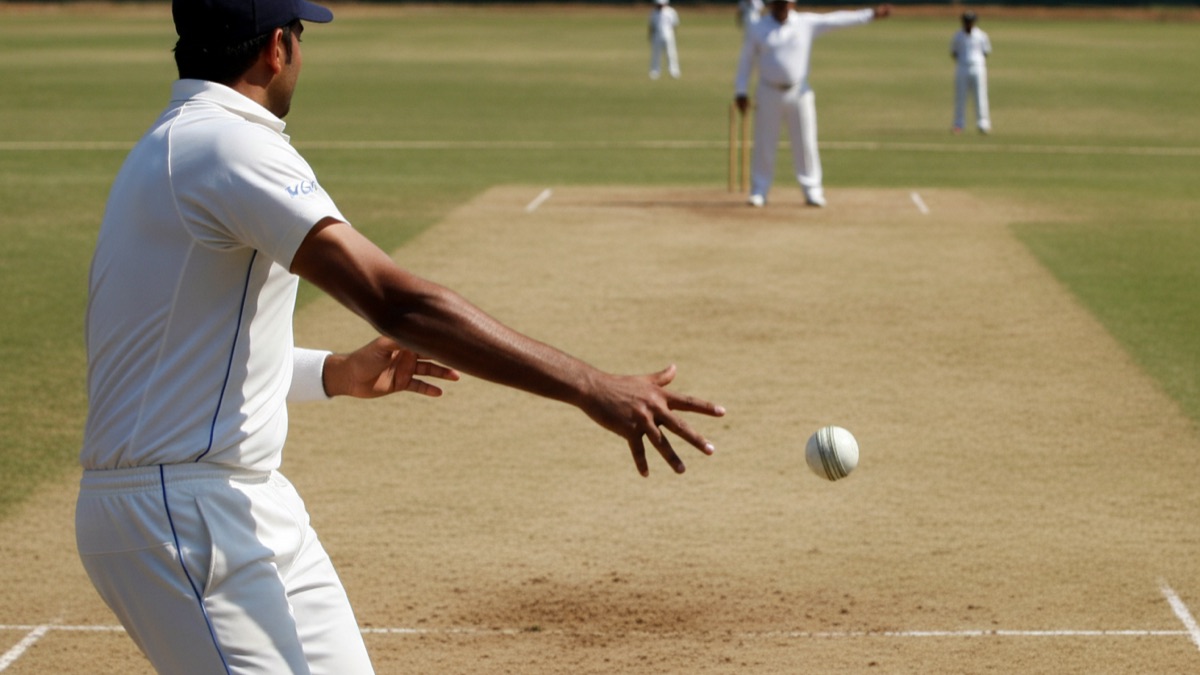
A bowling action in cricket looks, to a casual viewer, like a single fluid motion, yet a specific and precisely measured rule sits underneath it that can end a promising career or force a complete technical rebuild. The rule concerns how much a bowler's elbow is allowed to straighten during the delivery, a distinction invisible to the naked eye but measurable to the degree with modern motion-capture technology. Understanding why this rule exists, how it is enforced, and why some perfectly legal actions look suspicious while some illegal ones look clean, requires understanding both cricket's history and a surprising amount of biomechanics.
What 'Throwing' Actually Means in Cricket
In cricket, the bowling arm must remain essentially straight through the delivery swing, distinguishing bowling from throwing, where the elbow bends and then rapidly straightens to generate extra propulsive force, similar to how a fielder throws the ball back to the wicketkeeper.
The distinction matters because cricket's entire competitive structure assumes bowlers cannot use the arm-whip motion available to throwers, which would allow far greater ball speed and unpredictability than the sport's balance between bat and ball was designed around.
A bowler whose elbow straightens beyond the permitted tolerance during the delivery swing is, by the letter of the law, throwing rather than bowling, regardless of whether the extension was intentional or a product of natural technique.
The 15-Degree Tolerance Explained
Cricket's governing body permits a maximum of 15 degrees of elbow extension between the point the bowling arm reaches shoulder height during the delivery swing and the point the ball is released, a threshold established through biomechanical research rather than an arbitrary number.
This tolerance exists because research demonstrated that even bowlers with actions long considered legitimately straight typically show some degree of elbow extension invisible to the naked eye, meaning a zero-tolerance standard would technically disqualify almost every bowler in the sport.
The 15-degree figure represents the threshold research identified as the point beyond which extension starts generating a meaningful, measurable speed and power advantage over a genuinely straight-arm action, rather than being within the natural variation of human joint movement.
Why the Naked Eye Cannot Judge This Reliably
Human vision simply cannot reliably distinguish a 10-degree elbow extension from a 20-degree one at bowling speed, since the entire delivery swing from the arm reaching shoulder height to ball release happens in a fraction of a second.
This perceptual limitation is precisely why some bowlers with genuinely legal actions have historically faced public suspicion, their bowling arm shape or follow-through creating a visual impression of throwing that biomechanical testing does not support.
Conversely, some actions that look smooth and clean to a television audience or umpire in real time have been measured and found to exceed the legal tolerance, since a compact-looking action can still contain more elbow extension than an action that looks more dramatic.
How Suspect Actions Get Reported
During a match, on-field umpires or the match referee can report a bowler's action if they have concerns, triggering a formal biomechanical assessment process rather than an immediate on-field penalty, since the naked-eye observation alone cannot conclusively establish an illegal action.
Opposing teams, commentators, or a bowler's own board can also raise concerns that lead to testing, though the formal reporting mechanism specifically routes through match officials rather than public commentary alone to keep the process procedurally consistent.
Reporting a bowler's action carries significant weight, since it triggers a testing process that can pause or end a player's international career pending results, which is why the threshold for a formal report is treated seriously rather than raised casually.
The Biomechanical Testing Process
A reported bowler undergoes testing at an accredited biomechanics laboratory, wearing reflective markers on the arm and shoulder while bowling at close to match intensity, allowing motion-capture cameras to calculate the exact degree of elbow extension across multiple deliveries.
Testing typically covers the bowler's full range of deliveries, since elbow extension can vary between a bowler's stock delivery and specialty variations like a faster ball or a particular type of spin delivery, any of which could individually exceed the tolerance even if others don't.
Results are analyzed by biomechanics specialists and reported to the governing cricket body, which determines whether the bowler's action, or specific deliveries within it, exceed the permitted tolerance and require remedial action.
What Happens When a Bowler Is Found Illegal
A bowler whose action is found to exceed the tolerance is typically suspended from bowling that specific delivery type, or from bowling altogether if the entire action is affected, while working with biomechanics and coaching specialists to remodel the action within legal limits.
This is treated as a remediation process rather than a permanent ban in nearly all cases; historically, most bowlers found to have an illegal action have returned to competitive cricket after retesting and demonstrating a corrected action within tolerance.
The remodeling period can take months and often changes a bowler's pace, control, or the shape of specific deliveries, meaning a bowler forced through this process sometimes returns a measurably different bowler than the one who was reported.
Why Some Bowling Actions Are Naturally Deceptive
Certain body types and shoulder configurations produce a bowling action that looks more suspicious than it biomechanically is, particularly bowlers with hyperextensible joints, where the arm can appear to bend or straighten more dramatically than the actual degree of rotation involved.
This natural variation is why biomechanical testing exists in the first place rather than relying on umpire judgment alone; the same underlying physiology that makes some actions look clean can make others look suspect despite both falling within legal tolerance.
Coaches and biomechanists have become more attentive to these individual variations over time, sometimes proactively testing a young bowler with an unusual action before it becomes a public controversy, to establish a documented baseline early in a career.
The History of Chucking Controversies
Cricket has faced high-profile bowling action controversies since at least the mid-20th century, when several prominent bowlers faced public and official scrutiny over actions that observers at the time believed constituted throwing, well before biomechanical testing existed to settle the question objectively.
Before motion-capture technology became available, these disputes were resolved largely through subjective umpire judgment and committee review, a process that generated significant controversy since reputations and careers hinged on visual impressions rather than measurable data.
The introduction of biomechanical testing in the early 2000s was directly motivated by these recurring, often bitter disputes, aiming to replace subjective visual judgment with an objective, defensible standard that could be applied consistently across bowlers and cases.
Spin Bowlers and the Doosra Controversy
A particular delivery in spin bowling, which turns unexpectedly in the opposite direction to a bowler's stock ball, became a focal point of throwing controversies in the 2000s, since generating that specific spin variation seemed to require more wrist and forearm action than other deliveries.
Testing during this period found that several prominent spin bowlers exceeded the legal tolerance specifically on this delivery while remaining within tolerance on their stock ball, illustrating why testing evaluates each delivery type separately rather than assessing a bowler's action as a single uniform motion.
This period significantly shaped how the sport thinks about action testing today, establishing the now-standard practice of testing a bowler's full repertoire of deliveries rather than a single representative ball.
Why Fast Bowlers Face Different Scrutiny
Fast bowlers generate extension differently than spin bowlers, often under greater whole-body force through a longer run-up, which can create genuine strain-related elbow extension that biomechanical testing must distinguish from a deliberately whipped throwing action.
The very high speeds fast bowlers operate at also make visual judgment even less reliable than with slower deliveries, since a delivery arriving at high pace gives spectators and umpires even less time to visually assess the bowling arm's shape during the critical release window.
This combination of factors is part of why fast bowling actions, despite generating fewer historical throwing controversies than certain spin deliveries, still receive close biomechanical monitoring, particularly for bowlers whose action changes noticeably under fatigue late in a long spell.
How Technology Has Changed Enforcement
Modern testing labs use high-speed cameras capturing hundreds of frames per second alongside reflective motion markers, producing three-dimensional models of the bowling arm's movement precise enough to measure elbow angle changes to within a degree or two.
This precision represents a dramatic improvement over the naked-eye and slow-motion video review methods used in earlier decades, which could estimate general extension but lacked the frame rate and marker-based tracking needed for a legally defensible, degree-specific measurement.
Some governing bodies have also explored real-time or near-real-time biomechanical monitoring during actual matches using wearable sensors, though widespread implementation remains limited compared to the controlled laboratory testing that still forms the primary enforcement method.
The Fairness Debate Around Testing
Critics of the current system have raised concerns that laboratory testing, conducted at reduced match intensity in a controlled setting, may not perfectly replicate a bowler's action under full match pressure, fatigue, and adrenaline, potentially producing results that differ from real competitive conditions.
Others have questioned whether the 15-degree tolerance is applied with genuine global consistency, given that testing facilities and biomechanics expertise are concentrated in a handful of countries, raising fairness concerns for bowlers from nations with less testing infrastructure.
These debates continue within the sport's governing bodies, with periodic reviews of both the testing protocol and the tolerance threshold itself, informed by ongoing biomechanical research into what actually constitutes a fair and consistent standard across different bowling styles.
Why the Rule Exists at All
The underlying rationale for restricting elbow extension is competitive balance: a bowler permitted to whip the arm like a thrower could generate significantly more pace and unpredictable movement than the sport's rules for bat dimensions, pitch length, and protective equipment were calibrated around.
Allowing unrestricted throwing would also fundamentally change the physical risk profile for batters facing significantly faster, harder-to-read deliveries, a safety consideration that sits alongside the competitive-fairness rationale for maintaining the restriction.
Preserving the distinction between bowling and throwing is, in this sense, foundational to what makes cricket the specific sport it is; removing the restriction wouldn't just change bowling technique, it would change the fundamental physical contest between bat and ball.
What Young Bowlers and Coaches Can Learn From This
Coaches working with developing bowlers increasingly encourage early biomechanical screening for unusual actions, since identifying a borderline action early in a career allows time for gradual technical correction rather than a disruptive, high-pressure remodel after the bowler has already reached elite competition.
Understanding that natural body variation, not intent to cheat, is the most common cause of a reported action helps reduce the stigma historically attached to being reported, reframing it as a technical correction process rather than an accusation of deliberate wrongdoing.
This shift in framing, from moral judgment toward biomechanical diagnosis, reflects the broader direction cricket's own governance has moved over the past two decades, treating action legality as a measurable technical question rather than a matter of umpire suspicion alone.
How Wristspinners and Fingerspinners Differ
Wrist-spin bowlers, who generate turn primarily through wrist rotation, and finger-spin bowlers, who generate turn through finger and hand position, present different biomechanical profiles to testers, since the two techniques distribute rotational force differently across the wrist, forearm, and elbow.
This distinction matters for testing because a delivery that relies heavily on wrist snap can sometimes create the visual impression of elbow extension even when the actual elbow angle change remains within tolerance, since the wrist and forearm motion draws the eye toward the same general area.
Biomechanists account for these technique-specific patterns when analyzing test results, since a one-size-fits-all visual template for what a 'legal' action looks like doesn't hold up once the different mechanical strategies bowlers use to generate spin or pace are properly understood.
The Role of National Cricket Boards in Testing
Individual national cricket boards typically operate their own accredited testing centers, working under protocols set by the sport's international governing body, which allows bowlers to be tested closer to home rather than requiring international travel for every assessment.
This decentralized structure has occasionally raised the consistency concerns mentioned earlier, since equipment calibration, tester expertise, and testing conditions can vary somewhat between accredited centers in different countries, even under a shared international protocol.
Coordination between national boards and the international governing body aims to standardize these variables over time, with periodic equipment audits and shared training for biomechanics staff intended to keep results comparable regardless of which accredited center conducts a given test.
What Happens During a Bowler's Comeback
A bowler returning from a remodeled action typically undergoes graduated reintroduction to competitive cricket, often starting in domestic matches at a lower level before returning to international competition, allowing coaches to monitor whether the corrected action holds under increasing pressure and fatigue.
Some bowlers find their pace or effectiveness changes noticeably after remodeling, since the biomechanical adjustments required to bring an action within tolerance can alter the timing and power generation the bowler previously relied on, requiring a broader adaptation beyond the elbow itself.
Others return largely unchanged in effectiveness, since the correction needed was sometimes marginal, illustrating that the practical impact of an action remodel varies considerably depending on how far outside tolerance the original action was measured to be.
Why This Rule Rarely Exists in Similar Forms Elsewhere
Few other sports impose a comparably precise, degree-measured biomechanical restriction on a core skill, which makes cricket's throwing rule something of an outlier in how formally codified and scientifically enforced it has become compared to technique rules in most other bat-and-ball or throwing sports.
This is partly a product of cricket's specific history of high-profile disputes creating sustained pressure for an objective solution, and partly a product of the sport's global governing structure being centralized enough to fund and standardize biomechanics testing across member nations.
Other sports facing comparable technique-legality disputes have sometimes looked to cricket's testing model as a template, though replicating it requires the same combination of governing authority, funding, and accredited laboratory infrastructure that took cricket years to establish.
How Broadcasters Now Use Biomechanical Data
Television coverage has increasingly incorporated simplified visualizations of bowling action data, showing viewers approximate arm angles during key moments of a delivery, which has helped build broader public understanding of why the rule exists beyond simply reporting when a bowler has been called.
This visibility has had a secondary effect of reducing some of the public suspicion historically directed at bowlers with naturally unusual actions, since audiences now have some visual reference for how much extension actually falls within legal tolerance rather than judging purely by impression.
Broadcasters generally source this data from the same accredited testing programs used for formal enforcement, meaning the graphics shown during a match are typically drawn from a bowler's prior clearance rather than a live measurement taken during the broadcast itself.
The Practical Difference Between Bowling and Throwing Speeds
Research comparing bowling and throwing actions has found that unrestricted arm-whip throwing can generate meaningfully higher release speeds than a legal bowling action for a given level of athletic effort, which is precisely the competitive advantage the 15-degree tolerance is designed to prevent.
This speed differential is part of why the rule receives such consistent enforcement attention rather than being treated as a minor technical formality; a bowler operating outside the tolerance isn't just bending a rule slightly, they are accessing a genuinely different, more powerful throwing mechanism.
Quantifying this difference through research has also strengthened the sport's justification for the rule during periods of public debate, giving administrators a concrete performance rationale to point to beyond tradition or historical precedent alone.
What This Means for Fans Watching a Match
For a spectator, the practical takeaway is that a bowling action looking unusual, jerky, or even visually alarming on screen is not itself evidence of an illegal delivery, since legality is determined by a specific measured threshold rather than general visual smoothness.
Equally, a bowler with a beautifully fluid-looking action is not automatically legal simply because the motion looks aesthetically clean; some of the more notable enforcement cases in the sport's history involved actions that appeared entirely unremarkable to television audiences at the time.
Understanding this gap between appearance and measurement is useful for any fan trying to make sense of why a particular bowler was reported, or why another bowler with a seemingly odd action has never faced scrutiny at all.
The throwing rule exists because cricket's competitive balance depends on bowlers not having access to the extra power a whipping arm motion would provide, and the 15-degree tolerance exists because biomechanical research showed that some natural elbow extension is unavoidable even in genuinely fair actions. What looks like a straightforward visual judgment call is actually a precisely measured biomechanical threshold, invisible to the naked eye and tested in a laboratory rather than decided by how an action appears in real time. The system isn't perfect, and debates about testing consistency and match-condition fidelity continue, but it replaced decades of subjective, often career-ending disputes with something far closer to an objective, defensible standard.
Sources
- International Cricket Council — Playing Conditions — official regulations on bowling action legality and the elbow extension tolerance
- ESPNcricinfo — Bowling Action Coverage — historical reporting on chucking controversies and biomechanical testing cases
- British Journal of Sports Medicine — peer-reviewed biomechanics research on cricket bowling action analysis
- Cricket Australia — Coaching Resources — technical explainer on bowling biomechanics and action assessment for coaches
FAQ
What is the maximum elbow extension a bowler is allowed?
Cricket's governing body permits up to 15 degrees of elbow extension between the arm reaching shoulder height and ball release, a threshold set through biomechanical research.
Can umpires tell if a bowler is throwing just by watching?
Not reliably. The delivery happens too fast for the naked eye to distinguish legal extension from illegal extension, which is why suspect actions are referred for laboratory biomechanical testing.
What happens if a bowler's action is found illegal?
The bowler is typically suspended from bowling that delivery, or bowling entirely if the whole action is affected, and works with coaches to remodel the action within legal limits before being retested.
Why do some legal bowling actions look suspicious?
Natural variation in joint flexibility and body shape can make a legal action look visually similar to throwing, which is exactly why the sport relies on measured testing rather than visual judgment alone.
Is being reported for a suspect action a permanent ban?
No — in the large majority of cases it triggers a remediation and retesting process, and most bowlers found to have an illegal action return to competitive cricket after correcting it.
About the Author
We reference International Cricket Council — Playing Conditions, ESPNcricinfo — Bowling Action Coverage, British Journal of Sports Medicine, and Cricket Australia — Coaching Resources to explain the background and current understanding of this topic.
Loved This Article?
Share it on WhatsApp → Share it on WhatsApp
Get more guides in your inbox — Subscribe to our newsletter for weekly surprising stories from Egypt, Saudi Arabia, Dubai, and beyond.