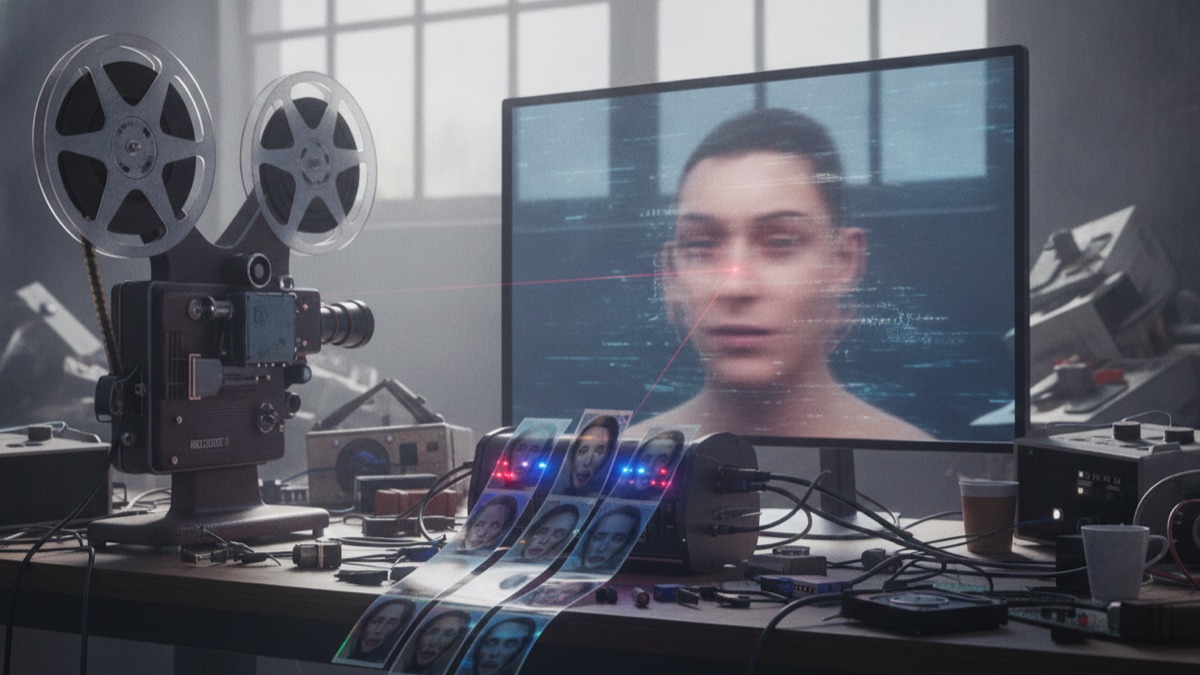
Every few months a new deepfake detection tool is announced with an impressive accuracy number, and every few months a new generation technique quietly makes that number irrelevant. This is not a coincidence or a temporary lag that better engineering will eventually close. It is baked into how the two sides of this contest are built. A generator only has to find one pattern a detector has not learned to flag; a detector has to anticipate every pattern a generator might someday produce. Understanding why that asymmetry exists helps explain why so many detection claims collapse the moment they meet real-world video instead of a clean laboratory dataset.
What a Deepfake Actually Is Under the Hood
A deepfake is the output of a generative model, usually a variant of a generative adversarial network or a diffusion model, trained to reproduce a face, voice, or full body in ways that were never actually recorded. The model does not copy pixels from a source clip; it learns a compressed statistical representation of how a face moves, blinks, and reacts, then renders new frames consistent with that representation.
Because the output is generated rather than copied, there is no original file to compare it against and no watermark baked into the pixels by default. Every frame is synthesized fresh, which means any inconsistency a detector might look for has to be inferred from the generated content itself rather than found by comparing it to something known to be authentic.
This generative-not-copied nature is the root of the whole problem. Traditional forensics — tampering detection, copy-move analysis, clone-stamp artifacts — assumes a real image was edited. Deepfakes are not edited; they are manufactured whole, so the entire toolkit built for detecting Photoshop-era manipulation only partially applies.
Why Generators Have a Structural Head Start
A deepfake generator can be trained and tested against detectors before it is ever released publicly. Researchers building generation techniques routinely run their own output through the leading detection tools of the day and adjust the model until it passes. The detector's own decision boundary becomes a training signal for the generator.
A detector cannot do the reverse nearly as easily. It cannot be trained against generation techniques that do not exist yet, and by the time a new generator is public enough to study, its outputs are already circulating. The detector is always reacting to a technique that has already had a head start in the wild.
This is why detection accuracy on last year's generation method can look excellent while accuracy on this year's method quietly falls off a cliff. The detector was never actually solving deepfakes in general; it was solving the specific generation artifacts it happened to be trained on.
The Training Data Problem
Detectors are usually trained as classifiers: shown labeled examples of real and fake video and asked to learn the difference. That means a detector's usefulness is capped by how recent and how diverse its labeled fake examples are.
Building a labeled dataset takes real time — generating thousands of fake samples across different generation methods, verifying authenticity of the real samples, and curating a balanced set. By the time that dataset is assembled and a model is trained on it, newer generation techniques have often already shipped, meaning the detector is trained on a snapshot of a technology that has already moved on.
Some research groups try to solve this by generating synthetic training data for detectors as fast as new generation papers appear, but this still means the detector's knowledge is bounded by whatever technique was public at training time, not whatever technique a bad actor is running today.
Why Lab Accuracy Doesn't Survive Contact With Social Media
A detector reporting ninety-plus percent accuracy in a published paper is almost always tested on clean, high-resolution video from a benchmark dataset. Real deepfakes circulating online rarely arrive in that condition.
Video shared on social platforms is re-encoded, compressed, resized, and sometimes re-recorded off a screen before it reaches a viewer. Each of those steps destroys or scrambles the exact statistical artifacts a detector was trained to notice, because compression and resizing introduce their own noise that can either mask a real artifact or mimic one that isn't there.
This is why independent audits of deployed detection tools against real, in-the-wild flagged content consistently show far lower accuracy than the tool's published benchmark. The gap is not fraud on the part of researchers; it reflects a genuine difference between a controlled test set and the messy pipeline video actually travels through before a person sees it.
Provenance as a Different Kind of Answer
Because after-the-fact detection is structurally reactive, a growing part of the field has shifted toward provenance instead: proving where a piece of media came from rather than trying to spot signs that it was faked.
The Coalition for Content Provenance and Authenticity, known as C2PA, is the most prominent effort here. It defines a standard for cryptographically signed metadata that travels with an image or video from the moment it is captured, recording the device, any edits made, and by whom, so a viewer can check a verifiable chain of custody rather than guess from the pixels.
Camera manufacturers and some major platforms have begun adopting this standard, but it only helps for content that was signed at capture. It does nothing for the billions of images and videos that already exist without that metadata, and it can be stripped by any platform or tool that doesn't preserve it, so provenance is a complement to detection, not a replacement for it.
The Voice Cloning Version of the Same Problem
Audio deepfakes follow the identical arms-race pattern, often with an even shorter lead time. Cloning a convincing voice used to require minutes of clean recorded speech; newer systems can produce a usable clone from a few seconds of audio, shrinking the amount of source material an attacker needs.
Audio detectors face the same training-data lag as video detectors: they are built on labeled examples of known cloning techniques and struggle against a method released after the detector shipped. Phone calls add another layer of compression and bandwidth limiting on top of that, further degrading the subtle artifacts a detector might otherwise catch.
This is part of why organizations increasingly recommend a verification step outside the audio channel entirely — a callback to a known number, a pre-agreed verification phrase — rather than relying on a listener's or a detector's ability to tell a cloned voice from a real one.
Why Detector Companies Rarely Publish Full Failure Rates
Commercial detection tools have a business incentive to report their strongest numbers, typically drawn from the benchmark conditions described earlier rather than adversarial, real-world tests.
Independent academic evaluations that pit multiple commercial detectors against fresh, unseen generation techniques and realistically compressed video tend to be published far less often than vendor marketing material, partly because running such an evaluation is expensive and partly because the results are less flattering to publish widely.
This asymmetry in what gets publicized adds to the perception gap: the public sees confident accuracy claims, while the harder truth — that detection accuracy on genuinely novel or degraded content is meaningfully lower — is documented mostly in specialist literature.
The Cat-and-Mouse Loop, Concretely
Once a detection technique becomes well known — say, a method that flags unnatural blinking patterns or inconsistent lighting on the eyes — generation researchers can specifically train their models to correct exactly that flaw, since it is now a known, documented weakness.
This has happened repeatedly: early deepfakes struggled with realistic blinking, and that specific tell was fixed within a generation or two once it became a widely cited detection signal. The same pattern has played out with hand rendering, teeth detail, and audio-lip synchronization.
Each fixed tell removes one tool from the detector's kit without adding anything back, which is why the list of reliable visual tells for a careful observer has shrunk steadily rather than grown over the past several years of generation model development.
What Actually Slows Down Malicious Use in Practice
Given the structural disadvantage of pixel-level detection, most of the practical progress against harmful deepfakes has come from measures that do not rely on spotting the fake at all.
Platform-level context signals — an account's history, unusual distribution patterns, coordinated posting behavior — can flag suspicious content even when the media itself passes technical detection, because manipulation campaigns tend to leave behavioral fingerprints separate from the video itself.
Media literacy and verification habits at the point of consumption, such as checking whether a claim is being reported by any established outlet before sharing, remain more reliable in practice than trusting a green checkmark from an automated detector, since the detector's confidence does not track the actual difficulty of the specific fake in front of it.
Why Regulation Has Focused on Disclosure, Not Detection
Recognizing that technical detection cannot be guaranteed to keep pace, several jurisdictions have moved toward rules requiring disclosure of synthetic media rather than rules assuming platforms can reliably catch it.
Political advertising rules in a number of countries now require labeling of AI-generated or AI-altered content, shifting the obligation onto the creator or distributor to disclose rather than onto a detector to discover.
This approach acknowledges the arms-race dynamic directly: rather than betting on detection technology winning a race it is structurally likely to keep losing, disclosure rules try to change the incentives around producing undisclosed synthetic media in the first place.
The Watermarking Approach and Its Limits
A parallel idea to provenance metadata is embedding an invisible watermark directly into a generative model's output, so any image the model produces carries a detectable signature even after some editing.
Several major AI labs have shipped watermarking systems along these lines, and in ideal conditions they can be detected reliably. Independent researchers have shown, however, that watermarks embedded this way can often be removed or weakened through common transformations like cropping, recompression, or adding noise, without visibly damaging the image.
Because watermarking only works if every generator adopts it and no removal tool becomes widely available, it functions best as one layer among several rather than a definitive fix, similar to provenance metadata's dependence on universal adoption.
Why the Financial Incentive Structure Doesn't Help Detectors
Building a state-of-the-art generative model has become commercially valuable — for entertainment, advertising, dubbing, and other legitimate uses — which has funneled significant research investment into making generation better, faster, and more accessible.
Detection, by contrast, has a much smaller commercial market: it is mostly bought by platforms, newsrooms, and security teams rather than by a broad consumer base willing to pay for it, meaning the pool of money and talent flowing into detection research is structurally smaller than the pool flowing into generation.
This funding imbalance compounds the technical asymmetry already described: even if detection were not structurally reactive by nature, it would still be under-resourced relative to the technology it is trying to keep up with.
What a Realistic Timeline Looks Like
Researchers in this field are generally candid that a permanent, general-purpose deepfake detector — one that reliably catches any future generation technique without retraining — is not something current approaches can deliver, because detection is fundamentally a response to a known technique rather than a general solution.
The more realistic goal being pursued is a layered system: provenance metadata for content that supports it, watermarking as an additional signal, behavioral and distribution analysis at the platform level, and disclosure requirements backed by real penalties, with pixel-level detection treated as one weaker signal among several rather than the primary line of defense.
This shift in framing — from 'build a detector that wins' to 'build a system where no single layer has to win alone' — is itself an acknowledgment that the original arms race, fought purely on the pixel level, was not one detection could realistically win outright.
Why Live Video Calls Are an Even Harder Case
Detecting a manipulated pre-recorded clip is difficult enough, but a real-time deepfake overlaid onto a live video call removes an option available in the recorded case: there is no file to send to a slower, more thorough analysis tool, because the call is happening now and any decision has to be made within the conversation itself.
Live deepfake tools work by processing a webcam feed frame by frame and swapping the face in real time, which introduces its own artifacts — slight delays, occasional frame drops, edges that shimmer under fast head movement — but these artifacts are far more likely to be dismissed by a viewer as ordinary video-call lag than as evidence of manipulation.
This is part of why corporate security guidance increasingly recommends a secondary channel for any high-stakes request made over video or voice call, such as a wire transfer authorization, rather than trusting the call itself: a small number of real incidents involving cloned executive voices and faces on calls have already resulted in fraudulent transfers, precisely because the live setting removes the option to pause and run forensic analysis before acting.
How Legal Frameworks Differ Across Regions
Because detection cannot be relied upon as a backstop, lawmakers in different regions have taken different approaches to what is actually prohibited, rather than trying to mandate a detection standard that current technology cannot reliably meet.
Some jurisdictions have focused narrowly on specific harms — non-consensual intimate imagery, impersonation of a candidate close to an election, fraud committed using synthetic voice or video — rather than attempting to regulate synthetic media as a category, since a blanket ban would also sweep in legitimate uses like dubbing, satire, and special effects.
Other regions have leaned more on mandatory labeling requirements for AI-generated political content specifically, on the theory that disclosure obligations are easier to enforce consistently than any technical detection mandate would be, given that detection accuracy itself cannot currently be guaranteed by regulation.
What Newsrooms Actually Do Differently
Professional fact-checking teams generally do not rely primarily on automated detection tools when verifying a suspicious video, precisely because they are aware of how unreliable those tools are on real-world content; instead they treat the tool's output as one input among several.
Standard newsroom verification instead leans on triangulation: checking whether the same footage appears from multiple independent camera angles or sources, verifying the claimed location against visible landmarks or weather conditions, and checking whether the account that first posted the video has a plausible reason to have been present.
This human-led, context-heavy process is slower than running a video through a detection tool, but it is also the reason professional verification teams catch fabricated video that automated tools miss — the strongest signals usually live in the surrounding context of who posted what, when, and from where, not in the pixels of the video itself.
The Cost of False Positives, Not Just Missed Fakes
Discussion of detection failure usually focuses on missed fakes, but the opposite error carries its own damage: a detector wrongly flagging genuine footage as synthetic, which can hand a real wrongdoer a ready-made excuse to dismiss authentic evidence as fabricated.
This dynamic already has a name among researchers studying misinformation — sometimes called the liar's dividend — where the mere existence of convincing synthetic media makes it easier for someone caught on a real recording to claim, plausibly to at least some audience, that the recording itself must be fake.
A detector with a non-trivial false-positive rate makes this strategy easier to run, because the accused can point to the tool's own uncertainty as cover, which is one more reason serious verification work leans on corroborating context rather than a single tool's binary yes-or-no output.
The gap between deepfake creation and deepfake detection is not a temporary engineering problem waiting for a clever breakthrough; it is a structural feature of how the two technologies relate to each other. Generators can test themselves against detectors before release, detectors can only be trained on techniques that already exist, and real-world compression destroys the subtle signals detectors rely on. That is why the field has increasingly shifted its energy toward provenance, watermarking, disclosure rules, and platform-level behavioral signals rather than betting everything on a single, ever-improving detector. For anyone consuming media day to day, the safest posture is treating detection tools as one weak signal among several rather than a verdict, and falling back on the same habit that has always protected careful readers: checking whether a surprising claim is corroborated before believing or sharing it.
Sources
- Coalition for Content Provenance and Authenticity (C2PA) — the technical standard for cryptographically signed content provenance metadata
- National Institute of Standards and Technology — publishes evaluation frameworks for media forensics and deepfake detection benchmarks
- Wikipedia: Deepfake — background on generative techniques and the history of detection countermeasures
- Partnership on AI — industry coalition research on synthetic media disclosure and provenance practices
FAQ
Can any app reliably detect a deepfake today?
No single app can reliably catch every deepfake, because detectors are trained on past generation techniques and lose accuracy quickly against newer methods or heavily compressed social media video. They can still catch older or low-effort fakes, but should be treated as one weak signal, not a verdict.
Why can't researchers just train detectors on every new technique as it appears?
By the time a new generation technique is public enough to study and build a labeled training set around, its outputs are usually already circulating. The detector is structurally always reacting to something that already had a head start.
What is C2PA and does it solve the problem?
C2PA is a standard for cryptographically signed metadata that records where a piece of media came from and what was edited. It helps for content signed at capture by a supporting device or platform, but does nothing for existing unsigned content and can be stripped if not preserved end to end.
Why do lab accuracy numbers not match real-world performance?
Lab benchmarks typically use clean, uncompressed video. Real content shared on social media is re-encoded, resized, and sometimes re-recorded off a screen, which destroys or distorts the exact artifacts detectors were trained to notice.
What actually helps protect against being fooled by a deepfake?
Corroboration habits matter more than any single tool: checking whether a surprising or emotionally charged video is reported by an established outlet before sharing it, and for high-stakes situations like a suspicious phone call, verifying through a separate known channel rather than trusting the audio alone.
About the Author
We reference Coalition for Content Provenance and Authenticity (C2PA), National Institute of Standards and Technology, Wikipedia: Deepfake, and Partnership on AI to explain the background and current understanding of this topic.
Loved This Article?
Share it on WhatsApp → Share it on WhatsApp
Get more guides in your inbox — Subscribe to our newsletter for weekly surprising stories from Egypt, Saudi Arabia, Dubai, and beyond.