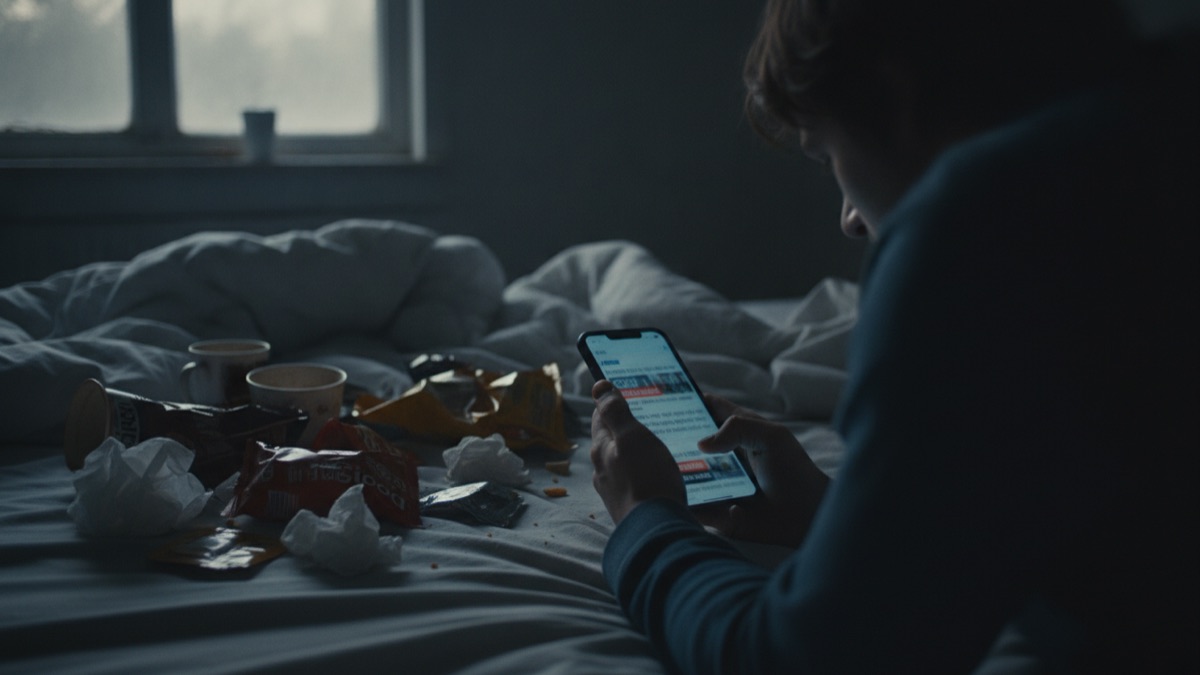
Almost everyone who scrolls a news or social feed late at night recognizes the feeling: the content is making them anxious, they know it, and they keep scrolling anyway. This is not a personal failing or a simple lack of self-control, even though it is often described that way. It is the predictable result of two things intersecting — a feed engineered around variable rewards, and a nervous system that evolved to prioritize threat-related information above almost everything else. Understanding the actual mechanics behind doomscrolling explains why willpower-based advice so consistently fails, and what kind of intervention tends to work instead.
What Doomscrolling Actually Means, Precisely
Doomscrolling refers specifically to the compulsive consumption of negative news or distressing content well past the point of being informed, distinguished from ordinary news-checking by the compulsive quality of the behavior and the fact that it continues even as the person consciously notices it is making them feel worse.
This distinction matters because checking the news to stay informed is a healthy, bounded behavior with a natural stopping point once the relevant facts are known, while doomscrolling has no natural stopping point built into the activity itself, since the feed is designed to always offer one more item.
Researchers studying this behavior generally define it by outcome rather than by content alone: the same article read once for genuine information differs meaningfully from the same article read repeatedly, alongside dozens of similar ones, in a spiral that leaves the reader feeling worse than before they started.
The Variable Reward Schedule Behind Every Feed
Modern social and news feeds are built on infinite scroll combined with a ranking algorithm that surfaces unpredictable content, a structure that closely resembles a variable-ratio reward schedule, the same reinforcement pattern known from behavioral psychology to produce the most persistent, hardest-to-extinguish behavior of any reward pattern studied.
Unlike a fixed reward, where a person knows exactly what they will get and when, a variable reward keeps the brain's dopamine-driven anticipation system engaged precisely because the next scroll might surface something unusually interesting, upsetting, or validating, and there is no way to know in advance which scroll will deliver that hit.
This is the same underlying mechanism that makes slot machines and other games of chance so difficult to walk away from, and it operates on the scrolling behavior itself rather than on the specific content, which is part of why doomscrolling can persist even when a person consciously dislikes most of what they are seeing.
Why Negative Content Grabs Attention More Than Positive Content
Human attention carries a well-documented negativity bias, an evolved tendency to notice, remember, and prioritize threatening or negative information over neutral or positive information, because in an ancestral environment, missing a threat was far more costly than missing a reward.
This bias operates automatically and below the level of conscious choice, meaning a person does not decide to find bad news more compelling; the attentional system is already tuned that way before conscious evaluation even begins, which is why negative headlines reliably outperform neutral or positive ones in engagement metrics across virtually every platform studied.
Feed-ranking algorithms optimize for engagement, and because negativity bias makes distressing content reliably more engaging on average, algorithms trained on real user behavior tend to amplify exactly the kind of content most likely to trigger a doomscrolling spiral, not because anyone designed it maliciously but because it is what the optimization target rewards.
The Cortisol Feedback Loop That Keeps the Cycle Going
Consuming distressing content triggers the body's stress response, releasing cortisol and adrenaline as if responding to an immediate physical threat, even though the actual threat depicted in a news story is usually distant, abstract, or something the reader has no direct ability to influence.
Elevated cortisol sharpens attention and vigilance in the short term, which paradoxically makes it easier to keep scrolling and processing more distressing content rather than easier to stop, since the body is now in a heightened state specifically tuned to keep monitoring for additional threat information.
Over an extended scrolling session, this creates a self-reinforcing loop: each distressing piece of content triggers a stress response that increases vigilance, which increases the pull toward the next piece of content, extending the session well past the point where any new, useful information is actually being gained.
Why This Differs From Ordinary Information-Seeking
Genuine information-seeking behavior is generally goal-directed and self-limiting: a person checks a specific update, confirms the fact they were looking for, and stops, because the underlying uncertainty that motivated the search has been resolved.
Doomscrolling, by contrast, often continues even after the relevant facts are already known, because the activity has shifted from information-seeking to a self-soothing or anxiety-management behavior that, counterintuitively, tends to increase rather than decrease the anxiety it was ostensibly meant to address.
This is part of why some psychologists distinguish doomscrolling from healthy vigilance during a genuine, actionable crisis, where checking for specific, relevant updates serves a real coordinating function, from doomscrolling during a period with no new actionable information, where the same behavior serves no such function and mainly compounds distress.
Why Uncertainty Specifically Fuels the Behavior
Doomscrolling tends to intensify during periods of high collective uncertainty — a natural disaster, a public health crisis, an unfolding conflict — because the human mind is strongly motivated to reduce uncertainty, and a feed constantly promises the next piece of information that might finally resolve it.
The problem is that during a genuinely unfolding, uncertain situation, no single piece of content can actually deliver full resolution, since the situation itself has not resolved, which means the search for certainty through scrolling is structurally unable to succeed even as it strongly feels like the next update might be the one that finally does.
This mismatch between what scrolling promises and what it can actually deliver during genuine uncertainty is a major reason doomscrolling sessions during a crisis tend to be both longer and more distressing than doomscrolling during calmer periods, when there is comparatively less unresolved uncertainty driving the search.
The Sleep Disruption Connection
Doomscrolling disproportionately happens at night, partly because bedtime is one of the few extended, unstructured periods many people have for uninterrupted phone use, and partly because a racing, threat-activated mind is itself a barrier to falling asleep, creating a loop where anxiety delays sleep and delayed sleep, in turn, worsens next-day anxiety.
Screen exposure itself also delays the release of melatonin, the hormone that helps regulate sleep onset, adding a physiological barrier on top of the purely psychological one created by consuming distressing content right before attempting to sleep.
This combination is why sleep researchers specifically flag doomscrolling, rather than screen use in general, as a particularly disruptive nighttime habit, since it combines the light-exposure problem common to all screen use with an additional stress-activation problem specific to the emotional content being consumed.
Why Willpower-Based Advice Tends to Fail
Advice framed purely around self-discipline — simply deciding to stop, or telling oneself to put the phone down — tends to fail because it treats doomscrolling as an isolated choice rather than as the output of a system deliberately engineered to make continuing the more attention-grabbing option at every single decision point.
Behavioral research on habit change consistently finds that removing or reducing the cues that trigger a behavior works far better than relying on in-the-moment willpower to resist a behavior once its cues are already present and its reward loop is already engaged.
This is why interventions that succeed tend to change the environment — the phone's physical location, the specific apps installed, the notification settings — rather than relying on the person to consciously out-argue an engagement system that was professionally designed and continuously refined specifically to win that argument.
Friction-Based Interventions That Actually Show Results
Adding physical friction between the urge to scroll and the ability to act on it — charging a phone in another room overnight, using grayscale display mode which reduces the visual reward of colorful content, or removing a specific app rather than merely muting its notifications — has shown measurably better results in behavior-change studies than intention-based approaches alone.
Friction works because it interrupts the automatic, low-effort nature of the habit loop at the exact moment the urge appears, forcing a brief pause during which the more deliberate, reflective part of the mind has a chance to weigh in before the automatic behavior takes over completely.
This is also why simply knowing about negativity bias and variable reward schedules, while useful for understanding the problem, rarely changes behavior on its own; the friction has to be built into the environment itself, because relying on remembering that knowledge in the exact moment of temptation is asking the least reliable part of the system to do the heaviest lifting.
Setting Specific Times Rather Than General Limits
Behavior-change research on habit formation consistently finds that specific, scheduled behaviors are far easier to sustain than vague intentions to 'scroll less,' because a scheduled check has a clear beginning and end, while an open-ended intention leaves the actual stopping point to be negotiated anew every single time.
Designating a specific, bounded window for checking news or social feeds — for example, once in the morning and once in the early evening, each for a fixed duration — gives the behavior the goal-directed, self-limiting quality of healthy information-seeking described earlier, rather than the open-ended quality that makes doomscrolling so hard to end.
This approach also reduces the total number of decision points at which the urge to check has to be resisted, since outside the designated window the behavior is simply not on the table as an active decision, which removes a significant amount of the willpower burden compared to trying to resist the urge continuously throughout the day.
Why Curating What Feeds You Follow Matters More Than People Expect
Because algorithmic ranking amplifies whatever content reliably captures engagement, and negative content reliably captures more engagement on average, an unmanaged feed drifts toward more distressing content over time purely as a byproduct of the ranking system responding to aggregate behavior, not because of any conscious choice by the individual user.
Actively curating followed accounts, muting specific keywords, and periodically resetting a feed's algorithmic profile by deliberately engaging with calmer, more constructive content can meaningfully shift what the algorithm learns to surface, since these systems are responsive to genuine behavioral signals over time rather than fixed in place.
This curation work requires deliberate, sustained effort precisely because the default trajectory of an unmanaged feed pulls in the opposite direction, toward more engagement-maximizing and therefore more distressing content, which is why periodic, intentional feed maintenance is now recommended by several digital wellbeing researchers as a standard practice rather than an occasional fix.
The Difference Between Staying Informed and Staying Anxious
Genuine engagement with current events generally involves processing information deeply enough to form an opinion, take an action, or have a meaningful conversation about it, while doomscrolling typically involves shallow, rapid consumption of many similar items without processing any single one deeply enough to reach that point.
This distinction gives a useful practical test: after a scrolling session, a person who was genuinely staying informed can usually summarize what they learned in a few clear sentences, while a person who was doomscrolling often struggles to articulate anything beyond a diffuse, generalized sense of dread accumulated across dozens of half-read items.
Framing the goal as depth of engagement with a smaller amount of information, rather than breadth of exposure to as much content as possible, tends to produce both better-informed opinions and less accumulated anxiety, since the underlying cognitive process of forming an actual understanding is fundamentally different from the process of passive, high-volume scrolling.
When Doomscrolling Signals Something Beyond a Habit
For most people, doomscrolling is a habit shaped by feed design and negativity bias rather than a sign of an underlying mental health condition, and it responds well to the environmental and friction-based interventions described throughout this piece.
For some people, though, persistent doomscrolling that significantly interferes with sleep, work, or relationships, or that occurs alongside other symptoms of anxiety or depression, can be one visible piece of a larger clinical picture that benefits from professional support rather than self-directed habit change alone.
The practical distinction is functional impact: occasional doomscrolling that a person can interrupt with the strategies described here is different from a pattern that persists despite genuine attempts to change it and that is accompanied by broader difficulty functioning, which is a reasonable signal to seek support beyond habit-level fixes.
What Platforms Themselves Have Started Doing
Some major platforms have introduced features like scrollable content warnings, time-spent reminders, and options to see less of a specific content category, acknowledging at a design level that unmanaged engagement optimization can produce outcomes users themselves report regretting.
These built-in tools are generally opt-in and easy to ignore, which limits their real-world impact compared to a default behavior change, but they represent one of the few levers available at the platform level rather than the individual level, and their existence is itself an acknowledgment that the underlying mechanics described throughout this piece are well understood by the platforms operating them.
Digital wellbeing researchers generally view these features as a useful but insufficient response, arguing that the core incentive structure behind engagement-optimized ranking remains unchanged even as opt-in wellbeing tools are added around its edges, which is why individual-level friction and curation strategies remain the more reliable lever available to most people today.
A Realistic Standard for Change, Not a Perfect One
Given that doomscrolling is the predictable output of a system deliberately engineered around variable rewards and negativity bias, expecting to eliminate the behavior entirely through willpower alone sets an unrealistic standard that tends to produce discouragement rather than durable change when it inevitably fails on a bad day.
A more realistic and evidence-aligned goal is reducing both the frequency and the depth of doomscrolling episodes through the environmental changes described throughout this piece — friction, scheduled windows, active curation — while accepting that an occasional lapse reflects the strength of the underlying system rather than a personal failure.
This reframing matters practically because people who treat an occasional lapse as proof that the whole effort has failed are far more likely to abandon the environmental changes that were actually working, compared to people who treat a lapse as expected friction in an ongoing process against a genuinely well-engineered system.
Why Group Chats and Comment Sections Add Another Layer
Doomscrolling rarely happens in a purely solitary information vacuum; group chats, comment threads, and reply sections add a social dimension where distressing content is amplified further by visible reactions, arguments, and the sense that everyone else is also watching the same unfolding situation in real time.
This social amplification can make stepping away feel like missing an important shared moment, a fear of social disconnection that operates alongside, and independently of, the negativity bias and variable reward mechanisms already described, adding yet another pull toward continuing rather than stopping.
Recognizing this social layer as distinct from the algorithmic and psychological mechanisms already covered matters because the friction-based interventions that work well against a passive feed sometimes need a companion step, such as muting a specific group chat during a bounded window, to be fully effective.
What Actually Happens in the Brain During a Long Session
Neuroimaging research on sustained screen engagement shows activity patterns in reward-processing regions that closely resemble those seen during other compulsive behaviors, with repeated engagement gradually requiring more novel or intense stimuli to produce the same level of engagement, a pattern researchers describe as a mild habituation effect.
This habituation helps explain why doomscrolling sessions often escalate in intensity over time within a single sitting, moving from mildly concerning headlines toward increasingly distressing content, since content that felt sufficiently engaging at the start of a session may no longer hold attention as strongly twenty minutes later.
Understanding this escalating pattern is part of why scheduled, time-boxed checking works better than an open-ended session with no predetermined endpoint: a fixed time limit interrupts the escalation before it reaches its most distressing, least productive phase.
Building a Personal Off-Ramp Rather Than a Ban
Total, permanent avoidance of news and social feeds is neither realistic nor necessarily desirable for most people, since staying reasonably informed carries genuine value, which is why the most durable approach tends to be a designed off-ramp — a clear, repeatable cue that signals a session is ending — rather than an outright ban that eventually gets abandoned.
A simple, concrete off-ramp, such as reading one specific summary source and then closing the app, or setting a timer that ends the session regardless of what is currently on screen, gives the habit-forming part of the brain a consistent signal to associate with stopping, which an open-ended 'I'll stop when I feel done' intention cannot provide.
Over repeated use, this consistent off-ramp cue itself becomes a habit, gradually making the ending of a session feel as automatic as its beginning currently does, which is the ultimate practical goal of every intervention described throughout this piece.
Doomscrolling persists not because people lack self-control but because it sits at the intersection of two powerful, well-documented forces: a variable reward schedule that keeps the brain's anticipation system engaged regardless of content, and a negativity bias that makes distressing information reliably more attention-grabbing than reassuring information. Feed-ranking algorithms optimized for engagement amplify exactly the content this combination makes hardest to look away from, which is why the behavior feels compulsive rather than freely chosen. The interventions with real evidence behind them work by changing the environment rather than relying on in-the-moment willpower — adding friction between urge and action, scheduling specific bounded windows for checking feeds, and actively curating what a feed is allowed to show over time. None of this requires eliminating the behavior entirely or treating an occasional lapse as failure; it means building a system around a well-understood, deliberately engineered pull, rather than fighting that pull head-on every single time it appears.
Sources
- Wikipedia: Negativity bias — background on the evolved attentional bias toward negative and threatening information
- American Psychological Association: Technology use guidance — psychological research on compulsive digital media use and wellbeing
- Wikipedia: Variable-ratio reinforcement schedules — the behavioral psychology mechanism underlying infinite-scroll feed design
- Sleep Foundation — research on screen use, melatonin suppression, and nighttime anxiety-driven scrolling
FAQ
Is doomscrolling a sign of weak willpower?
No. It results from feeds engineered around variable rewards and human negativity bias, a combination behavioral research shows produces persistent, hard-to-resist behavior in almost anyone, not a personal character flaw.
Why does doomscrolling happen more at night?
Bedtime is often the least structured period for phone use, and screen exposure delays melatonin release while distressing content activates a stress response, both of which interfere with falling asleep and extend the scrolling session.
Does knowing about negativity bias help you stop?
Rarely on its own. Understanding the mechanism helps explain the pull, but lasting change comes from environmental interventions — friction, scheduled windows, active feed curation — rather than relying on willpower in the exact moment of temptation.
What's the difference between staying informed and doomscrolling?
Staying informed is goal-directed and self-limiting: you check a specific update and stop once you know it. Doomscrolling continues past that point into shallow, repetitive consumption that leaves you feeling worse without adding meaningful new understanding.
When should doomscrolling be treated as more than a habit?
If it persistently interferes with sleep, work, or relationships, or occurs alongside other symptoms of anxiety or depression, and doesn't respond to genuine attempts at environmental change, it may be part of a larger picture worth discussing with a mental health professional.
About the Author
We reference Wikipedia: Negativity bias, American Psychological Association: Technology use guidance, Wikipedia: Variable-ratio reinforcement schedules, and Sleep Foundation to explain the background and current understanding of this topic.
Loved This Article?
Share it on WhatsApp → Share it on WhatsApp
Get more guides in your inbox — Subscribe to our newsletter for weekly surprising stories from Egypt, Saudi Arabia, Dubai, and beyond.