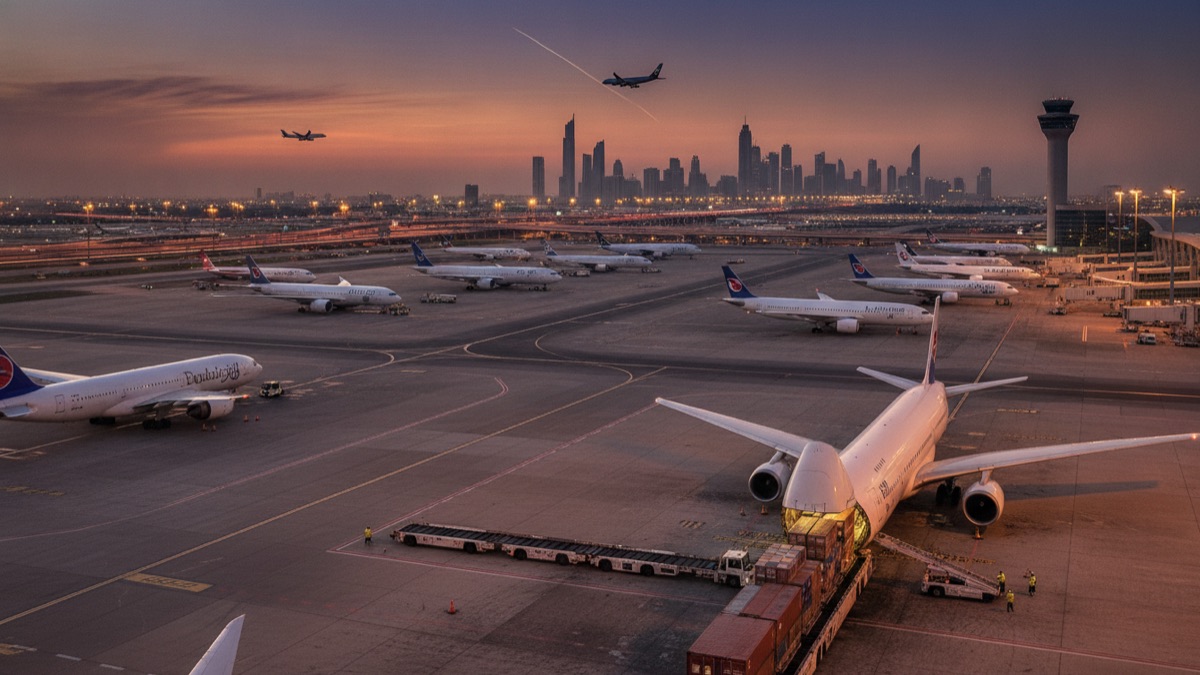
A passenger flying from Manila to São Paulo, or from Johannesburg to Manchester, is statistically quite likely to pass through Dubai without ever intending to visit the emirate at all. That accident of geography, engineered deliberately into a national strategy over five decades, is the foundation of how a city with no domestic aviation market of its own became one of the busiest international connecting points on Earth. Understanding why Dubai became a global aviation hub means understanding a coordinated bet across geography, government policy, airline strategy, and airport infrastructure, all pointed at the same goal for decades rather than any single lucky break.
A Connecting Point Most Passengers Never Meant to Visit
Unlike aviation hubs that grew primarily to serve a large domestic population, such as major American or Chinese airports, Dubai's aviation hub developed around international transfer traffic almost entirely, passengers boarding one long-haul flight, landing in Dubai, and boarding another long-haul flight to a completely different continent within hours.
This transfer-heavy model means a significant share of the millions of passengers moving through Dubai's airports each year never formally enter the country at all, spending their entire visit within the airport's transit areas before continuing to their actual destination.
The Geography That Started It All
Dubai's location places it within roughly an eight-hour flight of a very large share of the world's population, sitting almost equidistant between major population centers in Western Europe, South and East Asia, and East Africa in a way that few other major cities can match.
This geographic position means a single-stop connection through Dubai can link city pairs that would otherwise require considerably more circuitous routing or multiple connections through other hubs, a structural advantage that predates any policy decision but that Dubai's planners recognized early and built an entire aviation strategy around exploiting.
Dubai Had No Domestic Market to Fall Back On
Unlike hub airports built primarily to serve large domestic populations, Dubai and the wider UAE had a comparatively small resident population when its aviation strategy began taking shape, meaning there was no meaningful domestic traffic base to build an airline or airport around.
This absence of a domestic fallback market, which might elsewhere be seen as a disadvantage, instead pushed Dubai's aviation planners toward an international transfer-focused model from the very beginning, since international connecting traffic was effectively the only viable path to building a large-scale aviation business at all.
Founding Emirates as a Hub-Building Tool
Emirates airline was established in 1985, at a time when Dubai's existing airline relationships were in flux, with government backing and a deliberate mandate to grow international connectivity rather than to serve a captive domestic customer base the way many national carriers elsewhere were originally structured.
From its earliest years, Emirates was conceived less as a conventional national flag carrier and more as an instrument of broader economic strategy, with route decisions driven heavily by which city pairs would generate valuable connecting traffic through Dubai rather than by domestic political pressure to serve particular constituencies.
The Hub-and-Spoke Model Explained
The hub-and-spoke model concentrates flights through a single central airport, allowing an airline to connect passengers between a very large number of origin and destination city pairs through one transfer point, rather than requiring a direct flight between every possible pair of cities served.
This model produces powerful network effects: each additional destination added to a hub airline's network does not just serve that one new city pair, it multiplies the number of possible connecting itineraries through the hub, making an already-large network progressively more valuable as it grows rather than simply adding capacity in a linear way.
Why an Airline Built for Connections, Not Origins
Emirates structured its fleet, schedules, and route network specifically to maximize convenient connections through Dubai, scheduling banks of arriving and departing flights in coordinated waves so passengers transferring between long-haul routes could do so with reasonably short layovers rather than being stranded for many hours between connections.
This scheduling discipline, combined with a large and continuously growing route network, made Dubai an increasingly attractive routing choice for travel agents, corporate travel departments, and eventually flight-search algorithms comparing options across many possible connecting hubs worldwide.
Dubai's Open Skies and Liberal Air Rights Policy
Dubai's aviation authorities pursued comparatively liberal bilateral air services agreements with a large number of countries, allowing far more foreign airlines to operate flights to and from Dubai, and with greater frequency, than many more restrictive aviation markets elsewhere permit.
This openness worked in both directions: it allowed Emirates and other Dubai-based carriers to expand aggressively into foreign markets, while also allowing a wide range of international carriers to serve Dubai directly, reinforcing the emirate's position as a well-connected node regardless of which specific airline a passenger happened to be flying.
Building Airport Capacity Ahead of Demand
Dubai International Airport underwent repeated, large-scale expansions over multiple decades, frequently building new terminal and runway capacity in anticipation of future traffic growth rather than waiting until existing infrastructure became a genuine bottleneck constraining further expansion.
This build-ahead-of-demand approach carried real financial risk, since expensive infrastructure could theoretically sit underutilized if projected growth failed to materialize, but it also meant the airport rarely became the limiting factor holding back Emirates' and other airlines' route expansion plans, a constraint that has stalled hub ambitions at more capacity-limited airports elsewhere.
The Wide-Body, Long-Haul Fleet Strategy
Emirates built its fleet strategy heavily around large, wide-body long-haul aircraft rather than the more mixed narrow-body and wide-body fleets typical of many other major carriers, a choice well suited to a hub model built around funneling large volumes of connecting passengers across long-haul routes rather than serving many shorter regional routes directly.
This fleet concentration allowed the airline to move very large numbers of connecting passengers per flight, improving the economics of serving distant, thinner point-to-point markets indirectly through Dubai that would be difficult to justify serving with a direct flight on their own.
Tourism and Aviation Growing Together
Dubai's aviation growth and its tourism strategy developed in close coordination rather than as separate initiatives, with new hotel capacity, attractions, and destination marketing campaigns timed to absorb the growing volume of passengers now able to reach Dubai conveniently as either a stopover or a final destination.
This coordination meant Dubai's airport was never purely a connecting point in the strictest sense; a meaningful share of transiting passengers were deliberately encouraged, through stopover programs and marketing, to extend their layover into a short visit, converting pure transfer traffic into tourism revenue as well.
Free Zones, Ownership Rules, and Investment Certainty
Dubai's broader business environment, including free zones offering favorable ownership and tax conditions for foreign companies, made the emirate an attractive location for aviation-adjacent businesses like aircraft leasing, maintenance, logistics, and cargo handling to establish regional operations alongside the airport itself.
This ecosystem effect reinforced the core aviation hub, since airlines and logistics companies operating nearby infrastructure and maintenance facilities added further reasons for carriers to route traffic and cargo through Dubai rather than competing hubs offering a narrower range of adjacent services.
Competing With Established European and Asian Hubs
When Dubai's aviation strategy began accelerating, established hubs such as London, Frankfurt, and Singapore already held dominant positions on many of the same long-haul connecting routes Dubai hoped to capture, meaning Emirates and Dubai's airport authorities had to compete directly against decades of accumulated route networks, brand recognition, and airline alliances.
Dubai's response was largely to compete on price, schedule convenience, and an expanding route map covering secondary cities that established hub carriers had been slower to prioritize, gradually building market share on specific city pairs rather than attempting to displace incumbents everywhere at once.
The Rivalry With Regional Gulf Hubs
Dubai's aviation strategy did not develop in isolation within the Gulf region; neighboring hubs, most notably Abu Dhabi's Etihad Airways and Qatar's Doha-based Qatar Airways, pursued broadly similar hub-and-spoke strategies around roughly the same geographic advantage, creating intense regional competition for the same pool of long-haul connecting traffic.
This regional rivalry pushed all three hubs to continuously expand route networks, invest heavily in premium cabin products, and compete aggressively on price and schedule, with Dubai generally maintaining an advantage in sheer network scale and first-mover accumulated brand recognition built up over a longer period.
Al Maktoum International and the Next Expansion
Recognizing that Dubai International Airport's physical site constraints would eventually limit further hub growth, Dubai has developed Al Maktoum International Airport with substantially greater ultimate capacity, positioned as the future center of the emirate's aviation strategy over the coming decades.
This long-term planning reflects the same build-ahead-of-demand philosophy that shaped Dubai International's earlier expansions, treating airport capacity as a strategic asset to be developed proactively rather than a constraint to be managed reactively once growth plans already exceed available infrastructure.
Cargo Aviation as a Second Pillar
Alongside passenger traffic, Dubai built a substantial air cargo operation leveraging the same geographic connecting advantage, positioning the emirate as a logistics hub for goods moving between Asia, Europe, Africa, and beyond, a business line that diversified aviation revenue beyond passenger transfers alone.
This cargo dimension has proven commercially significant in its own right, particularly during periods of disrupted passenger demand, since air freight volumes do not necessarily track passenger travel patterns and can provide meaningful revenue even when passenger numbers face temporary headwinds.
Resilience Through Downturns and Disruptions
Dubai's aviation hub has weathered multiple serious disruptions over the decades, including regional conflicts, global financial downturns, and a severe pandemic-driven collapse in international air travel, each testing whether the hub model could recover its transfer traffic once conditions normalized.
In each case, the underlying geographic advantage and accumulated route network proved durable enough that traffic recovered, generally faster than at many competing hubs, reinforcing the view among airline planners that Dubai's hub position reflects structural advantages rather than a temporary market condition vulnerable to permanent erosion after a single disruption.
Why the Model Is Difficult to Copy
Other cities and countries have studied Dubai's aviation strategy closely, hoping to replicate its success, but reproducing the specific combination of favorable geography, a government-backed carrier built explicitly around hub economics, liberal air rights policy, and decades of build-ahead infrastructure investment has proven difficult to assemble all at once elsewhere.
Dubai's position as a global aviation hub ultimately reflects a rare alignment: a geographic accident that happened to sit at the crossroads of major population centers, combined with a government willing to commit sustained capital and policy support toward exploiting that position over multiple decades rather than years, producing a hub whose scale advantages continue compounding even as competitors invest heavily in trying to close the gap.
How Emirates and Dubai's Aviation Strategy Reinforced Each Other
Emirates airline's growth and Dubai's broader aviation infrastructure investment developed in close coordination rather than independently, with the government-owned carrier's route expansion decisions directly informed by, and in turn justifying, continued investment in airport capacity and connecting infrastructure.
This tight coordination between a flag carrier and state infrastructure planning is relatively unusual internationally, where airlines and airport authorities are more commonly separate entities with potentially competing commercial interests rather than working from a single integrated strategic plan.
Analysts studying aviation hub development generally point to this alignment as a structural advantage difficult for competitors to replicate, since it removes a coordination problem that airlines and airports in more fragmented ownership structures typically have to negotiate through commercial agreements rather than shared strategic planning.
The Role of Open Skies Agreements and Air Rights
Dubai's aviation growth has been shaped significantly by its ability to negotiate favorable bilateral air service agreements with other countries, securing landing rights and route access that gave Emirates and other UAE carriers room to expand aggressively into markets with less competitive access.
These negotiated air rights became a point of ongoing friction with some major international carriers and their home governments, who argued that state financial backing gave UAE carriers an unfair competitive advantage in securing both aircraft and favorable route access compared to airlines without similar government support.
This dispute over fair competition in international aviation remains only partially resolved, but it hasn't slowed Dubai's continued aviation growth, suggesting the underlying geographic and infrastructure advantages have mattered more to sustained hub status than the ongoing regulatory disputes.
What Al Maktoum International Signals About Future Capacity
Plans for Al Maktoum International Airport to eventually surpass Dubai International in capacity reflect a long-term strategic bet that continued aviation growth will keep outpacing even Dubai's already substantial existing infrastructure, requiring an entirely new facility rather than incremental expansion alone.
This forward-looking capacity planning mirrors the same ahead-of-demand infrastructure philosophy seen in Dubai's metro extensions and other major projects, suggesting the aviation strategy is one part of a broader, consistent approach to infrastructure investment across the city's development.
Why Geography Alone Doesn't Fully Explain the Hub Status
While Dubai's central location between Europe, Asia, and Africa is frequently cited as the primary explanation for its hub success, aviation researchers note that several other cities occupy similarly advantageous geographic positions without achieving comparable hub status, suggesting geography created opportunity rather than guaranteed outcome.
The combination of favorable geography with sustained, coordinated infrastructure investment and airline strategy is what ultimately distinguished Dubai's trajectory, a reminder that geographic advantage alone rarely determines aviation hub outcomes without matching strategic execution over a sustained period.
Sources
- Dubai Airports — Operator of Dubai International Airport and Al Maktoum International Airport.
- Emirates — Dubai-based long-haul carrier central to the emirate's hub-and-spoke aviation strategy.
- International Air Transport Association (IATA) — Global airline industry body publishing data and analysis on hub airport traffic and route networks.
- UAE General Civil Aviation Authority (GCAA) — Federal regulator overseeing UAE civil aviation policy and bilateral air services agreements.
FAQ
Why is Dubai's location so important for aviation?
Dubai sits within an eight-hour flight of roughly two-thirds of the world's population, making it geographically well positioned as a connecting point between Europe, Asia, and Africa in ways few other cities can match.
What is Dubai's open skies policy?
Dubai's aviation authorities have pursued liberal bilateral air services agreements with many countries, allowing far more airlines and routes to operate freely compared with more restrictive aviation markets elsewhere.
Why does Emirates airline matter so much to Dubai's aviation strategy?
Emirates was built specifically as a long-haul, hub-and-spoke carrier designed to funnel international connecting traffic through Dubai, and its route network was deliberately structured around the airport's strategic position rather than domestic demand.
What is the hub-and-spoke model in aviation?
The hub-and-spoke model concentrates flights through a central airport, allowing passengers to connect between many origin and destination pairs through a single transfer point rather than requiring direct flights between every city pair.
Why is Dubai building a second major airport?
Al Maktoum International Airport is being developed with substantially greater capacity than Dubai International, reflecting the emirate's plan to keep growing its aviation hub role well beyond the physical limits of its original airport.
About the Author
We reference Dubai Airports, Emirates, the International Air Transport Association, and the UAE General Civil Aviation Authority to explain the background and current understanding of this topic.
Loved This Article?
Share it on WhatsApp → Share it on WhatsApp
Get more guides in your inbox — Subscribe to our newsletter for weekly surprising stories from Egypt, Saudi Arabia, Dubai, and beyond.