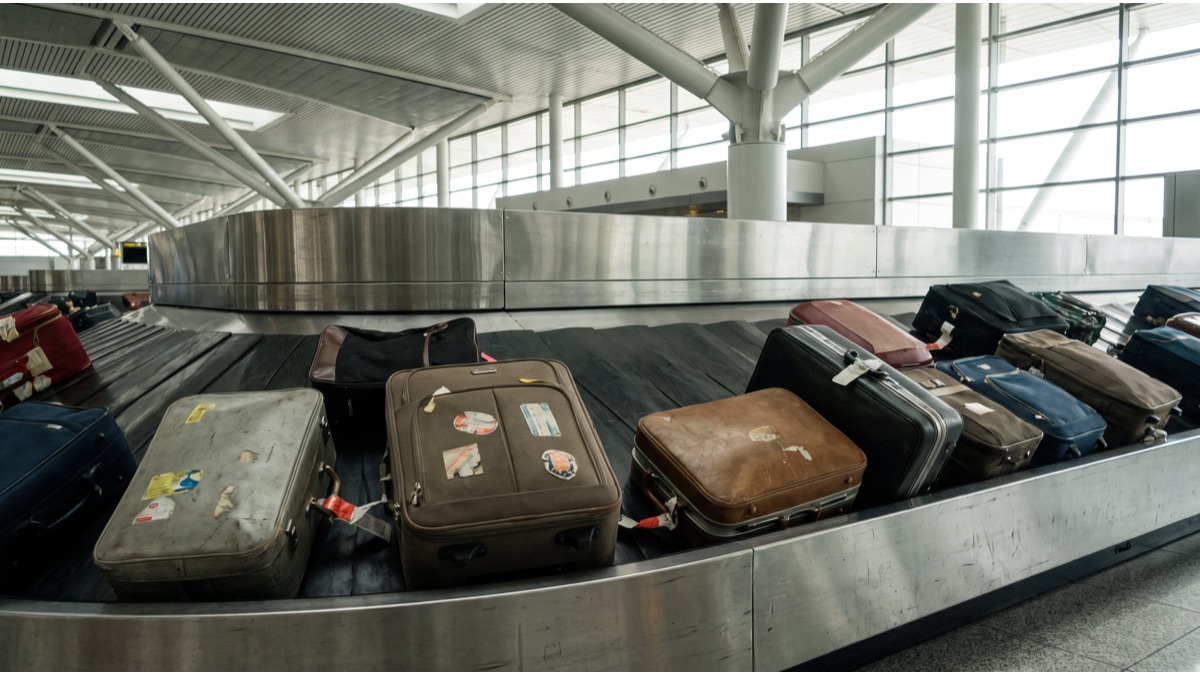
A checked bag travels several kilometres through machinery the passenger never sees, descending below the terminal into a network of belts, sorters and screening machines that must deliver it to a specific aircraft within a fixed window.
The system handles enormous volumes with a low failure rate, and the failures that occur are mostly not losses at all. The large majority of mishandled bags are simply delayed, usually because a connection was too short for both the passenger and the bag to make it. Understanding how the system works explains why connections cause most problems and why a bag almost always turns up.
What Happens After Check-In
A bag receives a tag encoding its destination and flight, then drops onto a belt that carries it below the terminal into the handling system.
From that point it is routed automatically, with the system tracking its position and deciding which path it takes at each junction.
The passenger and the bag then travel entirely separately, following different routes and different timings until they meet again at the destination.
How Bag Tags Are Read
The printed tag carries a licence plate number that identifies the bag, with the details held in a database rather than encoded in the tag itself.
Arrays of scanners read the barcode from multiple angles as the bag passes, since a tag can face any direction on a moving belt.
Read rates are high but not perfect, and bags that cannot be read divert to a manual station where a person enters the number, which is slower and creates a bottleneck.
Why Radio Tags Are Replacing Barcodes
Radio frequency tags can be read without line of sight and at much higher reliability, eliminating most manual handling of unreadable bags.
They also allow tracking at many more points, so a bag's position is known continuously rather than only where a scanner was installed.
Adoption has been slow because tags cost more and the benefit depends on other airports reading them too, which is a coordination problem rather than a technical one.
How Sortation Actually Works
Once identified, a bag travels on a conveyor network where diverters push it onto branches leading toward the correct flight.
High-capacity systems use individual carriers on a track, each holding one bag and tipping it into the correct chute at speed.
This resembles a rail network more than a conveyor, with the control system routing thousands of independent vehicles simultaneously while avoiding collisions.
Why Screening Determines the Layout
Every checked bag is screened for explosives, and this is the slowest stage, so the entire system is designed around keeping screening machines fed.
Machines are arranged in parallel with buffering before them, since a queue at screening backs up into sortation and eventually to check-in.
Bags flagged by automated analysis divert to further inspection, and only a small proportion require a person to open them physically.
What CT Screening Changed
Computed tomography produces a three-dimensional image that can be rotated and analysed automatically, rather than the flat projection of older equipment.
This substantially reduced false alarms, which matters because every alarm requires human review and slows the entire line.
The same technology is now appearing at passenger security, which is why some airports no longer require liquids and laptops to be removed from bags.
How Early Bags Are Stored
Passengers check in hours before departure, but a bag cannot be loaded until the aircraft is ready, so early bags go to automated storage.
These stores hold thousands of bags and release them at the right moment, functioning as a buffer that smooths a highly uneven arrival pattern.
Without storage, the system would need capacity for peak check-in rather than average flow, which would require far more equipment for the same throughput.
Why Connections Cause Most Problems
A transfer bag must be unloaded, moved across the airport and loaded onto another aircraft within the connection time, which is frequently shorter than the passenger's own path.
If the inbound flight is late, the bag has less time than scheduled, and it is the bag rather than the passenger that usually misses the connection.
This is why the large majority of mishandled bags involve a transfer, and why direct flights have dramatically lower rates of delay.
What Minimum Connection Time Means
Every airport publishes a minimum time between flights that can be sold as a connection, calculated from how long transfers physically take.
This figure reflects baggage transfer as well as passenger movement, and it varies by terminal and by whether the connection crosses between airlines.
Booking a connection at exactly the minimum works when everything is on schedule, which is precisely when problems are least likely to matter.
Why Interline Transfers Are Harder
When a journey involves two airlines without a partnership, bags may need collecting and rechecking, since systems and ground handlers differ.
Even where through-checking is possible, transferring between handlers adds steps and each handover is a point where information can be lost.
This is why separately booked flights carry substantially more risk than a single itinerary, even when the connection time appears generous.
How Bags Are Loaded
Larger aircraft carry bags in containers loaded in the hold, which allows a whole container to be moved as one unit and speeds turnaround considerably.
Smaller aircraft are bulk loaded, meaning each bag is placed individually by hand, which is slower and physically demanding work.
Load planning also matters for balance, since weight distribution affects how the aircraft handles, and containers are assigned to positions accordingly.
Why Bags Are Sometimes Left Behind
Aircraft have weight limits that vary with temperature, altitude and runway length, and on constrained flights bags are the flexible element.
When a flight is weight-limited, some bags are deliberately offloaded and sent on a later service, which is a planned decision rather than an error.
Passengers are rarely told at the time, which is why a bag can fail to arrive on a flight that departed and landed entirely normally.
What Happens When a Passenger Does Not Board
Security rules generally require that a checked bag does not travel without its passenger on the same aircraft, which is called bag matching.
If someone checks in and then fails to board, their bag must be located and removed, which requires finding one container among many and unloading it.
This is a common cause of departure delay, and it is why gate agents make increasingly urgent announcements for missing passengers.
How Bags Are Traced When Missing
A global system shares baggage records between airlines, allowing a bag checked with one carrier to be identified and forwarded by another.
Reports are matched against found bags using description and content details as well as tag numbers, since tags are sometimes torn off in handling.
This is why staff ask detailed questions about appearance and contents, which frequently identifies a bag whose tag is missing entirely.
Why Most Missing Bags Are Found
The overwhelming majority of mishandled bags are delayed rather than lost, and most are reunited with their owner within a day or two.
Permanent loss is rare, since a bag that stops moving is eventually opened and identified from its contents even without any tag.
The statistic that alarms passengers therefore describes delay far more than disappearance, which is a substantially different thing.
What Happens to Genuinely Unclaimed Bags
After a defined period, bags that cannot be matched to an owner are disposed of, generally by sale to specialist retailers who resell the contents.
This is a small volume relative to total traffic, and it consists mostly of bags with no tag, no identifying contents and no matching report.
The obvious lesson is that identification inside the bag matters more than the tag outside it, since the outer tag is what typically goes missing.
How Tracking Apps Get Their Data
Airlines increasingly show passengers where their bag is, using scan events from the same infrastructure that routes it through the system.
The information is event-based rather than continuous, so a bag appears to jump between locations, which reflects where scanners exist rather than gaps in handling.
This has reduced anxiety substantially and also reduced enquiries, since passengers can see a bag is loaded rather than asking someone to check.
Why Personal Trackers Changed Expectations
Consumer tracking devices placed inside bags let passengers see their own bag's location independently of any airline system.
This has produced situations where a passenger knows precisely where a bag is while being told it cannot be located, which has been embarrassing enough to change airline practice.
Several airlines now accept tracker data in claims, which is an unusual case of consumer technology directly altering how an industry handles disputes.
What Compensation Rules Provide
International conventions set a liability limit for delayed, damaged or lost baggage, which applies regardless of the actual value of the contents.
The limit is considerably lower than many passengers assume, which is why valuable and essential items should travel in hand luggage.
Passengers can generally claim reasonable expenses for essentials during a delay, though airlines vary in how readily they pay without a specific request.
How Systems Fail at Scale
Baggage systems fail progressively rather than suddenly, since a jam or screening backlog causes bags to accumulate faster than they clear.
Once bags exceed storage capacity they are set aside manually, at which point the automated tracking that makes the system work is lost.
This is why images of baggage halls piled with luggage appear during disruption, since manual handling is far slower and the backlog compounds.
Why Staffing Is the Usual Constraint
Automation handles sorting and screening, but loading and unloading aircraft remain manual, so ground handling capacity limits how many flights can be turned around.
Handling is physically demanding, outdoor, shift-based work with high turnover, which makes staffing levels difficult to maintain.
Several widely reported baggage crises were staffing failures rather than equipment failures, following reductions that could not be reversed quickly when demand returned.
What New Airports Do Differently
Recently built airports install individual carrier systems throughout, achieving higher throughput and better tracking than conveyor-based designs.
Retrofitting an existing terminal is far harder, since baggage systems occupy space that cannot easily be expanded and cannot be shut down for rebuilding.
This is why baggage performance correlates with terminal age, and why some older hubs struggle despite substantial investment.
How Self Bag Drop Changed the Front End
Passengers increasingly tag their own bags and place them on a belt themselves, which removes the staffed desk from the process entirely.
This increases throughput per square metre and shifts staff toward exception handling, where a person is genuinely needed.
It also moves the point of failure earlier, since an incorrectly attached tag causes a problem deep inside the system rather than at the desk.
Why Baggage Is Screened Differently From Cabin Bags
Hold baggage screening focuses on explosives and can use higher radiation doses and slower analysis, since no passenger is waiting beside the machine.
Cabin screening must balance detection against throughput, with people queuing, which historically constrained the technology that could be deployed.
As faster imaging has become available, the two are converging, which is why cabin rules on liquids and electronics have begun to relax in some airports.
What the System Actually Achieves
A modern baggage system moves millions of items annually with a mishandling rate of a few per thousand, almost all of which are resolved within days.
It does this while screening every item, matching bags to passengers, and meeting fixed departure times that cannot be extended for a delayed bag.
The failures are concentrated in transfers and in disruption, which means the practical advice for passengers is to prefer direct flights, allow generous connections, and put identification inside the bag.
Why Some Items Cannot Be Checked
Lithium batteries above a certain capacity are prohibited from the hold, because a fire in an inaccessible compartment cannot be fought by the crew.
This is why power banks and spare batteries must travel in the cabin, where a thermal event can be seen and dealt with immediately.
The rule frequently surprises passengers because it inverts the usual assumption that the hold is where awkward items belong.
How Oversized Items Are Handled
Skis, instruments and pushchairs cannot pass through standard sortation, so they are routed through a separate manual channel to the aircraft.
This bypasses most of the automated tracking, which is a substantial part of why oversized items are mishandled more often than ordinary suitcases.
It is also why they are frequently delivered to a different point at arrival, since they never entered the belt system in the first place.
What Happens at the Arrival Belt
Bags are unloaded into carts and driven to a reclaim belt, which is one of the few parts of the process the passenger actually observes.
Priority bags are loaded last onto the aircraft so they emerge first, which is why the tag genuinely works when handlers follow the sequence.
Delays at reclaim are usually caused by aircraft parking position and available staff rather than by anything happening inside the terminal.
Why Bags Are Sometimes Sent to the Wrong City
Misrouting usually results from a tag being misread or an old tag remaining attached, since scanners cannot tell which of two tags is current.
This is why handlers remove previous tags and why leaving them on a case genuinely increases the risk of a bag following a previous journey.
Once misrouted, a bag is generally identified at the wrong destination and forwarded, which adds a day rather than causing permanent loss.
How Ground Handling Is Contracted
Most airlines do not handle their own baggage but contract specialist companies, which frequently serve several carriers at the same airport.
This makes performance dependent on contracts and staffing at the handler rather than on the airline whose name is on the ticket.
It also explains why the same airline performs very differently at different airports, since the operation is executed by a different company at each.
Why Hub Airports Are Harder Than Origins
An airport where most passengers begin their journey handles a predictable flow of bags arriving steadily through the morning.
A hub receives large batches simultaneously as aircraft land in banks, then must sort them onto departures leaving within a narrow window.
This produces sharp peaks that require far more capacity than average volume suggests, which is why hub baggage systems are disproportionately expensive.
What Happens During Irregular Operations
When flights are cancelled, bags already loaded must be removed and rerouted, and bags in the system must be redirected to different aircraft.
This is far harder than normal operation because the destination for each bag changes after it has already been sorted toward somewhere else.
Recovery therefore takes considerably longer than restoring the flight schedule itself, which is why baggage backlogs persist after disruption appears resolved.
A checked bag travels several kilometres through machinery no passenger sees, screened for explosives, sorted by machines routing thousands of independent carriers at once, and buffered in automated storage until its aircraft is ready. The system moves millions of items with a mishandling rate of a few per thousand. What matters most is that those failures are overwhelmingly delays rather than losses. Almost all are resolved within a day or two, and permanent loss is rare, because a bag that stops moving eventually gets opened and identified from its contents. The statistic that alarms people describes lateness far more than disappearance. The cause is concentrated in one place: transfers. A connecting bag must be unloaded, moved across the airport and reloaded within the connection window, which is frequently tighter than the passenger's own walk — and when the inbound flight is late, it is the bag rather than the person that misses. Direct flights have dramatically lower rates for exactly this reason. Two other things follow from how the system works: bags are sometimes offloaded deliberately when a flight is weight-limited, which is a decision rather than an error, and identification inside the bag matters more than the tag outside, because the outer tag is the part that goes missing.
Sources
- Wikipedia — system architecture, sortation and screening
- IATA — baggage handling statistics, tracking standards and resolution systems
- US Transportation Security Administration — hold baggage screening requirements and CT deployment
- European Union Aviation Safety Agency — bag matching rules and ground handling regulation
- International Civil Aviation Organization — liability limits for delayed, damaged and lost baggage
FAQ
Are missing bags usually lost for good?
No. The overwhelming majority are delayed rather than lost, and most are reunited within a day or two. Permanent loss is rare because stopped bags are opened and identified from contents.
Why do bags go missing on connections specifically?
A transfer bag must be unloaded, moved and reloaded within the connection window, which is often tighter than the passenger's own route. If the inbound is late, the bag misses.
Why did my bag not arrive on a flight that was on time?
Aircraft have weight limits that vary with temperature and runway length. On constrained flights, some bags are deliberately offloaded to a later service.
Why do they hold a flight when a passenger doesn't board?
Security rules generally require a checked bag not to fly without its passenger, so the bag must be located and removed — which means finding and unloading a specific container.
What should I do to protect my luggage?
Put identification inside the bag, since the outer tag is what typically goes missing. Keep valuables and essentials in hand luggage, as liability limits are lower than most people expect.
About the Author
We reference Wikipedia, IATA, US Transportation Security Administration, European Union Aviation Safety Agency, and International Civil Aviation Organization to explain the background and current understanding of this topic.
Loved This Article?
Share it on WhatsApp → Share it on WhatsApp
Get more guides in your inbox — Subscribe to our newsletter for weekly surprising stories from Egypt, Saudi Arabia, Dubai, and beyond.