A letter posted with a single domestic stamp can reach an address on another continent, handled along the way by postal services in countries the sender has no relationship with and paid nothing to. This is so routine that almost nobody asks why foreign postal workers deliver mail for free.
The answer is a treaty older than most of the countries that signed it, which established that mail is settled between nations rather than charged to senders. Combined with sorting machinery that reads handwriting at thousands of items per hour and a delivery economics that has been quietly upended by parcels, it explains most of what seems strange about how post actually operates.
The Problem That Existed Before Treaties
Before international agreement, sending a letter abroad required calculating payment for every country it would transit, with separate arrangements negotiated between each pair of nations.
Senders frequently had to pay several times, or arrange for recipients to pay on arrival, and mail was regularly returned or destroyed when the accounting could not be resolved.
The complexity grew impossible as trade expanded, since the number of bilateral arrangements required rises far faster than the number of countries involved.
What the Universal Postal Union Established
An international agreement in the nineteenth century created a single postal territory, under which each country agreed to deliver incoming international mail as if it were domestic.
The sender pays only their own country's postage, and the destination country delivers without charging the recipient, treating the labour as reciprocal rather than billable.
This works because mail flows roughly balance between countries over time, so each service delivers approximately as much foreign mail as its own mail is delivered elsewhere.
How Terminal Dues Settle the Imbalance
Flows are not perfectly balanced, so a system of payments called terminal dues compensates countries that deliver more incoming mail than they send outward.
Rates were historically set low for developing countries as a form of development support, which made sense when international mail was overwhelmingly correspondence between individuals.
The arrangement became contentious once commercial parcels dominated, since businesses in countries with low terminal dues could ship goods abroad more cheaply than domestic sellers could ship within their own country.
Why the Rates Were Renegotiated
The imbalance created by e-commerce produced a genuine competitive distortion, with small parcels arriving from abroad costing less to deliver than identical domestic shipments.
This prompted a serious dispute in which a major member threatened withdrawal from the union entirely, which would have ended the single postal territory for a substantial share of world mail.
The resolution allowed countries to set their own rates for incoming parcels above certain volumes, preserving the union while removing the distortion, at the cost of considerable added complexity.
What a Postcode Actually Encodes
Postal codes are not arbitrary labels but hierarchical identifiers, with successive characters narrowing from region to district to delivery area, which allows sorting decisions at each stage.
Systems differ substantially in precision, with some countries narrowing to a street segment or even a single building while others identify only a broad town area.
Higher precision permits more automation, since a machine can route directly to a delivery round rather than requiring a human to interpret the address at the destination office.
How Sorting Machines Read Addresses
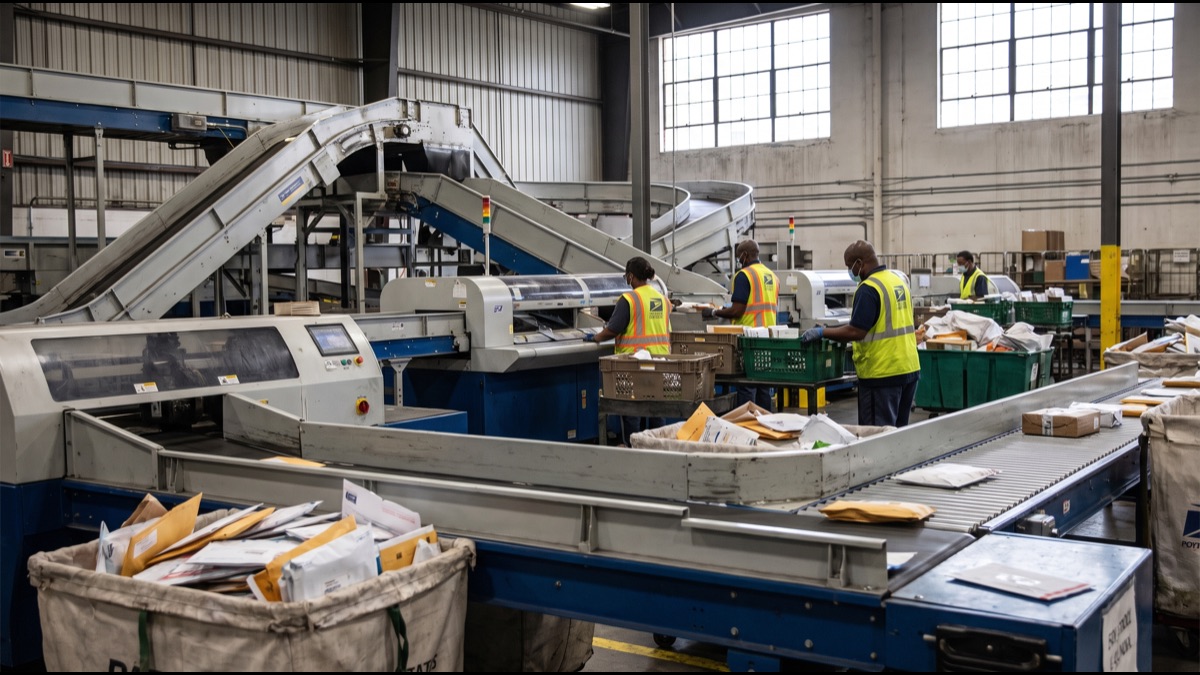
Modern sorting centres photograph every item and apply optical character recognition, which reads printed addresses reliably and handwritten ones with surprising accuracy.
Items the machine cannot interpret are sent to human operators who view the image remotely and type the relevant portion, with the item continuing through the machine meanwhile.
Once interpreted, the machine sprays a barcode onto the item encoding the delivery point, so subsequent handling reads the barcode rather than repeating the address interpretation.
Why Sorting Happens in Multiple Passes
A sorting machine has a limited number of output bins, far fewer than the number of destinations, so mail is sorted repeatedly with each pass refining the grouping.
The first pass separates by broad region, the second by delivery office, and a final pass sequences items into the exact order a carrier will walk their route.
That final sequencing is the step that most changed the work, since carriers previously spent hours each morning manually ordering their mail before setting out.
How the Network Is Shaped
Postal networks are hub-and-spoke systems, with mail collected locally, transported to regional centres for sorting, then distributed outward to delivery offices.
This is far more efficient than direct connections, since the number of routes required grows manageably rather than exploding as the number of locations increases.
The cost is that most items travel further than the geographic distance suggests, and a letter to a neighbouring town may travel hundreds of kilometres through a sorting centre.
Why the Last Mile Dominates Cost
Transporting mail between cities is cheap per item because volume is enormous and vehicles run full, while final delivery to individual addresses is labour-intensive and cannot be consolidated.
This final stage typically accounts for the majority of total delivery cost, which is why competition has focused there and why rural delivery is so much more expensive per item.
The economics explain why postal services are structured around a carrier walking a fixed route regardless of volume, since the walking is the cost and the items carried are nearly free.
What Universal Service Obligations Require
Most countries legally require their postal operator to deliver to every address at a uniform price, regardless of how remote or expensive that address is to serve.
This is a genuine cross-subsidy, with profitable urban delivery funding loss-making rural routes, and it is the main reason postal services are structured as they are.
Competitors are not bound by the same obligation, which allows them to serve only profitable areas, a pattern that has consistently strained the economics wherever postal markets were opened.
Why Letter Volumes Collapsed
Correspondence, bills, statements and advertising have moved substantially to electronic delivery, and letter volumes in most developed countries have fallen dramatically from their peak.
Because the cost of a delivery round is largely fixed, falling volume raises the cost per item sharply, creating a spiral where price rises accelerate the shift away from post.
Services have responded by reducing delivery frequency, consolidating sorting centres, and in several countries separating the letter and parcel businesses financially.
How Parcels Changed the Business
Online retail produced enormous growth in parcel volume, which partially offset letter decline, though parcels are heavier, bulkier, and considerably more expensive to handle per item.
Sorting infrastructure designed for flat items required substantial reinvestment, since parcels cannot be processed by the same machinery and need different handling entirely.
The competitive environment is also completely different, since parcel delivery is a contested commercial market while letters were typically a protected monopoly.
Why Delivery Density Determines Everything
The single most important variable in delivery economics is how many items are delivered per stop and how close together the stops are.
This is why parcel lockers and pickup points have expanded rapidly, since consolidating many deliveries at one location eliminates the most expensive part of the operation.
It also explains why delivery to apartment buildings is far cheaper than to detached houses, and why the same parcel costs vastly different amounts to deliver in different places.
How Tracking Actually Works
Tracking numbers are scanned at each handover point, creating a series of timestamped events rather than continuous location monitoring, which is why tracking appears to jump between updates.
Gaps in tracking usually mean the item is in transit between scan points rather than lost, though the absence of information during long international legs generates constant customer contact.
International tracking requires the destination country's system to recognise and report on the sending country's identifier, which works well between major services and poorly elsewhere.
What Happens at Customs
International parcels must clear customs, where declared contents and value determine whether duty or tax applies, and where prohibited items are supposed to be intercepted.
Postal channels historically received lighter treatment than commercial freight, which created an enforcement gap that grew significant as small-package e-commerce expanded.
Several jurisdictions have removed or reduced the value threshold below which imports entered duty-free, which was originally intended for gifts rather than for a large share of retail commerce.
How Undeliverable Mail Is Handled
Items that cannot be delivered and cannot be returned end up in dedicated recovery centres, where staff open them specifically to find identifying information.
This is one of the few circumstances where opening mail is lawful, and the process is tightly controlled precisely because it is such a clear exception to the usual protections.
Items with genuine value are stored for a statutory period before being auctioned or destroyed, and the proceeds generally return to the postal service rather than to any claimant.
Why Redirection Is Harder Than It Looks
Forwarding mail to a new address means intercepting items after they have already been sorted for the original destination, which works against the entire automated flow.
Redirection is therefore applied at the delivery office by pulling flagged items out and re-injecting them into the network, which adds a day or more to transit.
Because the service depends on a person or machine matching names as well as addresses, it fails in predictable ways for shared households and for slight variations in how a name is written.
Why Mail Still Has Legal Weight
Many legal processes require notification by post, since a delivered letter provides evidence of service in a form courts have long accepted.
Registered and recorded delivery services exist specifically to create that proof, with a signature or scan providing a documented record of when the item arrived.
This has slowed the decline in certain categories considerably, since the legal requirement persists regardless of how much more convenient electronic notification might be.
Why Post Offices Are Closing
Counter networks were built when almost every transaction required attending in person, and most of those transactions have since moved online or to automated alternatives.
Closures are politically difficult because a post office frequently functions as the last remaining public service in a small community, giving it significance beyond its transaction volume.
Several countries have responded by relocating counters into existing shops, which preserves access at far lower cost while reducing the range of services available.
How Postal Services Became Banks
In many countries the postal network is also a financial institution, offering savings accounts, payments and money transfer through the same counters that handle mail.
This arose because the postal network reached everywhere including areas no commercial bank found worth serving, making it the natural infrastructure for financial inclusion.
In several countries the financial arm is now considerably more profitable than the mail operation, effectively reversing which business subsidises the other.
Why Addresses Are Not Universal
A large share of the world's population lives at locations without a formal street address, which makes conventional postal delivery impossible regardless of network capability.
Some countries have addressing systems that do not follow the street-and-number pattern at all, organising instead by block, by landmark, or by order of construction.
Various digital addressing schemes have been proposed to fill the gap, though adoption has been limited because an address is only useful if the delivery network actually accepts it.
What Stamps Actually Represent
The adhesive stamp was a significant administrative innovation because it shifted payment to the sender at a uniform rate, replacing systems where recipients paid on delivery according to distance.
Uniform pricing regardless of distance was the genuinely radical element, since it meant the cost of a letter no longer depended on how far it travelled within a country.
This simplification enabled mass adoption, and the resulting volume increase more than compensated for revenue lost on long-distance items that had previously been charged more.
How Mail Is Actually Secured
Interfering with mail is a specific criminal offence in most jurisdictions, treated separately from ordinary theft because the postal system depends on trust in the chain of custody.
Postal services operate their own investigative bodies in several countries, with powers that reflect the historical importance of the mail as national infrastructure.
These protections predate and are considerably stronger than those applying to most private courier services, which is one reason legal notifications still favour postal delivery.
Why Delivery Frequency Is Being Reduced
Several countries have moved from daily letter delivery to alternate days or fewer, since maintaining daily rounds for steadily declining volume became difficult to justify.
The saving is substantial because the fixed cost of the round is what dominates, so halving frequency removes close to half the cost while still delivering all the mail.
Opposition is generally strongest from businesses and from rural residents, for whom postal delivery remains a more significant channel than it does for urban households.
How Automation Changed Employment
Sorting was historically enormously labour-intensive, with large workforces manually reading and separating items in overnight shifts at every processing centre.
Machine sorting eliminated most of that work, and the sequencing of mail into carrier order removed a further substantial portion of the remaining manual effort.
Delivery itself has resisted automation almost entirely, which is why postal employment has shifted heavily toward delivery roles even as total headcount fell.
What Drone and Robot Delivery Has Achieved
Considerable investment has gone into automating final delivery, with trials of aerial drones and pavement robots operating in a number of countries.
Results have been mixed, with meaningful success in specific niches such as medical supplies to remote areas, but limited progress toward general delivery at scale.
The obstacles are less technical than practical, involving regulation, weather, security of unattended items, and the simple fact that a human carrier delivering many items per stop remains highly efficient.
Why the System Persists
Despite the collapse in letters, no alternative has emerged that reaches every address in a country at a uniform price with legal standing behind delivery.
The universal network retains value precisely because it is universal, and any competitor serving only profitable areas cannot replace it without recreating the same obligation.
This is why postal reform in most countries has focused on restructuring the obligation rather than removing it, since the alternative is leaving a substantial minority of addresses unserved.
What the Treaty Actually Achieved
The single most consequential feature remains that a sender pays once, in their own currency, at their own country's rate, and the item is delivered anywhere by services they never dealt with.
This required countries to accept performing work for each other without direct payment, on the understanding that the arrangement balances out over time and volume.
It is one of the oldest functioning international agreements, and it has survived wars, dissolutions, and the near-total replacement of its original purpose by electronic communication.
The reason a single domestic stamp carries a letter to another continent is a nineteenth-century treaty that made the world one postal territory. Each country agreed to deliver incoming foreign mail as if it were domestic, on the understanding that flows roughly balance over time. Where they do not, terminal dues settle the difference — an arrangement that worked quietly for over a century and then broke, because e-commerce made it cheaper to ship a small parcel from abroad than from within the same country. The machinery underneath is equally counterintuitive. Mail is sorted in multiple passes because machines have limited output bins, with a final pass sequencing items into the exact order a carrier walks. Most of the cost is not transport between cities, which is nearly free per item, but the last mile, where a person walks a route regardless of how much they carry. That single fact explains parcel lockers, rural delivery costs, reduced delivery frequency, and why competitors serve only dense areas. What has kept the system alive despite letters collapsing is the obligation nothing else has replaced: delivery to every address at a uniform price, with legal weight behind it. A competitor serving only the profitable half cannot substitute for that without taking on the same burden.
Sources
- Wikipedia — history and structure of the international postal agreement
- Universal Postal Union — terminal dues, member obligations, and global mail statistics
- US Postal Service — sorting operations, delivery economics, and universal service
- Ofcom — postal market regulation and universal service obligation analysis
- OECD — research on postal sector reform and e-commerce delivery
FAQ
Why does foreign post deliver my letter without being paid?
A nineteenth-century treaty made the world one postal territory. Each country delivers incoming mail as domestic, and imbalances are settled between services through payments called terminal dues.
Why does mail to a nearby town travel so far?
Postal networks are hub-and-spoke. Mail goes to a regional sorting centre and back out, which is far more efficient overall than maintaining direct connections between every pair of towns.
Why is delivery the most expensive part?
Transport between cities is cheap per item because vehicles run full. Final delivery cannot be consolidated — a carrier walks a route regardless of volume, and that labour dominates total cost.
Why has tracking stopped updating on my parcel?
Tracking records scans at handover points, not continuous location. Gaps usually mean the item is in transit between scans, which is common on long international legs.
Why did international parcel rates change recently?
Low terminal dues meant a parcel from abroad could cost less to deliver than a domestic one. Countries can now set their own rates for incoming parcels above certain volumes.
About the Author
We reference Wikipedia, Universal Postal Union, US Postal Service, Ofcom, and OECD to explain the background and current understanding of this topic.
Loved This Article?
Share it on WhatsApp → Share it on WhatsApp
Get more guides in your inbox — Subscribe to our newsletter for weekly surprising stories from Egypt, Saudi Arabia, Dubai, and beyond.