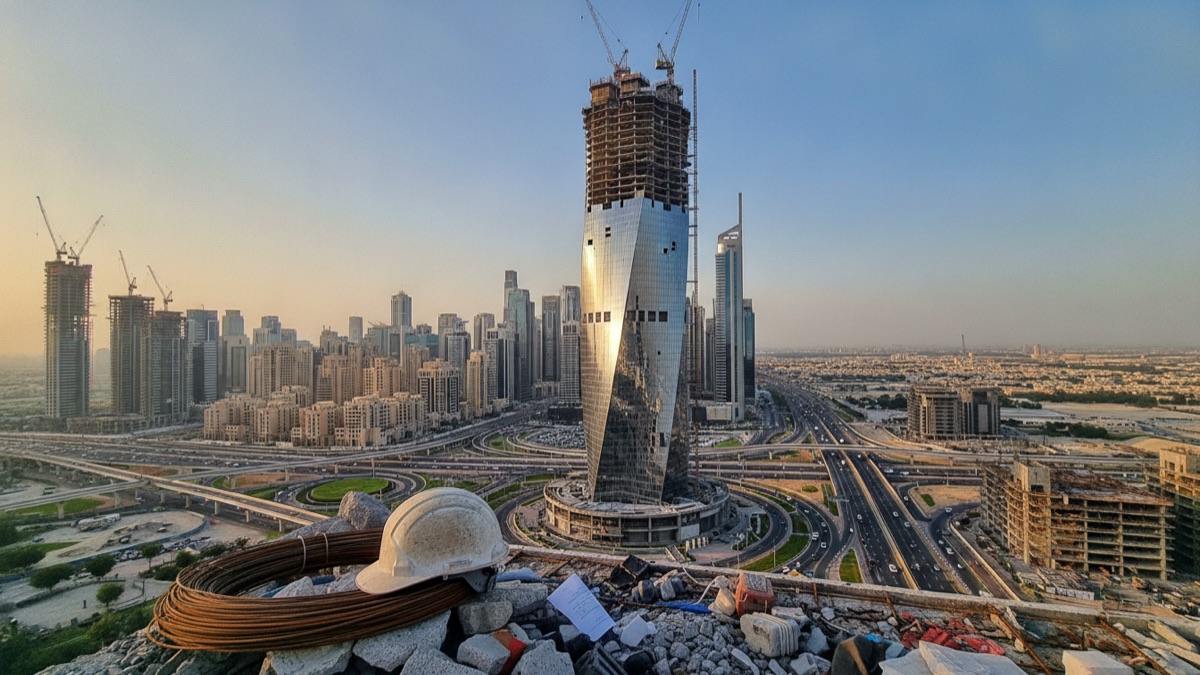
Photographs of Dubai from the early 1990s show a modest, low-rise coastal city, with Sheikh Zayed Road running through mostly open desert. Photographs of the same stretch of city from today show one of the densest concentrations of supertall towers on Earth, anchored by the world's tallest building, ringed by artificial islands, and still growing. The transformation happened in roughly two decades, a pace that would be almost inconceivable for most cities, which typically build up their skylines over a century or more of gradual economic development. Understanding why Dubai changed this fast requires looking past the individual buildings themselves and into a deliberate economic strategy, a set of unusually permissive regulations, and genuine engineering advances that all converged at the same moment in the emirate's history.
The Oil Wasn't Going to Last, and Dubai Knew It
Unlike some of its Gulf neighbors, Dubai never had especially large oil reserves, and by the 1990s its leadership was acutely aware that whatever oil revenue the emirate did have would not sustain its economy indefinitely. This created a sense of urgency that shaped decades of subsequent policy: Dubai needed to build an economy that didn't depend on oil before its oil ran out.
This urgency translated directly into an aggressive strategy of economic diversification, with the ruling government actively steering investment toward tourism, trade, finance, aviation, and real estate rather than passively collecting oil revenue and hoping it would last. A soaring, internationally recognizable skyline became a deliberate branding tool in that strategy, a visible signal that Dubai was a serious, ambitious, modern global city worth investing in.
This is a meaningfully different starting point than most world cities, where skylines grew organically alongside gradual population and economic growth over many decades. Dubai's skyline was, to a significant degree, built as a strategic economic statement first and a response to organic population pressure second.
Freehold Property Laws Opened the Floodgates
For much of its history, property ownership in Dubai, as in most of the UAE, was restricted to UAE nationals, which meant the pool of potential buyers and investors for large-scale real estate development was inherently limited. A pivotal legal change in the early 2000s allowed foreigners to buy freehold property in designated areas of the city for the first time.
This single regulatory shift had an outsized effect, instantly opening Dubai's real estate market to a vastly larger pool of international capital, from individual investors seeking a second home or rental income to institutional developers seeking large-scale projects, all of whom now had a legal path to genuine ownership rather than only long-term leases.
The timing coincided with a period of unusually high global liquidity and rising wealth in the broader Gulf region and beyond, meaning Dubai opened its property market to foreign buyers at almost exactly the moment a large amount of international capital was actively searching for new places to invest, a combination that accelerated development far faster than either factor would have alone.
A Regulatory Environment Built for Speed
Beyond property ownership rules, Dubai's government structured much of its business and construction regulatory environment specifically to minimize the friction and delay that typically slows large development projects in more established, bureaucratically layered cities. Free zones offering full foreign ownership, tax exemptions, and streamlined licensing processes made it dramatically easier for developers and construction firms to set up operations quickly.
Government entities and semi-government developers were also able to move faster than typical private-sector real estate development in many other countries, since land allocation, permitting, and large-scale master planning could be coordinated more directly through government-linked development companies rather than navigating a fragmented landscape of many independent private landowners and local jurisdictions.
This combination of light-touch regulation and coordinated, top-down master planning allowed entire new districts, rather than just individual buildings, to be designed and built out as unified projects, which is part of why so much of Dubai's skyline feels cohesively planned rather than accumulated piecemeal over time the way most historic city skylines are.
Engineering Advances Made Supertall Construction Feasible
None of this economic and regulatory momentum would have produced a supertall skyline without genuine advances in structural engineering that made building extremely tall towers economically and technically feasible in the first place. Innovations in high-strength concrete, buttressed core structural systems, and high-speed elevator technology all matured significantly in the decades leading up to Dubai's building boom.
The Burj Khalifa, which became the world's tallest building upon its completion, relied on a Y-shaped buttressed core design specifically developed to help the tower resist wind loads and structural stress at extreme height, an engineering solution that had to be refined through extensive wind-tunnel testing and computer modeling before construction could proceed with confidence.
These engineering advances weren't unique to Dubai, but the city's willingness to fund ambitious, technically risky projects at a scale few other cities were attempting gave engineers and construction firms a proving ground to apply and refine techniques that had previously existed mostly in theory or in much more modest applications elsewhere.
Desalination and Power Infrastructure Had to Keep Pace
A skyline of this density and scale requires enormous amounts of fresh water and electricity, resources that a desert coastal city cannot simply draw from natural sources at the volumes needed. Dubai's rapid vertical growth was matched, and in many ways enabled, by equally rapid investment in desalination plants and power generation infrastructure built specifically to keep pace with construction.
Without this parallel infrastructure buildout, the skyline's growth would have quickly outstripped the city's basic ability to supply water and electricity to its new towers, hotels, and residential communities, making desalination and power capacity a less visible but equally essential part of the story behind the skyline's speed.
This infrastructure investment also had to anticipate future demand rather than simply react to it, since a supertall tower under construction today needs guaranteed utility capacity years in advance of its completion, requiring planners to build ahead of demonstrated need in a way that added real financial risk to the overall strategy.
Land Reclamation Created Room to Build
Dubai's natural coastline offered a limited amount of prime waterfront land, and rather than treating that as a hard constraint, developers pursued large-scale land reclamation, creating entirely artificial islands and extended coastlines specifically designed to maximize the amount of valuable waterfront property available for development.
These reclamation projects required dredging and engineering on a scale that had rarely been attempted for purely commercial real estate purposes anywhere in the world, moving vast quantities of sand and rock to build stable new landmasses capable of supporting major construction, a process that itself became part of Dubai's international reputation for ambitious engineering.
By effectively manufacturing new waterfront land rather than being limited to its natural coastline, Dubai was able to expand its developable area significantly beyond what geography alone would have allowed, adding yet another dimension to how quickly the city's built footprint could grow.
A Deliberate Strategy of Iconic, Record-Breaking Architecture
Dubai's development strategy leaned heavily on building structures explicitly designed to hold superlatives, the tallest building, the largest mall, the biggest artificial archipelago, rather than simply adding conventional office and residential towers at a steady pace. This wasn't incidental; record-breaking architecture generated global media attention that functioned as extremely effective, essentially free international marketing.
This branding-through-architecture strategy meant individual buildings were often designed and funded with global visibility as an explicit goal alongside their basic commercial function, which pushed developers toward architecturally ambitious, distinctive designs rather than more generic tower forms that might have been faster and cheaper to build.
The cumulative effect of many individually iconic buildings concentrated in one relatively compact area produced a skyline that reads as instantly recognizable and photogenic from a distance, reinforcing the same tourism and investment-attraction goals that motivated the original diversification strategy in the first place.
Population Growth Followed the Construction, Not the Other Way Around
In most cities, population growth creates demand that gradually drives new construction. Dubai's growth pattern often ran in something closer to the reverse direction: ambitious construction and economic opportunity, driven by the strategic and regulatory factors already described, attracted a rapidly growing population of expatriate workers and professionals from around the world.
This population, drawn largely by employment opportunities in construction, finance, tourism, aviation, and trade, came to vastly outnumber the local Emirati population within the city, creating sustained demand for housing, offices, and services that further justified and funded continued rapid development.
This self-reinforcing cycle, where construction created economic opportunity, which attracted population, which created further demand for construction, helped sustain the pace of the skyline's growth over an extended period rather than the boom being a single short burst followed by stagnation.
Global Capital Found a Uniquely Welcoming Home
Dubai positioned itself as a genuinely international financial and business hub, with light taxation, English widely used alongside Arabic in business contexts, and a regulatory environment explicitly designed to be comfortable and familiar for foreign investors and multinational companies, particularly compared to some neighboring markets with more restrictive or less transparent business environments at the time.
This positioning attracted not just real estate investment but the broader ecosystem of finance, professional services, and corporate headquarters that supports large-scale development, creating a self-sustaining business environment rather than one dependent purely on speculative property investment that might have proven far less durable over time.
The city's geographic position, roughly equidistant from major markets in Europe, Asia, and Africa, and served by an increasingly extensive long-haul airline network built up in parallel, also made it a genuinely convenient hub for international business and travel, reinforcing the broader economic case for continued investment in its physical infrastructure and skyline.
The 2008 Financial Crisis Was a Real Setback, Not a Full Stop
Dubai's rapid growth was not free of serious disruption. The 2008 global financial crisis hit the emirate's heavily leveraged real estate sector hard, causing property values to fall sharply, several major projects to stall or be significantly delayed, and forcing a debt restructuring supported by financial assistance from neighboring Abu Dhabi.
This period is an important corrective to any narrative that presents Dubai's growth as smooth and inevitable; the skyline's development actually slowed noticeably for several years following the crisis, and some ambitious projects planned during the boom years were ultimately scaled back, delayed for many years, or never completed at all.
The eventual recovery and continued growth after this setback demonstrated that Dubai's underlying economic diversification strategy had enough substance to weather a severe downturn, even though the crisis proved that the pace of the boom years had, in retrospect, outrun sustainable financing in some specific cases.
A Model Other Cities Have Studied, With Mixed Conclusions
Dubai's development pattern has become a widely studied case among urban planners and economists, both as a model of how deliberate, coordinated, top-down strategy can compress decades of typical urban development into a much shorter period, and as a cautionary example of the financial and labor practices that came with pursuing that pace.
Some elements of Dubai's approach, particularly the coordinated master planning, the aggressive regulatory streamlining, and the deliberate use of iconic architecture as an economic branding tool, have been studied and partially replicated by other rapidly developing cities seeking to diversify their own economies or raise their international profile.
At the same time, the labor conditions associated with the construction boom, along with questions about the long-term financial sustainability of some of the more speculative real estate development that occurred, have made Dubai's model a subject of genuine debate rather than an uncomplicated success story to be copied wholesale.
The Land and Regulatory Framework That Made It Possible
Rapid vertical growth requires more than capital and ambition; it requires a legal framework that lets that capital move quickly. Dubai's introduction of freehold property ownership for foreign buyers in designated zones in the early 2000s was a pivotal regulatory shift, since it allowed international investors to own property outright rather than only lease it, unlocking a much larger pool of capital willing to fund speculative high-rise development.
Alongside freehold reform, streamlined approval processes for large-scale master-planned developments meant that entire districts could be planned, approved, and broken ground on far faster than in cities with more layered, multi-jurisdictional planning processes. A single master developer could control zoning, infrastructure, and construction sequencing across an entire district, reducing the coordination friction that slows growth in cities with fragmented land ownership.
This regulatory environment did not just permit fast growth, it was specifically engineered to attract it, positioning Dubai in direct competition with other regional and global cities for the same pool of international development capital and effectively front-loading decades of typical urban growth into a much shorter window.
Why Supertall Construction Became Commercially Viable
Building extremely tall structures was technically possible well before Dubai's boom, but it had rarely been commercially attractive because the engineering premium for extreme height often outweighed the additional revenue from extra floors. Advances in high-strength concrete, wind-engineering modeling, and high-speed elevator systems through the 1990s and 2000s gradually lowered that premium, making supertall towers a more defensible investment.
Dubai's developers were also willing to treat height itself as a marketing asset rather than a pure cost, since a record-breaking tower generated global media attention and prestige value that translated into premium sale prices for units, effectively turning engineering ambition into a direct revenue driver rather than just an expense to be minimized.
This combination of falling technical costs and rising brand value from height created a rare alignment where supertall construction made financial sense at a scale rarely seen elsewhere, encouraging a wave of ever-taller projects that reinforced Dubai's identity as a global proving ground for vertical construction technology.
The Human and Logistical Cost Behind the Speed
The compressed construction timelines that produced Dubai's skyline required an enormous, rapidly mobilized labor force, drawn overwhelmingly from South Asian countries under the kafala sponsorship system that governed migrant labor in the Gulf during this period. This workforce made the pace of construction possible, working on tight schedules across a city that was, in effect, a permanent large-scale construction site for two decades.
Labor conditions on major projects drew sustained international scrutiny and criticism over this period, particularly regarding wages, living conditions, and worker mobility, prompting labor reforms in the UAE over time including changes to sponsorship rules and minimum wage protections that were introduced progressively rather than all at once.
Any account of how the skyline rose this quickly is incomplete without acknowledging that the pace was inseparable from the scale and conditions of the labor force that built it, a dimension of the story that receives less attention than the architecture itself but is central to understanding how the timeline was achievable.
How the 2009 Financial Crisis Interrupted the Trajectory
Dubai's skyline did not rise in an uninterrupted straight line; the global financial crisis of 2008-2009 hit the city's debt-fueled real estate boom hard, halting numerous projects mid-construction and triggering a well-documented debt crisis that required financial support from neighboring Abu Dhabi to help stabilize.
Several announced supertall and mega-development projects from the pre-crisis boom period were shelved, redesigned at smaller scale, or delayed by years, and some partially built structures remained visibly incomplete on the skyline for an extended period afterward as a reminder of how exposed the growth model was to global credit conditions.
The recovery that followed involved a more diversified, less purely speculative approach to development, with greater emphasis on completing and monetizing existing projects before launching new ones, a lesson that shaped how subsequent waves of Dubai's growth, including the current one, have been financed and paced.
What the Current Growth Wave Does Differently
The current phase of Dubai's development, distinct from the pre-2009 boom, has been more deliberately diversified across sectors like tourism, logistics, finance, and technology, with real estate treated as one growth pillar among several rather than the primary driver it was during the earliest boom years.
Financing structures have also shifted toward greater use of pre-sale revenue, phased development tied to demonstrated demand, and more conservative debt ratios on major projects, reflecting lessons drawn directly from the exposure the earlier speculative model revealed during the global downturn.
This more measured approach has not slowed the visible ambition of new projects, but it has changed how they are sequenced and financed, with greater emphasis on completing and generating revenue from one phase before committing capital to the next, a discipline that was less consistently applied during the fastest years of the original boom.
How the Skyline Functions as a Branding Strategy
Beyond its functional role, Dubai's skyline has operated as a deliberate branding instrument, with signature towers appearing in tourism campaigns, corporate logos, and media coverage in a way that converts architecture into a recognizable global shorthand for the city's ambitions, similar to how other cities have historically been branded by a single iconic structure.
This branding value is not incidental to the development strategy; it is frequently cited explicitly by officials and developers as a return on the investment in record-setting or visually distinctive architecture, treating global recognizability as a measurable outcome alongside square footage and occupancy rates.
Lessons for Other Rapidly Developing Cities
Urban planners studying Dubai's compressed growth trajectory frequently point to the combination of unified land-use control, deliberate branding strategy, and willingness to absorb early financial risk as the replicable elements of the model, while treating the specific debt exposure that led to the 2009 crisis as a cautionary counterexample rather than something to imitate.
Cities elsewhere in the Gulf and beyond that have attempted similar rapid-growth strategies have generally borrowed selectively from Dubai's approach, adopting the master-planning and foreign-investment elements while building in more conservative financing safeguards from the outset, a direct response to the lesson the earlier crisis made unavoidable.
Dubai's skyline changed as fast as it did because several powerful forces converged at almost exactly the same moment: an urgent economic need to diversify away from limited oil reserves, a deliberate legal opening of property ownership to international buyers, a regulatory environment built specifically to minimize development friction, genuine advances in supertall structural engineering, and a strategic embrace of record-breaking architecture as a global marketing tool. None of these factors alone could have produced this transformation on this timeline; it was their combination, backed by sustained government coordination and substantial financial risk-taking, that compressed what most cities build over a century into roughly two decades. The 2008 financial crisis proved that pace came with real vulnerabilities, but the underlying strategy had enough substance to recover and keep building, which is why Dubai's skyline continues to grow today rather than standing as a frozen monument to one particular economic moment.
Sources
- Khaleej Times — UAE-based English-language newspaper covering Dubai's real estate and development history.
- Wikipedia — Burj Khalifa — Background on the structural engineering and construction history of the world's tallest building.
- Wikipedia — Economy of Dubai — Overview of Dubai's economic diversification strategy and property market history.
- Dubai Department of Economy and Tourism — Official government source on Dubai's economic development strategy.
FAQ
Why did Dubai focus so heavily on iconic, record-breaking buildings?
Record-breaking architecture generated substantial global media attention, functioning as effective international marketing that supported Dubai's broader strategy of attracting tourism, investment, and business away from its historically oil-dependent economy.
When were foreigners first allowed to own property in Dubai?
A pivotal legal change in the early 2000s allowed foreigners to buy freehold property in designated areas for the first time, dramatically expanding the pool of investors able to fund large-scale development.
Did the 2008 financial crisis affect Dubai's development?
Yes, significantly. Property values fell sharply, several major projects stalled, and the emirate required a debt restructuring supported by Abu Dhabi, noticeably slowing the pace of skyline development for several years afterward.
How does Dubai supply enough water and power for so many tall buildings?
The city invested heavily and in parallel in desalination plants and power generation infrastructure specifically to keep pace with construction, since a desert coastal city cannot draw the needed volumes from natural freshwater sources.
Is Dubai's development model unique, or have other cities copied it?
Elements of it, particularly coordinated master planning and the use of iconic architecture for economic branding, have been studied and partially adopted by other rapidly developing cities, though labor practices and financial sustainability questions have made it a debated model rather than a simple success story to copy.
About the Author
We reference Khaleej Times, Wikipedia — Burj Khalifa, Wikipedia — Economy of Dubai, and Dubai Department of Economy and Tourism to explain the background and current understanding of this topic.
Loved This Article?
Share it on WhatsApp → Share it on WhatsApp
Get more guides in your inbox — Subscribe to our newsletter for weekly surprising stories from Egypt, Saudi Arabia, Dubai, and beyond.