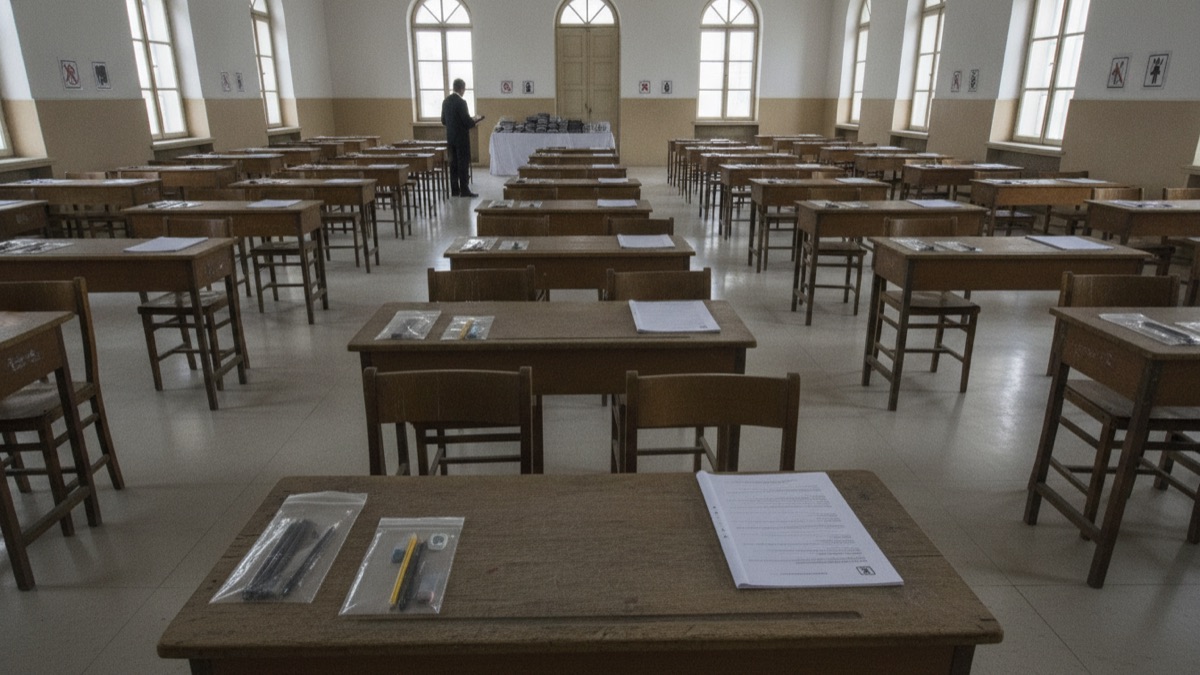
Anyone who has sat a major standardized exam remembers the ritual: fixed seating with wide gaps between desks, a proctor reading identical instructions aloud from a printed script, clocks that must not be adjusted mid-test, and papers that arrive in sealed packets opened only in front of the room. It can feel needlessly rigid, even theatrical, especially for a test on material the room already spent months studying. But almost none of these rules are arbitrary. Each one exists because, at some point, its absence allowed cheating serious enough that a testing organization rewrote its procedures to close that specific gap. Exam-hall procedure is less a tradition than a slowly accumulated defense record.
Why Seating Spacing Is So Precise
The gap between exam desks is not aesthetic. It is calibrated against the demonstrated range at which a person can read another candidate's paper without obvious head movement, which testing bodies have studied directly using eye-tracking and observation during controlled trials of proctoring effectiveness.
Alternating seating by subject or by a randomized candidate list, rather than by class roster order, closes a related loophole: friends who sit next to each other by habit, or classmates who know each other's handwriting well enough to signal answers, lose the advantage of predictable placement.
Exam boards that have published post-incident reviews describe seating reform as one of the single highest-value, lowest-cost interventions available, because it addresses the most common and least technologically sophisticated form of exam misconduct: simply looking at a neighbor's page.
Why the Instructions Are Read Verbatim
Reading a fixed script rather than paraphrasing might seem like unnecessary formality, but it exists so that every candidate, in every room, in every country administering the same exam, receives functionally identical information about timing, permitted materials, and prohibited conduct.
This matters legally as much as practically: if a proctor in one room happens to mention an extra minute of grace time or a slightly different rule about calculators, and a candidate is later penalized for something another room's proctor didn't enforce, the exam body faces a defensible fairness challenge that a scripted, recorded instruction set is designed to prevent.
Verbatim scripts also protect against a subtler problem — an experienced or nervous proctor unintentionally revealing something about question difficulty or content through tone, emphasis, or an off-script aside, which large-scale standardized testing treats as a leak vector worth guarding against.
Why Clocks and Timing Rules Are So Rigid
Exam timing rules — a single visible clock, no personal watches in some formats, an announced start and end with synchronized proctor clocks across a building — trace back to disputes over whether a candidate genuinely received the full allotted time, disputes that are far harder to resolve after the fact than to prevent in advance.
Extra time accommodations for candidates with documented needs are handled through separate, pre-approved arrangements precisely because ad hoc timing decisions made in the room, however well-intentioned, create exactly the kind of inconsistency that undermines an exam's defensibility if challenged later by an unsuccessful candidate.
Digital exams that log keystroke or click timestamps have made some of these disputes easier to resolve conclusively, but paper-based, in-person exams still rely on the rigid procedural rule because there is no digital log to fall back on if a timing complaint is raised.
The Chain of Custody for Exam Papers
Sealed packets opened only inside the exam room, in front of candidates, exist to answer a specific question after the fact: could this specific paper have been seen by anyone before the exam started? A documented, witnessed unsealing closes off an entire category of leak allegations before they can even be raised.
Numbered or barcoded packets, signed custody logs at each transfer point from printer to secure storage to exam room, and tamper-evident seals are all direct responses to historical incidents where papers went missing, were photographed in transit, or were opened and resealed without authorization.
Some high-stakes national exams now stagger release times across time zones specifically because a paper made public in an earlier time zone can otherwise leak to candidates in a later one before they sit down, a problem that chain-of-custody rules alone cannot fully solve without timing coordination as well.
Why Personal Items Are Banned Even When They Seem Harmless
Rules against wearing smartwatches, bringing translucent-only water bottles, or using a particular style of calculator usually trace back to a specific documented incident where that exact item category was used to store or transmit unauthorized information, rather than a generalized suspicion of every candidate.
Testing organizations that publish integrity reports have described a recurring pattern: after any given cheating method becomes public, that specific method's window closes, but attempted misconduct shifts to whatever category of item is least restricted, which is why banned-item lists tend to expand incrementally rather than staying fixed.
This also explains why rules can look inconsistent to outsiders — a device banned in one exam format but permitted in another usually reflects a real difference in that format's actual documented misuse history, not an arbitrary difference between testing bodies.
How Historical Cheating Incidents Shaped Modern Rules
Some of the most consequential exam-security reforms in modern testing history followed large, publicly documented cheating scandals involving organized rings that obtained papers in advance, coached candidates on likely content, or physically impersonated test-takers, each of which prompted specific procedural countermeasures still in use today.
Photo identification checks at the door, for instance, became standard largely in response to documented cases of substitute test-takers sitting exams for paying clients, a form of fraud that simple visual proctoring alone could not reliably catch without an ID verification step.
Randomized seat assignment by exam number rather than alphabetical or classroom order followed documented cases where candidates deliberately arranged to sit near a particular person, which made predictable seating itself part of the security problem being solved.
The Role of Multiple Proctors and Rotating Duties
Large exam halls typically assign more than one proctor and rotate their positions and attention zones throughout the exam specifically because a single, stationary proctor develops predictable blind spots that repeat candidates or organized cheating attempts can learn to exploit over time.
Proctors are also frequently rotated between different exam sessions and locations rather than always overseeing the same familiar group of candidates, reducing the risk of a proctor becoming complicit, whether through direct collusion or simply relaxed vigilance built from familiarity.
Post-incident reviews of exam security breaches have repeatedly flagged proctor fatigue and habituation, not just candidate misconduct, as a contributing factor, which is why break schedules and rotation policies for staff receive as much procedural attention as the rules governing candidates themselves.
Why Digital and Paper Exams Have Different Rule Sets
Computer-based exams can log far more about candidate behavior automatically — keystroke timing, tab-switching, unusual pauses — which allows some physical rules, like banning all personal electronics outright, to be partially replaced by software-level monitoring instead.
But digital formats introduce their own distinct risk categories, like screen mirroring, remote assistance software, or a second device out of camera view, which is why remote and computer-based testing has developed an entirely separate rulebook rather than simply relaxing the in-person one.
Testing organizations transitioning formats have generally found that digital monitoring reduces some traditional cheating methods while creating new ones, meaning total rule complexity doesn't necessarily decrease with technology — it shifts toward a different set of enforceable, technical safeguards.
Why Instructions Cover Even Bathroom Breaks
Rules restricting how many candidates can leave for a bathroom break at once, requiring an escort, or logging exit and return times exist because unsupervised gaps have historically been used to consult hidden notes, communicate with an outside accomplice, or receive answers through a hidden device.
Some exams limit bathroom breaks to specific windows rather than allowing them at any point, which reduces the number of moments proctors must simultaneously track candidates both inside and outside the room, simplifying the security burden even at some cost to candidate comfort.
These specific restrictions tend to loosen over time only for exam formats and locations with a long track record of no documented incidents, illustrating that rule strictness is calibrated to actual risk history rather than applied uniformly regardless of context.
The Legal Weight Behind Exam Procedures
Because standardized exam results often gate access to universities, professional licenses, or immigration pathways, exam bodies operate under significant legal exposure if their procedures cannot be shown to have been fair and consistent, which pushes them toward rigid, documented process over case-by-case judgment calls.
Appeals and legal challenges to exam results are far more common in high-stakes national systems than most candidates realize, and testing organizations that have lost such challenges frequently cite inconsistent, undocumented proctor discretion as the specific failure point that triggered a successful appeal.
This legal backdrop is a major reason exam rules resist common-sense exceptions in the room: a proctor cannot simply decide a rule doesn't apply this time, because doing so creates a precedent that undermines the exam's defensibility for every other candidate in every other room.
How International Exams Coordinate Across Time Zones
Exams administered simultaneously across many countries face a specific logistical challenge: a paper opened in one time zone becomes a leak risk for candidates in a time zone hours behind who haven't sat the exam yet, which forces careful scheduling and, in some cases, staggered content between regions.
Some international testing bodies use multiple exam versions with equivalent difficulty administered in different regions specifically to reduce the value of any single leaked paper, accepting the added cost and complexity of maintaining several parallel, calibrated versions of the same assessment.
Time-zone coordination failures have caused real, documented postponements and re-administrations in the past, which is part of why current international exam calendars are planned years in advance with contingency windows built in for exactly this kind of failure.
What Happens When a Rule Is Broken
Documented rule violations typically trigger a graduated response rather than automatic disqualification — a first, minor infraction might result in a formal warning noted on the candidate's file, while clear evidence of coordinated cheating typically results in score cancellation and, in serious cases, a multi-year ban from retaking the exam.
Exam bodies generally require corroborating evidence beyond a single proctor's suspicion before taking serious action, both to protect innocent candidates from false accusations and to withstand legal challenge, which is why investigations into suspected cheating can take weeks or months after the exam date itself.
Publicly available integrity reports from major testing organizations show that the overwhelming majority of flagged incidents involve unauthorized materials or communication rather than sophisticated technological cheating, suggesting the traditional rules — seating, silence, sealed papers — still address the most common real-world risk.
Why the System Still Feels Excessive to Most Candidates
For any individual honest candidate, the vast majority of these rules will never matter, which is exactly why they can feel like theater: the system is designed around the small percentage of attempted misconduct, not the large majority who would never consider it, and that mismatch between individual experience and institutional purpose is where the sense of excess comes from.
This is a common pattern in security design generally — most passengers never notice most airport security measures doing anything for them personally, most bank customers never benefit directly from anti-fraud checks — and exam security follows the same logic of protecting the integrity of the whole system rather than serving any one participant.
Understanding the specific incident history behind a given rule tends to make it feel less arbitrary even when it remains inconvenient, which is part of why some testing organizations have begun publishing plain-language explanations of their security rationale alongside the rules themselves.
Why Mock Exams Deliberately Copy the Real Rules
Schools and test-prep programs that run mock exams under full exam-hall conditions — seating charts, timed sections, banned items — are not simply imitating tradition for its own sake; they are training candidates to perform under the exact procedural constraints they will face, since unfamiliarity with the room's rules is itself a documented source of lost time and unnecessary errors on exam day.
Candidates who have never experienced a strict, silent, tightly timed room before their actual exam often lose several minutes to disorientation alone — fumbling with unfamiliar answer sheets, misjudging pacing without a visible countdown, or being caught off guard by a proctor's unfamiliar verbal cues — losses that have nothing to do with subject knowledge.
This is why well-run preparation programs treat procedural familiarity as a distinct, coachable skill separate from content mastery, and why some high-stakes exams publish detailed room diagrams and sample instruction scripts in advance specifically to reduce this avoidable source of candidate error.
How Strictness Varies Across Countries and Exam Types
National exam systems differ noticeably in how visibly strict their procedures are, which often reflects a real difference in that system's specific incident history and the stakes riding on the result rather than an arbitrary cultural preference for formality or informality.
University entrance exams that determine access to a limited number of highly competitive seats, or professional licensing exams tied to legal practice rights, tend to carry the strictest documented procedures, while lower-stakes classroom assessments with no external gatekeeping function can reasonably apply lighter rules without the same legal exposure.
International comparisons of exam security also show that systems administering the same exam across many countries simultaneously tend to converge on stricter shared rules than any single national exam would need alone, because the security has to hold against whichever country's weakest documented enforcement point is.
What Candidates Can Actually Do About the Rules
Since the rules are fixed and rarely negotiable in the room itself, most of what a candidate can control happens beforehand: reading the exact permitted-items list well in advance, confirming any accommodation paperwork is filed and approved ahead of time, and doing at least one full-length timed practice run under comparable conditions rather than only reviewing content.
Arriving with plenty of buffer time before the announced start reduces exposure to the one part of the process that is genuinely unpredictable for the candidate — building or room-finding delays — without needing to interact with any of the stricter in-room rules under time pressure.
Ultimately, treating the procedural strictness as a known, published, and fixed part of the environment — rather than something to negotiate or resent in the moment — tends to reduce a candidate's own stress more effectively than any individual rule change ever could, since the system is simply not designed to bend.
The Purpose Behind Enforced Silence
Strict no-talking rules exist for a more specific reason than general discipline: even brief, seemingly innocent verbal exchanges have historically been used to pass along answer confirmations, warn of an approaching proctor, or coordinate timing between candidates working together, making silence a direct security measure rather than mere classroom etiquette carried into the exam hall.
Some exam formats extend this to controlling ambient noise generally, restricting mechanical pencils that click, packaging that crinkles, or devices that vibrate, because these have been used in documented cases as improvised signaling methods between candidates who agreed on a code beforehand.
The rule against speaking even to ask a legitimate question directly to fellow candidates, requiring all communication to route through a proctor instead, similarly closes off a channel that could otherwise be used to smuggle content-relevant information disguised as an innocuous clarification request.
Exam-hall procedure can look like an inherited ritual with no clear purpose, but nearly every specific rule — the gap between desks, the sealed packet, the synchronized clock, the banned smartwatch — traces back to a documented incident that revealed a real gap in a previous version of the process. Testing organizations operate under enough legal and reputational exposure that they cannot afford to leave a known vulnerability unaddressed, which is why the rulebook has grown steadily stricter over decades rather than staying simple. None of this makes the experience less tense for an honest candidate quietly following instructions they've never needed. But it does mean the strictness is a byproduct of the system defending itself against a long, specific history of people trying to beat it, not an arbitrary show of institutional authority for its own sake.
Sources
- Academic Dishonesty — Wikipedia — Overview of documented cheating methods and institutional countermeasures in testing.
- Educational Testing Service (ETS) — Major standardized-testing organization publishing security and proctoring policy information.
- Cambridge International Education — International exam board with published guidance on exam-hall regulations and integrity.
- British Council — Administers international exams and publishes candidate conduct and exam-day procedures.
FAQ
Why are exam desks spaced so far apart?
The spacing is calibrated against the demonstrated range at which one candidate can read another's paper, a distance testing organizations have studied directly using observation and eye-tracking during proctoring research.
Why must proctors read instructions word for word instead of summarizing?
To guarantee every candidate, everywhere, receives identical information. A scripted instruction set prevents inconsistencies between rooms that could otherwise undermine an exam's fairness and legal defensibility.
Why are personal smartwatches and certain calculators banned?
Most banned-item rules trace back to a specific documented incident where that exact item was used to store or transmit unauthorized information, not a generalized suspicion of every candidate.
What happens if a candidate is caught breaking a rule?
Responses are typically graduated: minor infractions may result in a formal warning, while clear evidence of coordinated cheating usually leads to score cancellation and, in serious cases, a multi-year ban from retaking the exam.
Do digital exams have fewer rules than paper exams?
Not necessarily. Digital formats can automatically log behavior like keystrokes and tab-switching, reducing some physical rules, but they introduce new risks like screen mirroring or remote assistance, so total rule complexity often shifts rather than shrinks.
About the Author
We reference Academic Dishonesty — Wikipedia, Educational Testing Service (ETS), Cambridge International Education, and British Council to explain the background and current understanding of this topic.
Loved This Article?
Share it on WhatsApp → Share it on WhatsApp
Get more guides in your inbox — Subscribe to our newsletter for weekly surprising stories from Egypt, Saudi Arabia, Dubai, and beyond.