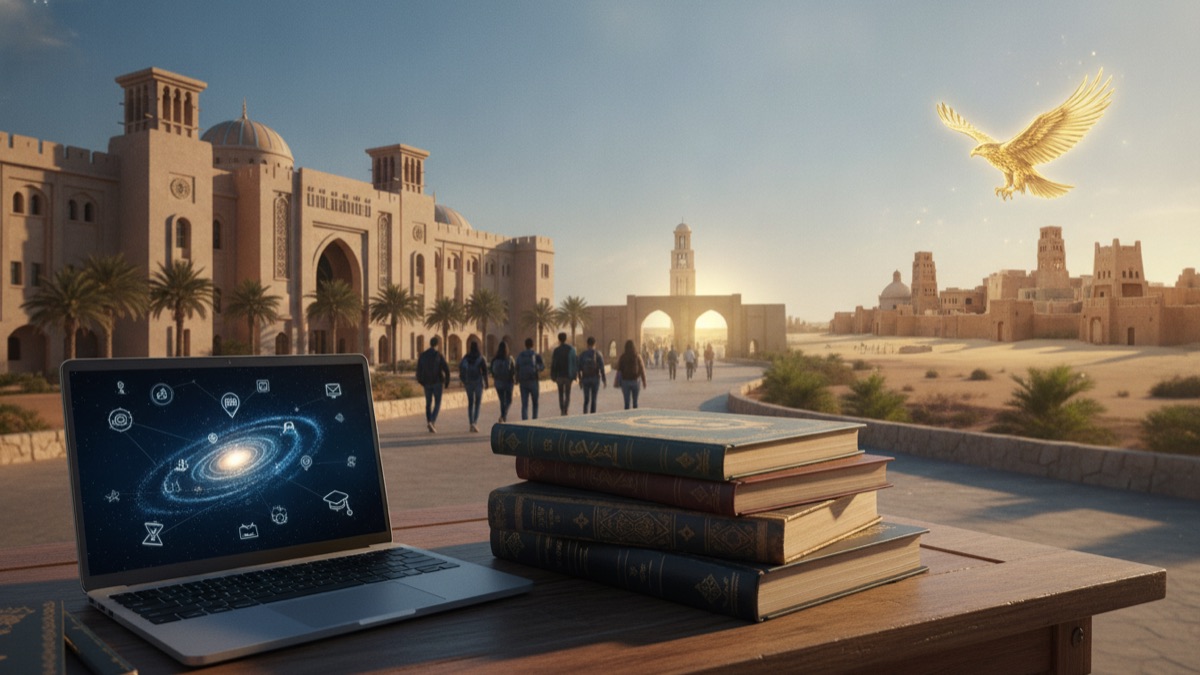
Saudi Education at a Glance
Education in Saudi Arabia has transformed from a small network of Quran schools and tribal tutors into one of the largest state-funded systems in the Arab world. Today, the Kingdom spends a significant share of its national budget on education, and the sector is governed by the Ministry of Education, the Ministry of Higher Education responsibilities, and a growing number of independent commissions.
This guide explains how the system works for families, students, and curious readers. It covers public and private schooling, the structure of the curriculum, leading universities such as KAUST, KSU and KFUPM, scholarship pathways, and the ambitious changes introduced under Saudi Vision 2030. It is an informational overview, not legal or admissions advice, so always check official sources before making decisions.
Whether you are an expatriate parent choosing a school in Riyadh, a Saudi student planning university applications, or an international reader trying to understand the Kingdom’s human capital strategy, the following sections will give you a practical, up-to-date picture.
Public & Private Schooling in Saudi Arabia
Saudi basic education is divided into four main stages. Pre-primary education is optional and typically covers ages three to five. It is offered by kindergartens, many of which are private and increasingly popular in major cities. The government has been expanding access to early childhood education as part of its national development plans.
Primary education lasts six years, usually from age six to twelve. It is compulsory and free in public schools for Saudi citizens. Students study Arabic, Islamic studies, mathematics, science, social studies, and, from later primary grades, English. The curriculum is standardized by the Ministry of Education and is taught in Arabic, with English introduced as a subject.
Intermediate education covers three years, ages twelve to fifteen, followed by secondary education, also three years, ages fifteen to eighteen. At the end of secondary school, students sit for the Tawjihi, the General Secondary Education Certificate examination. Tawjihi results are the main gateway to university admission in Saudi Arabia, and the score often determines which majors and institutions a student can enter.
Private schools form a large and growing segment, especially in Riyadh, Jeddah, the Eastern Province and other major cities. They fall into two broad categories: Saudi-curriculum private schools, which follow the national curriculum but may offer smaller classes and better facilities, and international schools, which teach British, American, Indian or other curricula and often use English as the main language of instruction. Tuition varies widely, from roughly 10,000 SAR per year for modest private schools to more than 100,000 SAR per year for elite international schools.
Private schools are supervised by the Ministry of Education and must meet licensing, safety and staffing requirements. For expatriate families, international schools are often the preferred choice because they provide continuity if children later move to another country. For Saudi families, the decision usually involves a balance of cost, language goals, religious instruction and university preparation.
Curriculum, Language & Assessment
The national curriculum emphasizes four pillars: Islamic studies, Arabic language, science and mathematics, and social studies. Islamic studies are taught throughout all grades and include Quran memorization, Hadith, Fiqh and Islamic history. Arabic is the language of instruction for most subjects in public schools, while English is taught as a core subject from primary school onward.
Science and mathematics have received increasing attention in recent years. New textbooks, teacher training programs and digital platforms aim to raise Saudi students’ performance in international assessments such as TIMSS and PISA. The Kingdom has also introduced coding and computational thinking into some grades, reflecting the priorities of Vision 2030.
Assessment is mainly exam-based. In addition to school-level tests, students face the Qiyas tests for university admission, administered by the National Center for Assessment. The most important is the Qudurat general aptitude test, which many universities require alongside Tawjihi scores. Some faculties, especially medicine and engineering, also require subject-specific tests.
For students in international schools, the path is different. They usually follow IGCSE, AP, IB or other international programs and apply to universities using those qualifications. Some Saudi universities accept international certificates directly; others require equivalency procedures through the Ministry of Education.
Top Universities: KAUST, KSU & KFUPM
Saudi Arabia now hosts more than sixty universities and colleges. They range from large public institutions with tens of thousands of students to small, research-intensive universities with global ambitions. Three names stand out for international recognition.
King Abdullah University of Science and Technology (KAUST), located on the Red Sea coast near Thuwal, is the Kingdom’s flagship research university. Founded in 2009, KAUST offers only graduate programs—master’s and PhDs—in science, engineering and related fields. It operates in English, recruits faculty and students from around the world, and consistently ranks among the top universities in the Middle East for research output and citations. Its campus includes advanced laboratories, a supercomputing center and a marine research station.
King Saud University (KSU) in Riyadh is the oldest and one of the largest universities in Saudi Arabia. Established in 1957, it offers undergraduate and graduate programs across medicine, engineering, humanities, business, law and many other disciplines. KSU is known for its King Khalid University Hospital, its Arabic and Islamic studies programs, and its role in training large numbers of Saudi professionals. It frequently appears in regional university rankings and receives substantial research funding.
King Fahd University of Petroleum and Minerals (KFUPM) in Dhahran is widely respected for engineering, computer science, petroleum studies and business. It has long been the destination of choice for students pursuing careers in the energy sector, and it benefits from its location near Saudi Aramco and the Dammam industrial hub. KFUPM has been expanding its research partnerships and improving its international rankings, especially in engineering and technology.
Other notable institutions include King Abdulaziz University in Jeddah, which has a strong medical school and coastal research programs; Imam Mohammad Ibn Saud Islamic University, known for Islamic and Arabic studies; and Princess Nourah bint Abdulrahman University, one of the largest women’s universities in the world. Technical and vocational training is delivered through the Technical and Vocational Training Corporation and specialized colleges.
Scholarships: King Abdullah Scholarship & Beyond
For decades, Saudi Arabia has used scholarships as a tool to build national expertise. The most famous program is the King Abdullah Scholarship Program, launched in 2005. It sent hundreds of thousands of Saudi students to leading universities in the United States, United Kingdom, Canada, Australia and elsewhere. The program covered tuition, living expenses, health insurance and sometimes family accompaniment. It played a major role in producing a generation of Saudi doctors, engineers, scientists and administrators.
Today, scholarship policy is more targeted. The Custodian of the Two Holy Mosques Scholarship Program and other initiatives focus on degrees aligned with national priorities, such as artificial intelligence, health sciences, cybersecurity, renewable energy and advanced manufacturing. Students are selected based on academic merit, language proficiency and the relevance of the proposed field to the labor market.
Many Saudi universities also offer internal scholarships and financial aid for outstanding students. KAUST, for example, provides full financial support to all admitted graduate students, including tuition, housing and a living stipend. KSU, KFUPM and King Abdulaziz University have merit-based awards for top-performing undergraduates.
For international students, some Saudi universities offer limited scholarships, often tied to specific bilateral agreements or Islamic studies programs. Admission requirements typically include certified transcripts, language test scores, recommendation letters and a clear research or study plan.
Vision 2030 & Education Reforms
Saudi Vision 2030 places human capital development at the center of the country’s diversification away from oil. The education system is expected to produce a skilled, flexible workforce capable of competing globally and driving new industries. Reforms have touched almost every level of education.
At the school level, the Kingdom has revised curricula, introduced new teacher training frameworks, and expanded the use of technology in classrooms. Programs such as iEN provide digital learning resources to students and teachers across the country. There is also a stronger focus on critical thinking, problem solving and creativity, moving beyond rote memorization.
Higher education reforms include giving universities more administrative and financial autonomy, creating research centers of excellence, and improving ties between universities and employers. The government wants Saudi universities to rank higher internationally, increase research publications, and commercialize innovations. New universities and colleges have been established in regions that previously had limited access.
Vocational training has been upgraded through the Technical and Vocational Training Corporation and sector-specific colleges. Fields such as tourism, hospitality, aviation, information technology and health care are receiving special attention to support the growth of entertainment, tourism and logistics sectors. Lifelong learning and professional certification are also being promoted to help workers adapt to changing labor market needs.
Perhaps the most visible social change has been the integration of women more fully into education and the workforce. Female students now make up the majority of university graduates in Saudi Arabia, and their participation in science, engineering and business programs continues to rise. Universities have expanded facilities and opportunities accordingly.
Digital Learning & EdTech
The Saudi education system has embraced digital learning at scale. The Madrasati platform, launched during the COVID-19 pandemic, connected millions of students and teachers to live classes, assignments and resources. It remains a central part of blended learning in public schools and is used for homework, quizzes and parent communication. The iEN national education portal provides digital textbooks, practice tests and analytics for students, parents and teachers across the Kingdom.
Universities have also expanded online and hybrid graduate programs, especially in business, education and data science. Startups in the edtech space are attracting investment, with apps focused on English language learning, test preparation and skill-based micro-courses. The government views classroom technology as essential to reaching remote areas, improving equity and building the knowledge economy envisioned by Vision 2030.
Digital skills are now part of the conversation at every level. From primary students learning basic coding to university researchers using artificial intelligence and big data, technology is reshaping how Saudis learn, teach and innovate.
Choosing a School or University
Selecting the right educational path in Saudi Arabia depends on nationality, language, budget, career goals and family circumstances. For Saudi families, public schools offer a free, faith-based education in Arabic, while private and international schools provide alternative curricula, smaller classes and stronger English environments.
For expatriates, the main choice is usually between an international school that follows a home-country curriculum and a private Saudi-curriculum school. International schools often have waiting lists, so early application is wise. Accreditation, teacher qualifications, extracurricular offerings and university counseling services are important factors to consider.
At the university level, students should look beyond reputation to specific program strengths, research opportunities, internship links and graduate employment outcomes. A student interested in petroleum engineering may prefer KFUPM, while a future medical researcher may lean toward KSU or KAUST. Someone seeking an Islamic studies or Arabic specialization may choose Imam Mohammad Ibn Saud Islamic University.
When evaluating schools, look beyond marketing materials. Visit campuses if possible, ask about teacher turnover, inspect science and computer labs, and review recent inspection reports. For universities, check whether programs are accredited by the National Center for Academic Accreditation and Evaluation, or by international bodies such as ABET for engineering and AACSB for business. Alumni networks, career services and partnerships with employers can significantly affect graduate outcomes. Remember that the most expensive option is not always the best fit; a student who thrives in a supportive environment with strong mentorship often outperforms one in a famous brand.
Always verify admissions deadlines, document requirements and scholarship rules directly with the institution or the Ministry of Education. Policies change, and this article is intended as a starting point rather than a definitive guide.
Sources
- Ministry of Education, Saudi Arabia — Official policies, school curricula, and education statistics.
- Saudi Vision 2030 — National transformation goals, including human capital and education.
- King Abdullah University of Science and Technology — Graduate programs, research, and admissions.
- King Saud University — Programs, faculties, and university history.
- King Fahd University of Petroleum and Minerals — Engineering, energy, and technology education.
- Saudi Arabian Cultural Mission — Information on scholarships and sponsored students abroad.
FAQ
Is education free in Saudi Arabia?
Public education is free for Saudi citizens from primary school through university. Expatriates and some private-school students pay tuition, and there may be small fees for books or activities depending on the institution.
What is the school-leaving exam called?
The General Secondary Education Certificate is known as the Tawjihi. It is the main qualification for university admission and is usually taken at the end of secondary school.
Are international schools available?
Yes. Major cities have British, American, Indian, IB and other international schools. They are regulated by the Ministry of Education and often use English as the primary language of instruction.
What are the top universities in Saudi Arabia?
King Abdullah University of Science and Technology, King Saud University and King Fahd University of Petroleum and Minerals are among the most internationally recognized. King Abdulaziz University, Imam Mohammad Ibn Saud Islamic University and Princess Nourah bint Abdulrahman University are also highly regarded.
What is the King Abdullah Scholarship Program?
It was a large-scale government initiative that funded Saudi students to study abroad at leading international universities. Although the original program has evolved, targeted scholarship schemes continue to support study in strategic fields.
Do Saudi universities teach in English?
Most public universities teach in Arabic, though science, engineering, medicine and business programs often use English textbooks and may offer some courses in English. KAUST teaches entirely in English.
What is Vision 2030 changing in education?
Vision 2030 emphasizes quality, critical thinking, digital learning, university autonomy, vocational training, research commercialization and stronger links between education and the labor market.
Can foreign students study in Saudi Arabia?
Yes, but places are limited and usually tied to specific programs, bilateral agreements or Islamic studies scholarships. Requirements vary by university and should be confirmed with the institution.
What tests are required for university admission?
Most universities require Tawjihi results and the Qudurat general aptitude test. Some competitive programs require additional subject tests or interviews.
Is this article legal or admissions advice?
No. This is a general informational overview. Always consult official university admissions offices, the Ministry of Education, or qualified advisors before making educational decisions.
How long is the Saudi school day?
Most public schools run from early morning until early afternoon, typically around 7:00 AM to 1:00 PM or 2:00 PM, depending on the level and region. Private and international schools may have longer days and additional after-school activities.
Can Saudi students transfer credits from foreign universities?
Yes, subject to evaluation and approval by the Saudi Ministry of Education or the receiving university. Students usually need official transcripts, course descriptions and proof that the foreign institution is recognized.
What support is available for students with special needs?
Saudi Arabia has expanded special education services, including specialized public schools, integration programs in mainstream classrooms, and support units in some private schools. Families should contact individual schools to confirm available resources and individualized support.
About the Author
The doyouknow.app Editorial Team has been covering education, travel, culture and life in the Middle East since 2023. Our writers combine official sources with practical context to produce guides that are accurate, clear and genuinely useful for readers around the world.
Loved This Article?
Share it on WhatsApp → Share on WhatsApp
Get more Middle East guides in your inbox — Subscribe to our newsletter for weekly surprising stories from Saudi Arabia, the UAE, and beyond.