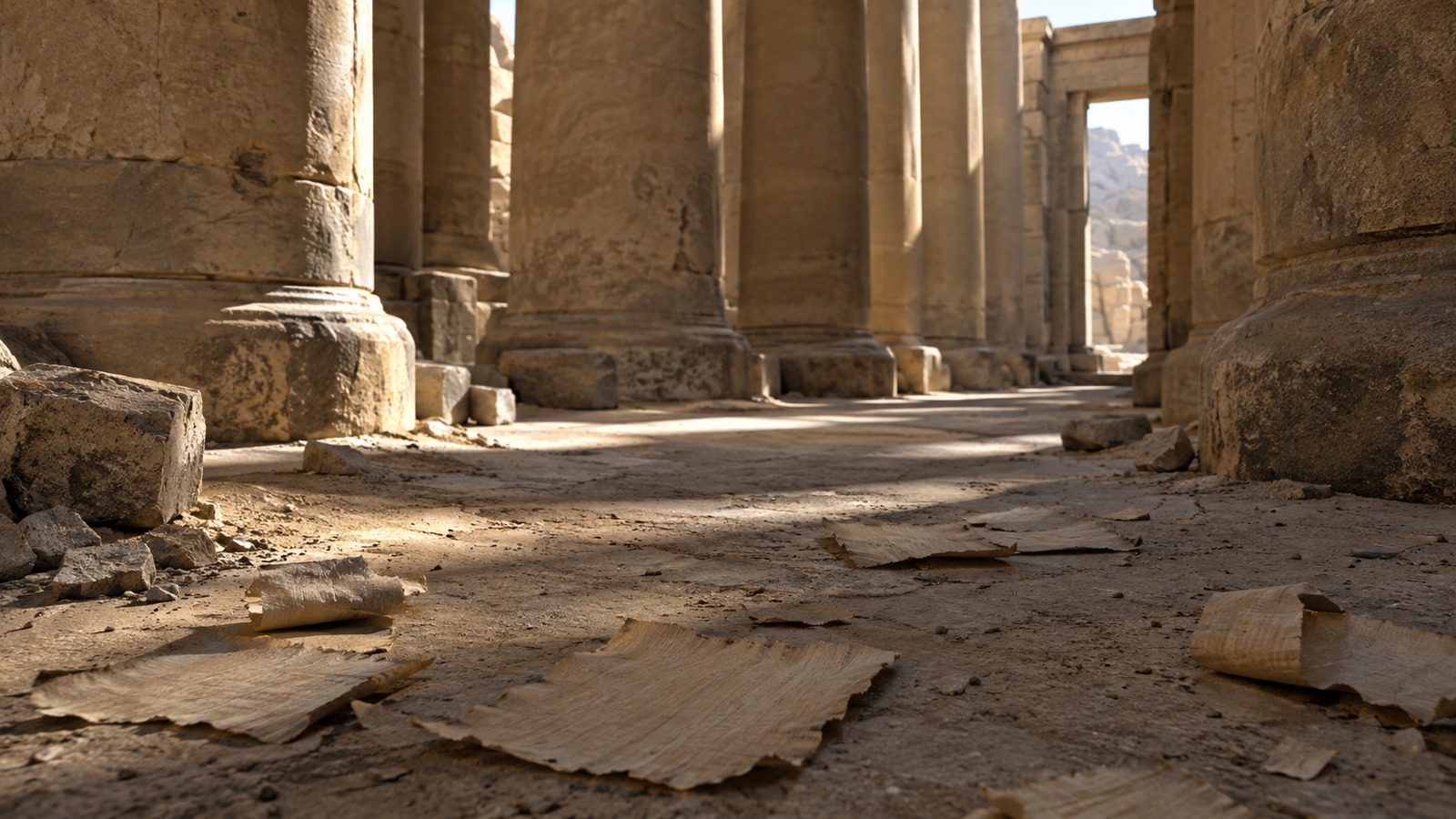
The Library of Alexandria did not vanish in a single dramatic blaze. Popular retellings compress centuries of gradual decline, repeated damage, and shifting political fortunes into one tidy image of flames consuming the ancient world's knowledge overnight, but the documented history is messier, longer, and in some ways more unsettling than the legend.
Untangling what actually happened requires separating a handful of genuinely documented events from a much larger body of later embellishment, and understanding why a single-fire story became so appealing to storytellers even though the evidence points toward a slower, more mundane unraveling.
What the Library of Alexandria Actually Was
The Library was not a single building in the way a modern library is, but the central component of a broader research institution attached to the royal palace complex in Alexandria, the city Alexander the Great founded on Egypt's Mediterranean coast in 331 BCE.
Its collection consisted of papyrus scrolls, the standard writing medium of the era, housed and catalogued on a scale that ancient sources describe as unprecedented, though the often-cited figures of several hundred thousand scrolls come from later writers and cannot be independently verified against a contemporary inventory.
What is better documented is the Library's function: it operated as a genuine research center where scholars produced original work, not merely a passive repository, which is part of why its eventual decline mattered so much to later accounts of the ancient world's intellectual life.
Why Ptolemaic Egypt Built Such an Institution
After Alexander's death, his general Ptolemy took control of Egypt and founded a dynasty that ruled for nearly three centuries. Establishing Alexandria as a center of Greek learning served a genuine political purpose, projecting the new dynasty's legitimacy and cultural authority to both Greek and Egyptian audiences.
The Library and its attached research institution, the Museion, were founded under Ptolemy I and expanded significantly under his son Ptolemy II, who is credited by ancient sources with aggressively growing the collection through purchase, commission, and less scrupulous means.
Royal patronage gave the institution resources unavailable to earlier centers of learning, including funds to pay resident scholars a salary simply to study and write, an arrangement closer to a modern research fellowship than anything that existed previously in the Greek world.
How the Library Actually Acquired Its Scrolls
Ancient sources describe acquisition methods that ranged from ordinary purchase in the book markets of Athens and Rhodes to considerably more aggressive tactics, including a reported policy of confiscating scrolls from ships docking in Alexandria's harbor, copying them, and returning only the copy while keeping the original.
A frequently repeated anecdote holds that Ptolemy III borrowed official Athenian copies of works by Aeschylus, Sophocles, and Euripides against a large security deposit, then forfeited the deposit and kept the originals, sending Athens copies instead — a story that, whether or not precisely accurate, reflects a genuine institutional appetite for acquiring authoritative texts by any available means.
This acquisitiveness meant the Library's holdings were not simply donated or purchased in the ordinary sense but actively hunted down, which historians point to as evidence of just how central controlling the era's most authoritative texts was to the Ptolemaic project of cultural prestige.
The Museion and the Scholars Who Worked There
The Library functioned as part of the Museion, literally a shrine to the Muses, a research institution that supported working scholars across mathematics, astronomy, medicine, geography, and literary scholarship, several of whom produced work that shaped their fields for centuries afterward.
Euclid organized geometry into the systematic form still taught today while working in this milieu; Eratosthenes calculated the Earth's circumference with striking accuracy using measurements taken from Alexandria and Syene; physicians associated with the institution advanced the study of human anatomy through methods that later centuries would not permit again for a long time.
This concentration of talent is precisely why the Library's eventual decline is treated as a genuine loss rather than simply the disappearance of old books: it represented an infrastructure for producing new knowledge, not only for storing existing knowledge, and that infrastructure could not simply be rebuilt once its continuity was broken.
Why the "One Great Fire" Story Is More Myth Than History
The popular narrative of a single catastrophic fire destroying the Library in one stroke conflates at least three distinct historical episodes separated by centuries, each with different causes, different extents of damage, and different levels of supporting evidence.
This compression happened gradually as later writers, working centuries after the events and often relying on earlier secondhand accounts rather than firsthand documentation, tended to simplify a complicated institutional decline into a single dramatic moment that made for a more compelling story.
Modern historians generally treat the "one fire" narrative with real skepticism, not because no fires occurred, but because the evidence better supports a pattern of repeated damage and long institutional decline than one clean destructive event with a definite date.
What Julius Caesar's Fire in 48 BCE Actually Burned
The best-documented fire connected to the Library occurred during Julius Caesar's involvement in Alexandria's civil war in 48 BCE, when Caesar, besieged in the palace quarter, reportedly ordered ships in the harbor set alight to prevent them falling to his opponents, and the fire spread to nearby buildings.
Ancient accounts, including those of Plutarch and Cassius Dio writing well after the event, describe this fire as damaging warehouses near the harbor that may have stored books, but the sources disagree on the scale of loss, and some historians argue the destruction affected a peripheral book depot rather than the Library's core collection.
Whatever its precise extent, this fire is the episode most solidly anchored in near-contemporary written testimony, which is one reason it anchors most modern discussions of the Library's damage even though it likely represents a partial, not total, loss.
The Daughter Library at the Serapeum
By the time of Caesar's fire, Alexandria appears to have had a second, related collection housed at the Serapeum, a major temple complex dedicated to the syncretic god Serapis, which several ancient sources describe as a "daughter library" holding a substantial secondary collection.
The existence of this second site matters enormously for understanding the Library's actual fate, since even a serious fire at the palace complex would not necessarily have destroyed everything, and later damage at the Serapeum represents a separate, later chapter in the collection's decline rather than a repeat of the same event.
Some modern historians argue the Serapeum eventually became the more significant of the two collections as the original palace-based Library declined through the turbulent later Ptolemaic and early Roman periods, making its own eventual fate especially consequential.
Why the Serapeum's Destruction in 391 CE Matters
In 391 CE, the Roman emperor Theodosius I issued edicts against pagan worship, and in Alexandria this led to the destruction of the Serapeum temple complex by a Christian mob, an episode described by the contemporary historian Rufinus and later writers with varying levels of detail about what happened to any books still housed there.
Whether the Serapeum still held a substantial book collection by 391 CE, after centuries of political instability, funding cuts, and earlier damage, is genuinely debated among historians, and some argue the collection had already been significantly diminished or dispersed well before the temple's physical destruction.
What is not seriously disputed is that the Serapeum's destruction removed a major cultural landmark and any books that remained within it, making this episode, alongside Caesar's fire, one of the two best-documented moments of real, physical loss connected to Alexandria's libraries.
The Legend of Caliph Omar and Why Historians Doubt It
A widely circulated story credits the Library's final destruction to the Arab conquest of Egypt in 642 CE, claiming Caliph Omar ordered the remaining books burned to fuel the city's bathhouses on the grounds that if they agreed with the Quran they were unnecessary, and if they disagreed they were heretical.
This account appears only in sources written roughly five to six centuries after the events it describes, with no contemporary seventh-century documentation supporting it, a gap that historians treat as strong evidence the story is a later fabrication rather than a recorded historical fact.
Most modern historians reject the Omar story as legend, noting it fits a familiar pattern of later writers, working in a different political and religious context, attributing a dramatic destructive act to a distant historical figure for polemical purposes rather than describing an actual documented event.
How Gradual Decline, Not One Fire, Actually Ended the Library
The evidence that survives points toward the Library's functional end resulting from a long accumulation of factors: reduced royal patronage as Ptolemaic Egypt's political fortunes declined, the disruption of Roman conquest in 30 BCE, periodic political violence in Alexandria, and the gradual loss of the specialized expertise needed to maintain and copy a fragile papyrus collection.
Papyrus itself is a genuinely perishable material that requires active recopying to survive across centuries, meaning that even without any fire at all, a collection that stopped receiving sustained institutional investment would have degraded and vanished simply through ordinary physical decay and administrative neglect.
This slower explanation is less dramatic than a single burning, but it is considerably better supported by the pattern of evidence, and it reframes the Library's disappearance as a story about the fragility of institutions rather than the destructive power of any one historical villain.
What Was Actually Lost — and What Survived Elsewhere
A great deal of ancient Greek literature and scholarship genuinely did not survive into the modern era, but attributing all of that loss to Alexandria specifically overstates the Library's unique role, since other major collections existed elsewhere in the ancient Mediterranean, and losses accumulated across many centuries and many separate events.
Works that survive today generally did so because they were copied and recopied across multiple locations over centuries, meaning a text's survival depended on a wider network of transmission rather than on any single library's continued existence, however prestigious.
This distributed pattern of survival is itself informative: it suggests the ancient world's intellectual loss resulted from the general fragility of a manuscript culture spread across a violent, unstable late-antique Mediterranean, not from one institution's single catastrophic end.
How Modern Scholars Reconstruct What the Library Held
No surviving catalogue lists the Library's full holdings, so modern scholars reconstruct an approximate picture using indirect evidence: citations and references to specific works by other ancient authors, later summaries and commentaries, and the biographical and scholarly output of Museion-affiliated researchers whose work implies access to particular texts.
This reconstructive method is inherently imperfect and leaves genuine gaps, but it has allowed historians to build a reasonably confident picture of the Library's scope in fields like mathematics, astronomy, and medicine, even without a surviving inventory.
The persistent uncertainty around exact numbers and exact contents is itself part of why the Library continues to attract popular fascination: an institution known mostly through its absence invites speculation in a way a well-documented one rarely does.
The Bibliotheca Alexandrina as a Modern Answer
In 2002, Egypt opened the Bibliotheca Alexandrina on Alexandria's waterfront, a modern library and cultural institution built with UNESCO support explicitly conceived as a successor to the ancient Library, though it holds no direct physical or documentary continuity with the original collection.
The project reflects a deliberate act of cultural memory rather than archaeological reconstruction, aiming to revive Alexandria's historical association with knowledge and international scholarship using an entirely new building, digital archives, and contemporary research programs.
Its existence is a useful reminder that the ancient Library's afterlife as a symbol has arguably outlasted and outgrown any factual account of its physical contents, shaping how the modern world thinks about libraries as institutions worth defending.
Why the Library Became a Symbol of Knowledge Lost
The Library's transformation into a near-universal shorthand for irretrievable cultural loss owes less to the precise facts of its decline than to how useful that image proved for later writers making arguments about the fragility of knowledge, the dangers of censorship, or the costs of political and religious violence.
Enlightenment-era writers in particular found the burning-library image a powerful rhetorical tool against religious intolerance and book-burning specifically, which helped cement the dramatic single-fire version of the story in popular culture even as the underlying scholarship pointed toward a slower, more complicated decline.
This gap between the popular symbol and the documented history is not unique to the Library of Alexandria, but few ancient institutions illustrate it as clearly, since the symbolic version has become so widely known that the more accurate, less cinematic account often surprises people encountering it for the first time.
What the Real Story Teaches About Historical Myths
The Library of Alexandria's actual history is a useful case study in how historical myths form: a genuinely significant institution experiences a real, complicated decline across centuries, later writers compress that complexity into a single memorable event, and each retelling strips away a little more of the original nuance in favor of narrative clarity.
Recognizing this pattern does not diminish the genuine loss involved. Centuries of accumulated scholarship, careful textual preservation work, and a functioning research infrastructure did disappear, gradually, through a combination of real violence, institutional neglect, and ordinary material decay, and that loss remains historically significant on its own terms.
What changes with the more accurate account is the lesson drawn from it: not a single villain to blame for one catastrophic act, but a demonstration of how consistently institutions depend on sustained investment and stability to survive, and how quickly even celebrated ones can unravel once that support is withdrawn.
Sources
- Wikipedia — overview of the Library's history, sources, and the historiography of its decline
- UNESCO — background on the modern Bibliotheca Alexandrina and its stated relationship to the ancient institution
- Encyclopaedia Britannica — reference overview of the Library, the Museion, and Ptolemaic Alexandria
- Library of Congress — comparative context on ancient library institutions and manuscript preservation
- World History Encyclopedia — detailed articles on the Museion, the Serapeum, and the Ptolemaic dynasty
FAQ
Did the Library of Alexandria burn down in a single fire?
No — the evidence points to at least two separate documented fires centuries apart (48 BCE and 391 CE) plus a long gradual decline, not one catastrophic event.
Did Caliph Omar order the Library burned?
Most historians reject this story; it first appears in sources written five to six centuries after the events with no contemporary documentation supporting it.
What actually burned in Julius Caesar's fire?
Ancient sources describe harbor warehouses that may have stored books catching fire during Caesar's 48 BCE siege, though the scale of any library loss is debated.
Is the modern Bibliotheca Alexandrina built on the original site?
It stands on Alexandria's waterfront near the ancient city center but has no direct physical or documentary continuity with the original Library's collection.
How do historians know what the Library held if no catalogue survives?
They reconstruct an approximate picture from citations in other ancient texts, later summaries, and the documented work of scholars affiliated with the Museion.
About the Author
We reference Wikipedia, UNESCO, Encyclopaedia Britannica, the Library of Congress, and the World History Encyclopedia to explain the background and current understanding of this topic.
Loved This Article?
Share it on WhatsApp → Share it on WhatsApp
Get more guides in your inbox — Subscribe to our newsletter for weekly surprising stories from Egypt, Saudi Arabia, Dubai, and beyond.