World Cup matches are played outdoors, in daylight, in the middle of summer. In several host cities that means pitch-level conditions can climb into territory that would be treated as a genuine occupational heat hazard in almost any other line of work, yet ninety minutes of high-intensity sprinting is exactly what is scheduled to happen there. The engineering response to that mismatch, broadly grouped under the heading of stadium cooling, is one of the least visible but most consequential pieces of World Cup infrastructure.
Understanding how it actually works means separating three related but distinct problems: keeping the playing surface itself within a safe and consistent temperature range, keeping the air that players breathe and move through tolerable, and keeping tens of thousands of seated spectators reasonably comfortable for hours at a time. Each of those problems has a different engineering answer, and not every host stadium needs to solve all three.
Why Heat Is a Genuine World Cup Problem
Elite footballers cover somewhere in the range of ten to twelve kilometres over a match, much of it at high intensity, wearing kit that is not designed primarily for thermal regulation. That workload generates substantial internal heat that the body must shed through sweating and radiant loss, and both of those cooling mechanisms become measurably less effective as ambient temperature and humidity rise.
When conditions push core body temperature high enough, the practical consequences are not merely subjective discomfort. Decision-making speed degrades, sprint capacity in the closing minutes of a half drops sharply, and in genuinely extreme cases heat illness becomes a real medical risk rather than a theoretical one. Tournament organisers have known this for years, which is precisely why the question of how to physically cool a stadium has become a serious design brief rather than a marketing afterthought.
The problem is compounded by the fact that footballers cannot simply pace themselves the way an endurance athlete training alone might. Match tempo is dictated by opponents, tactical situations, and the scoreline, meaning a player cannot unilaterally slow down during a dangerous heat spike without conceding a genuine competitive disadvantage, which removes one of the most natural self-protective behaviours available in other hot-weather sports.
What Counts as Dangerous Heat for a Footballer
Sports medicine bodies typically assess heat risk using a composite measure rather than raw air temperature alone, because humidity, direct sunlight, and air movement all change how effectively a body can actually dissipate heat. A hot but dry, breezy day can be considerably safer than a cooler but extremely humid and still one, which is part of why simple temperature forecasts are a poor guide to actual match-day risk.
Once a composite heat-stress reading crosses defined thresholds, protocols generally call for mandatory cooling breaks partway through each half, giving players a brief structured pause to rehydrate and cool down regardless of the score or flow of the match. Engineering solutions exist precisely to reduce how often those thresholds are crossed in the first place, rather than to replace the protocol entirely.
How Retractable Roofs Change the Cooling Problem
The single most effective tool against extreme heat is removing direct solar radiation altogether, which is exactly what a retractable roof does when closed. Direct sun exposure can add a substantial perceived-temperature penalty on top of ambient air temperature, so eliminating it changes the entire scale of the cooling challenge that remains to be solved mechanically.
A closed retractable roof also converts an open-air stadium into something closer to a very large enclosed space, which makes mechanical air cooling dramatically more tractable, since the conditioned air is no longer being continuously lost to the outside atmosphere. This is why several extreme-heat host venues rely on a combination of a closable roof and air-handling systems rather than either approach alone.
Materials matter too: dark, heat-absorbing surfaces on seating and concourses can raise local ambient temperature by a noticeable margin compared with lighter, more reflective finishes, which is why some newer venue designs specify seat colour and hardscaping material partly on thermal grounds rather than purely on branding or aesthetics.
How Air-Based Cooling Systems Actually Work
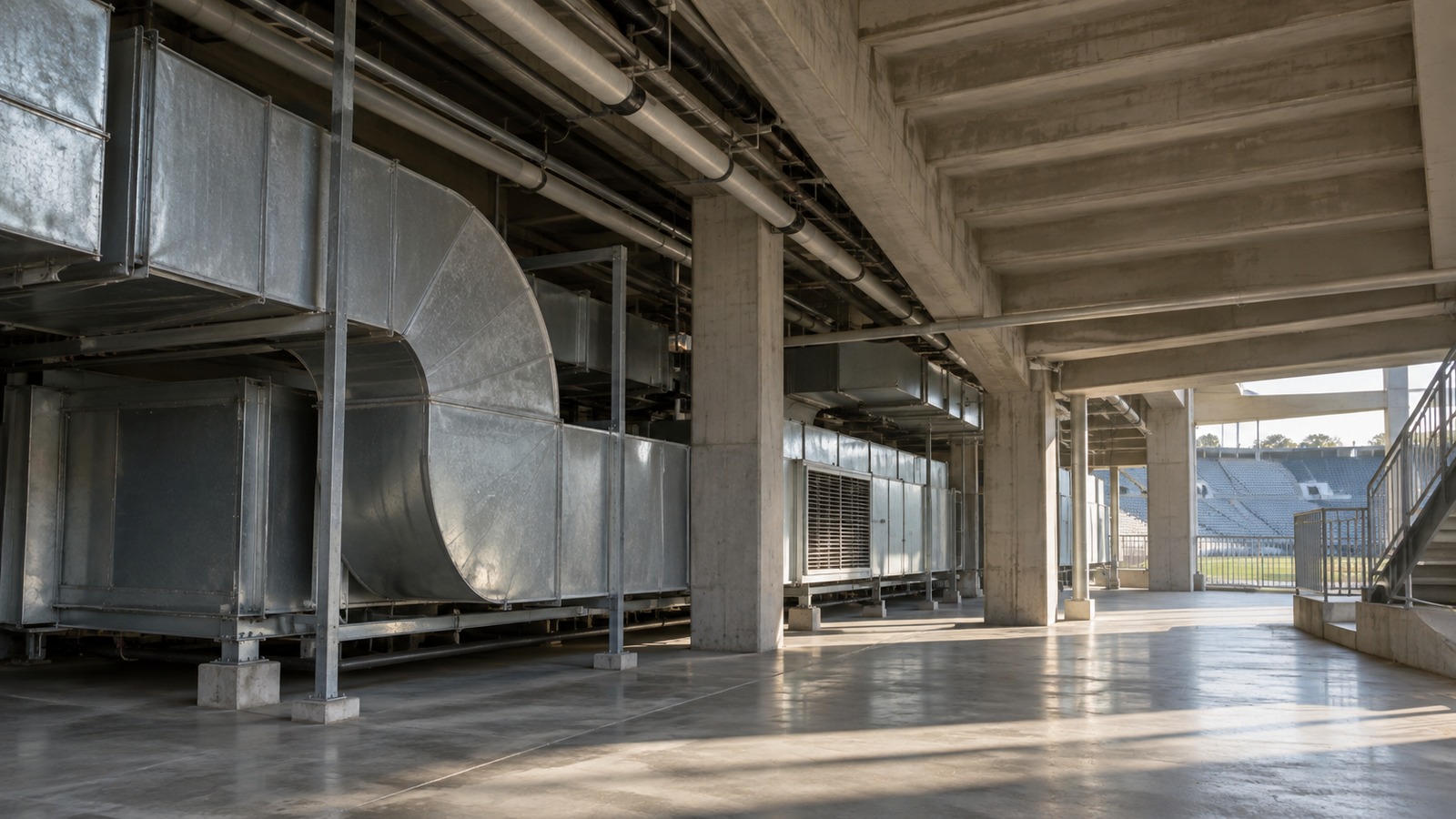
The core mechanical approach is broadly similar to large-scale air conditioning, adapted to an enormous and unusually shaped volume of air. Chilled air is produced by industrial cooling plant, then distributed through extensive ductwork to outlets positioned around the seating bowl and, in the more advanced pitch-focused installations, through nozzles built directly into the stands and even beneath the playing surface itself.
Rather than attempting to chill the entire volume of air inside a stadium uniformly, which would be extraordinarily energy-intensive, well-designed systems focus conditioned airflow specifically at occupied zones, the seating bowl and the pitch perimeter, using directional outlets and careful airflow modelling to concentrate the cooling effect where people actually are.
Why Cooling the Pitch Is Harder Than Cooling the Stands
Cooling seated spectators is, relatively speaking, the more tractable half of the problem, since air can be directed at fixed rows of people from outlets built into the stand structure. The pitch presents a harder challenge because natural turf is itself sensitive to airflow, temperature, and humidity in ways that affect its growth and playing characteristics, meaning cooling cannot simply blast cold air across the surface without consequence for the grass itself.
Some pitch-cooling approaches instead focus on a band of conditioned air at approximately player height rather than at ground level, using perimeter nozzles angled to create a cooler microclimate exactly where players are moving without significantly disturbing the turf's own growing conditions, which requires considerably more precise engineering than simple stand cooling.
Beneath-surface conditioning, where used, typically involves a network of pipes carrying chilled fluid installed under the root zone of the turf, primarily intended to keep grass roots within an optimal growing range rather than to cool the air players actually breathe, which illustrates how pitch cooling and pitch conditioning are related but not identical engineering goals.
How Sensors and Modelling Guide Real-Time Cooling
Modern stadium cooling installations are rarely running at a single fixed setting throughout a match. Temperature, humidity, and airflow sensors distributed around the bowl feed continuous data back to a control system, which adjusts output to compensate for factors like direct sun angle changing over the course of the afternoon or a sudden shift in outside wind conditions.
Before a tournament, engineers typically run extensive computational airflow modelling against historical weather data for the specific host city and kickoff time, essentially simulating how heat and air will move through the finished structure under a range of plausible match-day conditions, which shapes decisions about outlet placement long before the physical system is ever switched on.
Why Humidity Matters as Much as Temperature
Cooling systems that only lower air temperature without addressing humidity can leave a meaningful comfort and safety gap, since sweat evaporation, the body's primary cooling mechanism during exertion, becomes markedly less effective in humid air regardless of how cool that air technically is. This is why more sophisticated installations pair temperature control with active dehumidification rather than treating temperature as the only variable that matters.
Dehumidifying a stadium-scale volume of air is itself a substantial engineering undertaking, and the energy cost of doing so is one of the significant hidden costs of a genuinely effective cooling system, distinct from and additional to the energy required simply to lower temperature.
Away from the pitch, concourse and hospitality areas are frequently engineered as fully enclosed, conventionally air-conditioned spaces precisely because the harder open-bowl cooling problem does not need to be solved there at all, giving spectators a genuine escape option during breaks that the seating bowl itself, by its open-air nature, usually cannot offer to the same degree.
How FIFA's Heat Protocols Interact With Engineering
Mechanical cooling and formal heat protocols are designed to work together rather than as substitutes for one another. Even a stadium with an effective cooling system can still trigger mandatory cooling breaks if conditions cross defined thresholds, because engineering can reduce risk without eliminating it entirely, particularly for the substantial proportion of the pitch and stands that inevitably sit outside the zone of peak system effectiveness.
Match scheduling itself functions as a protocol-level lever independent of any hardware, since organisers can and do shift kickoff times for the hottest host cities to cooler parts of the day specifically to reduce reliance on mechanical systems and cooling breaks alike.
Broadcasters and match officials also draw on the same sensor networks, since a documented, continuously logged temperature and humidity record for a specific kickoff gives referees defensible, data-backed grounds for triggering a cooling break rather than relying on subjective judgement alone, which matters in a competitive context where any in-match decision can be second-guessed.
What Happens in Stadiums Without Mechanical Cooling
Not every World Cup host venue needs or uses active mechanical cooling. Stadiums in temperate host cities, or those hosting matches scheduled for cooler parts of the day or year, can rely on passive strategies instead, including structural shading, prevailing wind exposure through open stand design, and simply favourable ambient climate for the relevant kickoff window.
Passive design choices made at the original construction stage, such as stand orientation relative to prevailing wind and the sun's path, can meaningfully reduce peak in-stadium temperatures without any mechanical system at all, which is why cooling strategy varies considerably from venue to venue rather than following one uniform template across the tournament.
How Cooling Systems Try to Manage Energy Use
Chilling and dehumidifying air at stadium scale is genuinely energy-intensive, and that cost has become a legitimate point of scrutiny given wider commitments to reducing the environmental footprint of major sporting events. Some installations attempt to offset this through renewable energy sourcing, thermal storage that pre-cools reservoirs of water or ice during off-peak hours for release during the match itself, or heat-exchange approaches that are more efficient than brute-force refrigeration.
The genuine sustainability picture is mixed and depends heavily on specific system design and the source of the electricity powering it, and critics reasonably point out that mechanically cooling an open-air structure will always carry a meaningfully larger energy footprint than simply avoiding extreme-heat scheduling in the first place.
Retrofitting an older stadium with mechanical cooling after the fact is also considerably more expensive and structurally constrained than designing it in from the outset, since ductwork, outlet placement, and load-bearing considerations for the additional plant equipment are far easier to plan for on a blank sheet than to force into an existing bowl, which is part of why host selection and stadium design decisions are made years, not months, ahead of a tournament.
Why Kickoff Times Are Also a Cooling Strategy
Scheduling is, in effect, the lowest-cost cooling technology available to tournament organisers. Moving a match from early afternoon to evening in a hot host city can reduce peak heat exposure by a wide margin without requiring any mechanical intervention at all, which is why kickoff-time decisions for the hottest venues are made with heat risk as an explicit, not incidental, consideration.
This scheduling lever inevitably interacts with broadcast demands from markets in very different time zones, meaning the final kickoff time for any given match usually reflects a genuine trade-off between player safety, global audience reach, and local matchday atmosphere rather than any single dominant factor.
Player unions and medical bodies have periodically pushed for tournament scheduling to be shifted further still, arguing that engineering can only ever be a partial mitigation and that the more reliable long-term solution is simply not staging elite outdoor football in the hottest possible windows of a given host region's calendar, a position that puts sporting-calendar economics in direct tension with player welfare in a way stadium hardware alone cannot resolve.
What This Means for Fans Inside the Stadium
For spectators, an effectively cooled stadium can be the difference between a tolerable afternoon and a genuinely miserable one, particularly for fans without the option of retreating to shaded or air-conditioned concourse areas during breaks in play. Seating position relative to cooling outlets, direct sun exposure, and proximity to open sides of the bowl can all noticeably affect the experience even within a single, ostensibly cooled venue.
Stadium cooling technology exists because the physics of the problem leaves no simpler alternative: a live outdoor sporting event scheduled months in advance cannot be moved to avoid a heatwave on short notice, so organisers instead engineer around the climate they know they are likely to face. Retractable roofs remove the largest single source of heat load, air-handling systems target cooling at occupied zones rather than the whole stadium volume, sensor-driven control adapts output in real time, and scheduling absorbs whatever risk remains that hardware cannot solve.
None of these measures make a genuinely extreme-heat host city equivalent to a temperate one, and FIFA's own heat protocols exist precisely because engineering reduces rather than eliminates risk. But taken together, they represent a serious, purpose-built response to a problem that becomes unavoidable the moment a tournament is awarded to a hot-climate region and cannot simply be wished away by broadcast schedules or ticket sales.
Sources
- Wikipedia — overview of heat illness and exertional heat risk
- FIFA — tournament regulations, host city information, and player welfare protocols
- World Health Organization — guidance on heat stress and public health during extreme heat events
- ASHRAE — technical standards for large-scale ventilation, air conditioning, and thermal comfort
- UEFA — comparable stadium and match-day heat management practices from major football tournaments
FAQ
Do all World Cup 2026 stadiums need active cooling?
No. Only host venues in hot-climate regions or with retractable roofs typically deploy active mechanical cooling; venues in temperate host cities generally rely on scheduling and natural ventilation instead.
How much does stadium cooling actually lower the temperature?
Engineered systems in comparable tournaments have demonstrated pitch-level and stand-level reductions of several degrees Celsius compared to ambient outdoor conditions, enough to meaningfully change perceived heat stress even if it does not make a hot day feel cold.
Does cooling technology affect how the match is played?
Indirectly. Cooler conditions reduce fatigue-driven drop-offs in sprint speed and decision-making late in matches, which is part of why governing bodies also mandate cooling breaks in extreme heat regardless of mechanical systems.
Is stadium cooling only for spectator comfort?
No, player safety is the primary driver — heat-related illness risk during 90 minutes of high-intensity exercise is a genuine medical concern that shapes FIFA's own extreme-heat protocols.
Are cooling systems used for the World Cup considered sustainable?
It depends on the design; some systems are built around renewable energy and efficient heat-exchange rather than brute-force refrigeration, though the overall energy footprint of cooling a stadium remains a genuine sustainability debate.
About the Author
We reference Wikipedia, FIFA, the World Health Organization, ASHRAE, and UEFA to explain the background and current understanding of this topic.
Loved This Article?
Share it on WhatsApp → Share it on WhatsApp
Get more guides in your inbox — Subscribe to our newsletter for weekly surprising stories from Egypt, Saudi Arabia, Dubai, and beyond.