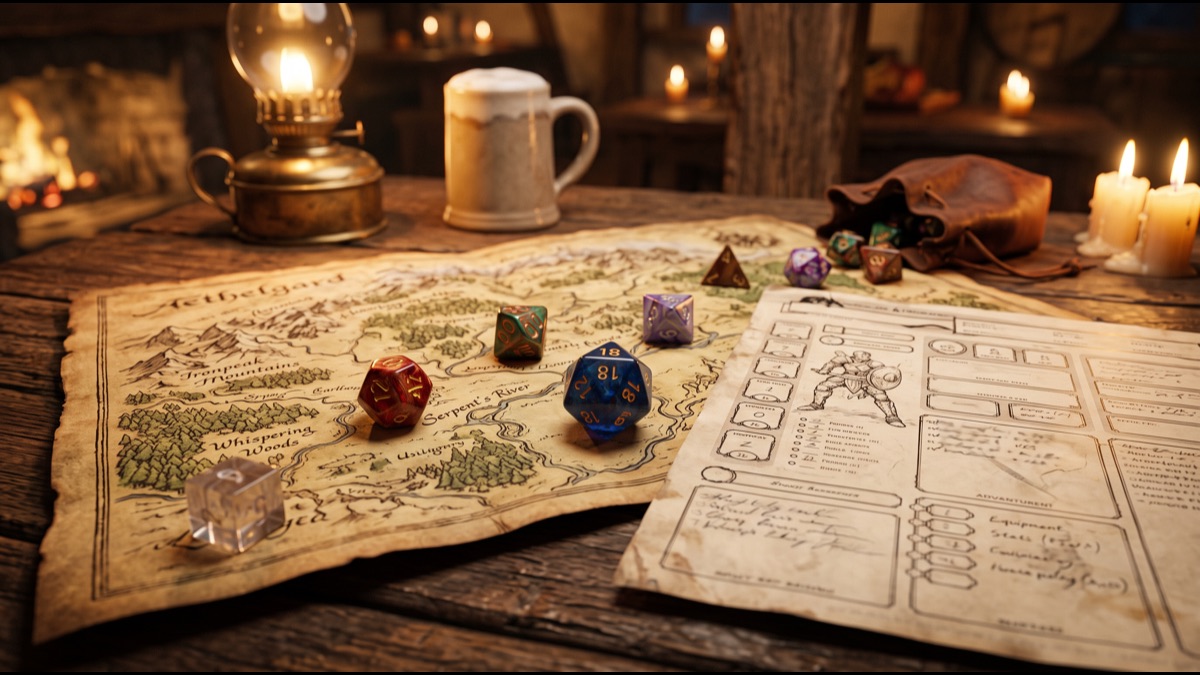
Tabletop role-playing games grew directly out of miniature wargaming, a hobby where players moved small figures across a table to refight historical battles, often from the Napoleonic era. What was missing from that hobby was any sense of an individual character with a personality and an ongoing story.
Dave Arneson supplied that missing piece around 1970-71 with his Blackmoor campaign, where players controlled single characters exploring a dungeon rather than commanding whole armies, and those characters could survive, grow, and carry their gains from one session into the next.
From Miniature War Games to Character-Driven Play
Dungeons & Dragons and What Came After
Gary Gygax built on Arneson's idea and, together with him, published Dungeons & Dragons in 1974 through the small company Gygax co-founded, TSR, in a modest initial print run of about 1,000 copies. It introduced now-standard elements like polyhedral dice, character classes, and a game master who narrates the world and adjudicates the rules.
In the 1980s, D&D became the target of an unfounded "Satanic Panic," a moral panic that wrongly linked the game to occultism and a handful of unrelated tragedies. Decades later, actual-play streams like Critical Role and mainstream shows like Stranger Things helped drive a major resurgence, pulling tabletop RPGs back into the cultural spotlight.
Sources
- Smithsonian Magazine — the origins of Dungeons & Dragons
- Library of Congress — the history of tabletop role-playing games
- Wired — the modern resurgence of tabletop RPGs
FAQ
Who actually invented Dungeons & Dragons?
Gary Gygax and Dave Arneson developed it together, building on Arneson's earlier Blackmoor campaign, and Gygax published it in 1974 through the company TSR that he co-founded.
Why did tabletop RPGs face controversy in the 1980s?
An unfounded moral panic known as the "Satanic Panic" wrongly linked Dungeons & Dragons to occultism, despite no credible evidence connecting the game to the tragedies it was blamed for.
What sparked the modern resurgence of tabletop RPGs?
Actual-play web series like Critical Role and mainstream pop culture references, particularly Stranger Things, introduced the hobby to a much wider, younger audience starting in the mid-2010s.
About the Author
We reference Smithsonian Magazine, Library of Congress, Wired to explain the background and current understanding of this topic.
Loved This Article?
Share it on WhatsApp → Share it on WhatsApp
Get more guides in your inbox — Subscribe to our newsletter for weekly surprising stories from Egypt, Saudi Arabia, Dubai, and beyond.