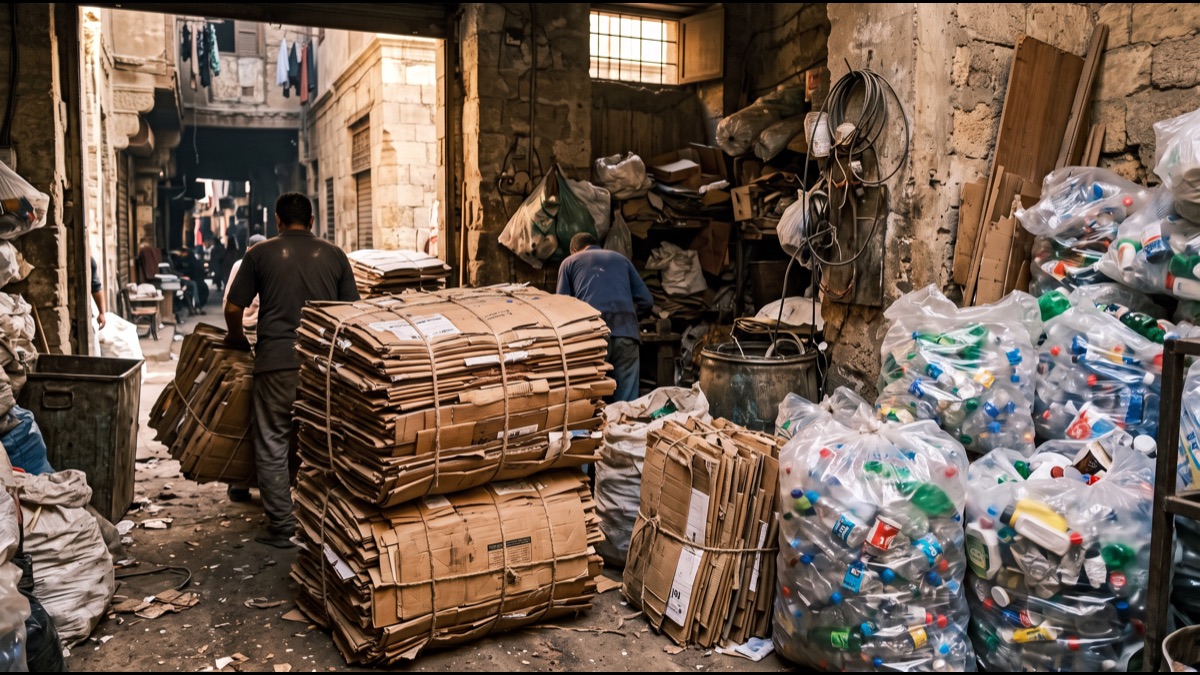
For decades, most of Cairo's household waste has not been collected by trucks dispatched from a municipal depot on a fixed schedule. It has instead been gathered door to door, sack by sack, by members of the Zabaleen, an informal community of roughly seventy thousand collectors and sorters who built one of the highest-performing recycling systems in the world without any government mandate requiring them to do so.
The story of how that system emerged, why it has repeatedly survived attempts to replace it with modern contracted alternatives, and what it actually looks like inside a Cairo sorting workshop reveals a great deal about informal economies that formal planning consistently underestimates.
Who the Zabaleen Actually Are
The word zabaleen is Egyptian Arabic for garbage people, a term the community itself has largely reclaimed despite its blunt origin. Most families trace their roots to Coptic Christian farmers who migrated from villages in Upper Egypt, particularly around Assiut, between the 1940s and 1970s, arriving in Cairo with few resources and finding waste collection one of the only trades open to newcomers without capital or connections.
They did not invent door-to-door collection from nothing. An earlier group known as the Wahiya, largely Muslim migrants from the Dakhla oasis, had already secured informal rights to collect waste from specific buildings and neighborhoods in exchange for a small monthly fee from residents. Zabaleen families entered into a subcontracting relationship with the Wahiya, taking on the physical collection and sorting in exchange for a share of what the recovered material was worth.
Why Cairo's Formal System Never Displaced Them
Cairo's population has grown far faster than any centrally planned sanitation department has managed to keep pace with, and the city's dense, informally built neighborhoods with narrow alleys are often physically inaccessible to standard compactor trucks. Door-to-door collection by cart, and later by small pickup trucks, could reach buildings that municipal vehicles simply could not.
Just as importantly, the Zabaleen offered residents something the formal system did not: a personal, negotiated relationship in which a familiar collector came to the door on a predictable schedule, in exchange for a modest informal fee that residents generally found reasonable given the convenience and reliability involved.
How the Door-to-Door Collection Route Actually Works
Each Zabaleen collector, historically working with a donkey cart and today often with a small three-wheeled vehicle or pickup, maintains a fixed route covering a specific set of buildings, often inherited from a parent or negotiated through years of relationship-building with a particular neighborhood. Residents place mixed household waste in bags or bins, and the collector gathers it directly rather than requiring residents to sort or carry it to a curb.
The relationship is transactional but personal. Collectors typically receive a small monthly payment directly from each household on their route, a sum that is separate from any municipal tax and that residents pay because the service is reliable, rather than because any authority compels them to.
What Happens Inside a Sorting Workshop
Once collected, waste is brought back to family workshops, most concentrated in a handful of neighborhoods on Cairo's eastern edge, where it is manually sorted by category, a labor-intensive process that typically involves the whole household, including women and children working alongside adult men.
Plastics, paper, cardboard, metal, glass, and textiles are separated into distinct streams, each destined for a different buyer or processing step. Organic waste historically went to feed pigs kept on site, while inorganic recyclables were baled, shredded, or otherwise prepared for sale to intermediaries who supplied Egypt's plastics and paper manufacturing industries.
Why Their Recycling Rate Outperforms Most Cities
Independent researchers and development organizations studying the system have repeatedly estimated that the Zabaleen recover and recycle around eighty percent of the waste that passes through their hands, a figure that compares favorably with recycling rates in many wealthy cities that operate far more heavily funded formal municipal programs.
The explanation is largely economic rather than environmental. Every material sorted out and sold represents direct income for the household doing the sorting, creating a powerful built-in incentive to extract as much recoverable value as possible from every load, an incentive that a salaried municipal worker collecting a fixed wage regardless of sorting effort simply does not have in the same way.
Formal municipal recycling programs in wealthier countries typically rely on residents voluntarily separating recyclables at the point of disposal, a step that depends entirely on public cooperation and that studies repeatedly show a meaningful share of households simply skip, contaminating entire truckloads with mixed waste that then becomes uneconomical to process. The Zabaleen system sidesteps that weak link almost completely, since sorting happens downstream of collection by people whose income depends directly on doing it thoroughly rather than upstream by residents with no direct stake in the outcome.
The Role Pigs Once Played in the System
For much of the twentieth century, pigs were the quiet engine of the entire operation. Organic food waste, which makes up a large share of any city's household trash and which has essentially no resale value once sorted out, was fed to pigs raised on site in Zabaleen neighborhoods, converting a disposal cost into livestock that could later be sold for meat.
This arrangement meant the Zabaleen could profitably accept genuinely mixed household waste rather than requiring residents to pre-sort it, since even the organic fraction that most recycling systems worldwide struggle to process economically had a clear buyer within the community itself.
How the 2009 Swine Flu Cull Devastated the Trade
In 2009, as the H1N1 influenza strain spread globally, Egyptian authorities ordered the culling of the country's entire pig population as a precautionary public health measure, despite public health experts at the time noting that the virus was not known to spread through pork consumption or contact with pigs in the way the policy implied.
Roughly three hundred thousand pigs were destroyed nationwide, the overwhelming majority of them owned by Zabaleen families who lost both a significant income source and, more immediately, their principal method for processing organic waste. Uncollected and unprocessed organic trash visibly accumulated in Cairo's streets in the following months, a consequence that community advocates had specifically warned authorities about beforehand.
Why Privatization in the 2000s Largely Failed
In the years before the cull, Cairo's government had already begun awarding formal, large-scale waste collection contracts to multinational companies, aiming to modernize the system with standardized bins, scheduled truck routes, and a fee collected through electricity bills rather than door-to-door cash payments.
The new contractors struggled on several fronts. Communal bins were poorly suited to neighborhoods accustomed to direct collection, uptake of the formal fee was inconsistent, and the recycling rates achieved by the multinational operators fell well short of what the Zabaleen had informally sustained for decades, prompting the city to lean back on the very informal system it had set out to replace.
Manshiyat Naser and the Cave Church
The largest concentration of Zabaleen families lives in Manshiyat Naser, a district built into the base of the Mokattam hills on Cairo's eastern edge, sometimes referred to informally as Garbage City because sorting workshops occupy the ground floors of so many of its apartment buildings, with recyclable material stacked and staged in courtyards and rooftops throughout the neighborhood.
Carved into the surrounding limestone cliffs is the Monastery of Saint Simon the Tanner, a complex of cave churches that community members themselves helped excavate and build following a series of quarry fires that cleared space in the rock, forming what is often described as the largest church complex in the Middle East and a significant point of pride and identity for the largely Coptic Christian community.
How Education Programs Reshaped the Community
Nonprofit organizations working with Zabaleen families, including groups focused specifically on the Mokattam community, established schools and vocational training centers aimed particularly at children who might otherwise have entered the sorting trade at a very young age instead of attending formal education.
These programs, some dating back to the 1980s and expanded with international development funding since, combined literacy and numeracy instruction with practical training in areas like handicrafts made from recycled material, textiles, and small business skills, gradually widening the range of livelihoods available to a generation raised within the community.
What Recycling Actually Sells For
The economics of Zabaleen recycling rest on a chain of intermediaries. A household sorting waste sells baled plastic, paper, or metal to a local trader, who in turn aggregates larger volumes for sale to processing facilities that convert the sorted material into raw input for Egypt's manufacturing sector, including plastic pellets used in packaging and construction materials.
Prices for recovered material fluctuate with global commodity markets for plastics and metals, meaning a household's monthly income from sorting can shift meaningfully with international price swings entirely outside their control, adding a layer of financial uncertainty to already physically demanding work.
Some materials carry substantially more value than others, which shapes daily behavior in the workshops. Clean, unmixed plastic bottles fetch far more per kilogram than contaminated or mixed plastic film, so households often specialize in extracting particular high-value streams first before moving on to lower-margin material, a practice that further increases the overall recovery rate compared with a one-size-fits-all municipal sorting line.
Why the Work Is Passed Down Through Families
Collection routes function much like inherited property within the community, passed from parent to child along with the relationships built up with residents on that route over years or decades, making entry into the trade for outsiders without an existing family connection genuinely difficult.
This inheritance pattern has helped preserve institutional knowledge, including which buildings produce which kinds of recyclable material and how best to negotiate fees, but it has also meant that children have historically begun working alongside parents from a young age, a pattern that the education initiatives described earlier were specifically designed to interrupt.
How Climate and Health Risks Shape the Trade
Manual sorting of unsegregated household waste exposes workers to health hazards ranging from sharp objects and broken glass to biological contamination and airborne particulates, risks that are considerably higher than those faced by workers in mechanized municipal sorting facilities equipped with protective infrastructure.
Health organizations working with the community have documented elevated rates of respiratory conditions and skin ailments among longtime sorters, and advocacy groups have pushed for improved protective equipment and workshop ventilation even as the fundamentally informal and unregulated nature of the trade limits what formal occupational safety standards can realistically be enforced.
What International Attention Has Changed
Documentary filmmakers, journalists, and environmental researchers have repeatedly featured the Zabaleen since the 1980s, drawing international attention to a recycling rate that many wealthy cities with far larger environmental budgets have struggled to match, and prompting occasional partnerships with European development agencies interested in the model's efficiency.
This attention has brought some tangible support, including composting projects and recycling school initiatives, but community advocates note that global interest has not always translated into secure legal recognition of the Zabaleen's collection rights or protection from being displaced by future formalization efforts.
Why the Model Still Matters for Other Cities
Waste management researchers studying rapidly urbanizing cities elsewhere in the developing world increasingly point to the Zabaleen system as evidence that informal, incentive-aligned recycling networks can outperform capital-intensive formal alternatives, provided they are supported rather than displaced by policy.
The lesson many draw is not that informal systems should remain permanently informal, but that any formalization effort needs to work with existing collectors and their accumulated route knowledge rather than around them, since Cairo's own experience with 2000s-era privatization showed how expensive it can be to rebuild from scratch what an informal network had already achieved.
Some municipal governments elsewhere have since experimented with hybrid models that formally register existing informal collectors, giving them recognized identification, access to protective equipment, and a legal right to specific routes, while leaving the underlying door-to-door collection method and the direct household payment relationship largely intact rather than replacing it wholesale with fleets of trucks and centralized bins. Early results from a handful of such pilot programs in other large developing-world cities suggest this middle path preserves much of the informal system's recovery-rate advantage while improving worker safety and giving collectors a more secure legal footing than they previously had.
The Zabaleen's story is ultimately one of a community turning a task nobody else wanted into durable, if precarious, livelihoods, and building along the way a recycling rate that formal urban sanitation planning around the world still has not matched. Whatever comes next for Cairo's waste management, any workable answer will likely need to include the people who have quietly been doing the job for three generations.
Sources
- Wikipedia — overview of the Zabaleen community, history, and recycling practices
- United Nations Environment Programme — research on informal recycling systems and urban waste management
- The Guardian — reporting on the Zabaleen and the 2009 pig cull's impact on Cairo waste collection
- National Geographic — feature coverage of Manshiyat Naser and Cairo's informal recyclers
FAQ
Who are the Zabaleen?
The Zabaleen are an informal community, largely Coptic Christian and originally from Upper Egypt, who collect and recycle a large share of Cairo's household waste as a livelihood passed down through families.
How much of Cairo's waste do the Zabaleen actually recycle?
Researchers and development agencies have repeatedly estimated the figure at roughly 80 percent of what the Zabaleen collect, dramatically higher than the recycling rates reported by most formal municipal systems worldwide.
What happened to the Zabaleen during the 2009 swine flu cull?
Egyptian authorities ordered the mass culling of pigs nationwide as a precaution, destroying the animals the Zabaleen relied on to consume organic waste and causing a visible buildup of uncollected trash across Cairo afterward.
Where do most Zabaleen families live and work?
The largest concentration is in Manshiyat Naser at the foot of the Mokattam hills, an area sometimes called Garbage City where sorting workshops occupy the ground floors of apartment buildings.
Did privatizing Cairo's waste collection replace the Zabaleen?
Multinational firms won formal contracts in the 2000s but struggled with door-to-door collection and low recycling rates, and the city ended up relying on the Zabaleen informally even after the contracts were signed.
About the Author
We reference Wikipedia, United Nations Environment Programme, The Guardian, and National Geographic to explain the background and current understanding of this topic.
Loved This Article?
Share it on WhatsApp → Share it on WhatsApp
Get more guides in your inbox — Subscribe to our newsletter for weekly surprising stories from Egypt, Saudi Arabia, Dubai, and beyond.