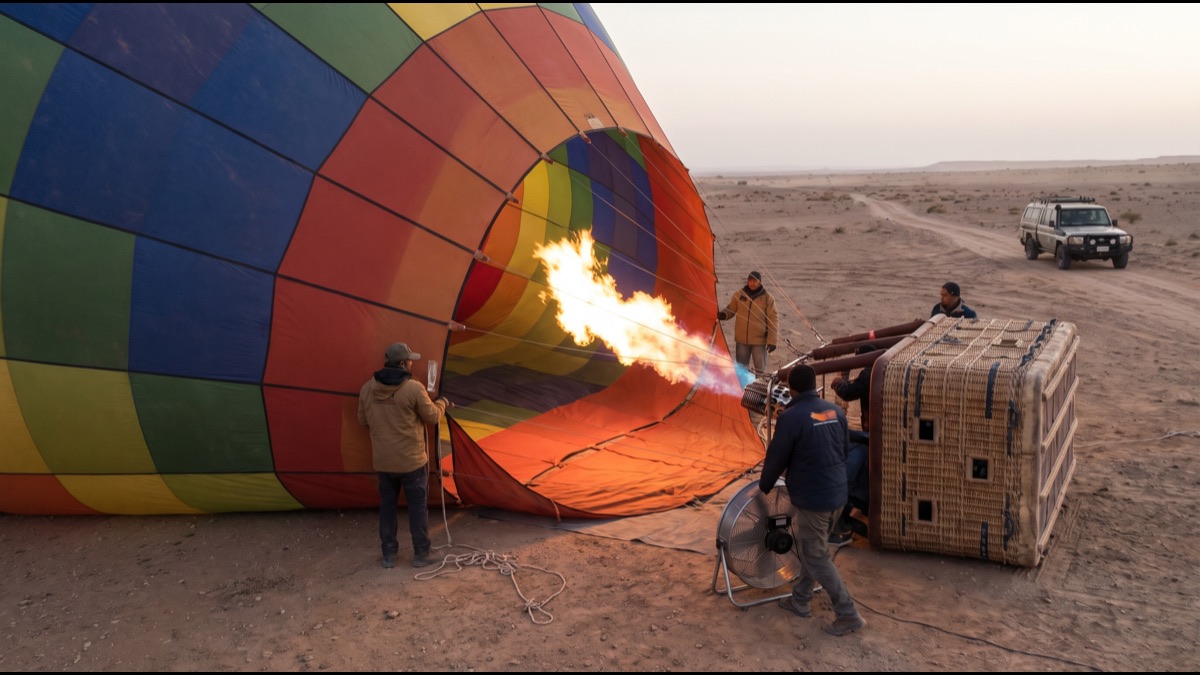
Passengers climbing into a hot air balloon basket before dawn over the Dubai desert are boarding one of the oldest flying technologies humans have ever built, one that has barely changed in its basic mechanism since its first flights in the eighteenth century. No engine pushes the balloon forward, no wing generates lift, and no steering wheel controls direction, yet pilots routinely guide these aircraft to a specific, planned landing spot using nothing more than heat, air density, and a detailed reading of the wind.
Understanding how a desert balloon flight actually works, from the specific physics keeping a basket of several adults aloft to why every single flight is scheduled for the narrow window right around sunrise, reveals a genuinely elegant, low-technology solution to human flight that has survived essentially unchanged for over two centuries precisely because nothing simpler has ever needed to replace it.
It also explains why the vast, flat, thermally predictable desert surrounding Dubai became one of the world's most popular hot air ballooning destinations, drawing hundreds of thousands of visitors annually to an activity that depends entirely on weather conditions the desert happens to provide with unusual reliability.
Why Every Flight Starts Before Sunrise
Hot air balloon flights over the Dubai desert are scheduled almost exclusively for the hour or so surrounding sunrise because that specific window offers the calmest, most predictable wind conditions of the entire day, before the desert surface heats up enough to generate the thermal turbulence that makes ballooning genuinely dangerous later in the morning.
This narrow operational window is not a marketing choice built around scenic sunrise photography, though that is a welcome side benefit; it is a genuine safety requirement, since ballooning in general depends heavily on calm, stable air, and desert environments specifically tend to lose that calm stability quickly once direct sunlight begins heating the ground.
The Simple Physics Holding Up a Very Large Basket
A hot air balloon flies on one straightforward physical principle: heated air is less dense than the surrounding cooler air, so a large enough envelope filled with sufficiently hot air becomes buoyant enough to lift the balloon's own fabric weight, the basket, and everyone riding inside it, in essentially the same way a hot air bubble rises through cooler surrounding air.
Scaling this simple principle up to safely carry multiple adult passengers requires an envelope of genuinely enormous volume, commonly tens of thousands of cubic meters of air, since the lift generated per unit of heated air is relatively modest, meaning size, not exotic technology, is what actually makes passenger-carrying balloon flight possible.
What the Burner Actually Does
The propane burner suspended above the basket is the only active mechanical component controlling the balloon's altitude, producing an intense, controllable flame the pilot fires in short, deliberate bursts to reheat the air inside the envelope whenever the balloon needs to climb or maintain altitude against natural cooling.
Pilots develop a genuinely refined feel for exactly how long and how often to fire the burner, since overheating the envelope wastes fuel and can cause an uncomfortably fast climb, while underheating it lets the balloon sink faster than intended, making burner control the single most important hands-on skill separating a smooth flight from a rough one.
Why Balloon Pilots Cannot Steer Left or Right
A hot air balloon has no rudder, propeller, or any mechanism capable of pushing it sideways through the air; it moves entirely at the mercy of whatever wind current it happens to be sitting in at any given altitude, which is precisely why balloons cannot be steered the way an airplane or even a car can be.
This fundamental lack of lateral control is not a design flaw or a limitation pilots work around reluctantly; it is simply the nature of how balloons have always worked, and every other aspect of balloon flight planning and piloting exists specifically to compensate for this one basic constraint.
How Pilots Actually Change Direction Using Altitude
Wind direction and speed frequently differ at different altitudes, sometimes substantially, so experienced balloon pilots steer indirectly by climbing or descending into a layer of air moving in a more favorable direction, effectively using altitude change as their only real steering input rather than any direct lateral control.
This technique requires pilots to build detailed knowledge of the specific wind layer patterns typical for their flying area, since successfully navigating toward a planned landing zone depends on correctly reading which altitude bands are moving which direction on that particular morning, information gathered from pre-flight weather balloons, forecasts, and simple accumulated local experience.
Why Desert Mornings Are the Only Reliable Flying Window
Beyond the general preference for calm morning air common to ballooning everywhere, the desert specifically presents an unusually sharp contrast between calm pre-dawn conditions and the rapid thermal turbulence that develops once the sun heats the exposed sand surface, a contrast more pronounced than in many other terrains where vegetation and moisture moderate surface heating.
This sharp desert-specific transition is why flight operators in the region maintain particularly strict, conservative cutoff times for launching, generally unwilling to fly even slightly later than the established safe window regardless of how calm conditions might appear to an untrained passenger at that particular moment.
The Chase Crew Nobody in the Basket Ever Sees
Every commercial balloon flight is supported by a ground chase crew driving a vehicle that tracks the balloon's position and general direction throughout the flight, predicting roughly where the pilot intends to land and positioning themselves to meet the balloon immediately upon touchdown to help secure the basket and begin packing up the envelope.
This ground support is essential precisely because a balloon cannot simply fly back to its starting point the way most aircraft can, so passengers are always driven back to the original departure point after landing rather than the balloon itself returning there, a logistics detail many first-time riders do not anticipate before their flight.
How a Balloon Actually Lands Without an Engine
Landing involves the pilot gradually reducing burner use to let the air inside the envelope cool and lose buoyancy at a controlled rate, aiming to touch down gently at a pre-identified open area, with the chase crew's real-time radio guidance on wind and ground conditions helping the pilot fine-tune the final approach.
Because a balloon cannot abort a landing and simply fly a go-around loop the way an airplane can if the approach looks wrong, pilots build in considerable safety margin when selecting a landing zone and generally begin planning for the actual touchdown location well before the final descent, rather than deciding at the last possible moment.
Why Weight Distribution in the Basket Genuinely Matters
Passenger placement within the basket is not arbitrary; pilots deliberately distribute weight to keep the basket balanced and to manage how the balloon responds during landing, since an unevenly loaded basket can tip or drag unpredictably on touchdown in a way that a well-balanced load handles far more smoothly.
This is part of why passengers receive specific standing position instructions during the pre-flight briefing and again immediately before landing, instructions that exist for genuine operational reasons tied to basket stability rather than being an arbitrary procedural formality imposed without functional purpose.
What Gets Checked Before Every Single Flight
Before each flight, pilots and ground crew conduct a detailed pre-flight inspection covering the envelope fabric for tears or wear, the burner and fuel system for leaks or malfunction, the basket structure itself, and all rigging connecting the basket to the envelope, a routine every bit as procedurally rigorous as pre-flight checks conducted on powered aircraft.
Weather conditions are checked and rechecked right up until the moment of launch, including current wind speed and direction at multiple altitudes and forecast conditions for the flight's expected duration, with pilots retaining full authority to cancel or delay a flight entirely if any of these checks raise a genuine safety concern.
Why Dubai's Desert Became a Global Ballooning Destination
The wide, flat, largely unobstructed desert terrain surrounding Dubai offers an unusually large and forgiving landing area combined with the reliably calm early morning conditions ballooning specifically requires, a combination considerably harder to find near many other major cities where terrain, buildings, and less predictable weather patterns make regular balloon operations far more constrained.
This natural suitability, combined with strong year-round tourist demand and deliberate promotion by the UAE tourism sector, has turned desert ballooning into one of the emirate's signature adventure tourism activities, operating commercially at a scale and consistency few other global desert regions have managed to sustain.
How Wildlife Encounters Factor Into the Route
Flight paths over the Dubai desert conservation areas frequently pass over native wildlife including Arabian oryx and gazelle populations protected within dedicated reserves, and operators generally treat wildlife sighting opportunities as a genuine attraction of the flight experience while also respecting protected area regulations governing minimum flight altitudes over sensitive conservation zones.
This intersection of tourism and conservation reflects a broader pattern in UAE desert tourism development, where activities like ballooning are positioned as low-impact ways to experience protected desert ecosystems compared to higher-impact activities like off-road vehicle tourism operating in the same general areas.
What Happens When Conditions Turn Bad Mid-Flight
If wind conditions shift unexpectedly during a flight, pilots prioritize finding the nearest safe, open landing area over continuing toward the originally planned landing zone, an improvised landing procedure built into standard pilot training precisely because desert wind conditions, while generally predictable at the scheduled flight time, can occasionally shift faster than forecast.
This flexibility is why chase crews track balloons continuously rather than simply waiting at a single predetermined location, since the ground team needs to be able to redirect quickly toward wherever the pilot actually ends up landing rather than assuming the flight will unfold exactly according to the original plan.
Why the Envelope Itself Has a Limited Lifespan
The balloon's fabric envelope, exposed to intense sun, heat, and repeated inflation and deflation cycles, has a finite operational lifespan measured in total flight hours rather than calendar years alone, requiring regular fabric strength testing and eventual full replacement once wear reaches manufacturer-specified limits, regardless of how visually intact the fabric might still appear.
Commercial operators maintain detailed logs tracking each envelope's total flight hours and inspection history specifically to ensure replacement happens according to genuine safety-driven schedules rather than being delayed based on cost considerations, a maintenance discipline regulatory authorities in the ballooning industry generally require and audit.
How Passenger Numbers Are Actually Limited
Each balloon has a specific maximum passenger capacity calculated from its envelope volume, the total lift that volume can generate at safe operating temperatures, and a safety margin built in beyond the theoretical maximum, meaning the number of paying passengers per flight is a genuine engineering constraint rather than simply a commercial decision about basket size.
Operators generally will not exceed this calculated capacity even when commercial demand might otherwise justify squeezing in an additional passenger, since doing so would directly compromise the safety margin the entire flight's performance calculations depend on.
Why the Post-Flight Toast Is an Actual Tradition
The champagne or juice toast commonly offered to passengers after landing traces back to a genuine historical ballooning tradition rooted in early flights where pilots, landing unannounced in rural farmland, would offer champagne to landowners partly as a friendly gesture and partly to reassure understandably startled farmers that the strange descending object was not a threat.
Modern operators maintain this toast as a charming nod to ballooning heritage rather than out of any continuing practical necessity, though it has also become a genuinely popular, expected part of the overall passenger experience regardless of most riders' awareness of the tradition's original historical purpose.
What Regulatory Oversight Actually Looks Like
Commercial hot air balloon operations are regulated by civil aviation authorities much like any other form of passenger aircraft, requiring licensed pilots who have completed specific balloon-rated training and certification, regularly inspected and certified aircraft, and adherence to defined operational safety procedures rather than operating under a lighter, informal recreational framework.
This formal aviation regulatory oversight, applied to what might otherwise seem like a purely recreational or ceremonial activity, reflects the genuine aviation risk involved in carrying paying passengers aloft, even using a technology as conceptually simple as heated air inside a large fabric envelope.
Why Photography Timing Is Its Own Small Science
Professional balloon photographers and operators time flights to capture the specific golden-hour lighting that occurs in the minutes immediately surrounding sunrise, when low-angle sunlight produces the warm, dramatic colors across sand dunes that make desert balloon photography so distinctly recognizable compared to imagery taken later in a harsher midday sun.
This lighting consideration genuinely overlaps with the underlying safety-driven flight scheduling rather than working against it, since the same calm early morning window required for safe flying happens to coincide almost exactly with the specific lighting conditions photographers and marketing teams most want to capture, a fortunate alignment rather than a deliberate photographic compromise on safety.
How Temperature Inside the Basket Actually Feels
Despite flying directly beneath an intensely hot propane burner, passengers in the basket generally experience comfortable, even slightly cool temperatures during a desert sunrise flight, since the burner's heat rises directly into the envelope above rather than radiating down into the basket, and pre-dawn desert air itself starts out notably cooler than daytime temperatures.
This counterintuitive comfort is one of the more pleasant surprises first-time riders mention afterward, having expected the proximity to an open flame to feel considerably warmer than it actually does throughout a typical flight of thirty to sixty minutes in the air.
Why This Ancient Technology Still Has No Real Replacement
Despite over two centuries of aviation progress producing vastly more capable, controllable, and powerful aircraft, nothing has genuinely replaced the hot air balloon for the specific experience it offers: slow, quiet, essentially wind-driven flight with panoramic, unobstructed views and none of the engine noise or vibration that defines every powered alternative.
That specific, irreplaceable experience, floating rather than flying in any conventional sense, is ultimately why passengers continue climbing into baskets before dawn over deserts and countryside around the world, drawn to an aircraft whose basic mechanism has needed essentially no fundamental reinvention since its first flight centuries ago.
Sources
- Wikipedia — overview of hot air balloon flight principles and operational history
- UAE General Civil Aviation Authority — regulatory framework for commercial balloon operations in the UAE
- Balloon Federation of America — background on ballooning safety standards and pilot certification
- Visit Dubai — tourism background on desert adventure activities including ballooning
FAQ
Why do balloon flights only happen right around sunrise?
That window offers the calmest, most predictable wind conditions of the day, before the desert surface heats up enough to create thermal turbulence that makes ballooning genuinely unsafe later in the morning.
Can a hot air balloon pilot actually steer left or right?
No — a balloon has no rudder or propeller and moves entirely with the wind at whatever altitude it is flying, so pilots steer indirectly by climbing or descending into wind layers moving in a more favorable direction.
How does a balloon land without an engine to control the approach?
The pilot gradually reduces burner use to let the air inside cool and descend at a controlled rate, aiming for a pre-identified open landing area with real-time guidance from a ground chase crew tracking wind and ground conditions.
Why does the balloon land in a different place than where it started?
Since balloons cannot fly back against the wind to their launch point, passengers are always driven back to the departure location by the chase crew after landing rather than the balloon itself returning there.
Is hot air ballooning actually regulated like other aviation?
Yes — commercial balloon operations require licensed, balloon-rated pilots, regularly inspected and certified aircraft, and adherence to formal civil aviation safety procedures, the same regulatory framework applied to other forms of passenger aircraft.
About the Author
We reference Wikipedia and other authoritative sources to explain the background and current understanding of this topic.
Loved This Article?
Share it on WhatsApp → Share it on WhatsApp
Get more guides in your inbox — Subscribe to our newsletter for weekly surprising stories from Egypt, Saudi Arabia, Dubai, and beyond.