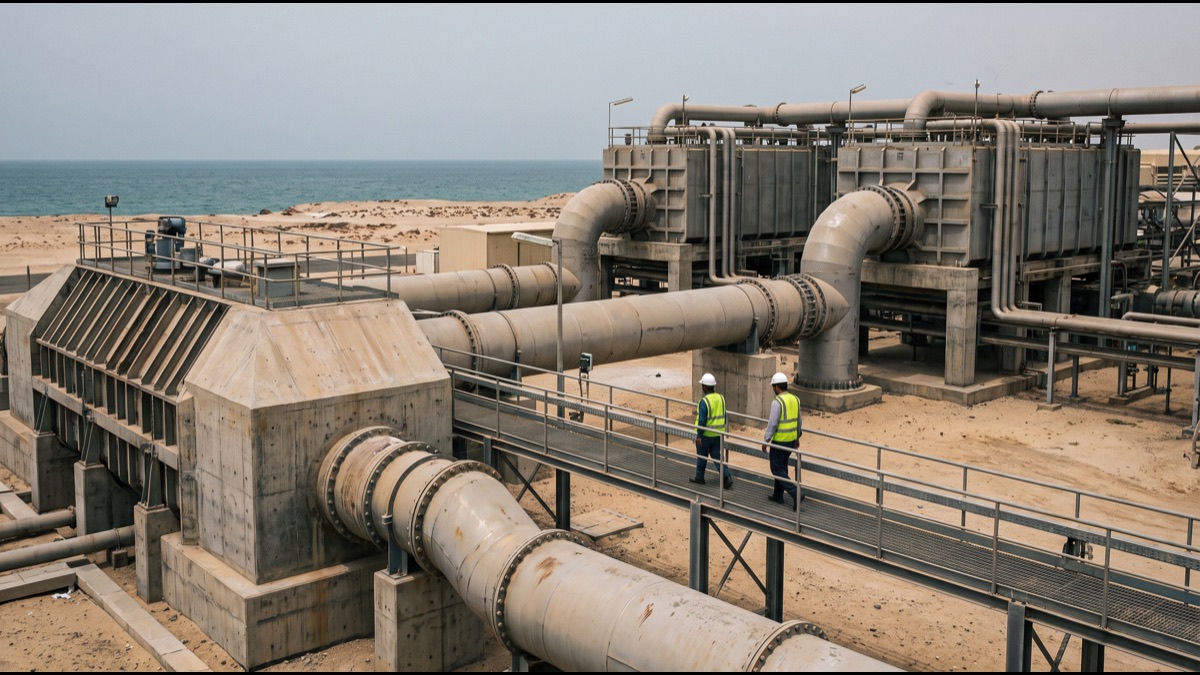
Dubai sits in one of the driest regions on Earth, with virtually no rivers, negligible rainfall, and groundwater reserves far too limited to support a metropolis of its size. And yet the taps run, the pools stay full, and the city's famously green landscaping survives the summer heat. The explanation is desalination: an industrial process that strips salt and minerals out of seawater from the Arabian Gulf, turning it into the fresh water that keeps the city running. Dubai's near-total dependence on desalinated water makes it one of the most striking examples anywhere of a modern city sustained almost entirely by engineered water supply rather than natural hydrology, and the systems behind it reveal a lot about the tradeoffs involved in building a desert megacity.
Why Dubai Has Almost No Natural Freshwater
Dubai's location on the Arabian Peninsula puts it in an arid climate zone with minimal annual rainfall, no permanent rivers, and underground aquifers that are either too small, too deep, or too saline to serve as a reliable freshwater source for a large urban population.
Historically, before large-scale desalination existed, settlements in this region relied on shallow wells, seasonal rainfall collection, and limited groundwater, which sharply constrained how large any community could realistically grow, since water availability set a hard ceiling on population.
Dubai's transformation from a small trading and pearling settlement into a global city of millions would not have been physically possible without solving this fundamental water scarcity problem, which is precisely why desalination infrastructure became a foundational, rather than optional, part of the city's development.
The Two Main Desalination Technologies
Desalination plants generally use one of two core approaches: thermal distillation methods, which heat seawater to produce steam that is then condensed into fresh water while leaving salts and minerals behind, or reverse osmosis, which forces seawater through extremely fine membranes that block salt molecules while allowing water molecules through.
Thermal methods, particularly multi-stage flash distillation and multi-effect distillation, were the dominant technology across the Gulf region for decades, valued for their reliability and ability to be paired directly with power plants that could supply the substantial heat energy the process requires.
Reverse osmosis has become increasingly common in newer plants because it generally consumes significantly less energy than thermal distillation, though it requires more sophisticated membrane technology and pre-treatment of the seawater to prevent membrane fouling and damage.
How Thermal Desalination Actually Works
In multi-stage flash distillation, seawater is heated and then passed through a series of chambers held at progressively lower pressure, causing a portion of the water to rapidly vaporize, or 'flash,' into steam at each stage without needing to reheat the water repeatedly, which improves overall energy efficiency compared to simple boiling.
The resulting steam is then condensed on cooler tubes carrying incoming seawater, which conveniently preheats that seawater for the next cycle while simultaneously producing the fresh water output, a clever use of the same energy input for two purposes at once.
Multi-effect distillation works on a similar underlying principle but structures the heating and evaporation stages somewhat differently, generally achieving even better energy efficiency than multi-stage flash, which is part of why it has become more common in newer thermal plants built across the Gulf.
How Reverse Osmosis Actually Works
Reverse osmosis desalination relies on applying high pressure to push seawater through semi-permeable membranes with pores small enough to block dissolved salt ions and other minerals while letting water molecules pass through to the other side as fresh water.
Because seawater has a naturally high salt concentration, this process requires overcoming significant osmotic pressure, which is why reverse osmosis plants use powerful high-pressure pumps and why membrane quality and maintenance are critical to both the efficiency and the output quality of the process.
Energy recovery devices that capture and reuse pressure energy from the concentrated leftover brine stream have substantially improved reverse osmosis efficiency over the past several decades, which is a major reason the technology has become increasingly cost-competitive with thermal methods.
Why Dubai Historically Favored Thermal Plants
Much of the Gulf region's original large-scale desalination infrastructure, including Dubai's early plants, relied heavily on thermal distillation paired with co-located power generation facilities, an approach known as cogeneration, where the same fuel source produces both electricity and fresh water simultaneously.
This cogeneration model made practical sense in a region with abundant, relatively low-cost natural gas for fuel, since it allowed a single power and desalination complex to serve two critical infrastructure needs at once, improving overall efficiency compared to running separate power and water facilities.
As energy economics and environmental priorities have shifted over time, this historical preference for thermal cogeneration has gradually given way to a broader mix of technologies, including a growing share of reverse osmosis and renewable-powered desalination capacity.
The Energy-Water Nexus
Desalination is fundamentally energy-intensive, whether through the direct heat required for thermal distillation or the electricity needed to power the high-pressure pumps in reverse osmosis systems, which means a desert city's water security is tightly linked to its energy security in a way that isn't true for cities with access to natural freshwater.
This tight coupling, often called the energy-water nexus, means that any disruption to fuel supply, energy prices, or power generation capacity has direct implications for water availability, making desalination infrastructure a strategic priority that governments in the region plan and invest in with long time horizons.
Recognizing this vulnerability has driven significant investment across the Gulf in diversifying both energy sources feeding desalination plants and the desalination technologies themselves, reducing the risk of any single point of failure affecting the water supply.
The Push Toward Solar-Powered Desalination
As solar power generation costs have fallen dramatically over the past decade, the United Arab Emirates has invested heavily in large-scale solar power projects, some of which are explicitly intended to supply increasing shares of the electricity used by reverse osmosis desalination plants.
Solar-powered desalination is particularly attractive for a desert region like Dubai because the same intense, near-constant sunlight that makes the climate harsh for freshwater availability is also an abundant, renewable energy resource that can help offset the environmental footprint of desalinating so much of the city's water supply.
This shift toward renewable-powered desalination represents a long-term strategy to decouple the region's water security from fossil fuel consumption, aligning water infrastructure planning with broader national goals around economic diversification and reduced carbon emissions.
Brine Discharge and Environmental Considerations
Desalination doesn't just produce fresh water; it also produces a concentrated leftover byproduct called brine, containing the salt and minerals removed from the seawater, which is typically discharged back into the sea and requires careful management to avoid concentrated, localized harm to marine ecosystems near outfall points.
The Arabian Gulf's unique characteristics, including its relatively shallow depth, warm water temperatures, and limited water exchange with the open ocean compared to other seas, mean that brine discharge and its cumulative environmental effects are subjects of ongoing scientific study and increasing regulatory attention across the region.
Modern desalination plant design increasingly incorporates diffuser systems designed to disperse brine discharge more widely and dilute its concentration more quickly, alongside environmental monitoring requirements intended to track and limit long-term impacts on nearby marine life.
Storage and Distribution Infrastructure
Producing desalinated water is only part of the challenge; Dubai also maintains an extensive network of storage reservoirs, pumping stations, and distribution pipelines designed to move treated water efficiently across the city and maintain a buffer of stored supply in case of any temporary disruption to production.
This storage capacity provides resilience against short-term interruptions, whether from planned maintenance at a desalination facility or unexpected operational issues, since a city entirely dependent on engineered water production cannot afford to have daily supply hinge on every plant running without interruption.
Water distribution infrastructure in a rapidly growing city like Dubai also has to be continually expanded and upgraded to keep pace with new development, since desalinated water only reaches homes and businesses if the surrounding pipe network has the capacity to deliver it.
How Desalinated Water Compares to Natural Freshwater
Properly treated desalinated water meets recognized drinking water quality standards and is generally safe and clean, though it can differ slightly from natural freshwater in mineral content, since the desalination process removes essentially all dissolved minerals, which is sometimes addressed by remineralization steps added after the core desalination process.
Some residents and researchers have noted taste differences between desalinated water and naturally sourced freshwater, largely attributable to this difference in mineral content, though these differences don't reflect any safety concern when the water has been properly treated and tested according to established standards.
Because desalinated water is essentially mineral-free at the point of production, water utilities in desalination-dependent regions generally have processes in place to adjust its chemistry before distribution, both for taste and for pipe infrastructure protection, since very low-mineral water can be more corrosive to certain pipe materials over time.
Water Demand Management Alongside Supply
Given how energy-intensive and costly desalinated water production is compared to naturally available freshwater in other regions, Dubai and other Gulf cities have also invested significantly in demand-side water conservation measures, including efficiency standards, public awareness campaigns, and, in some cases, tiered water pricing structures meant to discourage excessive consumption.
Landscaping and greenery, a highly visible feature of Dubai's urban environment despite the surrounding desert climate, represents a significant share of overall water demand, which has led to increased use of treated wastewater, sometimes called recycled or reclaimed water, for irrigation purposes rather than using desalinated drinking-quality water for that role.
This dual approach of expanding desalination supply while actively managing demand reflects a broader recognition that even highly efficient desalination technology cannot fully substitute for genuinely sustainable water use practices in a resource-constrained desert environment.
Desalination's Role in the Wider Gulf Region
Dubai's reliance on desalination is not unique; it reflects a pattern shared across much of the Gulf region, where several countries collectively operate some of the largest concentrations of desalination capacity anywhere in the world, a direct consequence of the region's shared arid climate and limited natural freshwater resources.
This regional concentration of expertise has also made Gulf desalination operators and engineering firms significant global players in desalination technology development and export, with knowledge and infrastructure experience gained locally increasingly applied to water-scarce projects in other parts of the world.
The scale of regional investment in desalination infrastructure also reflects how central water security is treated as a matter of national strategic planning across Gulf governments, comparable in seriousness to energy security given how directly the two are linked.
What Happens During Plant Maintenance or Disruption
Because a modern desert city like Dubai has essentially no fallback natural water source to rely on if desalination infrastructure were significantly disrupted, water utilities plan extensive redundancy into the system, operating multiple plants across different sites so that scheduled maintenance or an unexpected outage at one facility doesn't threaten overall city supply.
Interconnected pipeline networks and substantial reservoir storage further buffer against short-term production interruptions, giving operators time to bring backup capacity online or complete repairs without residents experiencing any noticeable disruption to their daily water supply.
This redundancy planning reflects lessons learned over decades of operating desalination-dependent water systems, treating water security with the same seriousness as electricity grid reliability, since a genuine prolonged failure would have consequences for a population with no meaningful alternative water source to fall back on.
The Cost of Desalinated Water
Desalinated water is inherently more expensive to produce than water drawn from natural freshwater sources like rivers or shallow aquifers, given the substantial energy input required regardless of which desalination technology is used, though costs have fallen considerably over recent decades as technology, particularly reverse osmosis, has become more efficient.
Governments across the Gulf region have historically subsidized water costs significantly to keep consumer prices manageable despite the high underlying production cost, a policy choice that reflects both the essential nature of water access and broader economic and social planning priorities.
As desalination technology continues improving and renewable energy increasingly powers a larger share of production, the underlying cost gap between desalinated and naturally sourced water is expected to continue narrowing, even though it's unlikely to disappear entirely given the fundamental energy requirements involved.
Looking Ahead: The Future of Dubai's Water Supply
Long-term water planning in Dubai and the wider region increasingly emphasizes a combination of continued desalination capacity expansion, greater use of renewable energy to power that capacity, expanded water recycling and reuse for non-drinking purposes, and ongoing demand management to keep overall consumption growth in check as the population and economy continue expanding.
Advances in membrane technology, energy recovery systems, and solar-power integration are expected to continue reducing both the cost and the environmental footprint of desalination over time, making the technology more sustainable even as a growing city's total water demand increases.
Dubai's experience offers a working example of how a modern city can sustain a large population in an environment with essentially no natural freshwater, but it also illustrates why water security in such environments requires sustained, deliberate infrastructure investment rather than being something a city can simply take for granted.
Why Desalination Plants Are Often Paired With Power Plants
Many desalination facilities in the Gulf region are built alongside power generation plants specifically because thermal desalination processes can make productive use of waste heat that a power plant would otherwise simply release into the environment.
This co-generation approach improves overall energy efficiency compared to running desalination and power generation as entirely separate systems, since one facility's byproduct becomes another facility's input rather than being wasted.
As newer reverse osmosis technology, which doesn't rely on heat in the same way, becomes more dominant, this traditional co-location advantage is becoming less central to plant siting decisions than it once was.
How Water Quality Is Monitored After Desalination
Desalinated water undergoes extensive testing before distribution, checking for mineral content, pH balance, and the complete absence of the salts and impurities the process is designed to remove, since desalinated water starts out essentially mineral-free and needs careful post-treatment.
Because pure desalinated water lacks the natural mineral content of typical freshwater, it is remineralized in a controlled way before distribution, both for taste and because completely demineralized water can behave differently in pipe systems.
Regulatory bodies overseeing municipal water supply set specific quality standards that desalinated water must meet, similar in principle to standards applied to any other municipal water source, ensuring consistency regardless of the water's origin.
Why Some Critics Raise Long-Term Concerns
Environmental researchers have raised questions about the long-term ecological effects of large-scale, sustained desalination in a semi-enclosed body of water like the Gulf, given its relatively limited water exchange with the open ocean compared to a coastline on a major open sea.
Concerns center on the cumulative effect of many desalination plants across multiple countries discharging brine into the same relatively contained body of water over decades, potentially affecting salinity levels and marine ecosystems over a longer timescale than any single plant's individual environmental review would capture.
This has prompted increased interest in regional environmental monitoring and coordination among Gulf states, since the cumulative effect of desalination in the region is inherently a shared, cross-border consideration rather than one any single country's regulations alone can fully address.
How Emergency Water Reserves Fit Into the System
Given the near-total reliance on desalination for potable water, Dubai and neighboring emirates maintain strategic reserve capacity, generally in the form of large-scale storage reservoirs, designed to provide a buffer against any temporary disruption to desalination operations.
These reserves are sized to provide a meaningful number of days of supply under normal demand conditions, a planning approach that treats water security with the same seriousness typically applied to other critical infrastructure like power grids.
This reserve capacity, combined with distributed production across multiple plants rather than reliance on a single facility, is part of the broader resilience strategy behind maintaining a stable water supply for a city with no natural freshwater fallback option.
The Energy-Water Tradeoff at the Heart of Desalination
Desalination is fundamentally energy-intensive, since removing salt from seawater requires overcoming the natural chemical bond that keeps salt dissolved in water, whether through the heat-driven thermal methods or the high-pressure membrane methods used today. This energy demand has historically been met largely through natural-gas-fired power, tightly linking Dubai's water security to its energy supply in a way few other essential utilities are linked.
This close coupling means that any disruption to gas supply or spike in energy costs has a direct knock-on effect on the cost and reliability of the freshwater supply, a vulnerability that has pushed utilities to treat water and power planning as a single integrated system rather than two separate infrastructure sectors.
Recognizing this tradeoff has been the main driver behind the push toward solar-powered desalination in recent years, since pairing reverse osmosis plants with solar generation reduces the exposure to fossil fuel price volatility and cuts the carbon footprint of a process that would otherwise scale its emissions directly with the city's growing population and water demand.
What Happens to the Leftover Brine
Desalination does not just produce freshwater; it produces a concentrated saltwater byproduct called brine that must be disposed of somewhere, and how that brine is managed is one of the more significant environmental considerations of large-scale desalination that receives less public attention than the freshwater output itself.
Discharging brine back into the sea without adequate dilution can create localized zones of elevated salinity and temperature near outfall points, which can stress marine ecosystems that are not adapted to those conditions, prompting increasing regulatory attention to how and where brine discharge is managed along heavily desalinated coastlines.
Engineers have developed several mitigation approaches, including diffuser systems that spread and dilute brine discharge across a wider area rather than concentrating it at a single point, and ongoing research into using brine as an input for other industrial processes rather than treating it purely as waste to be disposed of.
Dubai's water supply is, almost entirely, an engineering achievement rather than a natural gift. With virtually no rivers, minimal rainfall, and inadequate groundwater, the city depends on desalination plants along the Arabian Gulf coastline that convert seawater into drinking water through thermal distillation and, increasingly, more energy-efficient reverse osmosis technology. That dependence ties the city's water security tightly to its energy supply, which is why growing investment in solar-powered desalination, brine management, water recycling, and demand-side conservation all matter as much as building new plants. Dubai's transformation into a global metropolis in one of the driest places on Earth stands as a striking demonstration of how far engineered infrastructure can push past the limits nature originally set, provided the investment and planning behind it keep pace with the city's growth.
Sources
- Wikipedia — Desalination — Overview of desalination technologies including thermal distillation and reverse osmosis.
- Dubai Electricity and Water Authority (DEWA) — Dubai's official utility authority responsible for power and water production and distribution.
- Wikipedia — Reverse Osmosis — Technical background on the membrane-based desalination method increasingly used across the Gulf.
- International Renewable Energy Agency (IRENA) — Intergovernmental organization publishing research on renewable energy integration, including solar-powered desalination.
FAQ
Why doesn't Dubai just use groundwater or rivers?
Dubai's arid climate means there are no permanent rivers and groundwater reserves are too limited and often too saline to support a city of its size, which is why it depends almost entirely on desalinated seawater.
What are the two main desalination methods used?
Thermal distillation (heating seawater to produce steam that condenses into fresh water) and reverse osmosis (forcing seawater through fine membranes that block salt), with reverse osmosis becoming more common due to lower energy use.
Is desalinated water safe to drink?
Yes, properly treated desalinated water meets recognized drinking water standards, though it's often remineralized after processing since the desalination process removes essentially all dissolved minerals.
What happens to the salt removed from seawater?
It becomes a concentrated byproduct called brine, which is discharged back into the sea through systems designed to disperse and dilute it in order to limit localized impact on marine ecosystems.
Is Dubai moving toward renewable-powered desalination?
Yes. The UAE has invested heavily in large-scale solar power, part of which is intended to supply a growing share of the electricity used by reverse osmosis desalination plants.
About the Author
We reference Wikipedia — Desalination, Dubai Electricity and Water Authority (DEWA), Wikipedia — Reverse Osmosis, and International Renewable Energy Agency (IRENA) to explain the background and current understanding of this topic.
Loved This Article?
Share it on WhatsApp → Share it on WhatsApp
Get more guides in your inbox — Subscribe to our newsletter for weekly surprising stories from Egypt, Saudi Arabia, Dubai, and beyond.