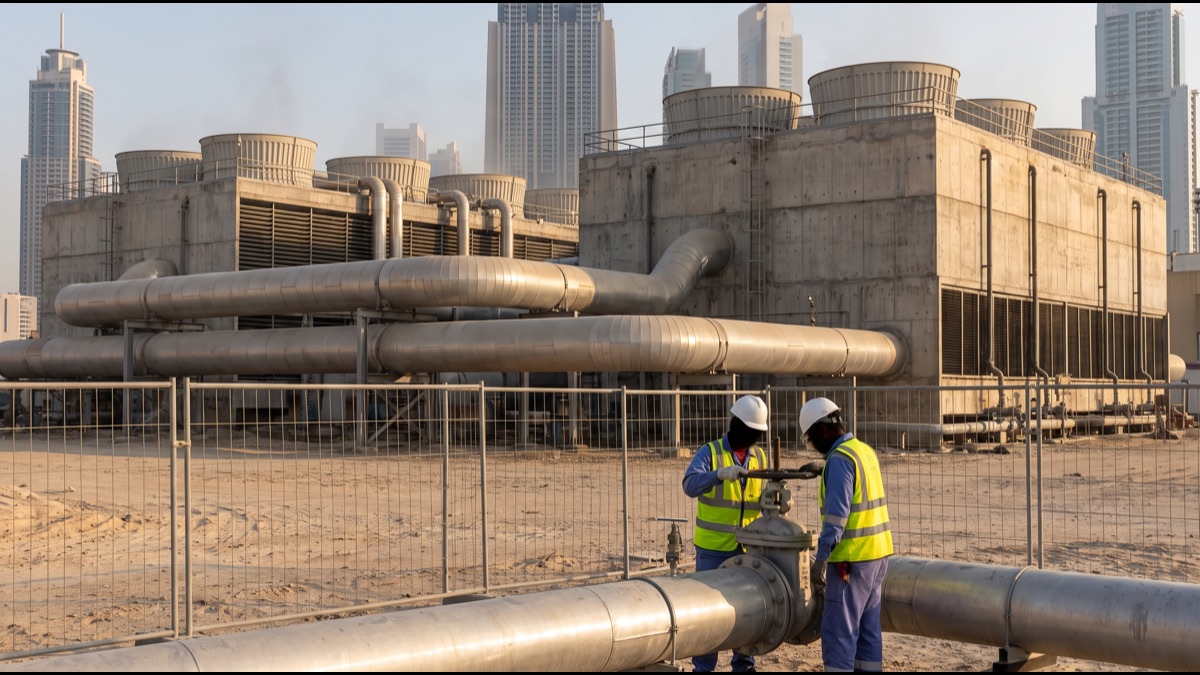
In a city where summer afternoons regularly cross 45 degrees Celsius, cooling is not a comfort feature; it is the thing that makes Dubai habitable, insurable, and buildable at the scale it now exists at. Yet drive through Downtown Dubai, Dubai Marina, Business Bay, or DIFC and you will not see the endless rooftop clutter of individual air-conditioning condenser units that define most hot-climate skylines. Instead, cooling in these districts is delivered the way electricity or water is: piped in from outside, centrally produced, and metered by consumption.
That system is called district cooling, and Dubai has built one of the largest networks of its kind anywhere in the world. Understanding how it actually works explains a great deal about why the city's newest skyscrapers can rise so close together, why some of its buildings have no visible cooling equipment at all, and why an entire industry of specialized utility companies has grown up around the simple, unglamorous act of chilling water at scale.
Why Dubai Needs an Industrial Answer to Heat
Cooling demand in Dubai is not a seasonal spike the way heating is in colder climates; it is a near-constant baseline load for roughly eight months of the year, and a significant load even in the mildest winter weeks. A typical commercial tower in Downtown Dubai can spend well over half of its total electricity budget on cooling alone, and residential towers are not far behind, particularly in the peak summer months when outdoor temperatures rarely drop below the low thirties even overnight.
At the scale of an entire city, that adds up to an enormous and highly predictable demand for refrigeration capacity, concentrated into dense vertical developments where thousands of individual compressor units would otherwise need to be installed, wired, maintained, and eventually replaced across hundreds of separate buildings. Dubai's planners recognized early in its high-rise building boom that treating cooling as a shared municipal-scale utility problem, rather than a per-building appliance problem, could solve this more efficiently.
What District Cooling Actually Is
District cooling works on the same basic principle as a home air conditioner, chilling a fluid and using it to absorb heat from indoor air, but scaled up by orders of magnitude and centralized. Instead of each building owning its own chiller plant, a single large facility produces chilled water and pumps it out through a network of heavily insulated underground pipes to every connected building in the surrounding district.
Inside each building, that chilled water flows through heat exchangers that cool the air circulated through the building's own internal ventilation system, then returns to the central plant warmer than it left, ready to be re-chilled and sent out again in a continuous closed loop. The building itself never needs its own compressor, condenser, or cooling tower; it simply taps into a shared thermal utility much as it taps into the electrical grid or the water mains.
The concept itself is not a Dubai invention. Early district heating networks date back over a century in parts of Europe and North America, and district cooling followed the same logic once large-scale refrigeration became practical, with early commercial examples appearing in dense American downtowns and later in other hot-climate cities. What makes Dubai's version distinctive is less the underlying engineering than the sheer scale at which it was rolled out, effectively designed into entire new districts from their very first master plan rather than retrofitted piecemeal into an existing city over decades.
Inside a District Cooling Plant
A district cooling plant is, in essence, an industrial-scale refrigeration factory. Banks of large electric chillers compress and expand refrigerant to extract heat from water circulating through the plant, dropping its temperature to typically around four to six degrees Celsius before it is pumped out into the distribution network.
These plants are deliberately sited to minimize pipe runs to major clusters of demand, and the largest of them, serving districts like Downtown Dubai or Dubai Marina, can produce cooling capacity measured in the hundreds of thousands of refrigeration tons, a scale that would be essentially impossible to replicate efficiently building by building. Redundant chillers and backup power supplies are standard, since a plant failure would leave an entire district without cooling in a climate where that is a genuine safety concern rather than a mere inconvenience.
How the Chilled Water Actually Reaches Your Building
The distribution network is arguably the least visible but most extensive part of the system: kilometers of pre-insulated steel or composite piping buried beneath Dubai's roads and pavements, engineered to minimize the small but unavoidable amount of heat that leaks into cold water as it travels through hot ground and hot ambient air over long distances.
Supply and return pipes run in parallel, forming a closed loop between the plant and every connected building, with pumping stations along the route maintaining the pressure needed to push chilled water through an extensive underground network without excessive energy loss. Because this infrastructure sits underground, it is largely invisible to residents, who only interact with the system through a small mechanical room in their building's basement or plant room.
Why It Is More Efficient Than Building-Level AC
The core efficiency argument for district cooling rests on economies of scale and diversity of demand. A handful of very large chillers running near their optimal operating point most of the time is inherently more efficient than hundreds of small chillers, each sized for a single building's peak load and consequently running well below optimal efficiency most of the year.
District systems also benefit from load diversity: not every connected building hits its peak cooling demand at exactly the same moment, so the central plant can be sized smaller relative to the sum of all individual buildings' theoretical peak loads than each building's own equipment would need to be. Maintenance, too, becomes dramatically more efficient when a single specialized operator services one industrial plant rather than building managers across the city each separately maintaining their own rooftop equipment.
What Thermal Energy Storage Actually Does
Several of Dubai's largest district cooling plants incorporate thermal energy storage, typically large tanks that produce and store chilled water, or in some cases ice, during off-peak overnight hours when electricity demand and cost are lower, then draw on that stored cooling capacity during the hottest and most expensive hours of the following afternoon.
This shifts a meaningful share of the electrical load used for cooling away from the grid's peak demand period, easing strain on Dubai's wider power network during the exact hours it is under the greatest stress, while also allowing the cooling provider to operate its chillers more consistently rather than cycling them hard to meet sudden afternoon spikes. It is a genuinely elegant piece of infrastructure engineering hidden entirely beneath ordinary streets.
Who Actually Runs Dubai's Cooling Networks
District cooling in Dubai is delivered by a small number of specialized licensed utility companies rather than by government departments directly, operating under long-term concession agreements with property developers that typically span decades and cover an entire master-planned district from the moment ground is broken.
Empower, established as a joint venture involving Dubai Electricity and Water Authority, is generally cited as the largest district cooling provider in the world by connected capacity, serving major districts including Downtown Dubai, Business Bay, and Dubai Design District. Tabreed operates extensively across the wider UAE and the Gulf region alongside several smaller specialized providers serving individual master developments.
How Buildings Actually Get Connected
Connection to a district cooling network is generally decided at the master-planning stage of a development, long before individual towers are designed, since the developer negotiates capacity and infrastructure agreements with the cooling provider as part of the district's original utility planning, alongside power, water, and telecommunications.
Once a building is designed around district cooling from the outset, retrofitting away from it later becomes genuinely difficult, since the building was never given the physical space, structural allowance, or rooftop access that independent chiller equipment would require. This is part of why district cooling connection agreements in Dubai are effectively permanent commitments rather than services a building owner can easily switch away from.
How District Cooling Gets Billed
Unlike electricity, which is billed on a broadly standardized per-kilowatt-hour basis across a jurisdiction, district cooling charges have historically varied more between providers and developments, combining a capacity or demand charge tied to the maximum cooling load a unit is entitled to draw with a consumption charge based on metered usage.
This billing structure has at times drawn criticism from residents who found it harder to understand, compare, or reduce than a conventional electricity bill for an individually owned AC unit, prompting Dubai's regulatory authorities to push cooling providers toward more standardized, transparent, and genuinely consumption-based tariff structures in recent years.
Why Some Residents Are Skeptical of the System
Beyond billing transparency, the most common resident complaint about district cooling is the total absence of choice: once a building is connected to a specific provider under a concession agreement negotiated by the developer, individual unit owners generally cannot switch providers or opt out in favor of installing their own equipment, unlike an electricity customer who can at least theoretically choose to be more energy efficient to lower their own bill.
Providers and regulators have responded to this concern by publishing more detailed tariff information, introducing metering upgrades that give residents clearer real-time consumption data, and in some cases capping or regulating the rates that can be charged, treating district cooling increasingly as a regulated utility rather than a purely commercial arrangement between a developer and its chosen contractor.
What Happens When a Plant Goes Offline
Given how dependent an entire district can be on a single cooling plant, redundancy is built deeply into the engineering: multiple chillers within each plant, backup power connections, and in many cases physical links between neighboring district cooling networks that allow emergency capacity to be shared if one plant experiences a serious fault.
A total, prolonged outage across a major district is consequently rare, though partial capacity reductions during peak summer demand or planned maintenance windows do occur, generally managed through advance notice to connected buildings and prioritization protocols that keep critical facilities like hospitals supplied first if capacity genuinely has to be constrained.
How District Cooling Fits Dubai's Sustainability Goals
District cooling is frequently cited by Dubai's government and utility providers as a meaningful contributor to the emirate's broader energy and sustainability strategy, since independent studies of well-designed district systems generally find they use significantly less electricity than an equivalent number of separate building-level chillers would to deliver the same amount of cooling.
Dubai's clean energy strategy has increasingly linked district cooling expansion with wider goals around reducing peak electricity demand and diversifying the emirate's energy mix, treating the technology as genuine infrastructure for reducing strain on the power grid rather than merely a convenience for developers, particularly as the city's building stock and population continue to grow.
Where the Technology Is Expanding Next
New master-planned districts across Dubai continue to be designed around district cooling from the outset, and providers have also pursued opportunities to retrofit older, non-networked areas where doing so is physically and economically feasible, gradually extending the technology's footprint beyond the newest downtown developments into more established parts of the city.
The next decade will likely see continued growth in thermal storage capacity, tighter integration between district cooling load-shifting and the wider electricity grid, and possibly greater use of alternative chilled-water production methods including some solar-assisted approaches, as Dubai continues treating the unglamorous business of chilling water as core urban infrastructure rather than an afterthought bolted onto individual buildings.
The economics also scale with the emirate's continued growth. Every new master-planned district approved in Dubai adds fresh demand to an already enormous cooling market, and providers routinely finance new plant capacity years ahead of construction based on projected connections from towers that have not yet broken ground, treating future cooling demand as a bankable, forecastable asset in much the same way a power utility forecasts electricity growth. That long planning horizon is itself part of why the system scales as smoothly as it does: capacity is rarely built reactively, and shortages during a heatwave are consequently far less common than they might otherwise be in a city adding hundreds of thousands of square meters of air-conditioned floor space every year.
What makes district cooling worth understanding is precisely that invisibility. Millions of people move through Dubai's air-conditioned towers, malls, and metro stations every single day without ever seeing the industrial plants, buried pipe networks, and thermal storage tanks quietly making that comfort possible, treating comfortable indoor temperatures the same way most city dwellers treat clean tap water: as a background utility rather than a daily engineering achievement.