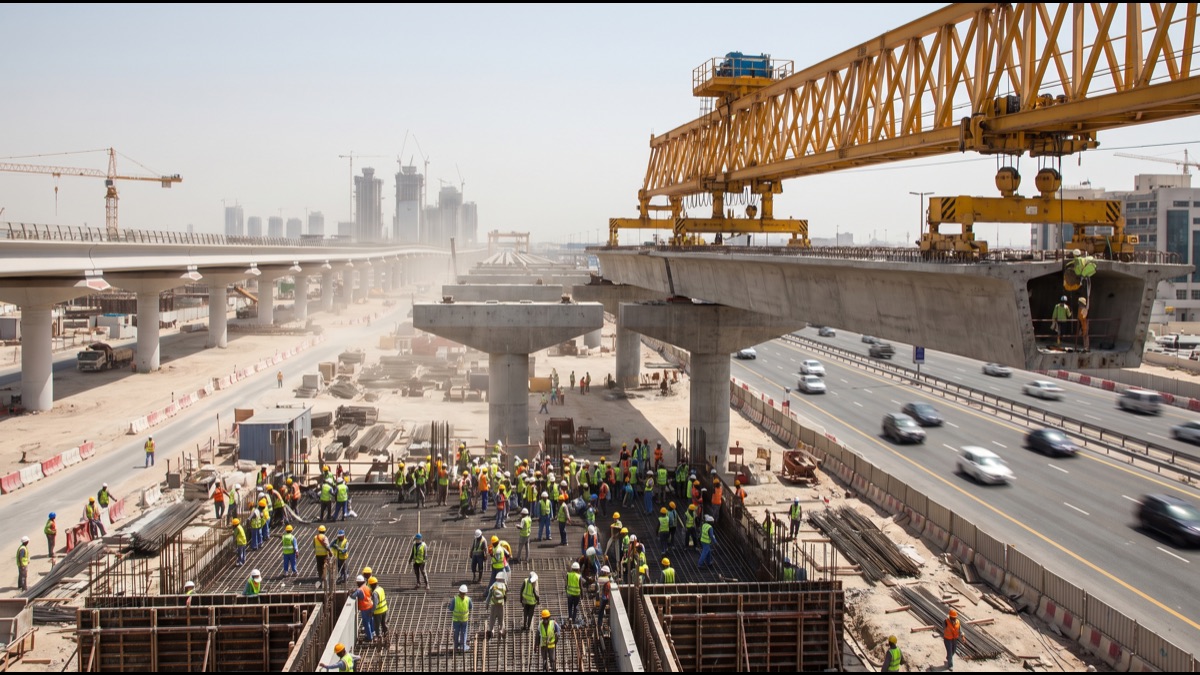
When Dubai Metro's Red Line opened to the public in September 2009, it became one of the longest fully automated, driverless metro systems in the world, built almost entirely from scratch across a fast-growing desert city in a construction window most transit planners would consider impossibly short. Cities that had spent decades debating, funding, and slowly building single metro lines watched Dubai deliver a complete, functioning network in roughly four years of active construction. The speed was not a fluke or a shortcut around good engineering; it reflected a specific set of planning, contracting, and design decisions that together removed many of the delays that typically stretch metro construction into decades elsewhere.
A Metro Built Faster Than Almost Anywhere Else
Major metro systems in established cities frequently take a decade or more from approval to opening day, hampered by fragmented contracting, utility relocation disputes, political changes, and phased funding that stretches construction across multiple budget cycles. Dubai's experience looked almost nothing like that pattern.
Construction on the Red Line broke ground in 2005, and the line opened for passenger service in September 2009, with the Green Line following roughly a year later. For a system of that scale, spanning tens of kilometers with dozens of stations, a functioning network delivered inside roughly four years remains a genuine outlier in global transit construction history.
Dubai's Transport Problem in the Early 2000s
By the early 2000s, Dubai's population and road traffic were both growing at a pace that quickly outstripped the capacity of its road network, a predictable consequence of the rapid economic growth, construction boom, and population influx the emirate was experiencing at the time.
Government planners recognized that road expansion alone could not keep pace with growth projections, and that a mass transit backbone was needed urgently rather than eventually, a sense of urgency that shaped nearly every subsequent decision about how the metro project would be structured, financed, and built.
Why the RTA Chose a Single Contractor Model
Dubai's Roads and Transport Authority (RTA), established in 2005 specifically to oversee the emirate's transport strategy, made an early and consequential decision to award the metro project as a single, integrated design-and-build contract to one consortium rather than splitting design, civil works, and systems integration among multiple separate contractors.
This single-contractor structure eliminated a major source of delay common to metro projects elsewhere, where disputes between separate civil contractors and systems integrators over interface responsibilities, design changes, and scheduling conflicts routinely produce costly delays and legal disputes that stretch timelines by years.
The Dubai Rail Link Consortium
The contract was awarded to a joint venture known as the Dubai Rail Link consortium, bringing together Japanese and other international engineering, construction, and rail systems firms with deep prior experience delivering large-scale rail projects on tight schedules elsewhere in the world.
Because this single consortium held responsibility for everything from civil engineering and viaduct construction through rolling stock, signaling, and automated train control, the project avoided the handoff delays and finger-pointing that occur when responsibility for a metro's physical structure and its operating systems sits with entirely separate organizations.
Choosing Elevated Track Over Tunneling
One of the most consequential early design decisions was building the vast majority of Dubai Metro above ground on elevated viaducts rather than underground in bored tunnels, a choice that significantly shaped both the construction timeline and the ultimate cost of the project.
Underground tunneling, while sometimes necessary in dense historic city centers with no available surface land, is considerably slower and more expensive than elevated construction, requiring specialized tunnel-boring equipment, extensive ground surveys, and far more complex logistics for removing excavated material.
Why Elevated Construction Is Faster
Elevated viaduct construction allows large sections of guideway to be built using repeatable, standardized processes, with pier foundations, columns, and deck segments produced using largely consistent methods across the entire alignment rather than custom-engineered solutions for each unique underground condition.
Dubai's flat desert terrain and largely undeveloped land along major road corridors at the time made elevated construction not just faster in theory but genuinely practical in execution, since the network's alignment could closely follow existing roads without needing to acquire or demolish dense urban development along the route.
Prefabrication as a Speed Strategy
Large sections of the elevated guideway were manufactured off-site using precast concrete segments, produced in dedicated casting yards and then transported to the alignment for installation, rather than being poured and cured in place along the entire route.
This prefabrication approach let multiple stages of construction proceed simultaneously rather than sequentially: casting yards could continue producing segments for future sections of track even while installation crews were actively erecting segments already completed elsewhere, compressing the overall schedule considerably compared with fully on-site construction methods.
Building Along Existing Road Corridors
Dubai Metro's alignment was deliberately routed to follow major existing roads, most visibly along Sheikh Zayed Road, rather than cutting new paths through developed neighborhoods, a decision that avoided the lengthy land acquisition, demolition, and resident relocation disputes that frequently delay metro projects built through already-dense urban areas.
Following road corridors also simplified utility relocation work, since major roads already concentrate much of a city's underground utility infrastructure in predictable locations, reducing the surprise discoveries of undocumented pipes, cables, and conduits that regularly stall metro construction projects elsewhere once excavation begins.
Going Fully Driverless From Day One
Dubai Metro was designed from the outset as a fully automated, driverless system, placing it among a relatively small number of major metro networks worldwide to launch with complete automation rather than converting to it later after years of conventional, driver-operated service.
This decision reflected a calculation about long-term operating costs and staffing rather than construction speed alone, since a driverless system requires no ongoing recruitment, training, and scheduling of train operators, a substantial recurring cost that older metro systems built decades earlier remain largely locked into due to legacy infrastructure and labor arrangements.
What Automation Removed From the Schedule
Building for full automation from the start also simplified the project in specific technical ways, since automated train control systems, platform screen doors, and integrated signaling could be designed as a single coherent system from the earliest engineering stages rather than retrofitted onto infrastructure originally built around manual driver operation.
Retrofitting automation onto an already-operating conventional metro, as several older systems around the world have since attempted, generally requires extensive, disruptive modifications to existing infrastructure; building automation in from day one avoided that entire category of complexity and cost.
Parallel Construction Across Multiple Sites
Rather than building the network sequentially from one end to the other, construction crews worked simultaneously across many separate sites along the alignment, with different teams handling piling, viaduct erection, station construction, and systems installation in parallel rather than waiting for each stage to complete before the next began elsewhere.
This parallel approach required substantial coordination and a large mobilized workforce, but it meant the overall project timeline was governed by the slowest individual work package rather than the sum of every stage completed one after another along the entire route.
Government Land Access and Approvals
Because Dubai's government held direct authority over land use planning and could grant land access and regulatory approvals rapidly compared with jurisdictions where multiple layers of government, private landowners, and community consultation processes must all separately sign off, the project avoided many of the approval delays that commonly stall metro construction elsewhere for years.
This streamlined approvals environment does not mean the project faced no regulatory oversight, but rather that the approval process moved through a smaller number of decision-making bodies with aligned priorities, considerably compressing a phase of large infrastructure projects that frequently consumes years in other cities.
The Financial Backing Behind the Timeline
The metro project was backed by substantial government financing during a period of strong economic growth and high government revenue in Dubai, allowing the project to proceed on a compressed schedule without the phased, budget-cycle-dependent funding structure that forces many metro projects elsewhere to build in stages over many years as money becomes available.
Having committed financing available upfront meant contractors could mobilize a large workforce and order materials and rolling stock well in advance, rather than pausing construction periodically while waiting for the next funding tranche to be approved, a common cause of schedule slippage on metro projects funded incrementally.
The 2008 Financial Crisis and Its Impact
The global financial crisis that began in 2008 hit Dubai's broader economy and real estate sector hard, and it arrived during the final stretch of Red Line construction, creating real uncertainty about the emirate's broader capacity to fund large infrastructure commitments going forward.
Despite that turbulence, the Red Line still opened on a schedule close to its original target in September 2009, a testament to how much of the project's critical path had already been completed by the time the crisis intensified, though subsequent phases and extensions were affected by the broader economic slowdown that followed.
Opening the Red Line in 2009
The Red Line's opening on September 9, 2009 (a symbolically chosen date reflecting the numeral nine) marked the practical culmination of years of design, prefabrication, and parallel construction work, delivering dozens of stations across a route connecting the airport, the city's business districts, and major residential areas along Sheikh Zayed Road.
The Green Line followed in 2011, extending the network's reach into older, more established parts of the city and further validating the construction model the project had used, since a second major line was delivered on a broadly similar accelerated timeline rather than requiring an entirely new approach.
Extensions Built for Major Events
Dubai has continued extending the metro network well beyond its original two lines, with additional stations and route extensions built specifically to serve major planned events and rapidly developing districts, following essentially the same elevated, prefabricated construction approach established during the original build.
These later extensions demonstrate that the original speed of construction was not a one-time achievement dependent on unusually favorable early-2000s conditions alone, but a repeatable construction methodology the emirate has continued applying as the city's transit needs have grown.
What Other Cities Have Tried to Copy
Transit planners and infrastructure officials from other rapidly growing cities have studied Dubai's approach closely, particularly the single-contractor delivery model, the preference for elevated over underground construction where terrain allows it, and the decision to build for full automation from the outset rather than retrofitting it later.
Replicating Dubai's specific results elsewhere has proven difficult, since many of the conditions that enabled the speed — centralized government land authority, available surface corridors along major roads, and committed upfront financing during a period of strong growth — are not easily reproduced in cities with more fragmented governance, denser existing development, or more constrained public budgets. Dubai Metro's construction speed ultimately reflects less a single engineering trick than a rare alignment of political will, available land, financing, and contracting structure all pointing in the same direction at once.
How Dubai's Metro Compares to Similarly Sized Systems Elsewhere
Cities of comparable population that built metro systems more gradually, often over multiple decades with public referendums and phased funding approvals, generally point to Dubai's centralized decision-making authority as the single largest factor separating its rapid delivery timeline from more incremental Western examples.
This centralized authority allowed Dubai's project leadership to make binding decisions on route alignment, station placement, and construction sequencing without the multi-stakeholder approval processes that often add years to metro projects in cities with more distributed governmental authority.
Engineers who worked on comparable international projects have noted that Dubai's approach traded some forms of public consultation for delivery speed, a tradeoff that would be politically difficult to replicate in many other metro-building contexts but was consistent with the broader governance model driving the city's other major infrastructure projects.
The Driverless Technology Choice and Why It Mattered
Dubai Metro's decision to operate as a fully automated, driverless system from launch was itself a significant technical and logistical choice, since driverless metro technology at the scale Dubai deployed was still relatively uncommon internationally when the system opened in 2009.
This choice eliminated the need to recruit, train, and staff a large pool of train operators, a meaningful practical advantage given Dubai's reliance on imported labor and the broader logistical challenge of building an entirely new transit workforce from scratch alongside the physical infrastructure itself.
The driverless system also allowed for more flexible service frequency adjustments based on real-time demand, since scheduling wasn't constrained by driver shift patterns, a technical advantage that has become more common in newer international metro systems following Dubai's early large-scale example.
What the Metro's Extension Pace Signals About Continued Investment
The pace of subsequent Dubai Metro extensions, including lines built specifically to serve major events and new development zones, suggests the original rapid-delivery model established during initial construction became a template for how the city continues to approach transit infrastructure rather than a one-time achievement.
This continued extension pace also reflects Dubai's broader urban development strategy of building infrastructure ahead of anticipated demand rather than purely reactively, a pattern visible across several of the city's major infrastructure projects beyond the metro system itself.
Sources
- Dubai's Roads and Transport Authority (RTA) — Government body responsible for planning, building, and operating Dubai Metro.
- Railway Technology — Industry publication covering major global rail and metro construction projects.
- Institute for Transportation and Development Policy (ITDP) — Research organization publishing comparative analysis of global transit construction methods and timelines.
- International Association of Public Transport (UITP) — Global public transport association publishing research on automated metro systems worldwide.
FAQ
How long did it take to build Dubai Metro's first line?
Construction of the Red Line began in 2005 and opened to the public in September 2009, meaning the core civil works and systems installation were completed in roughly four years.
Why is Dubai Metro driverless?
Dubai chose a fully automated, driverless system from the outset to reduce long-term operating costs, improve safety and consistency, and avoid the labor-intensive staffing model that older metro systems built decades earlier were locked into.
Who built Dubai Metro?
Dubai's Roads and Transport Authority (RTA) awarded the project to a single joint-venture consortium responsible for design, construction, and systems integration, rather than splitting the work among many separate contractors.
Why does Dubai Metro run mostly above ground?
Elevated viaduct construction is generally faster and cheaper than tunneling, and Dubai's flat terrain and available land along major roads made an elevated alignment both practical and significantly quicker to build than an underground system.
Is Dubai Metro still expanding?
Yes, Dubai has continued expanding the network well beyond the original Red and Green Lines, including extensions built for major events and new lines planned to serve growing residential and commercial districts.
About the Author
We reference Dubai's Roads and Transport Authority, Railway Technology, the Institute for Transportation and Development Policy, and the International Association of Public Transport to explain the background and current understanding of this topic.
Loved This Article?
Share it on WhatsApp → Share it on WhatsApp
Get more guides in your inbox — Subscribe to our newsletter for weekly surprising stories from Egypt, Saudi Arabia, Dubai, and beyond.