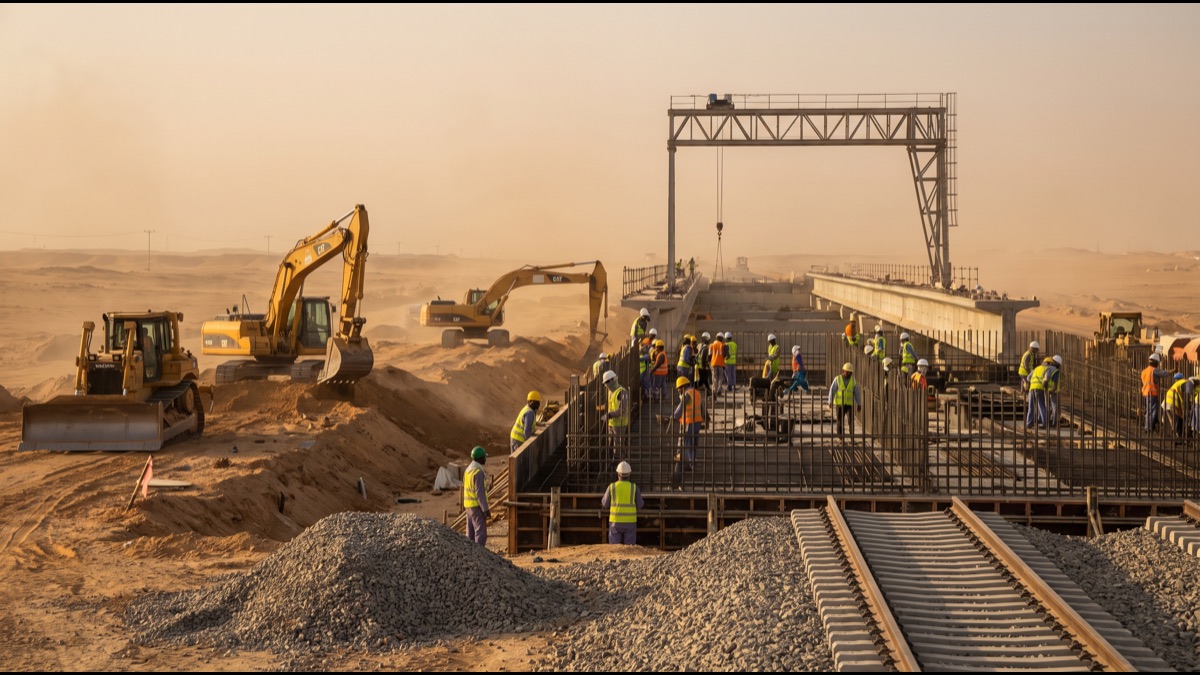
Saudi Arabia has spent the past decade turning rail from an afterthought into one of the clearest physical expressions of Vision 2030. New freight corridors, expanded passenger lines, and links between inland cities and coastal ports are being built at a pace the country has never attempted before. The reasons are as much economic as they are logistical: reducing dependence on trucking, cutting the cost of moving minerals and goods across a vast landmass, and giving cities beyond Riyadh and Jeddah a faster connection to the national economy. But building rail in Saudi Arabia is not simply a matter of laying track across flat desert. The terrain, the climate, and the sheer distances involved create engineering problems that most temperate-climate rail systems never have to solve, and the way Saudi planners are addressing them says a lot about how the kingdom builds infrastructure at scale.
Why Rail Became a Vision 2030 Priority
Vision 2030 is built around reducing Saudi Arabia's reliance on oil revenue by developing logistics, tourism, and industry as parallel pillars of the economy, and rail sits at the intersection of all three.
A country the size of Saudi Arabia cannot move heavy freight efficiently by road alone; trucking is flexible but expensive per ton over long distances, and it adds wear to a highway network that was never designed for the volumes an industrializing economy produces.
Rail solves this by moving enormous tonnage on a fixed, predictable schedule, which is why mining, petrochemicals, and construction materials feature so heavily in the freight corridors being expanded or newly built.
The Basic Engineering Challenge of Desert Rail
Laying track across desert terrain looks simple from a satellite image, but the ground itself is often unstable in ways that undermine a railbed if it is not properly prepared.
Loose sand does not compact reliably, so engineers typically have to stabilize the subgrade with layers of compacted aggregate before track can be laid, and in dune-heavy stretches this sometimes means rerouting around unstable formations rather than through them.
The alternative, forcing a straight line through shifting dunes, tends to create long-term maintenance headaches that cost far more over a rail line's lifespan than a longer but more stable route would have.
Fighting Sand Encroachment After the Track Is Laid
Building the line is only the first challenge; keeping it clear afterward is a continuous operation because wind-blown sand does not stop moving once construction ends.
Rail corridors in exposed desert stretches are typically protected with engineered windbreaks, angled fencing, and sometimes rows of drought-resistant vegetation designed to slow the wind before it reaches the ballast.
Even with these measures, maintenance crews still have to run scheduled clearing operations, because a rail line that looks clear in the morning can have meaningful sand drift across the ballast by the following week during peak wind season.
Why Heat Changes How Track Itself Is Designed
Steel rail expands and contracts with temperature, and the swing between a scorching afternoon and a cool desert night is far more extreme than what rail engineers deal with in temperate climates.
Continuous welded rail, which removes the small gaps that older bolted track used to allow for expansion, has to be laid and stressed at a carefully calculated temperature so that it does not buckle in extreme heat or crack under contraction in cooler months.
Getting this stressing process wrong is one of the more common causes of track failure in hot-climate rail systems worldwide, which is why Saudi rail contractors treat thermal calibration as a specialized part of construction rather than a routine step.
Foundation Work Nobody Sees From the Surface
Before any visible track appears, contractors spend a large share of the project timeline on foundation and drainage work that is almost invisible to anyone driving past the site.
Even in a desert climate, occasional heavy rain events can cause flash flooding across normally dry wadis, so culverts and drainage channels have to be built into the rail corridor to prevent water from undermining the embankment during rare but intense storms.
Skipping or underbuilding this drainage work is a known failure point in arid-region infrastructure generally, since the damage from a single flash flood can undo months of otherwise solid construction.
Freight Versus Passenger Priorities on the Same Network
Saudi Arabia's rail expansion serves two different missions that do not always pull in the same direction: moving industrial freight efficiently, and moving people quickly and comfortably between major cities.
Freight lines prioritize heavy axle loads, long straight stretches, and connections to ports and industrial zones, while passenger lines prioritize speed, station spacing, and a smoother ride quality that heavy freight infrastructure does not need.
Where the two share track, schedulers have to carefully sequence freight and passenger movements so that slower, heavier freight trains do not create bottlenecks for faster passenger services, which is one reason some new lines are being built as dedicated freight-only corridors.
Connecting Inland Cities to Coastal Ports
A large part of the economic logic behind new rail lines is linking inland industrial and mining regions directly to Red Sea and Gulf ports, cutting out the multiple truck-to-port handoffs that used to be standard.
For mineral exports in particular, a direct rail-to-port connection can meaningfully change the economics of a mining project, since bulk minerals are low-value-per-ton and highly sensitive to transport cost.
This is why some of the most heavily prioritized new lines run through mining regions rather than population centers, even though the passenger-facing announcements tend to get more public attention.
How Landia's Existing Network Shapes New Construction
New lines are rarely built in isolation; they are almost always designed to connect into the existing Saudi Railways network so that a shipment or passenger can move across multiple lines without switching systems entirely.
This means gauge, signaling standards, and electrification choices on new lines have to match or interface cleanly with what already exists, which constrains some design choices even when a newer technology might otherwise be preferred for a standalone project.
Retrofitting incompatibility after the fact is far more expensive than designing for interoperability from the start, so this coordination work happens early in the planning process, well before visible construction begins.
The Workforce Behind a Megaproject Timeline
Projects at this scale require a mix of local labor, specialized foreign contractors, and engineering firms with track records in exactly this kind of terrain, since desert-rail expertise is a narrow specialty within the broader rail industry.
Saudi Arabia has increasingly required international partners on these projects to include local workforce training components, both to build domestic capacity and to meet Vision 2030's broader goal of growing skilled employment for Saudi nationals.
This workforce-development requirement can add time to a project's early phases, since training pipelines have to be established alongside construction, but it is treated as a deliberate tradeoff rather than an unwanted delay.
Technology Partnerships That Make Desert Rail Feasible
Much of the specialized technology for extreme-heat signaling equipment, sand-resistant switch mechanisms, and thermal-tolerant rail components comes through partnerships with international rail engineering firms that have solved similar problems in other hot-climate regions.
Signaling equipment in particular has to be housed and cooled carefully, since electronic components that work reliably in a temperate climate can fail prematurely when exposed to consistent extreme heat without adequate protection.
These technology transfer partnerships are often structured so that maintenance and parts supply continue long after the initial construction contract ends, since a rail line is only as reliable as its ongoing technical support.
Financing Structures Behind the Expansion
Rail megaprojects of this scale are typically financed through a mix of government investment, sovereign wealth fund backing, and in some cases public-private partnership structures where a private operator takes on construction or operating risk in exchange for long-term contracts.
This financing approach spreads risk across multiple parties and can accelerate construction timelines compared with relying solely on direct government budgeting, though it also means contract structuring and risk allocation are negotiated carefully before ground is broken.
Because these projects sit inside a broader diversification strategy, their financing is generally evaluated not just on direct rail revenue but on the wider economic activity the corridor is expected to unlock along its route.
Environmental Considerations in Route Planning
Even in the desert, route planners have to account for protected areas, groundwater considerations, and occasional wildlife corridors, since a rail line is a permanent barrier that can disrupt natural water flow and animal movement if it is not planned around these features.
Environmental impact assessments for these projects typically examine both construction-phase disruption and the long-term footprint of the corridor once it is operational, since a permanent embankment changes local drainage patterns in ways that can persist for decades.
Where a straight-line route would cross a sensitive area, planners generally choose a longer alternate path rather than accept the long-term environmental cost of the shorter one, even though this adds to construction expense.
What Delays Actually Look Like on These Projects
Public announcements about megaprojects tend to emphasize ambitious completion dates, but the reality of construction in extreme conditions means schedules regularly shift due to weather windows, supply chain timing for specialized components, and the sequencing of foundation work before track can be laid.
Extreme summer heat itself limits the hours and months during which certain outdoor construction work can safely proceed, since worker-safety regulations restrict labor during the hottest parts of the day in peak summer months.
This seasonal construction rhythm is built into realistic project planning from the outset, even if it rarely appears in the headline timelines used in public communications about the project.
How These Lines Fit Into the Broader Vision 2030 Map
The rail expansion does not exist as a standalone initiative; it is deliberately sequenced alongside new industrial cities, expanded ports, and tourism developments so that transport capacity arrives roughly in step with the demand these other projects are expected to generate.
Planners coordinate rail timelines with these adjacent megaprojects because a finished rail line with no functioning port or industrial zone at its endpoint delivers far less economic value than one built to arrive alongside its destination infrastructure.
This cross-project sequencing is one of the more complex parts of Vision 2030's execution, since delays in one sector can ripple into the usefulness of rail infrastructure that was otherwise completed on schedule.
What to Watch as Construction Continues
The clearest sign of progress on any of these lines is not the announcement of a new segment but the connection of that segment into the operational network, since a completed but isolated stretch of track provides little practical value until it links to ports, cities, or existing lines.
Independent verification of freight volumes actually moving on new corridors, rather than construction-completion announcements alone, is generally the more reliable indicator of whether a line is functioning as intended.
As more lines come online through the rest of the decade, the practical test will be whether they measurably shift freight away from road transport and whether passenger lines meaningfully cut travel times between the cities they connect.
How Signaling Systems Are Adapted for Extreme Heat
Modern rail signaling relies on electronic sensors and communication equipment that were originally engineered for climates far cooler than the Saudi interior, so much of the adaptation work involves re-housing this equipment rather than redesigning it from scratch.
Control cabinets along the line are typically fitted with reinforced cooling and shading systems, since electronics that overheat even briefly can trigger false signals or outright failures that ripple through the entire schedule for that segment of track.
Redundancy is built in deliberately, with backup power and duplicate signaling paths at critical junctions, because a single point of failure in extreme heat is far more likely to actually occur than the equivalent failure would be in a temperate climate.
Why Maintenance Contracts Extend for Decades, Not Years
Because desert conditions accelerate wear on components that would last much longer elsewhere, maintenance is treated as a core part of the original project rather than an afterthought handled separately once construction wraps up.
Long-term maintenance contracts, sometimes spanning decades, are increasingly bundled into the original construction agreements so that the same contractor who understands the specific engineering choices made during construction remains accountable for keeping the line functional.
This bundling also gives contractors a direct financial incentive to build components that hold up well in the first place, since poor initial construction choices become their own maintenance burden for years afterward rather than someone else's problem.
Comparing This Expansion to Earlier Saudi Rail History
Saudi Arabia's rail history stretches back over a century, including the historic Hejaz Railway, but the current wave of expansion operates at a scale and technical sophistication that earlier rail projects never approached.
Where earlier lines were often built primarily for a single purpose, whether religious pilgrimage transport or basic regional connection, the current expansion is explicitly designed as an integrated freight and passenger network serving industrial diversification goals.
This shift from single-purpose lines to an integrated network is itself one of the more significant changes in how Saudi Arabia thinks about rail, treating it as core national infrastructure rather than a specialized service for a narrow use case.
The Role of Data and Monitoring in Modern Rail Operations
Newer sections of the network increasingly incorporate sensor-based monitoring that tracks rail temperature, track alignment, and early signs of sand accumulation in real time, rather than relying solely on scheduled physical inspections.
This kind of continuous monitoring allows maintenance crews to respond to a developing problem, such as a section of track drifting slightly out of alignment due to ground movement, before it becomes serious enough to require a service disruption.
Over time, the data collected from these systems also feeds back into how future lines are engineered, since patterns of wear on existing track reveal which design choices held up well in practice and which need to be revised for new construction.
What Success Actually Means for This Expansion
Measuring whether this rail expansion succeeds requires looking well beyond ribbon-cutting ceremonies, since the real test is whether freight volumes and passenger ridership grow to match the capacity that has been built.
Economists studying infrastructure investment generally look for a rail line to demonstrably shift a meaningful share of freight away from road transport within several years of opening, rather than simply running near-empty alongside continued truck traffic.
By that standard, the coming years of operational data, not the construction milestones themselves, will be what actually determines whether Saudi Arabia's rail investment delivers the economic transformation it was designed to support.
How International Contractors Are Selected for These Projects
Selecting a contractor for a desert rail megaproject is not simply a matter of choosing the lowest bid, since a contractor with no prior experience in extreme-heat, sand-prone terrain can end up costing far more once construction problems surface midway through the project.
Tender processes for these projects typically weight technical track record heavily, favoring firms that can demonstrate prior delivery of comparable rail infrastructure in similarly harsh climates, whether in other Gulf states, North Africa, or parts of Australia and the American Southwest.
Consortiums combining an international engineering firm with a Saudi construction partner have become increasingly common, since this structure pairs specialized technical expertise with local knowledge of regulatory processes, land acquisition, and labor logistics that a purely foreign contractor would otherwise need to build from scratch.
Land Acquisition and Community Impact Along New Routes
Before construction begins, planners have to resolve land rights along the proposed route, which can involve compensating landowners, relocating existing infrastructure such as roads or utility lines, and in some cases adjusting the route to avoid populated areas entirely.
This process tends to move more smoothly through open desert than through populated corridors near existing towns, which is one practical reason new lines sometimes take longer, less direct paths that avoid dense settlement rather than cutting straight through it.
Community consultation processes, while less prominent in public reporting than the engineering details, still shape final route decisions, since a rail corridor that disrupts local access to grazing land or existing roads can generate friction that slows a project even after construction has technically been approved.
Saudi Arabia's rail expansion is less a single project than an evolving system of interlocking engineering, financing, and workforce decisions, each shaped by the specific demands of building permanent infrastructure across an extreme desert environment. The visible outcome, faster freight movement and new passenger connections, depends on unglamorous work that happens well before any train runs: soil stabilization, thermal calibration, drainage planning, and coordination with a growing web of adjacent megaprojects. Understanding that underlying complexity is useful for anyone trying to judge how realistic a given completion timeline actually is, since the pace of this kind of construction is set as much by ground conditions and seasonal heat limits as it is by ambition. What is clear is that rail has moved from a minor line item to a central piece of how Saudi Arabia intends to connect its economy, and the coming years will show how much of that ambition converts into track that is actually carrying freight and passengers.
Sources
- Saudi Vision 2030 official site — Official framework document outlining the economic diversification goals rail investment supports
- Wikipedia: Saudi Arabia Railways — Background on the national rail operator and existing network
- Railway Technology — Industry coverage of rail engineering challenges in extreme climates
- IMF Saudi Arabia country page — Economic context on diversification strategy and infrastructure investment
FAQ
Why is Saudi Arabia investing so heavily in rail instead of just expanding roads?
Rail moves much larger volumes of freight per unit of energy and cost than trucking over long distances, and it reduces wear on a highway network that was not built for industrial-scale freight volumes. For Vision 2030's logistics goals, rail is generally the more efficient long-term investment for bulk freight.
What makes desert rail construction harder than rail construction elsewhere?
Unstable sand subgrades, extreme temperature swings that affect steel rail, sand encroachment after construction, and flash-flood drainage risk all require specialized engineering that temperate-climate rail projects do not usually need.
Are these new lines mainly for passengers or for freight?
Both, but many of the most heavily prioritized new corridors are freight-focused, connecting inland mining and industrial regions directly to ports, since that is where the clearest near-term economic return is expected.
How is this rail expansion actually being paid for?
Through a mix of direct government investment, sovereign wealth fund backing, and public-private partnership structures that share construction and operating risk with private contractors in exchange for long-term contracts.
Why do project timelines for these lines often shift?
Extreme summer heat limits safe outdoor construction hours, specialized components can face supply timing issues, and foundation and drainage work has to be completed properly before track-laying, all of which push back headline completion dates.
About the Author
We reference Saudi Vision 2030 official site, Wikipedia: Saudi Arabia Railways, Railway Technology, and IMF Saudi Arabia country page to explain the background and current understanding of this topic.
Loved This Article?
Share it on WhatsApp → Share it on WhatsApp
Get more guides in your inbox — Subscribe to our newsletter for weekly surprising stories from Egypt, Saudi Arabia, Dubai, and beyond.