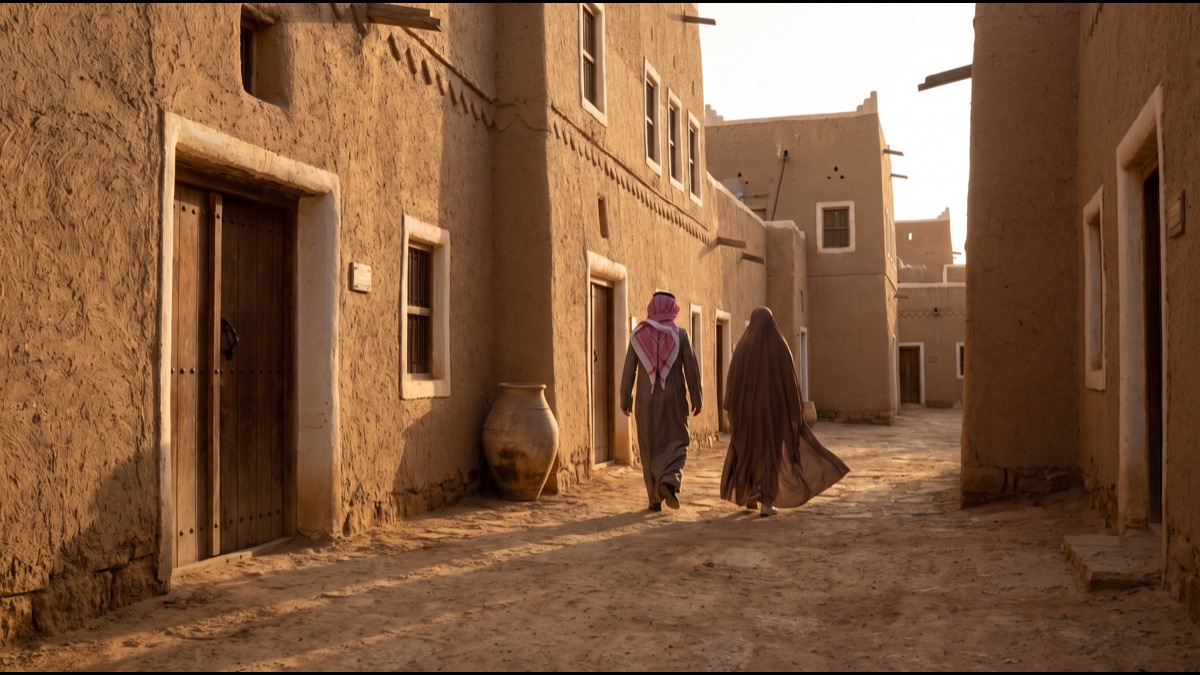
Diriyah Before 1744
Before there was a Saudi flag, national anthem, or drawn border, there was Diriyah. The settlement sits on the banks of Wadi Hanifa in the heart of Najd, a region of central Arabia where caravan routes crossed for centuries. People came from Yemen, Iraq, and across the peninsula, drawn to a fertile oasis in a sea of sand.
By the 15th century, Diriyah was a modest farming village. Its people grew dates and grain, built homes from mud brick, and relied on palm groves for shade and survival. Salwa Palace, perched on a hill above the wadi, served as both fortress and center of power. Diriyah was small, but its location gave it influence far beyond its size.
The 1744 Alliance
In 1744, Muhammad ibn Abd al-Wahhab arrived in Diriyah. A religious scholar calling for a return to pure monotheism and the reform of religious practice, he found a receptive patron in Muhammad ibn Saud, the ruler of the settlement. Their meeting produced one of the most consequential partnerships in Arabian history.
The deal was simple: Muhammad ibn Saud offered protection and political authority; Muhammad ibn Abd al-Wahhab offered religious legitimacy. Together, they turned a local village into the capital of an expanding state. Within three decades, the First Saudi State stretched from the Gulf to the Red Sea.
Rise and Fall of the First Saudi State
Under Imam Abdulaziz ibn Muhammad, who ruled from 1765 to 1803, Diriyah reached the height of its power. Under his son, Saud the Great, the state expanded further, controlling the Hijaz and sending campaigns as far as Iraq and Syria.
Diriyah itself was transformed. No longer a village, it became the capital of an empire. Houses spread outward, markets thrived, and scholars from across the Islamic world visited its courts. For a time, it was the most important city in Arabia.
But expansion created enemies. The Ottoman Empire, alarmed by the growing state, ordered Muhammad Ali Pasha of Egypt to crush it. In 1818, Ibrahim Pasha led an Egyptian army into Diriyah, destroyed the city, burned its houses, and exiled the ruling family. The First Saudi State came to a violent end.
The Historic Sites That Survived
Despite the destruction, much of old Diriyah survived. Today visitors can walk through:
- Salwa Palace, the fortress that served as the seat of government, built from mud brick on a hill overlooking the wadi.
- At-Turaif District, the historic heart of Diriyah where the ruling family lived and which is now a UNESCO World Heritage Site.
- The old markets, whose ruins still hint at the trade that once flourished here.
- Traditional Najdi houses, with their small windows for keeping out heat and flat roofs used for sleeping on summer nights.
- The palm groves, thousands of date palms that still line Wadi Hanifa.
In 2010, UNESCO inscribed At-Turaif on the World Heritage List, making it the first Saudi site to receive that recognition. The designation was not just an honor; it was international acknowledgment that a small oasis village had changed the history of Arabia.
Diriyah Under Vision 2030
Today Diriyah is undergoing the largest restoration project in Saudi history. The Diriyah Gate Development Authority, established in 2017, is turning the site into a global cultural and tourism destination.
The project includes:
- Restoring around 300 historic buildings using traditional materials and techniques.
- Building museums that document the history of the First Saudi State.
- Developing restaurants and hotels that blend modern luxury with Najdi character.
- Creating green spaces along the banks of Wadi Hanifa.
- Running educational programs for visitors and students.
The goal is not only to preserve the past, but to show that Saudi heritage is not archive material. It is a source of national pride and a driver of future development.
Why Diriyah Matters Today
For Saudis, Diriyah is more than ruins. It is proof that the Kingdom did not begin with oil. It began with an idea, an alliance, and a decision made in a tent nearly 280 years ago. That kind of history gives Saudis an identity that runs deeper than economics.
In a world where oil can reshape the value of societies, Diriyah reminds Saudis that their real worth lies in their civilization, their resilience, and their ability to build from the ground up.
Sources
- Diriyah Gate Development Authority — official history, restoration plans, and visitor information
- UNESCO World Heritage Centre — At-Turaif District in Diriyah World Heritage listing
- Visit Saudi — official tourism guidance on Diriyah and the surrounding region
Frequently Asked Questions
Why is Diriyah important in Saudi history?
Diriyah is the birthplace of the First Saudi State. It was from here that Muhammad ibn Saud launched his leadership in 1744 and formed an alliance with Muhammad ibn Abd al-Wahhab. The settlement grew from a small oasis village into the capital of a state stretching from the Gulf to the Red Sea.
Why was Diriyah destroyed in 1818?
Diriyah was destroyed by Egyptian forces led by Ibrahim Pasha on the orders of Muhammad Ali Pasha and the Ottoman Empire. The campaign aimed to end the First Saudi State, which had challenged Ottoman influence in Arabia.
Is Diriyah a UNESCO World Heritage Site?
Yes. In 2010, UNESCO inscribed At-Turaif District in Diriyah on the World Heritage List. It was the first site in Saudi Arabia to receive this designation.
What is the Diriyah Gate project?
The Diriyah Gate Development Authority, established in 2017, is transforming the site into a global cultural and tourism destination. The project includes restoring around 300 historic buildings, building museums, hotels, green spaces, and educational programs.
What can visitors see in Diriyah today?
Visitors can explore Salwa Palace, the At-Turaif District, traditional Najdi mud-brick houses, old markets, palm groves along Wadi Hanifa, and new museums, restaurants, and luxury hotels.
Related Reading
- Complete Saudi Arabia Travel Guide
- Saudi Vision 2030: A Complete Guide
- AlUla Saudi Arabia: Ancient Wonder & Modern Destination
- THE LINE: What We Know About NEOM's Linear City
- The Red Sea Project: Saudi Arabia's New Luxury Tourism Destination
About the author: The doyouknow.app editorial team writes about Saudi history, culture, and the identity that shapes the Kingdom. Have a topic idea? Get in touch.
📱 Tell a friend: Share on WhatsApp
📬 Get more Saudi facts. Subscribe to our newsletter for surprising stories from Saudi Arabia and beyond.