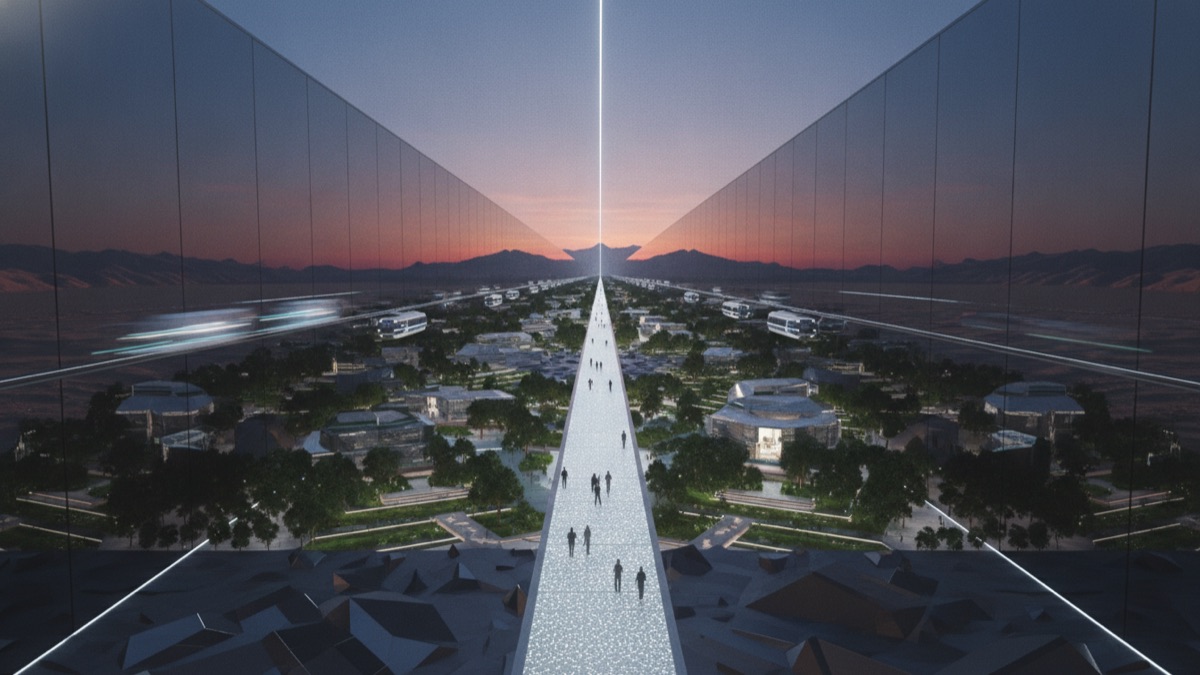
What Is THE LINE?
THE LINE is not just a long building. It is an attempt to rethink how humans could live in the future.
THE LINE is the most visually striking piece of NEOM, Saudi Arabia's $500 billion futuristic development zone in the country's northwest. Planned as a 170-kilometer linear city rising from the desert, it is designed to house up to nine million people inside a mirrored strip only 200 meters wide and 500 meters tall. Yet the numbers only tell part of the story. THE LINE is an attempt to reinvent the city itself.
The core idea is radical: a city with no cars, no roads, and no carbon emissions. Residents would move vertically through high-speed transit, while goods and services travel unseen below street level. Daily essentials would be within a five-minute walk. That concept turns traditional urban planning on its head.
Design of the Linear City
170 Kilometers of Compressed Development
THE LINE would stretch 170 kilometers across northwestern Saudi Arabia, roughly the distance from Riyadh to Al-Kharj. Instead of spreading outward, the city is compressed into a narrow band. Planners say this preserves 95 percent of the surrounding natural land, leaving the desert and mountains untouched while people live in a thin, dense edge.
500 Meters High
The planned height of 500 meters makes THE LINE taller than most skyscrapers on Earth, but it is not a single tower. It is a continuous chain of residential, commercial, and public modules wrapped in glass and aluminum facades engineered to create shade and reduce the need for air conditioning.
High-Speed Vertical Transit
To cover 170 kilometers efficiently, THE LINE relies on high-speed transit systems that could reach 100 kilometers per hour. The promised end-to-end journey is around 20 minutes, faster than many metro lines. Delivering that requires transport technology that has never been deployed at this scale in a single city.
Current Status
Construction Progress
Construction is underway. Reports point to large-scale excavation, bridge work, and tunneling across multiple sites, with thousands of workers on the ground. The physical progress, however, looks different from the dramatic renders unveiled in 2021.
Plan Adjustments
In 2023 and 2024, NEOM revised the timeline. THE LINE is now expected to roll out in phases, with the first phase designed for around 300,000 residents rather than the full nine million. The long-term vision remains ambitious, but the near-term plan has become more pragmatic.
Estimated Cost
NEOM as a whole is budgeted at roughly $500 billion. THE LINE alone could account for more than $100 billion. Those figures exceed the annual budgets of many countries, reflecting the scale of Saudi Arabia's bet on Vision 2030.
The Debate Around THE LINE
Engineering Challenges
Engineers and urban planners have raised serious questions. Providing water, energy, cooling, and waste management in a desert where summer temperatures exceed 50°C is hard enough for a conventional city. Doing it inside a 500-meter-tall, 200-meter-wide strip is unprecedented.
Environmental and Social Questions
The area is home to local communities, including the Huwaitat tribe. Some reports have described forced relocations, which NEOM has denied, saying consultations and agreements guide resettlement. Environmental groups also worry about the impact on desert wildlife and Red Sea coral reefs.
A New Urban Model?
Whether or not every element is delivered, THE LINE forces the world to ask hard questions. Must future cities sprawl? Can car ownership be eliminated? Is sustainable luxury possible? The project pushes the global conversation on urban design, even if parts of it evolve or shrink.
Why THE LINE Matters
THE LINE matters because it is a statement. It says Saudi Arabia wants to be known for more than oil. It says the future city can look nothing like the cities of the past. It says infrastructure does not have to follow old rules.
Whether the project is delivered exactly as announced or adapts to new realities, it has already changed the conversation. Engineers, planners, and investors around the world are watching. For Saudi Vision 2030, that symbolism is part of the point.
Sources
- NEOM official website — official specifications, designs, and project updates
- Bloomberg — NEOM coverage — economic reporting on financing, timelines, and scale
- Reuters — Saudi Arabia projects — international news and financial analysis
- Saudi Gazette — local news coverage of construction and government announcements
Frequently Asked Questions
What is THE LINE in NEOM?
THE LINE is a planned 170-kilometer linear city inside NEOM in northwestern Saudi Arabia. It is designed to be 500 meters tall, 200 meters wide, and home to up to nine million people, with no cars, no roads, and zero carbon emissions.
How long is THE LINE?
THE LINE is planned to stretch 170 kilometers from the coastal mountains of northwestern Saudi Arabia deep into the desert.
What are the construction phases of THE LINE?
THE LINE is being built in phases. The first phase is expected to accommodate around 300,000 residents, a significant scale-back from the original headline figure of nine million.
How much does THE LINE cost?
NEOM as a whole is backed by roughly $500 billion in planned investment. THE LINE alone could cost more than $100 billion.
Is THE LINE realistic?
That is debated. Engineers question the feasibility of water, energy, cooling, and waste systems at this scale in the desert. The phased approach suggests the project is adapting to real-world constraints, but the final outcome will take years to judge.
Related Reading
- NEOM City: Saudi Arabia's Futuristic City Guide
- What Is NEOM? Saudi Arabia's Futuristic City Project
- Saudi Vision 2030: A Complete Guide
- AlUla Saudi Arabia: Ancient Wonder & Modern Destination
- Complete Saudi Arabia Travel Guide
About the author: The doyouknow.app editorial team covers Saudi Arabia's most ambitious projects, ancient heritage, and modern transformations. We bring you facts that matter.
📱 Tell a friend: Share on WhatsApp
📬 Get more Saudi facts. Subscribe to our newsletter for surprising stories from Saudi Arabia and beyond.