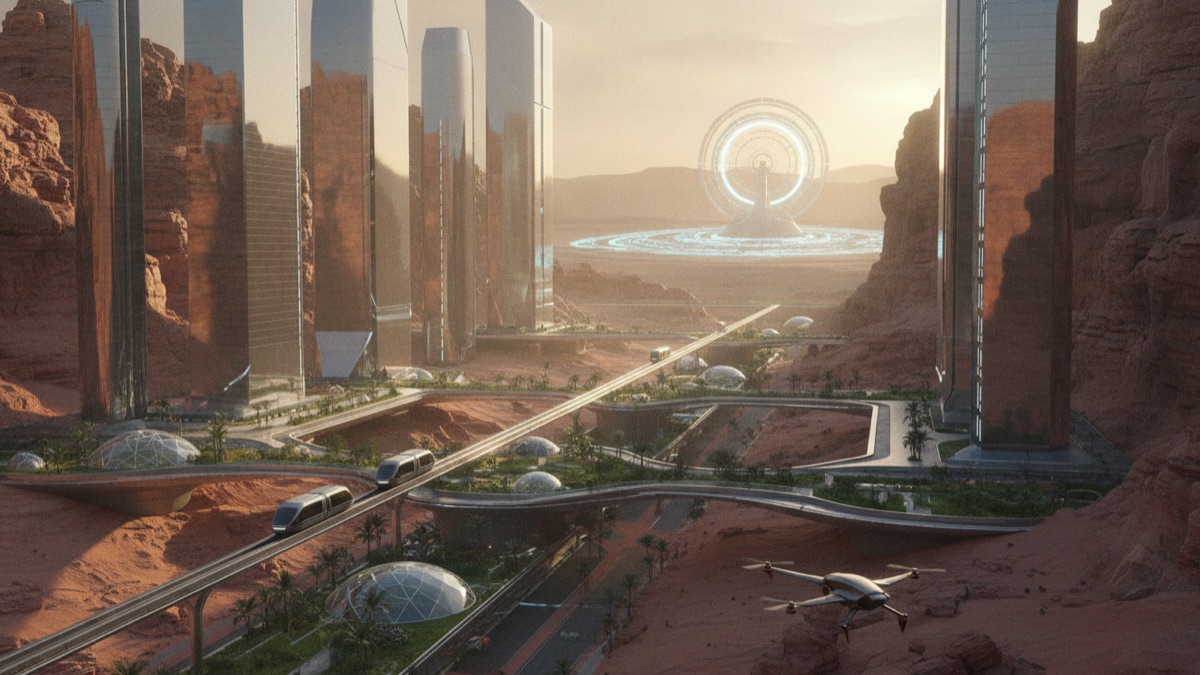
What Is NEOM?
In the northwestern corner of Saudi Arabia, along the pristine shores of the Red Sea, a project is underway that could redefine how humans live, work, and interact with nature. NEOM is not merely a city or a development zone. It is a $500 billion experiment in urban planning, sustainability, and technology — the largest and most ambitious project of its kind in human history.
Announced in 2017 as the crown jewel of Saudi Vision 2030, NEOM spans an area of 26,500 square kilometers, roughly the size of Belgium. The project derives its name from the Greek prefix "neo" (new) and the Arabic letter "M" for "Mustaqbal" (future). But beyond the branding lies a genuinely radical proposition: what if a city could be built from scratch using only renewable energy, artificial intelligence, and the most advanced construction technologies available?
NEOM is not a single city. It is a region comprising multiple interconnected projects, each with its own identity and function. From a 170-kilometer linear city to a floating industrial complex, from a mountain ski resort to a luxury island, NEOM aims to create an ecosystem where innovation, nature, and human well-being coexist. This guide explores every major component of the project, the technologies driving it, the challenges it faces, and what it means for Saudi Arabia's economic future.
THE LINE: The Linear City of the Future
THE LINE is the most visually striking and technically ambitious component of NEOM. Planned as a linear city stretching 170 kilometers across the Saudi desert, it is designed to be only 200 meters wide and 500 meters tall, creating a mirrored facade that rises from the landscape like a vertical wall.
The concept is radical in its simplicity: instead of urban sprawl, everything is stacked vertically. Homes, offices, schools, parks, and entertainment venues are arranged in layers, with high-speed rail running through the spine of the structure. The design promises that residents can access all daily necessities within a five-minute walk, eliminating the need for cars and traditional roads entirely. A high-speed train running the full length of THE LINE would connect its two ends in just 20 minutes.
The city is designed to house up to 9 million people while occupying only 34 square kilometers — a fraction of the land required by conventional cities of comparable population. This density, combined with vertical construction, is intended to preserve 95 percent of the surrounding land for nature. THE LINE also promises zero carbon emissions, 100 percent renewable energy, and a closed-loop water system that recycles every drop.
Construction of THE LINE began in earnest in 2022, with massive earthworks and foundation laying already visible from satellite imagery. The project is being developed in phases, with the first sections expected to welcome residents by 2030. However, engineers and urban planners worldwide continue to debate the feasibility of building at this scale within the proposed timeframe and budget.
Oxagon: The World's Largest Floating Industrial Complex
If THE LINE reimagines residential urban life, Oxagon reimagines industry. Planned as the world's largest floating industrial complex, Oxagon is an octagonal-shaped city built partly on land and partly on the Red Sea, designed to serve as a global hub for advanced manufacturing, clean energy, and maritime logistics.
Oxagon's strategic location on the Red Sea places it at the intersection of major global shipping routes connecting Asia, Europe, and Africa. The complex will feature a fully automated port capable of handling the world's largest container ships, supported by an integrated supply chain powered by artificial intelligence and robotics. The goal is to reduce shipping times and logistics costs dramatically while operating entirely on renewable energy.
The industries targeted for Oxagon are deliberately futuristic: hydrogen production, renewable energy equipment, advanced manufacturing, biotechnology, and food production using vertical farming and aquaculture. By clustering these industries together and powering them with solar and wind energy generated on-site, NEOM's planners aim to create the world's first truly carbon-neutral industrial zone.
The scale of Oxagon is staggering. When fully operational, it is expected to contribute tens of billions of dollars annually to Saudi Arabia's GDP while creating hundreds of thousands of jobs. The floating component, built on reclaimed sea platforms, represents an engineering challenge never attempted at this scale, requiring innovations in marine construction and materials science.
Trojena: Saudi Arabia's First Outdoor Ski Resort
At elevations exceeding 1,500 meters in the Sarawat Mountains, Trojena is NEOM's answer to adventure tourism. Planned as Saudi Arabia's first major outdoor ski resort, Trojena will feature year-round skiing thanks to a combination of natural snowfall in winter and artificial snow-making technology, alongside hiking, mountain biking, water sports on a man-made freshwater lake, and luxury residences.
Trojena has already hosted international sporting events, including the Asian Winter Games, proving that the project is moving from concept to reality faster than many expected. The resort is designed around a central artificial lake that will serve as a hub for water sports and outdoor activities during warmer months, transforming Trojena into a year-round destination.
The architecture of Trojena blends futuristic design with mountain landscapes. The "Vault" — a massive bowl-shaped structure — will house retail, dining, and entertainment venues beneath a retractable roof. Nearby, luxury hotels and chalets are designed to integrate with the natural terrain rather than dominate it. Trojena represents NEOM's effort to diversify Saudi Arabia's tourism offerings beyond desert and coastal experiences, tapping into the growing global market for adventure and eco-tourism.
Sindalah: The Red Sea's Luxury Island Gateway
Among all NEOM projects, Sindalah is the closest to welcoming visitors. This luxury island destination in the Red Sea has already begun opening select facilities, making it the first NEOM project where tourists can actually experience the vision firsthand.
Sindalah is designed as a yachting and diving paradise. The island features a 86-berth marina capable of accommodating superyachts up to 75 meters, alongside boutique hotels, fine dining restaurants, retail spaces, and a beach club. The marine environment around Sindalah is among the most pristine in the Red Sea, with coral reefs, dolphin populations, and clear waters that make it ideal for diving and snorkeling.
What distinguishes Sindalah from other luxury island destinations is its commitment to sustainability. The island operates on renewable energy, uses desalination and water recycling systems, and follows strict environmental protection protocols to preserve the marine ecosystem. The architecture is low-rise and unobtrusive, designed to blend with the island's natural contours rather than overshadow them.
Sindalah serves as a proof of concept for NEOM's broader tourism strategy: high-end, sustainable, experience-driven travel that appeals to global visitors while respecting the environment. Early visitor feedback and media coverage suggest that the island delivers on its promises, offering a glimpse of what the larger NEOM ecosystem could become.
Sustainability at the Heart of NEOM
NEOM's most ambitious claim is not its scale or its technology, but its commitment to sustainability. The project is designed to operate entirely on renewable energy, with solar and wind farms supplying 100 percent of its power needs. This is not a minor detail — it is the foundational principle upon which every sub-project is built.
Water management is equally critical. Located in one of the driest regions on Earth, NEOM cannot rely on conventional water sources. Instead, the project plans to use solar-powered desalination plants, combined with extensive water recycling and closed-loop systems that minimize waste. The goal is to produce more clean water than the region consumes, creating a net-positive water system.
Biodiversity protection is another core priority. NEOM's location encompasses marine habitats, mountain ecosystems, and desert landscapes that host unique species. The development plan allocates significant portions of the total area as protected zones, with wildlife corridors connecting different habitats. Coral reef restoration programs and marine protected areas around Sindalah and the Red Sea coast aim to ensure that development does not come at the expense of the natural environment.
Whether these sustainability targets are achievable at the scale and speed proposed remains a subject of intense debate among environmental scientists and engineers. What is clear, however, is that NEOM has made sustainability a central marketing point and a design constraint — which means success or failure will be measured against these standards.
Technology and Innovation
NEOM is designed to be the world's most technologically advanced city. Artificial intelligence will manage everything from traffic flow to energy distribution. Autonomous vehicles, drones, and robots will handle logistics, delivery, and maintenance. A city-wide digital infrastructure will provide high-speed connectivity and enable real-time data collection and analysis.
The NEOM Digital Infrastructure Company is building a backbone of fiber-optic cables, 5G and 6G towers, and edge computing facilities that will cover the entire region. This network will support not just consumer internet, but industrial IoT, autonomous systems, and smart city management platforms. Every building, vehicle, and public space is designed to be a data node in a city-wide nervous system.
Robotics and automation will play an especially large role in Oxagon, where autonomous cranes, robotic assembly lines, and AI-managed supply chains are planned. In THE LINE, facial recognition and biometric systems will replace traditional keys and tickets, while predictive algorithms will manage everything from waste collection to emergency response.
NEOM also aims to be a testing ground for emerging technologies. Partnerships with global technology companies are planned to trial everything from flying taxis and hyperloop transport to advanced materials and quantum computing. If successful, NEOM could become a living laboratory where tomorrow's technologies are deployed at scale today.
Timeline and Development Phases
NEOM is a multi-decade project with a phased implementation strategy. Understanding the timeline is essential to separating what is already happening from what remains on the drawing board.
2017–2019: Project announcement, master planning, and initial land acquisition. The foundational vision was established, and international consulting firms were brought in to design the sub-projects.
2019–2022: Early construction began on infrastructure, staff housing, and the first phases of Sindalah. Trojena hosted its first test events. Environmental impact assessments and marine surveys were completed.
2022–2025: Major construction acceleration. THE LINE's foundation work began, Oxagon's port facilities started development, and Trojena's core structures took shape. Sindalah began limited operations.
2025–2030: First residents expected in early sections of THE LINE. Oxagon's industrial zones scheduled to begin operations. Trojena planned to open for full tourism. Sindalah expected to reach full capacity.
2030–2045: Full build-out phases. The complete 170-kilometer length of THE LINE, full industrial capacity at Oxagon, and integration of all sub-projects into a single ecosystem.
It is important to note that timelines for projects of this magnitude frequently shift. Economic conditions, technological breakthroughs or setbacks, and geopolitical factors can all accelerate or delay specific phases. What is certain is that NEOM has moved beyond the conceptual stage — billions of dollars have been spent, thousands of workers are on site, and physical structures are rising from the desert and the sea.
Criticism and Challenges
No project of NEOM's scale escapes scrutiny, and criticism has come from multiple directions. Understanding these challenges is essential to forming a balanced view of what NEOM represents.
Feasibility concerns: Engineers and urban planners have questioned whether a 170-kilometer linear city can be built within the proposed budget and timeframe. The engineering challenges of vertical construction at this scale, combined with the harsh desert environment, are unprecedented. Some experts argue that the project will require significantly more time and money than currently projected.
Environmental impact: Despite sustainability claims, critics point out that building in a sensitive desert and marine ecosystem inevitably causes disruption. The energy and materials required for construction on this scale carry a significant carbon footprint, even if the completed city runs on renewables. Conservation groups have raised concerns about coral reef damage, wildlife displacement, and water consumption during the construction phase.
Resettlement issues: The construction of NEOM has required the relocation of existing communities in the Tabuk region. Reports from human rights organizations have documented concerns about the process, compensation, and consultation with affected residents. These issues have attracted international attention and remain a point of controversy.
Economic sustainability: Questions persist about who will live in and fund NEOM long-term. Attracting 9 million residents to a newly built city in the desert requires not just infrastructure but also jobs, services, and a compelling quality of life. Skeptics argue that without sustained oil revenues and international investment, NEOM could become a costly white elephant.
Impact on the Saudi Economy
NEOM is more than a construction project. It is the physical manifestation of Saudi Arabia's effort to transform its economy away from oil dependence. The project is expected to contribute approximately $48 billion annually to the Kingdom's GDP by 2030, rising significantly as more phases come online.
Job creation is a central pillar of NEOM's economic rationale. The project aims to create 380,000 jobs by 2030 and 1 million by 2045. These jobs span construction, technology, tourism, manufacturing, and services. Crucially, NEOM is designed to prioritize Saudi talent through training programs, education partnerships, and employment quotas that ensure the project builds local human capital alongside physical infrastructure.
Tourism revenue is another major component. Saudi Arabia has set a target of 100 million annual visitors by 2030, up from roughly 17 million in 2019. NEOM's sub-projects — Sindalah's yacht tourism, Trojena's ski resort, THE LINE's urban attractions — are designed to capture a significant share of this market. The project positions Saudi Arabia as a competitor to established tourism destinations in the UAE, Turkey, and the Mediterranean.
Perhaps most importantly, NEOM sends a powerful signal to global investors. By committing $500 billion and mobilizing the world's top engineering and technology firms, Saudi Arabia is demonstrating that it can execute complex, long-term projects. Success at NEOM would validate the broader Vision 2030 strategy and attract further investment into sectors from renewable energy to biotechnology. Failure, conversely, could undermine confidence in the Kingdom's economic diversification efforts.
Sources
- NEOM Official Website — Official updates on all NEOM sub-projects, sustainability commitments, and visitor information.
- Saudi Vision 2030 — Official government portal on economic transformation, diversification goals, and development strategy.
- Public Investment Fund (PIF) — Saudi sovereign wealth fund details on NEOM financing and governance.
- Bloomberg — Financial and construction updates on NEOM project costs, timelines, and international partnerships.
- Reuters — International reporting on Saudi economy, NEOM construction progress, and policy developments.
- Nature Journal — Scientific assessments of large-scale urban development and environmental sustainability in arid regions.
- Saudi Gazette — Local coverage of NEOM and Vision 2030 implementation, employment, and regional impact.
Frequently Asked Questions
What is NEOM in simple terms?
NEOM is a $500 billion futuristic development project in northwestern Saudi Arabia. It includes multiple cities and zones — THE LINE, Oxagon, Trojena, and Sindalah — designed to run on renewable energy and advanced technology. It is part of Saudi Vision 2030 and aims to diversify the Kingdom's economy beyond oil.
What is THE LINE?
THE LINE is a planned 170-kilometer linear city within NEOM. It is designed to be 500 meters tall, 200 meters wide, and house 9 million people. The city promises no cars, no roads, and zero carbon emissions, with all daily necessities accessible within a five-minute walk.
What is Oxagon?
Oxagon is a planned floating industrial city within NEOM, shaped like an octagon. It aims to be the world's largest fully automated port and a hub for clean manufacturing, hydrogen production, and advanced logistics — all powered by renewable energy.
Can you ski in Saudi Arabia at Trojena?
Yes. Trojena is NEOM's mountain destination at elevations above 1,500 meters. It is designed to offer outdoor skiing in winter through a combination of natural and artificial snow, alongside year-round adventure sports, luxury hotels, and a man-made lake for water activities.
Is Sindalah open to visitors?
Yes, Sindalah has begun opening select facilities and is the first NEOM project to welcome tourists. The luxury island features a superyacht marina, boutique hotels, fine dining, and diving experiences, all operating on renewable energy.
How much does NEOM cost?
NEOM is backed by $500 billion in planned investment, primarily funded by Saudi Arabia's Public Investment Fund (PIF). Additional funding comes from international investors and private sector partnerships. Costs may rise as the project scales.
When will NEOM be completed?
NEOM is being built in phases over several decades. Early sections of THE LINE may welcome residents by 2030, while Trojena and Sindalah are already partially operational. Full completion of all phases may extend to 2045 or beyond.
Will NEOM really run on 100% renewable energy?
NEOM's official plan is to power all operations using solar, wind, and green hydrogen. While the completed city is designed for 100% renewable energy, the construction phase currently relies partly on conventional power sources. Long-term success depends on scaling renewable infrastructure to match demand.
How many jobs will NEOM create?
NEOM aims to create approximately 380,000 jobs by 2030 and 1 million by 2045. These span construction, technology, tourism, manufacturing, and services, with a strong focus on training and employing Saudi citizens.
Can tourists visit NEOM now?
Tourists can currently visit Sindalah island, which has opened select hotels, restaurants, and marine activities. Other parts of NEOM remain under construction. Visitors should check the official NEOM website for current access and booking options.
Related Reading
- What Is NEOM? Saudi Arabia's Futuristic City Project
- AlUla Saudi Arabia: Ancient Wonder & Modern Destination
- Complete Saudi Arabia Travel Guide
- Saudi Vision 2030: A Complete Guide
- Burj Khalifa: 10 Surprising Facts You Didn't Know
About the author: The doyouknow.app editorial team explores Saudi Arabia's most ambitious projects, ancient heritage, and modern transformations. We bring you facts that matter.
📱 Tell a friend: Share on WhatsApp
📬 Get more Saudi facts. Subscribe to our newsletter for surprising stories from Saudi Arabia and beyond.