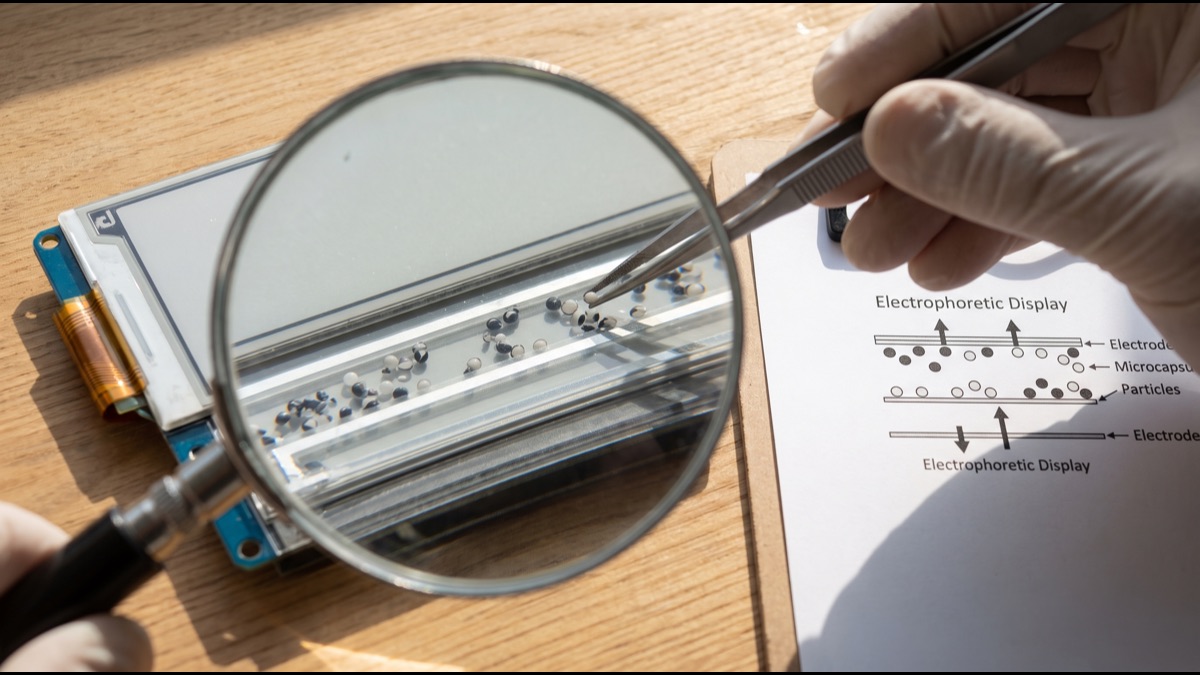
An e-reader left untouched on a shelf for a month will still show the exact page it was on when you set it down, with no battery drain at all, something no phone or laptop screen can do. That single fact is the clearest clue to how electronic ink actually works, and it has almost nothing in common with the backlit LCD or OLED panels most other screens rely on.
Understanding electronic paper display technology, commonly shortened to e-ink, means starting with a genuinely different physical principle: instead of constantly emitting light to form an image, the screen physically rearranges pigment and then simply stops, leaving the arrangement in place until told otherwise.
Why E-Readers Do Not Look Like Phone Screens
Conventional displays, whether LCD or OLED, form an image by controlling how much light passes through or is emitted from each pixel, and they have to keep doing this continuously, refreshing dozens of times per second, for as long as the image is on screen, which is precisely why they drain batteries quickly and can be hard to read in direct sunlight.
Electronic ink takes a fundamentally different approach borrowed from how ink sits on a printed page: rather than emitting light, it reflects ambient light off a physically arranged surface of pigment, which is why e-readers look flat and paper-like and remain perfectly legible outdoors, but also why they cannot produce their own light without an additional front-light layer.
This reflective approach also explains why e-ink screens tend to look identical whether you view them straight on or from a sharp angle, much like a printed page, whereas conventional emissive screens can shift in brightness or color depending on viewing angle because the light source itself is directional. Manufacturers frequently point to this angle-independent readability, alongside the complete absence of screen glow in a dark room, as two of the clearest everyday signs that a display is genuinely reflective rather than simply dimmed.
Inside a Single Microcapsule
The active layer of an e-ink display consists of millions of microscopic capsules, each roughly the width of a human hair, sandwiched between a top transparent electrode layer and a bottom layer of pixel electrodes, with each capsule floating in a clear liquid.
Inside every capsule are tiny particles, typically white titanium dioxide particles and black particles, given opposite electrical charges, so that when an electric field is applied across the capsule, the two colors of particles migrate toward opposite ends, and whichever color ends up facing the viewer becomes what that spot on the screen displays.
How a Charge Rearranges Millions of Capsules
To form an image, the display's controller applies a specific voltage pattern to the grid of electrodes beneath the capsule layer, and depending on the polarity applied at each individual pixel location, either the white particles or the black particles rise to the top of the corresponding capsules.
Because each capsule can be addressed independently, arranging thousands of capsules into black, white, or a range of gray shades in between, produced by applying intermediate voltages that only partially separate the particles, is what builds up recognizable text and images on the page, the entire process typically completing within a fraction of a second across the whole screen.
Why the Image Stays Without Power
The particles inside each microcapsule are naturally bistable, meaning that once they have migrated to a given position, they physically stay there through ordinary intermolecular forces and the confines of the capsule itself, with no ongoing electrical field required to hold them in place.
This is the core reason e-ink devices sip power so sparingly compared to conventional screens: energy is spent only during the brief moment an image changes, while displaying a static page, whether for seconds or for weeks, costs essentially nothing, which is also why an e-reader can go months between charges under normal reading use.
The Front Light You Are Not Actually Seeing
Many modern e-readers include a warm or adjustable front light, which can create the impression that the screen itself is glowing, but the light in these devices does not sit behind the display the way a phone backlight does; instead, it sits in a thin layer above the e-ink surface and shines down onto it.
That distinction matters because the display is still working exactly as it would in daylight, reflecting light rather than emitting it directly toward your eyes, which is part of why many readers describe e-ink screens with the front light on as noticeably less fatiguing during long reading sessions than a conventional backlit tablet screen.
Why Page Turns Used to Flash Black
Early e-ink devices would briefly flash the entire screen black before drawing the next page, a behavior that struck new users as an odd glitch but was actually a deliberate and necessary step in how the technology managed image quality.
Because leftover charge or slightly mispositioned particles can accumulate in the capsules after repeated partial updates, manufacturers built in periodic full-screen refreshes, driving every capsule fully to black and then fully to white, to clear out this residue and prevent visible ghosting, the faint outline of a previous page bleeding into the next one; modern e-readers have significantly reduced how often this full flash occurs, but it has not been eliminated entirely.
Color E-Ink and Why It Still Looks Muted
Newer color e-ink technology adds a layer of tiny color filters, or in some designs, four different colored pigment particles per capsule instead of two, over the same underlying black-and-white contrast mechanism, allowing the display to mix colors much the way process printing does.
Because color is layered on top of the fundamentally black-and-white reflective mechanism rather than generated directly the way an OLED subpixel produces color light, current color e-ink panels tend to look noticeably softer and less saturated than a phone or tablet screen, a limitation manufacturers are actively working to narrow with each new generation of the panels.
Why Refresh Rate Rules Out Video
Because physically migrating particles through a viscous fluid inside each capsule takes measurably longer than switching a liquid crystal or an OLED pixel, e-ink panels historically refreshed at well under one frame per second in full-quality mode, a pace obviously unsuited to smooth video or fast scrolling.
Manufacturers have introduced faster partial-refresh modes that sacrifice some contrast and introduce more visible ghosting in exchange for smoother scrolling and even basic video playback on some devices, but even these faster modes remain well short of the refresh rates conventional screens handle easily, which is why e-ink is still built around reading rather than motion-heavy interfaces.
Where E-Ink Shows Up Beyond E-Readers
The same bistable, low-power reflective display principle has found its way into electronic shelf labels used in supermarkets, transit signage, smartwatch always-on displays, and secondary phone-back screens, in every case because the specific combination of readability in bright light and near-zero power draw when static outweighs the drawback of a slow refresh rate.
Retailers in particular have adopted e-ink shelf tags at scale because a central system can update thousands of prices at once with a short burst of power, and each tag then displays that price indefinitely without a battery change for years, a cost and labor saving that a printed paper tag simply cannot match once price changes become frequent.
Why Sunlight-Heavy Climates Suit E-Ink Especially Well
Because e-ink's readability actually improves as ambient light gets brighter, the opposite of how a conventional backlit screen behaves in strong sunlight, the technology has found a particularly appreciative audience in regions where outdoor light levels are intense for most of the year, including the Gulf, where reading on a beach, a balcony, or a sun-drenched terrace with a phone or tablet often means fighting glare and hunting for shade.
An e-reader taken outdoors under the same conditions simply becomes easier to read as the sun gets stronger, since more ambient light means more light available to reflect back toward the reader's eyes, and battery anxiety essentially disappears for anyone accustomed to charging a phone daily, since weeks of typical reading can pass on a single charge even with frequent outdoor use in hot conditions where phone batteries drain faster than usual.
How Manufacturers Keep Extending Battery Claims
Beyond the fundamental bistability of the pigment particles, manufacturers have squeezed additional battery life out of e-readers by optimizing the surrounding hardware, including processors that stay in a deep sleep state between page turns, wireless radios that only wake briefly to sync purchases or sync progress, and firmware tuned to minimize how much of the screen actually needs to be redrawn for common actions like turning a page versus opening a menu.
Battery capacity itself has also grown steadily even as device bodies have gotten thinner, so the combination of a fundamentally low-power display technology with incremental hardware efficiency gains is why current-generation e-readers can advertise battery life measured in weeks under typical use, a figure that would have sounded implausible for any backlit consumer electronics device of comparable size.
Why E-Ink Has Not Simply Been Replaced by Cheaper LCDs
Cost has always favored conventional LCD panels, which benefit from decades of manufacturing scale built around televisions, monitors, and phones, so it might seem logical that a cheaper backlit screen would eventually make e-ink obsolete for reading devices, yet dedicated e-readers have remained a stable, if niche, product category for well over a decade rather than disappearing.
The reason comes down to a specific reading experience that a growing body of anecdotal and some formal eye-strain research associates with reflective, non-flickering displays: many long-session readers report noticeably less eye fatigue on e-ink than on a backlit tablet or phone screen held at the same distance for the same length of time, an experiential difference publishers and device makers have leaned on heavily in marketing dedicated reading hardware.
What Comes Next for Reflective Displays
Research groups and manufacturers continue working on faster-switching pigment formulations, thinner and more flexible capsule layers that can wrap around curved surfaces, and improved color filter arrays intended to close the saturation gap with emissive displays without sacrificing the reflective, low-power behavior that defines the category in the first place.
Flexible and even foldable e-ink panels have already appeared in limited commercial products, suggesting that future reading devices, and possibly wearable or foldable secondary displays, could combine the paper-like reading comfort of today's e-readers with form factors that a purely rigid glass panel could never achieve, extending the same core microcapsule principle described above into shapes it was never originally built for.
What to Actually Check Before Buying a Reflective-Screen Device
Shoppers comparing e-readers often focus on screen resolution alone, but three other specifications tend to matter more for day-to-day satisfaction: the refresh technology used for turning pages, since some budget models still perform a visible full flash on every page rather than only periodically, the presence and warmth range of an adjustable front light for reading after dark, and whether the device supports the file formats and library or bookstore ecosystem the buyer already relies on.
Storage capacity matters far less for e-ink devices than it does for phones or tablets, since text-based books take up comparatively little space even by the thousands, though anyone planning to load large PDF files, scanned documents, or graphic-heavy content, common with technical manuals and comics, benefits from a larger screen and more onboard storage than a typical novel-reading setup requires.
Finally, waterproofing has become a meaningful differentiator among higher-end e-readers aimed at beach, pool, and bathtub reading, a feature that would be unremarkable on a phone but represents genuine engineering effort on a device whose core technology, exposed capsule layers sealed behind a rigid or semi-flexible front sheet, was not originally designed with submersion in mind.
A Common Misconception About How the Screen "Prints"
A persistent misconception holds that e-ink devices physically print new ink onto the page each time content changes, as though a tiny inkjet mechanism were embedded inside the screen, but no ink is ever added, removed, or consumed during normal use; the same fixed supply of black and white particles sealed inside the capsules at the factory is simply rearranged for the entire working life of the display.
This distinction is why an e-ink screen cannot run out of ink the way a desktop printer can and why the display looks essentially identical on day one and years later provided the capsule layer itself has not been physically damaged, since nothing is being deposited, absorbed, or depleted, only relocated back and forth within a sealed system designed to keep functioning through hundreds of thousands of page changes over a device's typical lifespan.
The Trade-Off That Defines the Technology
Every decision in e-ink's design ultimately traces back to a single trade-off: give up the ability to refresh quickly and display rich, saturated color in exchange for a screen that behaves far more like paper, readable in sunlight, gentle on battery life, and comfortable during hours of continuous reading.
That trade-off has kept electronic ink confined to a specific set of use cases rather than replacing conventional screens broadly, but within those use cases, dedicated reading devices, price tags, and always-on indicators, it remains difficult for backlit displays to match, which is precisely why the technology has persisted largely unchanged in its core mechanism for two decades while everything built around it has been refined.
Sources
- Wikipedia — overview of electronic paper and e-ink display technology
- E Ink Corporation — technical background on microcapsule electrophoretic displays
- IEEE Spectrum — engineering reporting on e-paper and reflective display advances
- Good e-Reader — industry coverage of e-reader and e-ink hardware developments
FAQ
Why can an e-reader last weeks on a single charge?
Because the particles inside each microcapsule are bistable and stay in place without any ongoing electrical field, the screen uses power only when the displayed image actually changes, not while a static page is simply being viewed, which is fundamentally different from how every backlit display consumes energy.
Why do e-ink screens sometimes flash black when turning a page?
That flash is a deliberate full-screen refresh that drives every capsule fully black and then fully white to clear out residual charge from previous partial updates, preventing faint ghost images of earlier pages from lingering visibly on screen after several page turns.
Can e-ink displays show video?
Some newer panels support faster partial-refresh modes capable of basic video and smoother scrolling, but the physical speed of migrating particles through liquid inside each capsule still falls well short of the refresh rates conventional LCD or OLED screens handle easily and without visible ghosting.
Why does color e-ink look less vivid than a phone screen?
Color is added as a filter layer or extra pigment particles on top of the same underlying black-and-white reflective mechanism rather than generated directly the way OLED subpixels produce light, which currently limits color saturation compared to backlit displays, though the gap keeps narrowing with each new generation.
Is the light on an e-reader the same as a phone backlight?
No — an e-reader front light sits in a thin layer above the display and shines down onto it, so the screen still works by reflecting light rather than emitting it directly, which many readers find less fatiguing over long sessions than a conventional backlit screen at the same brightness.
About the Author
We reference Wikipedia and other authoritative sources to explain the background and current understanding of this topic.
Loved This Article?
Share it on WhatsApp → Share it on WhatsApp
Get more guides in your inbox — Subscribe to our newsletter for weekly surprising stories from Egypt, Saudi Arabia, Dubai, and beyond.