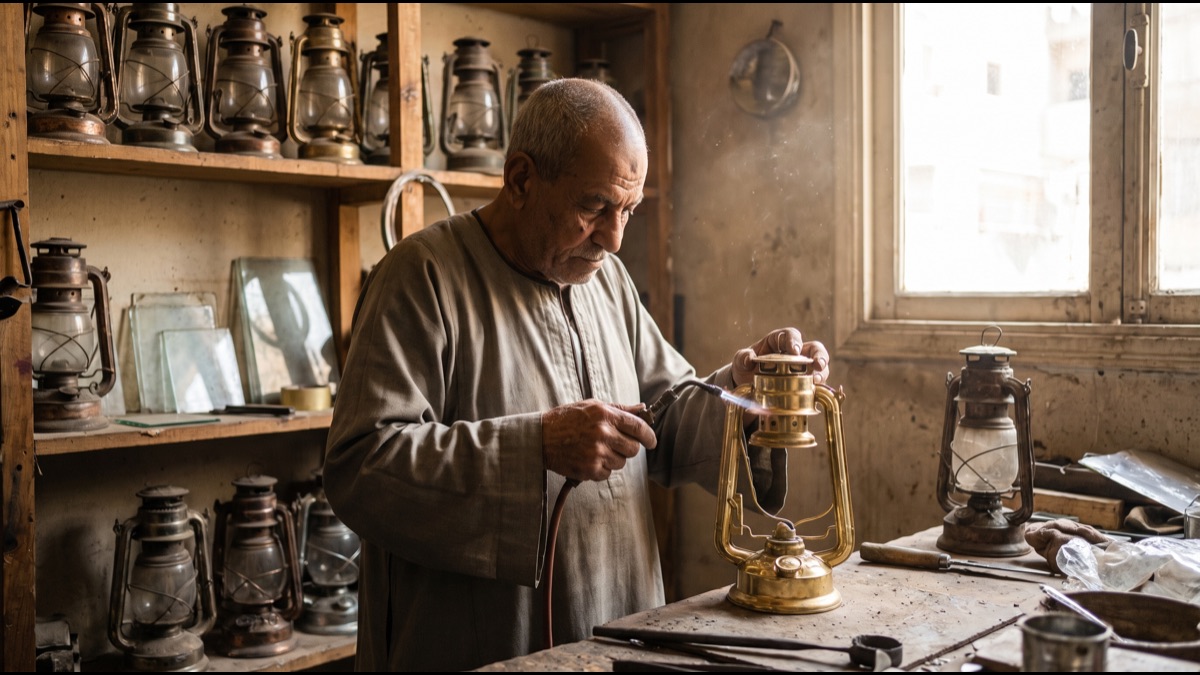
Walk through almost any Egyptian street in the weeks before Ramadan and you will see the same object hanging from balconies, strung across alleyways, and stacked in market stalls by the thousand: a small metal-and-glass lantern called a fanous, its candle or bulb glowing through colored panes. Few decorations anywhere in the world are this closely tied to a single country and a single month, and the story of how it got that way runs back more than a thousand years.
Understanding the fanous means untangling a popular legend that most Egyptians grow up hearing, the more cautious historical record behind it, and a genuine modern industry that has had to fight for survival against cheap imported competition in recent decades.
What a Fanous Actually Is
A fanous is a portable lantern, traditionally built from a metal frame, most often tin or copper, holding panels of colored glass around a central candle, producing a warm, multicolored glow when lit and carried or hung in place after dark.
The word itself derives from the Greek phanos, meaning light or torch, entering Arabic through centuries of trade and cultural exchange around the Mediterranean, a linguistic history that hints at how old the basic object predates its specifically Egyptian and specifically Ramadan-linked identity.
The Fatimid Caliph Story Most Egyptians Grow Up Hearing
The most widely repeated origin story places the fanous's rise in tenth-century Cairo, shortly after the Fatimid dynasty founded the city, when residents are said to have gone out at night carrying lit lanterns to greet the arrival of the caliph, illuminating his path through the streets after dark.
Later folklore extends the story, claiming the caliph subsequently ordered lanterns to be lit throughout the city every night of Ramadan specifically, both for practical illumination before electric lighting existed and as a mark of the month's special status, cementing an association between the object and the month that persists to this day.
Why Historians Treat the Origin Story Carefully
Professional historians studying Fatimid Cairo generally treat the caliph-greeting story as plausible folklore rather than a precisely documented historical event, noting that surviving contemporary sources from the period are thin and that popular legends about the origins of beloved traditions frequently acquire specific, colorful details over subsequent centuries of retelling.
What is better documented is that lantern use for practical nighttime illumination was already common in medieval Cairo generally, and that Ramadan nights, when Muslims break their fast after sunset and streets fill with activity, provided an obvious occasion for that existing practice to become symbolically loaded and eventually codified into a specific seasonal custom.
A second, less commonly told variant of the origin story credits an earlier Fatimid ruler with ordering lanterns lit to help guide worshippers safely to and from mosques on dark Ramadan evenings before street lighting existed in any organized form, a more mundane practical explanation that historians tend to find at least as plausible as the more romanticized caliph-greeting version most Egyptians hear as children.
How Cairo's Artisan Quarter Turned It Into a Craft
Regardless of the precise founding legend, lantern making developed into an established craft concentrated in specific artisan districts of historic Cairo, particularly around the area near Bab Zuweila and the wider Islamic Cairo district, where metalworkers and glassworkers passed techniques down through family workshops across generations.
This concentration of skilled labor in a defined geographic area allowed the craft to develop increasingly elaborate designs over the centuries, with the most skilled workshops producing large, ornate lanterns commissioned for mosques, wealthy households, and public celebrations, alongside simpler versions made for ordinary family use.
What Traditional Fanous Making Actually Involves
Making a traditional fanous by hand involves cutting and shaping metal sheet into a frame, typically tin-plated steel or copper for higher-end pieces, then cutting colored glass panels to fit the frame's openings, and finally assembling the pieces with a mechanism to hold a candle securely inside while allowing airflow to keep it burning.
Skilled artisans can produce distinctive silhouettes and cutout patterns in the metalwork that cast decorative shadows in addition to colored light, a level of craftsmanship that takes years to master and that distinguishes hand-made pieces from simpler mass-produced versions at a glance.
Apprenticeships in the traditional lantern trade historically began in childhood or early adolescence, with a young worker spending years learning first the simpler tasks of cutting glass to size and assembling basic frames before eventually progressing to the more demanding metalwork patterns that define a master craftsman's signature style, a slow and largely oral transmission of skill that mirrors many other historic Cairo artisan trades operating in adjoining streets of the same old city district.
How the Fanous Became Tied Specifically to Ramadan
Beyond the founding legend, several practical factors reinforced the fanous's specific association with Ramadan over time. The month's nightly rhythm, with families and communities active well after dark for iftar meals, evening prayers, and social gatherings, created sustained demand for outdoor lighting precisely during this period more than at other times of year.
Merchants and households alike began displaying lanterns specifically to mark the month's arrival, turning what may have started as practical illumination into a visible, anticipated seasonal decoration comparable in cultural function to how other traditions mark their own major religious or cultural observances with specific symbolic objects.
The Children's Song That Comes With the Lantern
A well-known Egyptian children's song, traditionally sung while carrying a fanous through the streets during Ramadan evenings, remains one of the most recognizable pieces of Egyptian popular culture connected to the tradition, taught to children across generations and still performed in schools and homes throughout the country.
This musical tradition helped cement the fanous specifically as a childhood memory and a marker of Ramadan's arrival for successive generations, giving the object an emotional and nostalgic weight that goes well beyond its function as mere decoration or illumination.
Television and radio broadcasts in Egypt have reinforced this association further, with the song and images of children carrying lanterns through darkened streets appearing regularly in Ramadan-season advertising and public broadcasting segments each year, effectively re-teaching the tradition to each new generation of Egyptian children even as household composition and urban life have changed considerably since the song was first popularized.
How Industrialization Changed the Craft
Through the twentieth century, mechanized manufacturing gradually supplemented and in many cases replaced fully handmade lantern production, allowing Egyptian factories to produce metal-and-glass fanous designs at significantly higher volumes and lower costs than individual artisan workshops could manage alone.
This industrialization made the fanous affordable and widely available to a much larger share of the population than the traditional handcrafted versions had ever reached, expanding the tradition's reach even as it reduced the relative economic importance of the specialized handcraft workshops that had originated the design centuries earlier.
Why Cheap Imported Lanterns Became Controversial
Beginning in the early 2000s, mass-produced plastic lanterns imported mainly from China, typically battery-powered and often playing recorded music or flashing lights rather than holding an actual candle, entered the Egyptian market at prices well below what local metal-and-glass workshops could match.
The rise of these imports prompted periodic public debate and media coverage in Egypt, with commentators and craft advocates arguing that cheap imported plastic lanterns threatened both a traditional domestic industry and the authenticity of a cultural symbol, occasionally spurring public campaigns encouraging shoppers to buy Egyptian-made fanous instead.
How Egyptian Manufacturers Responded to Competition
Domestic manufacturers responded to import competition in several ways, including producing their own lower-cost plastic and metal-hybrid designs to compete directly on price, while some higher-end workshops instead leaned further into artisanal, handcrafted positioning, marketing detailed traditional metalwork specifically as a premium, authentically Egyptian alternative to imported mass-market versions.
Government and industry bodies have at times supported domestic lantern manufacturers through trade measures and public awareness campaigns timed to coincide with the pre-Ramadan shopping season, when lantern sales are heavily concentrated and public attention to the issue is highest.
Small business associations representing Cairo's traditional metalworking districts have also lobbied for recognition of the fanous craft as an element of intangible cultural heritage, arguing that protecting the tradition requires more than seasonal marketing campaigns and instead needs sustained support for training new artisans, since the specialized hand-metalwork skills involved are not easily picked up without years of apprenticeship under an experienced craftsperson.
What a Modern Fanous Workshop Actually Looks Like
A contemporary Egyptian fanous workshop today often blends both worlds, using some mechanized processes for cutting metal and glass at scale while still relying on skilled hand assembly and finishing for higher-end pieces, particularly the large decorative lanterns commissioned for hotels, mosques, and public displays during the season.
Workshops typically ramp up production intensely in the months before Ramadan, since the overwhelming majority of annual fanous sales are concentrated in this narrow pre-season window, making the timing of production and distribution logistically critical to a workshop's yearly revenue.
How the Fanous Spread Beyond Egypt
While most closely associated with Egypt specifically, the fanous has spread over recent decades as a recognized Ramadan decoration across other Arab countries and Muslim communities internationally, appearing in Ramadan markets and household decorations well beyond its original Cairo origins.
Egyptian manufacturers and craft workshops remain widely regarded as the tradition's authentic center, and Egyptian-made fanous are specifically sought after and exported to serve Ramadan markets in other countries where the tradition has taken root but local manufacturing capacity has not developed to the same degree.
Why the Design Keeps Evolving Every Ramadan
Manufacturers regularly introduce new fanous designs each year tied to current events, popular culture, or trending themes, a practice that has become its own minor tradition, with certain years producing notably popular novelty designs that briefly dominate market stalls before the following year's fresh designs take their place.
This constant design turnover reflects genuine consumer demand for novelty within a broadly stable tradition, allowing the fanous to remain commercially and culturally relevant across generations rather than freezing into a single unchanging historical form.
Manufacturers pay close attention to which characters, colors, and themes proved most popular the previous season, treating fanous design in some respects like a genuine annual product cycle complete with early prototypes, limited test runs, and rapid retooling of production lines once a particular year's bestselling design becomes clear from early sales figures in market stalls across major cities.
What the Fanous Represents Beyond Decoration
Beyond its decorative and illuminating function, the fanous has become a broader symbol of Egyptian identity and Ramadan spirit specifically, appearing in national advertising campaigns, government cultural promotion, and diaspora communities abroad as an immediately recognizable marker of Egyptian and Ramadan cultural heritage.
Egyptians living outside the country frequently display a fanous during Ramadan specifically as a way of maintaining a visible connection to cultural identity and childhood memory, extending the object's emotional significance well beyond its original practical function as a simple source of nighttime light, sometimes shipping or carrying a specific hand-made piece across continents rather than settling for a locally available imported substitute precisely because of that emotional weight.
Why the Tradition Has Outlasted Every Predicted Decline
Despite periodic predictions that cheap imports, changing consumer tastes, or simple modernization would eventually erode the fanous tradition, annual sales data and continued widespread visible use across Egyptian cities each Ramadan season suggest the custom remains firmly embedded in national cultural practice rather than fading toward obsolescence.
The combination of genuine childhood nostalgia, an ongoing domestic manufacturing base adapting to compete on price and design, and continuous reinforcement through popular culture, including the enduring children's song, appears to have given the fanous a cultural resilience that has repeatedly outlasted the specific economic and competitive pressures that periodically threatened it, a pattern researchers studying material folk traditions elsewhere frequently observe: objects tied to strong childhood memory and annual ritual tend to survive market disruptions that would otherwise be expected to erode them entirely within a generation or two.
More than a thousand years after its earliest documented use in Cairo, the fanous remains one of the most visible and immediately recognizable symbols of Ramadan across the Arab world, a small handmade or factory-produced object that continues to carry an outsized cultural weight every year the holy month arrives.
Whether a given family hangs an inexpensive imported plastic version or a hand-cut metal-and-glass piece purchased from a workshop whose techniques trace back generations, the underlying gesture remains essentially unchanged from whatever combination of legend and practical necessity first put a lit lantern on a Cairo street: marking the arrival of a month unlike any other with a small, warm, deliberately visible point of light that a child will very likely still remember carrying decades later.
Sources
- Wikipedia — overview of the fanous, its history, and cultural significance
- BBC — reporting on Egyptian fanous manufacturing and competition from imported lanterns
- Al Jazeera — coverage of Ramadan traditions and craft industries across the Arab world
- Egyptian State Information Service — official coverage of Ramadan cultural heritage and traditions
FAQ
Where does the fanous tradition actually come from?
The most widely repeated origin story ties it to Cairo's residents greeting the arrival of a Fatimid caliph at night by carrying lit lanterns to illuminate his path, a practice folklore says was later adopted for Ramadan nights generally.
Were fanous lanterns always made of metal and glass?
Traditional fanous were handcrafted from tin or copper frames with colored glass panels and a candle inside, a design that changed relatively little for centuries before industrial and later plastic versions appeared.
Why did cheap imported plastic lanterns become controversial?
Mass-produced battery-powered plastic lanterns imported mainly from China undercut Egyptian artisan workshops on price, prompting periodic public campaigns encouraging shoppers to buy locally made fanous instead.
Is the fanous only used in Egypt?
While most closely associated with Egypt, the fanous has spread as a Ramadan decoration to other Arab countries and Muslim communities worldwide, though Egyptian workshops remain the craft's traditional center.
Do children still sing songs while carrying a fanous?
Yes, a well-known children's song traditionally sung while carrying a fanous through the streets during Ramadan nights remains a widely recognized part of Egyptian popular culture across generations.
About the Author
We reference Wikipedia, BBC, Al Jazeera, and Egyptian State Information Service to explain the background and current understanding of this topic.
Loved This Article?
Share it on WhatsApp → Share it on WhatsApp
Get more guides in your inbox — Subscribe to our newsletter for weekly surprising stories from Egypt, Saudi Arabia, Dubai, and beyond.