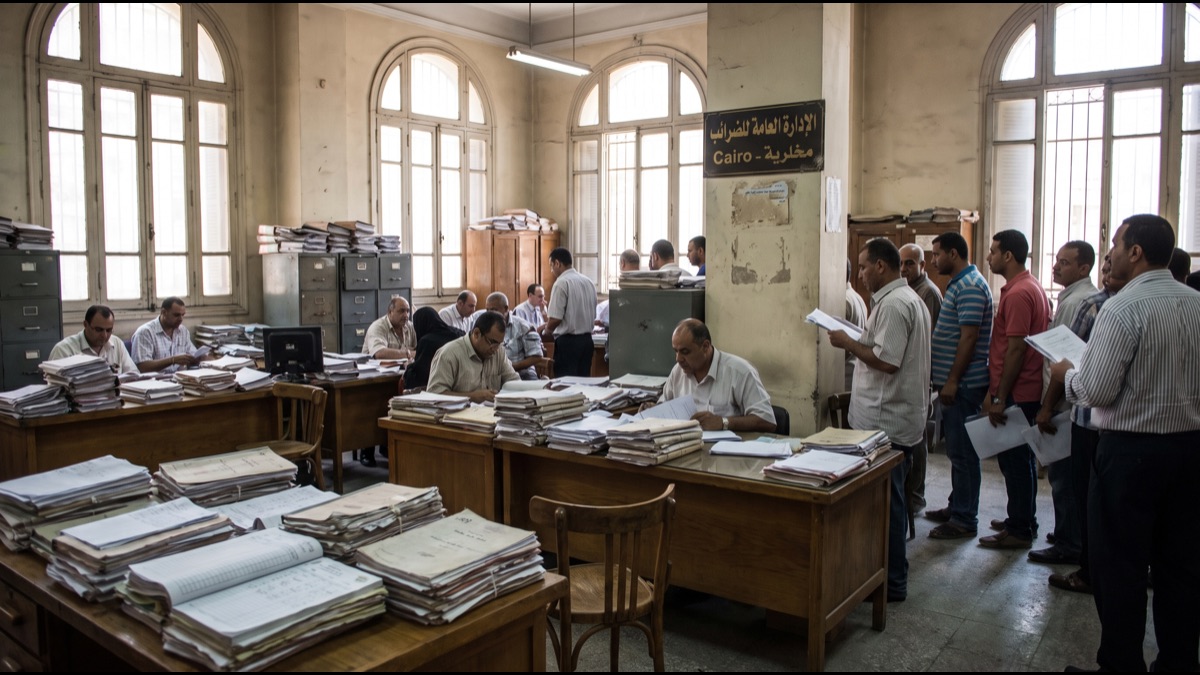
Egypt's personal income tax runs on a progressive bracket system familiar in structure to many countries, yet the honest picture of who actually pays it looks quite different once you account for how the country's economy is genuinely organized. A large share of collection happens automatically before a salaried worker ever sees their paycheck, while a substantial informal and cash-based economy remains largely untouched by the same mechanism.
Understanding how the system actually functions in practice, rather than just how the law describes it on paper, means looking separately at how salaried employment is taxed, how self-employment and business income is taxed, and why such a large gap persists between the two in actual day-to-day compliance.
The Basic Structure of Egypt's Income Tax
Egypt applies a progressive income tax structure, meaning income is divided into successive brackets, with each bracket taxed at its own marginal rate that increases as income rises, rather than a single flat percentage applied uniformly to all earnings regardless of amount.
The brackets and specific rates are set by law and periodically adjusted, typically upward in the exempt threshold to account for inflation and rising cost of living, a recurring policy tool used to keep the tax burden on lower earners from eroding as prices and nominal wages both climb over time.
How the Tax-Free Threshold Actually Works
A specific annual income threshold is fully exempt from tax entirely, meaning earners below that level owe no income tax whatsoever on their salary, a deliberate policy choice intended to shield lower-income workers from a tax burden they would struggle to absorb.
Income above the threshold is not taxed entirely at the next bracket's rate; instead, only the portion of income falling within each successive bracket is taxed at that bracket's specific rate, the standard marginal-rate mechanism used in progressive tax systems worldwide to avoid a sudden cliff-edge jump in total tax owed at each bracket boundary.
This distinction between average and marginal tax rates is frequently misunderstood by taxpayers themselves, leading some to mistakenly believe that crossing into a higher bracket reduces their overall take-home pay compared to staying just below it, when in fact only the incremental income above the threshold is taxed at the higher rate, leaving total net income strictly higher after any raise that pushes someone into a new bracket.
Why Most Salaried Workers Never File Anything
For the large majority of formally employed Egyptians working for a registered employer, income tax is collected entirely through payroll withholding, meaning the employer calculates the tax owed each pay period, deducts it directly from the employee's gross salary, and remits it to the tax authority on the employee's behalf.
This arrangement means most salaried workers never personally file a tax return or handle a tax payment themselves at all, experiencing the entire system passively as a simple reduction in take-home pay compared to their gross contracted salary, with the employer bearing the compliance and calculation burden entirely.
How Employers Calculate Withholding Each Month
Employers use payroll software or accounting staff to apply the current bracket structure to each employee's monthly salary, accounting for any eligible deductions, and calculate the exact amount to withhold before the employee receives their net pay, a calculation that must be redone whenever tax law or an employee's salary changes.
Employers are legally responsible for remitting withheld amounts to the tax authority on a regular schedule and face penalties for late or incorrect remittance, which places genuine compliance pressure on formal businesses even though the individual employee experiences none of that administrative burden directly.
Larger companies typically use dedicated payroll software that automatically incorporates the latest bracket updates whenever tax law changes, while smaller formal businesses may rely on external accountants to handle the same calculations, but in both cases the underlying obligation and mechanism remain identical: correct withholding calculated and remitted before the employee ever sees the deducted amount reflected only as a lower net figure on their payslip.
Why Self-Employed People Face a Completely Different Process
Self-employed professionals, freelancers, and business owners cannot rely on an employer to withhold tax on their behalf, so they must generally register with the tax authority, maintain their own income records, and file an annual return declaring total income and calculating the tax owed themselves.
This self-reporting model carries a fundamentally different compliance profile than payroll withholding, relying on the taxpayer's own honesty and record-keeping rather than an automatic mechanical deduction, which is precisely why self-employment income has historically proven far harder for tax authorities everywhere, not just in Egypt, to fully capture.
Freelancers working with foreign clients and paid through international platforms face an additional layer of complexity, since income arriving from abroad through digital payment services may not automatically pass through any Egyptian bank account subject to routine reporting, leaving compliance almost entirely dependent on voluntary self-declaration by the freelancer themselves.
What Counts as Taxable Income Beyond Salary
Beyond ordinary employment salary, Egyptian tax law generally treats rental income, business profits, certain investment returns, and various other income streams as taxable, each sometimes subject to its own specific rules, rates, or reporting requirements distinct from the standard employment income bracket structure.
This creates a genuinely complex landscape for anyone earning income from multiple sources simultaneously, such as a salaried employee who also rents out a second property, since different income streams may need to be tracked, reported, and taxed under different specific provisions of the tax code rather than one unified simple calculation.
How the Informal Economy Sits Outside the System
A very substantial share of Egyptian economic activity, spanning street vending, unregistered small businesses, cash-based service work, and informal employment arrangements without a formal contract, operates largely outside the payroll withholding system entirely, since there is no registered employer performing automatic deduction.
Workers and business owners operating informally are technically still liable for income tax under the law, but the practical mechanisms available to the tax authority for identifying, assessing, and collecting from this population are considerably weaker than the automatic system applied to formal salaried employment, creating a large de facto gap between legal liability and actual collection.
Why the Informal Sector Is So Large in the First Place
Economists studying Egypt's labor market point to several reinforcing factors behind the informal sector's substantial size, including the administrative and financial burden of formal business registration, the relative ease of operating in cash outside any banking or accounting system, and the absence of strong practical enforcement mechanisms capable of identifying informal activity at scale.
This dynamic is far from unique to Egypt and appears across many middle-income economies with a comparable mix of formal and informal sectors, but it has particularly significant implications for tax policy specifically, since a tax system's fairness and revenue potential both depend heavily on how broad a share of actual economic activity it can genuinely reach.
Development economists studying informality across the region often note a further reinforcing loop: a smaller formal tax base means the government must set higher rates on those who are formally captured to raise the same total revenue, which in turn increases the relative financial incentive for marginal businesses to remain informal rather than register, making the underlying gap self-perpetuating and structurally difficult to close absent a deliberate and sustained policy push to shrink it over time.
What Deductions and Exemptions Actually Exist
Egyptian tax law provides for various deductions and exemptions beyond the basic tax-free threshold, including allowances related to social insurance contributions, certain life insurance premiums, and specific categories of income the law explicitly excludes from the taxable base entirely.
Navigating which deductions genuinely apply to a specific taxpayer's situation typically requires either professional accounting assistance or careful personal study of current regulations, since the specific list and eligibility criteria have been adjusted multiple times through periodic tax law amendments over recent years.
How the Egyptian Tax Authority Is Organized
Egypt's Ministry of Finance oversees the Egyptian Tax Authority, the body responsible for administering income tax collection, processing returns from self-employed and business taxpayers, auditing compliance, and pursuing enforcement action against identified underpayment or evasion.
The authority has increasingly invested in digital infrastructure over recent years specifically to expand its practical reach into segments of the economy that have historically proven difficult to monitor through traditional paper-based record inspection alone.
Why Electronic Invoicing Became a Major Reform Priority
Egypt has progressively rolled out mandatory electronic invoicing and electronic receipt systems requiring businesses above certain size thresholds to issue and report transactions digitally in real time to the tax authority, directly addressing the historical difficulty of verifying actual sales and income through paper records alone.
This digital infrastructure is specifically designed to make under-reporting of business revenue considerably harder over time, since transaction-level data becomes visible to the tax authority essentially as it happens rather than only during a periodic audit of a business's own self-maintained paper records.
The rollout has proceeded in phases by business size and sector, starting with the largest taxpayers whose compliance yields the greatest revenue impact per business monitored, before gradually extending mandatory participation down to smaller enterprises, a sequencing choice common to similar digital tax reforms attempted in other middle-income countries facing comparable informality challenges.
How Tax Brackets Have Changed Over Recent Years
Egyptian authorities have periodically revised income tax brackets and the exempt threshold, generally adjusting upward to account for inflation and currency depreciation that would otherwise push more lower-income workers into taxable brackets purely due to rising nominal wages that have not kept pace with actual purchasing power.
These periodic adjustments are typically announced alongside broader annual budget and fiscal policy statements, reflecting the government's ongoing balancing act between raising sufficient tax revenue and avoiding placing excessive additional burden on households already managing significant cost-of-living pressures.
What Happens If Someone Underpays or Fails to File
Underpayment or failure to file by taxpayers required to self-report can result in financial penalties, interest charges on unpaid amounts, and in more serious or repeated cases, formal legal action initiated by the tax authority, though enforcement intensity in practice varies considerably depending on the size and visibility of the taxpayer involved.
Larger, more visible businesses and higher-income self-employed professionals generally face closer scrutiny and higher practical enforcement risk than very small informal operators, a pattern common to tax enforcement systems generally, since audit resources are finite and authorities typically prioritize cases with the largest potential recovery.
How Foreign Residents and Expats Are Taxed
Foreign nationals working and residing in Egypt are generally subject to the same income tax framework applied to Egyptian citizens on income earned within the country, though specific treatment can vary depending on residency status, the existence of a double taxation treaty between Egypt and the individual's home country, and the specific nature of their employment arrangement.
Multinational employers operating in Egypt typically handle payroll withholding for foreign staff in essentially the same manner as for local employees, meaning most foreign salaried workers experience the same passive, automatic withholding process rather than needing to navigate self-reporting themselves, though it remains worth checking any relevant tax treaty before assuming income earned elsewhere is fully unaffected.
Why the Gap Between Formal and Informal Taxation Persists
The core structural challenge facing Egyptian income tax policy is not the design of the bracket system itself, which is broadly conventional and comparable to systems used elsewhere, but rather the practical reach of collection mechanisms into an economy where a very large share of activity happens outside formal, registered, bank-mediated channels entirely.
Closing this gap meaningfully would likely require not just tax policy changes but broader structural shifts toward financial inclusion, formal business registration incentives, and continued expansion of digital payment and invoicing infrastructure, changes that touch far more of the economy than tax administration alone and that are likely to unfold gradually over years rather than through any single reform measure.
Policymakers weighing these tradeoffs must also avoid moving so aggressively against informality that they push marginal, subsistence-level economic activity out of operation entirely rather than into the formal system, a genuine risk that has shaped the gradual, phased approach favored over any single abrupt crackdown on unregistered economic activity.
Understanding Egypt's income tax system therefore means holding two pictures simultaneously: a relatively conventional, automatically enforced progressive system for the formal salaried workforce, and a much less reliably enforced self-reporting obligation for everyone operating outside that formal structure, with the practical fairness and revenue outcome of the whole system depending heavily on how that second, much larger and harder-to-reach group is eventually brought closer to the first over the coming years.
Sources
- Wikipedia — overview of Egypt's tax system and income tax structure
- International Monetary Fund — analysis of Egypt's fiscal policy and tax reform efforts
- Reuters — reporting on Egyptian tax law amendments and electronic invoicing rollout
- World Bank — research on informal economy size and tax collection challenges in Egypt
FAQ
How does Egypt collect income tax from most salaried workers?
Through payroll withholding, where an employer calculates and deducts the applicable tax directly from an employee's salary each month and remits it to the tax authority, so most salaried workers never handle the payment themselves.
Is Egypt's income tax a flat rate or progressive?
It is progressive, structured in ascending brackets so that higher portions of income are taxed at higher marginal rates, with a tax-free threshold exempting the lowest earners entirely.
Do all Egyptians actually pay income tax on their earnings?
No; a very large informal and cash-based sector of the economy operates largely outside the automatic withholding system, meaning actual tax compliance varies enormously between salaried formal employees and informal or self-employed workers.
How are self-employed people and business owners taxed differently?
They must generally file their own annual returns declaring income and calculating tax owed themselves, a self-reporting process that carries a much higher compliance burden and enforcement challenge than automatic payroll withholding.
Has Egypt tried to modernize tax collection recently?
Yes, through electronic invoicing and receipt systems, digital tax filing platforms, and efforts to integrate more of the informal economy into the formal banking and tax system over the past several years.
About the Author
We reference Wikipedia, International Monetary Fund, Reuters, and World Bank to explain the background and current understanding of this topic.
Loved This Article?
Share it on WhatsApp → Share it on WhatsApp
Get more guides in your inbox — Subscribe to our newsletter for weekly surprising stories from Egypt, Saudi Arabia, Dubai, and beyond.