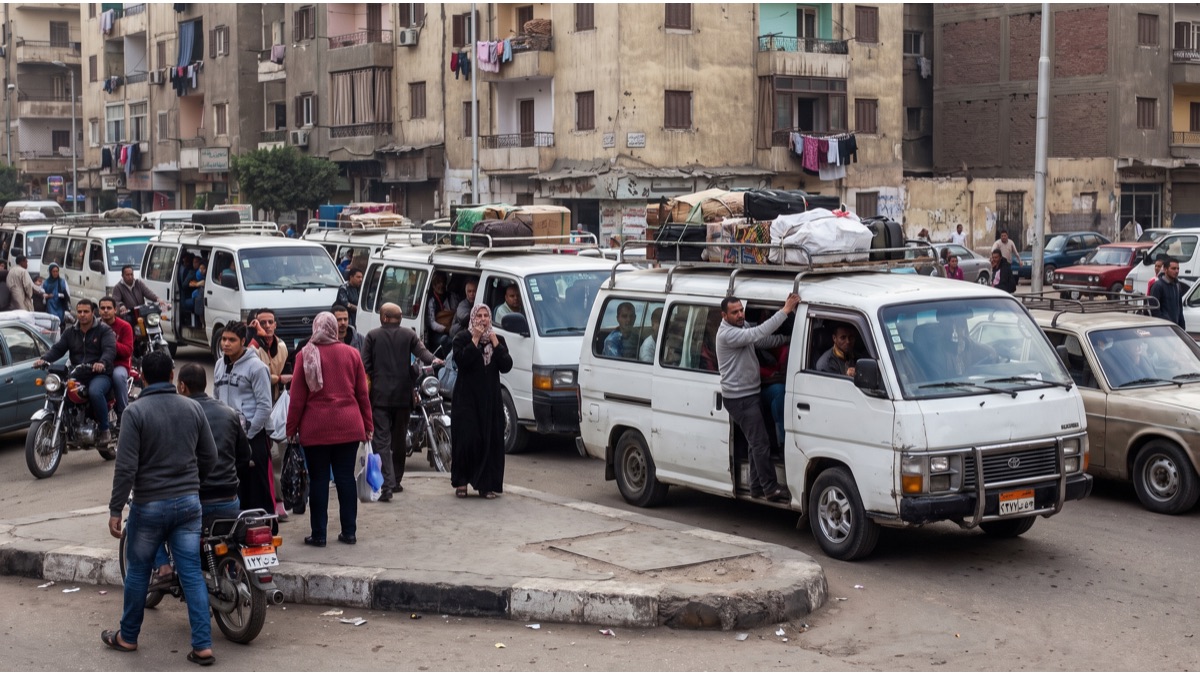
Egypt moves a huge share of its urban population every single day using a transport system that has no published timetable, no fixed stops marked on any official map, and no single company running it. That system is the microbus, a fleet of privately owned fourteen-seat vans that together carry more daily passengers in greater Cairo than the metro, the tram, and the public bus network combined.
Understanding how something this informal manages to move millions of people reliably every day, without central coordination, reveals a great deal about how large cities in the developing world actually solve transportation problems that formal planning has struggled to keep pace with.
What a Microbus Actually Is
A microbus is typically a small van, most commonly a Hyundai H100 or an older Toyota Hiace, modified with bench seating to carry around fourteen passengers on a fixed route between two points, usually a major terminal and a specific neighborhood or town, rather than covering an entire city grid the way a conventional public bus does.
Each vehicle is independently owned, usually by an individual or a small family business rather than a large transport company, and the driver keeps the fare revenue from each trip after covering fuel, maintenance, and any dues owed to whichever informal association controls the terminal the vehicle departs from.
Why Waiting Until Full Is the Whole Business Model
Microbuses do not depart on a schedule. Instead, a vehicle sits at its terminal or a designated waiting point and fills up seat by seat as passengers arrive, departing only once every seat is occupied, a practice universally understood in Egyptian Arabic as waiting until full.
This model exists because the economics only work when every seat is sold. A microbus operator earns essentially nothing running a half-empty vehicle, so the entire system optimizes for departing full rather than departing on time, trading a degree of unpredictability for a driver who has no incentive to leave money on the table by pulling away early.
How Fares Actually Get Collected
There is no fare box, card reader, or conductor walking the aisle. Instead, passengers hand their cash forward, passenger to passenger, until it reaches whoever is seated nearest the driver, who then passes it along; change flows backward through the same human chain until it reaches the original passenger.
This works because the fare for a given route segment is common knowledge among regular riders, and because the small scale of the vehicle and the shared destination create enough social accountability that disputes over shortchanging are genuinely rare, despite the system relying entirely on strangers handling each other's cash without any formal verification.
New riders unfamiliar with a route sometimes simply announce their destination aloud and ask a neighboring passenger how much to hand forward, and it is common practice for someone already familiar with the fare to answer honestly rather than exploit the newcomer's uncertainty, a small but consistent social norm that keeps the entire cash-relay system functioning smoothly across millions of daily transactions with essentially no formal enforcement mechanism behind it at all.
How Routes Emerged Without Any Official Map
For most of the microbus system's history, no government agency published an authoritative map of which routes existed or where they actually stopped along the way. Routes instead emerged organically over years as drivers identified profitable connections between residential areas and major terminals, transit hubs, or employment centers.
New drivers learned the informally agreed stopping points, fare levels, and terminal etiquette for a given route primarily by working alongside established drivers, meaning route knowledge functioned as a form of oral tradition passed through the driving community rather than as codified public information available to newcomers or occasional riders.
What a Mahatta Terminal Actually Does
Every major microbus route originates from a terminal known locally as a mahatta, an informally organized waiting area, often just a stretch of roadside near a major intersection or transit interchange, where vehicles queue in the order they arrived and fill sequentially as passengers show up.
These terminals are typically overseen by an informal association of drivers who collect a small daily due from each vehicle using the space, in exchange for maintaining queue order, negotiating with local authorities over the site, and resolving disputes between drivers competing for the same passengers.
The physical footprint of a mahatta can range from a barely marked patch of curb serving a handful of vehicles a day to a sprawling multi-lane staging area near a major interchange handling dozens of routes and hundreds of departures, and larger terminals often develop their own informal micro-economy of tea vendors, snack sellers, and mechanics who service passing vehicles between trips.
Why Drivers Compete Aggressively for Passengers
Because income is earned per trip rather than through any salary, drivers have a direct financial incentive to move as many full trips as possible in a working day, which produces the assertive, sometimes reckless driving style microbuses are widely known for, including frequent lane changes and abrupt stops to pick up a waving passenger.
This same incentive structure also drives competition at terminals, where drivers may call out destinations loudly to attract passengers to their specific vehicle rather than a competitor's, effectively functioning as the informal marketing mechanism for a system with no advertising budget or centralized dispatch.
How the 2019 Unified Microbus Law Tried to Formalize the Sector
Egyptian authorities introduced legislation aimed at bringing the historically unregulated microbus sector under a more consistent framework, requiring vehicles to display governorate-specific identifying stickers, mandating visible fare boards showing the official price for each route segment, and setting vehicle age and condition standards.
Enforcement has been uneven across governorates, and many of the underlying informal practices, including the mahatta association structure and the wait-until-full departure model, have persisted largely unchanged beneath the new layer of formal identification, illustrating how difficult it is to formalize a system built on decades of organically developed local custom.
Why the Vehicles Themselves Are Almost Always the Same Few Models
The Hyundai H100 and older-generation Toyota Hiace dominate the fleet because both models offer a favorable balance of purchase cost, fuel efficiency, and interior space that can be reconfigured with bench seating to maximize passenger capacity within the regulatory size class that qualifies as a microbus rather than a full-size bus.
A active secondary market exists specifically for used vans suitable for conversion, and small workshops specializing in interior reconfiguration, seat installation, and cosmetic refurbishment have become a minor industry of their own, supplying a steady stream of vehicles into a fleet that continuously needs replacement as older vans age out of service.
How Microbuses Complement the Metro Rather Than Compete With It
Cairo's metro network, while heavily used, covers a limited number of fixed lines that leave large swaths of the metropolitan area, particularly newer and less densely developed districts, without direct rail access, a gap that fixed-route scheduled buses have also struggled to fill economically at the neighborhood level.
Microbuses fill precisely this last-mile gap, connecting residential streets too narrow or too low-demand for larger buses to metro stations, major roads, and other transit hubs, functioning less as a competitor to formal transit and more as its essential feeder network across the city's dense and unevenly developed neighborhoods.
What Ownership Actually Looks Like
Most microbuses are owned by individual drivers or small family operations rather than corporate fleets, often financed through installment purchase arrangements that can take years to pay off, meaning a driver's daily income must simultaneously cover fuel, informal terminal dues, vehicle maintenance, and loan repayments before any profit remains.
Some owners hire a second driver to operate the vehicle on a shift they cannot personally cover, splitting the day's earnings under an informal arrangement, which extends the vehicle's productive hours without requiring the owner to be physically present for every trip the van makes.
Why Safety Concerns Persist Despite Regulation
The same per-trip income incentive that keeps the system efficient also creates real safety pressure, since a driver's earnings depend on completing as many trips as possible, encouraging speed, overcrowding beyond the nominal fourteen-seat capacity, and aggressive maneuvering to beat competing vehicles to waiting passengers.
Traffic safety researchers and Egyptian road-safety officials have repeatedly flagged microbuses as disproportionately represented in urban accident statistics relative to their share of vehicles on the road, a pattern regulators have tried to address through the licensing and vehicle-condition requirements introduced alongside the 2019 reforms, with only partial success to date.
Passenger overcrowding beyond the vehicle's rated capacity remains a particularly persistent issue, since an additional standing or squeezed-in rider represents pure extra profit for the driver on a trip whose fuel cost is already fixed, creating an incentive that runs directly counter to the safety case for capping occupancy at the manufacturer's intended seating limit.
How Digital Mapping Apps Have Started Changing the System
In recent years, independent developers and some government-backed initiatives have built smartphone applications specifically aimed at documenting microbus routes, fares, and terminal locations, addressing the long-standing information gap that made the system genuinely difficult for newcomers, tourists, or occasional riders to navigate confidently.
These apps rely heavily on crowdsourced input from regular riders and drivers themselves, gradually building a more complete and continuously updated picture of a network that no single centralized authority has ever fully mapped, and offering a rare example of technology formalizing information around an informal system without changing how that system actually operates on the ground.
What Fares Actually Cost Passengers
Fares are set informally per route segment based on distance and are generally understood by regular riders without needing to ask, remaining low enough that microbuses serve as the dominant transport choice for lower and middle-income commuters across Egypt's cities, considerably cheaper on a per-trip basis than private ride-hailing services.
Fare increases do happen, typically following broader fuel price adjustments, and tend to spread across a route within days as drivers informally coordinate a new common price, a process that happens without any announcement or regulatory filing yet manages to produce a remarkably consistent fare across all vehicles serving the same route.
This informal price coordination works partly because drivers on the same route see each other constantly at the shared terminal and along the road, making it easy to learn what competitors are charging, and partly because a driver charging noticeably more than everyone else on an identical route would simply lose passengers to the next vehicle in the queue, creating a natural ceiling on how far any single operator can push fares above the emerging local norm.
How the System Handles Peak Demand
During rush hours, more vehicles naturally gravitate toward high-demand routes as drivers respond directly to where passengers are waiting, a self-organizing response to demand that requires no central dispatch instruction, functioning similarly to how surge pricing signals demand in ride-hailing apps, except here the signal is simply visible queue length at a terminal.
During off-peak hours or on lower-demand routes, passengers may wait considerably longer for a vehicle to fill, illustrating the fundamental tradeoff of the wait-until-full model: total system capacity flexes naturally with demand, but individual wait times become substantially less predictable than they would be under a fixed timetable.
Why the Informal Model Has Proven So Durable
Despite decades of intermittent government attempts to formalize or replace it, the microbus system has persisted because it solves a genuine coordination problem, matching flexible transport supply to unpredictable, dispersed demand across a sprawling and unevenly developed city, more cheaply and more responsively than any centrally planned alternative attempted so far.
Transport researchers studying rapidly urbanizing cities elsewhere frequently point to Egypt's microbus network, alongside similar informal systems in other developing-world cities, as evidence that flexible, driver-owned paratransit fills a role that formal mass transit systems, constrained by fixed routes and large capital costs, are structurally unable to fill on their own.
Building an equivalent fixed-route bus network with comparable coverage would require a scale of public capital investment and ongoing subsidy that has proven politically and financially difficult to sustain in most of the cities that have attempted it, which is part of why microbus-style paratransit has persisted and even expanded in many rapidly growing urban regions rather than being phased out as economies formalize.
Whatever changes come to Egypt's urban transport in the years ahead, from expanded metro lines to new formal bus rapid transit corridors, the microbus's fundamental advantage, matching supply to demand in real time without central coordination, means it is likely to remain the backbone connecting neighborhoods to the rest of the city for a long time to come, even as the vehicles themselves, the mapping tools riders use to navigate them, and the regulatory stickers on their windshields continue to modernize around that same enduring core model.
Sources
- Wikipedia — overview of paratransit and informal transport systems globally
- World Bank — research on informal urban transport in Cairo and comparable developing-world cities
- Reuters — reporting on Egyptian microbus regulation and road safety statistics
- Egyptian State Information Service — official coverage of transport regulation initiatives
FAQ
How does a microbus decide when to leave?
It leaves once every seat is filled, a practice known locally as waiting until full, meaning departure time depends entirely on how quickly passengers arrive rather than any published schedule.
How is the fare paid on a microbus?
Cash is passed hand to hand forward through the other passengers to the driver, and any change is passed back the same way, a system that relies entirely on collective trust among strangers.
Are microbus routes officially published?
Historically no single official map existed; routes emerged through decades of informal driver and passenger consensus, though government and app-based mapping efforts have begun documenting them more formally in recent years.
Did Egypt ever try to regulate microbuses?
A unified microbus law introduced governorate-specific vehicle stickers and mandated visible fare boards, aiming to formalize a sector that had operated almost entirely outside official oversight for decades.
Why do microbuses still dominate despite the Cairo Metro?
The metro covers a limited number of fixed lines, while microbuses fill in the dense last-mile connections between neighborhoods that no fixed-rail or scheduled-bus system can practically reach.
About the Author
We reference Wikipedia, World Bank, Reuters, and Egyptian State Information Service to explain the background and current understanding of this topic.
Loved This Article?
Share it on WhatsApp → Share it on WhatsApp
Get more guides in your inbox — Subscribe to our newsletter for weekly surprising stories from Egypt, Saudi Arabia, Dubai, and beyond.