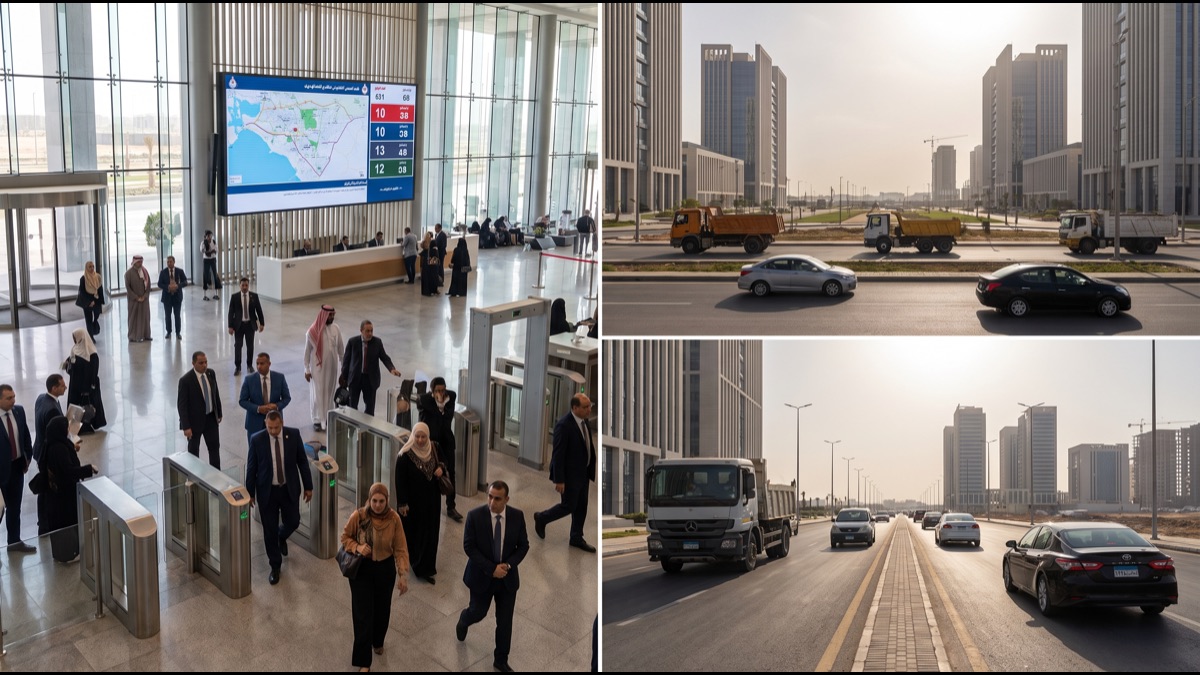
Roughly 45 kilometers east of downtown Cairo, in a stretch of desert that had almost nothing built on it a decade ago, Egypt has been constructing an entirely new city intended to eventually house the country's central government, parliament, and a population planners once projected could reach several million residents. Widely known simply as the New Administrative Capital, the project is now functioning in a genuinely partial sense: the presidency, cabinet, and parliament have physically relocated there, an unmistakable skyline anchored by Africa's tallest tower has risen from the desert, and thousands of residents have moved into finished housing districts, even as most of greater Cairo's roughly 22 million people remain exactly where they were. Understanding how the new capital actually functions today means separating the government relocation that has genuinely happened from the city-wide population and economic vision still years from being realized.
Why Egypt Decided to Build an Entirely New Capital
Cairo's metropolitan area had grown to one of the most densely populated urban regions in the world by the 2010s, with traffic congestion, air pollution, and infrastructure strain that officials repeatedly cited as symptoms of a city that had long outgrown its planning capacity.
Rather than continuing to expand government ministries and institutions piecemeal within an already saturated Cairo, planners proposed building a purpose-designed administrative and business district from scratch, one that could be engineered around modern government operations, wide roads, and green space from day one rather than retrofit into a centuries-old urban core.
The project was formally announced in 2015, framed by Egyptian officials as both a practical solution to Cairo's congestion and a broader statement of national ambition, timed to coincide with a period of major infrastructure investment across the country including the Suez Canal expansion.
Choosing the Site and Master Planning the City
Planners selected a roughly 700-square-kilometer desert site along the Cairo-Suez road corridor, deliberately positioned to sit between Cairo and the Red Sea coast and to connect eventually with Egypt's broader New Urban Communities network of planned cities.
The master plan divided the city into distinct functional districts, including a government district for ministries and the presidency, a central business district for commercial towers, residential neighborhoods planned around different income levels, and a large planned green area intended to be among the largest urban parks in the region.
Unlike Cairo's dense, organically grown street pattern, the new capital's layout follows a wide, grid-oriented road network designed explicitly around car and eventual mass-transit flow, a deliberate departure from the older city's traffic bottlenecks.
Who Actually Owns and Develops the Project
The project is developed primarily through the Administrative Capital for Urban Development company, commonly referred to as ACUD, a joint venture structure combining Egypt's New Urban Communities Authority, which has close institutional ties to the Egyptian military, with additional development and financing partners.
This ownership structure has made the military's broader economic role in Egypt a recurring subject of independent commentary, since ACUD and related entities sit within a wider pattern of military-affiliated companies playing an expanded role in Egyptian infrastructure and real estate development over the past decade.
ACUD has managed both the government-facing infrastructure build-out and the commercial real estate sales program that funds much of the ongoing construction, giving the entity unusually broad control over the project's pace and priorities compared to typical single-purpose infrastructure authorities.
China's Financing and Construction Role
China has played an unusually large role in the new capital's construction, most visibly through the China State Construction Engineering Corporation, which built the government district's central business district towers including the city's signature skyscraper under financing arrangements involving Chinese state-linked lending.
The financing structure for the central business district portion of the project involved Chinese loans to Egyptian entities, part of a broader pattern of Chinese infrastructure financing across Egypt and the wider region during the same period China's Belt and Road Initiative was expanding its presence in North Africa and the Middle East.
Egyptian officials have generally described the Chinese partnership as a commercial financing and construction relationship rather than a geopolitical alignment, though international analysts have noted the new capital as one of several high-profile examples of Chinese capital and contractors playing a central role in a major Egyptian infrastructure project.
Inside the Government District and the Move of State Institutions
Egypt's presidency formally relocated operations to the new capital starting in 2019, followed by phased moves of the cabinet, parliament, and numerous government ministries over the following years, a process officials have periodically described in terms of specific ministry-by-ministry completion milestones.
The new parliament building and Supreme Constitutional Court, both architecturally prominent structures within the government district, were completed and opened as part of this phased relocation, giving the district functioning core state institutions well before the surrounding residential city reached anything close to full occupancy.
Despite these relocations, many government functions, particularly at the local Cairo governorate level and numerous ministry sub-offices serving the public directly, have remained in Cairo, meaning the practical experience of interacting with Egyptian government services for most citizens has not shifted as dramatically as the headline relocation announcements might suggest.
The Iconic Tower and the City's Skyline
The Iconic Tower, standing at roughly 385 meters, is both the new capital's tallest building and the tallest skyscraper on the African continent, serving as the project's most recognizable landmark and a frequent visual shorthand in coverage of the broader development.
Positioned within the central business district built under the Chinese-financed construction agreement, the tower anchors a cluster of additional high-rise commercial towers intended to establish the new capital as a business and financial hub distinct from, though geographically close to, Cairo's existing commercial districts.
The tower's observation deck and mixed commercial, hotel, and office program have been promoted as tourism and business draws in their own right, part of a broader effort to generate visible economic activity in the district beyond government office occupancy alone.
Housing, Real Estate Sales, and Who Is Actually Moving In
Residential development has proceeded through multiple planned neighborhoods marketed at different price points, from more affordable government-linked housing programs to higher-end private residential compounds sold to both Egyptian buyers and, in some marketing campaigns, targeted at Gulf and international investors.
Real estate sales revenue has functioned as a direct funding mechanism for the broader project, with ACUD and private developers using unit sales and installment payment plans to help finance ongoing infrastructure and construction costs, a model similar to how several of Egypt's earlier planned satellite cities were financed.
Early residents have included government employees relocated as part of ministry moves, private sector workers in the new business district, and buyers who purchased units as investments or second homes, though move-in has generally lagged behind original sales and marketing timelines as construction and utility completion took longer than initially projected.
Population Realities Versus the Original Multi-Million Vision
Original planning documents and early official statements described eventual population targets in the range of several million residents across the city's full build-out, positioning it as a genuinely major new urban center rather than a limited government enclave.
Actual resident population has grown steadily but remains a small fraction of that long-term target, reflecting both the multi-decade construction timeline planners always acknowledged and the practical reality that filling a brand-new city takes considerably longer than filling government buildings with relocated ministry staff.
Independent urban planning commentary has generally treated the gap between announced eventual population and current actual population as an expected feature of any large planned-city project's early years rather than evidence the project has stalled, while also noting that reaching the original multi-million target on the originally implied timeline looks increasingly unlikely.
Transport Links: The Monorail, Highways, and High-Speed Rail
Connecting the new capital to Cairo has required substantial transport infrastructure investment, including an elevated monorail system linking the new capital to East Cairo, a major expressway corridor, and integration into Egypt's broader planned high-speed rail network connecting the new capital to other cities including Alexandria and Sokhna.
The monorail, developed with international rail contractors, was designed specifically to address the risk that a car-dependent new city with limited public transit would simply recreate Cairo's traffic problems in a new location, an outcome planners explicitly wanted to avoid given how central traffic congestion was to the project's original justification.
Transport link construction has, like much of the broader project, proceeded on a phased timeline, with sections opening progressively rather than a complete network being available from the outset, meaning early residents and commuters have depended heavily on private vehicles and shuttle services during the network's build-out period.
Utilities, Green Space, and Sustainability Claims
Planners have promoted the new capital's planned central park as one of the largest urban green spaces in the region, part of a broader sustainability narrative that has also included solar power installations, modern water treatment infrastructure, and underground utility corridors designed to avoid the street-level cable and pipe disruptions common in older Cairo neighborhoods.
Water and electricity infrastructure for the city was built as new, purpose-designed systems rather than extensions of Cairo's existing aging networks, an approach intended to avoid inheriting some of the maintenance and capacity issues that have periodically affected utility reliability in parts of greater Cairo.
Independent environmental commentary has noted that building an entirely new desert city, regardless of individual green design features, carries a substantial embedded resource and construction footprint, a tension inherent to any large new-city project marketed partly on sustainability grounds.
Financing the Build: Land Sales, Debt, and Foreign Investment
Beyond Chinese financing for the central business district, the broader project has relied on a mix of Egyptian government capital, ACUD's own real estate sales revenue, and periodic international investment interest from Gulf and other foreign investors in specific commercial and residential components.
The overall project cost has been estimated by various outlets in the tens of billions of dollars across its full multi-decade build-out, a figure that has drawn scrutiny given Egypt's broader macroeconomic challenges, including periods of currency devaluation and IMF-linked fiscal adjustment programs during the same years the new capital was under construction.
Egyptian officials have generally defended the financing model by emphasizing that a substantial share of costs are recovered through real estate sales rather than pure government debt, though independent economists have continued to debate how much of the project's true cost is ultimately borne by public finances versus private buyers.
Criticism, Affordability Concerns, and Cairo's Continued Role
Critics, including some Egyptian economists and urban planners, have questioned whether a new capital was the most cost-effective response to Cairo's congestion compared to alternative investments in existing Cairo transit and infrastructure, a debate common to large new-capital projects in other countries as well.
Affordability has been a recurring theme in commentary about the new capital's residential offerings, with much of the marketed housing positioned toward upper-middle-income and wealthier buyers, raising questions about how representative the new capital's eventual population will be of Egypt's broader income distribution.
Cairo itself has not been abandoned or significantly depopulated as a result of the new capital project, continuing to function as Egypt's primary commercial, cultural, and population center even as specific government functions have relocated, a division of roles officials have generally described as intentional rather than a sign the new capital has underperformed.
How the New Capital Fits Egypt's Broader Urban Strategy
The New Administrative Capital sits within a wider Egyptian government strategy of building multiple new planned cities across the country, including projects in the Red Sea, Delta, and Upper Egypt regions, intended collectively to redistribute population growth away from the historically overcrowded Nile Valley corridor.
Officials have framed this broader new-cities strategy as a long-term response to Egypt's population growth, arguing that continuing to concentrate nearly all new development within a few percent of the country's total land area, the traditionally inhabited Nile Valley and Delta, was not sustainable regardless of any single project's individual success.
The new capital functions, in this framing, as the flagship and most politically visible example of a strategy Egyptian planners intend to replicate, with varying degrees of ambition and progress, across several other new city projects developed over the same period.
Common Misconceptions About the New Administrative Capital
A common misconception is that the entire Egyptian government has moved out of Cairo; in reality, the presidency, cabinet, and parliament have relocated, but many ministry functions, local governorate offices, and the vast majority of Cairo's population and daily commercial activity remain in the original city.
Another misconception assumes the new capital is already home to millions of residents matching its long-term planning targets; actual population has grown steadily but remains far below those eventual figures, reflecting the project's genuinely multi-decade construction and occupancy timeline.
A third misconception treats the project as purely a government initiative with no private real estate component; in practice, private residential and commercial sales, including to individual homebuyers and investors, function as one of the project's primary ongoing financing mechanisms.
Egypt's New Administrative Capital is functioning today as a genuinely partial reality: a working seat of national government, a rapidly rising skyline anchored by Africa's tallest tower, and a growing but still modest resident population, all built on a Chinese-financed central business district and an Egyptian military-linked development authority that continues selling real estate to fund ongoing construction. Whether the city eventually reaches anything close to its original multi-million population vision remains an open question that will likely take another decade or more to answer, but the core government relocation at the heart of the project has already, unmistakably, happened.
Sources
- Administrative Capital for Urban Development (ACUD) — Official project development and planning updates.
- Egyptian State Information Service — Government statements on relocation, planning, and national infrastructure strategy.
- World Bank — Egypt — Independent economic and urban development analysis.
- International Monetary Fund — Egypt — Macroeconomic context for Egypt's infrastructure financing during the project's construction.
- Reuters — Africa — Independent reporting on financing, construction progress, and government relocation milestones.
FAQ
Has Egypt actually moved its government to the New Administrative Capital?
Yes, in stages: the presidency, cabinet, parliament, and numerous ministries have relocated operations to the new capital since 2019, though many government functions and most residents still remain based in greater Cairo.
Who is paying for Egypt's New Administrative Capital?
The project is developed primarily through the Administrative Capital for Urban Development company, a joint venture between Egypt's military-linked New Urban Communities Authority and Chinese construction financing and contracting partners, alongside private real estate sales revenue.
How many people actually live in the New Administrative Capital?
Actual resident population has grown gradually but remains far below the city's eventual planned capacity of several million, with move-in paced by the completion of residential districts, utilities, and transport links rather than happening all at once.
What is the Iconic Tower?
The Iconic Tower is the New Administrative Capital's tallest building and Africa's tallest skyscraper, serving as the city's most visible landmark and a symbol of the broader project's scale.
Why did Egypt build a new capital instead of expanding Cairo?
Officials cited Cairo's severe overcrowding, traffic congestion, and limited room for a modern government district as reasons for building a purpose-planned new city rather than continuing to expand government functions within the existing capital.
About the Author
We reference the Administrative Capital for Urban Development, the Egyptian State Information Service, the World Bank, the International Monetary Fund, and Reuters Africa coverage to explain the background and current understanding of this topic.
Loved This Article?
Share it on WhatsApp → Share it on WhatsApp
Get more guides in your inbox — Subscribe to our newsletter for weekly surprising stories from Egypt, Saudi Arabia, Dubai, and beyond.