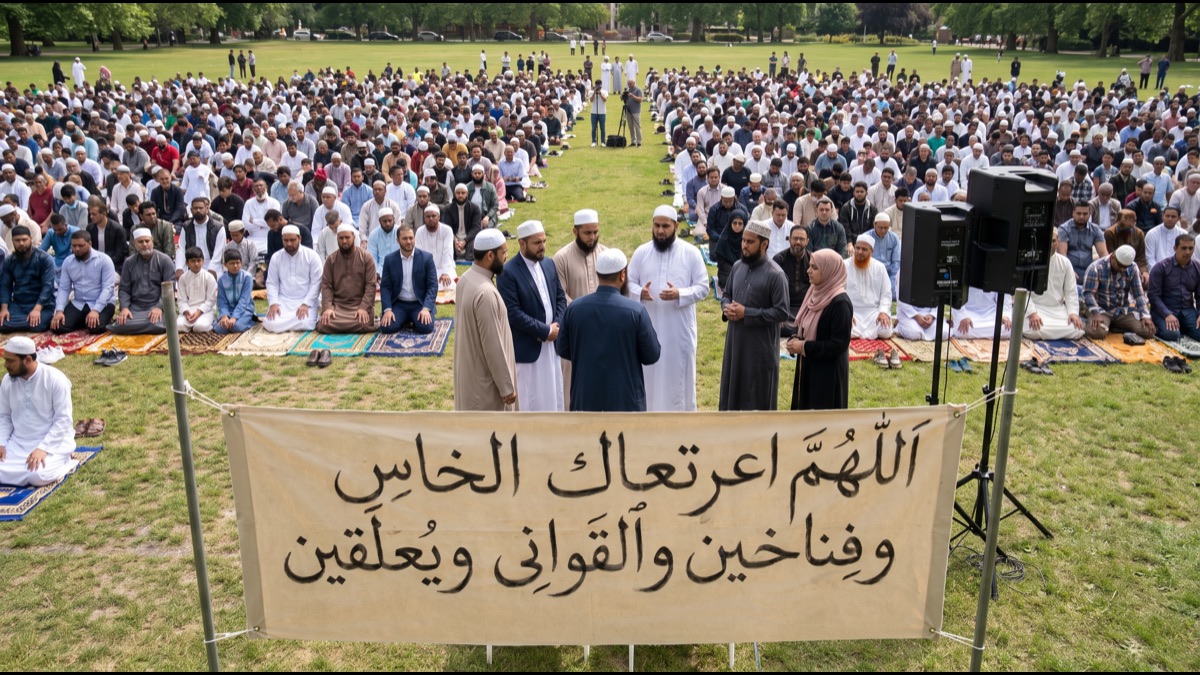
Eid prayer is the one major congregational prayer in Islam that begins without anyone calling people to it. There is no adhan echoing across the neighborhood, no iqama signaling the start of the rows, and no fixed five-times-a-day rhythm behind it, yet it still draws some of the largest crowds of the entire Islamic calendar into a single space at a single moment. Anyone who has only ever prayed the five daily prayers and then shown up to an Eid prayer for the first time typically notices immediately that something structural is different, even before they can articulate exactly what.
The five daily prayers, from Fajr through Isha, follow an unbroken template: adhan, iqama, a fixed number of rak'ahs performed the same way whether a person prays alone in a bedroom or behind an imam in a packed mosque. Eid prayer breaks from that template almost point by point. It is missing the call to prayer that would normally announce it, it carries a distinctive set of extra declarations of "Allahu Akbar" that do not appear anywhere in the daily prayers, and it reverses the order of sermon and prayer that Muslims are used to from the Friday Jumu'ah service.
None of these differences are accidental or a matter of regional custom drifting over centuries. They are deliberate features of how Eid prayer was established, each one tied to the specific character of the two annual celebrations it marks: Eid al-Fitr at the end of Ramadan and Eid al-Adha during the pilgrimage season. Understanding why each element differs, rather than simply memorizing that it does, makes the prayer far easier to follow for anyone attending for the first time or trying to explain it to someone who has never seen it.
This piece walks through the specific structural differences one at a time: the missing call to prayer, the extra takbeers and exactly where they go, the reduced two-rak'ah length, the reversed sermon order, the preference for open-air congregations, the narrow window in which the prayer can even be performed, and what actually happens for someone who arrives late or misses it altogether.
Why There Is No Adhan or Iqama Before Eid Prayer
Every one of the five daily prayers is preceded by the adhan, the call to prayer recited from the minaret or, in a home setting, quietly by whoever is present, followed shortly before the prayer itself begins by the iqama, a second, shorter announcement that signals the rows should now form and the prayer is about to start. Eid prayer has neither. Historical accounts describe the Prophet Muhammad leading Eid prayer without either being called, and that precedent has been maintained essentially unchanged across the major schools of Islamic jurisprudence ever since.
The absence is not an oversight or a simplification; it reflects that Eid prayer is not one of the five obligatory daily prayers that structure ordinary time, but a separate, occasion-specific act of communal worship tied to a particular calendar date rather than a particular time of day repeated every twenty-four hours. Because everyone attending already knows the date and the general morning timeframe, the practical function the adhan serves for daily prayers, alerting a dispersed community that a specific prayer time has begun, simply does not apply in the same way to a single annual gathering that people already plan around in advance.
In practice, many mosques and open-air prayer grounds do make an announcement calling people to Eid prayer, often phrased as "as-salatu jami'ah," meaning roughly "the prayer is assembling," but this is a general summons rather than the formal adhan or iqama with their specific wording and ritual status. A worshipper listening for the familiar cadence of "Allahu akbar, ash-hadu an la ilaha illa Allah" before Eid prayer begins will simply not hear it, and that silence is itself one of the clearest immediate signals that a different kind of prayer is about to take place.
The Extra Takbeers That Set Eid Prayer Apart
The single most distinctive feature of Eid prayer, and usually the first thing a first-time attendee actually notices once the prayer begins, is a series of additional takbeers, raised-hand declarations of "Allahu Akbar," recited beyond the normal opening takbeer that starts every prayer. In the first rak'ah, most schools of jurisprudence describe seven additional takbeers recited after the opening takbeer and before the recitation of Surah al-Fatihah begins. In the second rak'ah, five additional takbeers are recited after rising from prostration and before beginning that rak'ah's recitation.
Between each of these extra takbeers, worshippers typically pause briefly, and many raise their hands each time much as they do for the single opening takbeer of an ordinary prayer, though the exact hand position and any words recited silently between takbeers vary somewhat between the Hanafi, Shafi'i, Maliki, and Hanbali schools. Some schools describe six rather than seven in the first rak'ah, and some describe five rather than seven as well, which is part of why the total count can differ slightly depending on which school's guidance a particular mosque or community follows, though seven and five is the count most widely taught and practiced.
These extra takbeers are not filler or ornamentation; they function as the prayer's most audible expression of collective celebration and remembrance of God, deliberately amplified compared to an ordinary daily prayer specifically because Eid marks a moment of communal joy and gratitude rather than the routine rhythm of everyday worship. A congregation of several thousand people simultaneously raising their hands and declaring "Allahu Akbar" in near-unison, repeated across both rak'ahs, produces an atmosphere that daily prayers, performed the same way every single day, are not really designed to create.
Why Eid Prayer Is Only Two Rak'ahs
Where Fajr is two rak'ahs, Dhuhr, Asr, and Isha are each four, and Maghrib is three, Eid prayer is fixed at exactly two rak'ahs regardless of which of the two Eids is being observed. This length is not adjustable or extended the way some voluntary prayers can be lengthened with additional units; two rak'ahs, embellished with the extra takbeers described above, is the complete prayer.
Scholars generally explain the brevity by pointing to Eid prayer's function within a broader day of activity rather than as an isolated act of worship. Eid morning traditionally includes bathing and dressing in one's best clothes, eating something sweet before the prayer on Eid al-Fitr specifically, traveling to the prayer ground, performing the prayer and hearing the khutbah, and then moving directly into visiting family, exchanging greetings, and, for Eid al-Adha, beginning the sacrifice. A long, multi-part prayer would compress the time available for everything else the day is actually built around.
The two-rak'ah length also matches the length of Fajr, the shortest of the five daily obligatory prayers, though the two should not be confused: Eid prayer's brevity in rak'ah count is offset by the additional takbeers and, notably, by a khutbah that many communities treat as a fuller, more anticipated sermon than a typical weekday reminder, meaning the overall time commitment for attending Eid prayer, sermon included, is often longer in practice than the prayer's short rak'ah count alone would suggest.
Why the Khutbah Comes After the Prayer, Not Before
Friday's Jumu'ah prayer follows a strict order: the khutbah is delivered first, and only after the sermon concludes does the congregation stand and pray, with the sermon itself functioning as something close to a prerequisite condition for the prayer that follows it. Eid prayer flips that order entirely. The two rak'ahs are prayed first, and only once the prayer is complete does the imam deliver the khutbah.
This reversal has a direct practical consequence that differs from Jumu'ah as well: attending the Eid khutbah is recommended but not obligatory in the way that listening to the Jumu'ah khutbah effectively is, since the Jumu'ah khutbah is bound up with the validity conditions of that specific prayer while the Eid khutbah is not. In practice, this means it is far more common, and not considered a breach of etiquette in the same way, for some worshippers to pray the two Eid rak'ahs and then leave before or during the sermon, particularly in very large open-air congregations where thousands of people are trying to disperse afterward. Scholars point to a specific reported history behind the ordering: accounts describe the Prophet Muhammad praying Eid prayer before delivering the sermon, and later, when he noticed portions of the congregation leaving before he finished speaking, he is reported to have remarked that he would from then on deliver the sermon in a way that let people choose whether to stay, rather than compelling their attention the way the Jumu'ah khutbah does. That reported flexibility is part of why the post-prayer Eid khutbah retains a more optional character to this day.
Why Eid Prayer Is Traditionally Held in Open Spaces
While the five daily prayers are most commonly performed inside a mosque, Eid prayer carries a specific recommendation, strong in some schools and simply preferred in others, to be held outdoors in a large open field or dedicated prayer ground rather than inside a building, wherever climate, space, and local circumstances reasonably allow it. This open-air ground is often called a musalla in Arabic-speaking regions and an eidgah in South Asian Islamic tradition, and many cities maintain a permanent, named open space used specifically for this purpose year after year.
The reasoning generally given for this preference is straightforward: Eid prayer is meant to be a visible, maximally inclusive communal event, and an open field can accommodate a far larger crowd, including people who may not otherwise regularly attend a particular neighborhood mosque, than most mosque buildings realistically can. Some accounts describe even women and, in some traditions, menstruating women who are exempt from the prayer itself being encouraged to attend the gathering and hear the khutbah, which reinforces the reading of Eid prayer as fundamentally a public community occasion rather than a strictly ritual obligation performed quietly indoors.
In dense modern cities, and especially where winter or summer weather makes an outdoor gathering genuinely impractical, mosques regularly host Eid prayer indoors instead, sometimes running several consecutive congregations back to back to accommodate everyone who wants to attend, or renting convention centers, stadiums, and sports halls specifically for the occasion. The underlying preference for scale and visibility persists even when the specific outdoor setting does not.
The Narrow Timing Window for Eid Prayer
Each of the five daily prayers has its own defined window, but together they cover essentially the entire day and night, from just before dawn through the period after nightfall. Eid prayer's window, by contrast, is narrow and occurs only once per year for each of the two Eids: it begins once the sun has fully risen to roughly the height it reaches about fifteen to twenty minutes after sunrise, and it must be completed before the sun reaches its zenith at midday, after which point the specific Eid prayer can no longer be performed that day at all.
This window is deliberately timed to avoid the two periods during which prayer is generally discouraged or prohibited: the moment of sunrise itself and the moment the sun is at its highest point before noon, both associated in Islamic tradition with times when prayer should be avoided for reasons unrelated to Eid specifically. Because the window only opens after sunrise has fully passed and must close before true midday, communities with very early sunrises, common in summer in higher-latitude regions, sometimes perform Eid prayer noticeably earlier in the clock-time morning than communities closer to the equator.
Unlike a missed daily prayer, which can typically be made up individually at essentially any later point, a missed communal Eid prayer cannot simply be rescheduled to the following day; the specific date and the specific narrow morning window are what define it, and once that window has closed, the congregational Eid prayer for that particular Eid, in that particular location, is over for the year.
How Eid al-Fitr Prayer Differs in Practice From Eid al-Adha
The core structure, two rak'ahs, extra takbeers, post-prayer khutbah, is identical for both Eid al-Fitr and Eid al-Adha, but the surrounding customs and the tone of the khutbah differ noticeably between the two. Before Eid al-Fitr prayer, it is recommended to eat something, traditionally dates, before leaving for the prayer ground, and to have already paid zakat al-fitr, the specific charitable payment tied to breaking the Ramadan fast, ahead of the prayer so that it reaches those in need before the celebration begins.
Before Eid al-Adha prayer, by contrast, it is recommended not to eat beforehand, with the first meal of the day instead coming after the prayer, ideally from the meat of the sacrifice performed that day or shortly after, echoing the story of Ibrahim's willingness to sacrifice and the animal sacrifice that Muslims perform during Eid al-Adha and the following days of Tashreeq. The Eid al-Adha khutbah also typically addresses the rites of Hajj and the meaning of sacrifice directly, since the Eid falls during the pilgrimage season even for the overwhelming majority of Muslims worldwide who are not themselves performing Hajj that year.
Eid al-Adha additionally extends its takbeer tradition well beyond the prayer itself: the extra takbeers recited communally in the days leading up to and following Eid al-Adha, sometimes called the takbeerat al-tashreeq, are recited after each of the five daily prayers for several days surrounding the holiday, a practice that has no real equivalent around Eid al-Fitr, where the recommended additional takbeers are concentrated mainly on the night before Eid and the morning of the prayer itself.
The Structure of Each Rak'ah in Detail
The first rak'ah opens with the worshipper making the standard opening takbeer that begins any prayer, followed immediately by the seven additional takbeers described earlier, each typically separated by a brief pause. After the final extra takbeer, the imam recites Surah al-Fatihah followed by another chosen surah, commonly Surah al-A'la or Surah Qaf in many traditions, before the rak'ah proceeds through bowing and prostration exactly as in any ordinary prayer.
Rising for the second rak'ah, the worshipper again recites five additional takbeers before the imam begins reciting al-Fatihah and a second surah, commonly Surah al-Ghashiyah or Surah al-Qamar depending on local custom, followed again by the standard bowing and double prostration. After the second prostration of the second rak'ah, the prayer concludes with the tashahhud and the closing salutations exactly as any two-rak'ah prayer would, at which point the congregation remains seated and the imam rises to deliver the khutbah rather than the prayer simply ending there.
Because the extra takbeers are concentrated specifically at the start of each rak'ah, before the recitation begins, the parts of the prayer that follow, the actual Qur'anic recitation, bowing, and prostration, look essentially identical to an ordinary prayer once underway. This is part of why newcomers sometimes find the very beginning of each rak'ah the most disorienting part to follow, since the takbeer count is the one element that genuinely departs from the rhythm of daily prayer, while everything after it settles back into familiar territory.
What Happens If You Miss the Congregational Eid Prayer
Because Eid prayer is generally considered a recommended communal act rather than a strictly individually obligatory one in most schools of jurisprudence, though a small number of scholars do treat it as individually obligatory, someone who misses the congregational prayer entirely is not treated the way someone who deliberately skips one of the five daily obligatory prayers would be. There is no formal makeup ritual replicating the exact communal Eid prayer at a later date, since the specific timing and communal character are central to what the prayer actually is.
Most schools of jurisprudence do, however, permit someone who missed the congregational prayer, whether through oversleeping, travel, illness, or simply arriving after the window closed, to pray two rak'ahs individually as a form of the Eid prayer on their own, generally without most of the extra takbeers being treated as strictly required in that individual version, since the communal, amplified character of the full ritual is understood to be tied specifically to the congregation itself.
Someone who arrives at the prayer ground after the imam has already begun, a common situation in large, crowded congregations where people are still arriving as the prayer starts, is generally instructed to simply join the congregation at whatever point they arrive, following the imam's movements, and then complete any rak'ah or takbeers they missed on their own once the imam finishes, using broadly the same principle applied when someone joins a daily prayer already in progress.
Why Eid Prayer Has No Individual Makeup Requirement
The absence of a formal makeup requirement traces back to how Eid prayer is classified relative to the five daily prayers within Islamic legal reasoning. The five daily prayers are considered fard ayn, individually obligatory on every adult Muslim regardless of whether they pray alone or in a group, which is precisely why a missed daily prayer generally must eventually be made up individually. Eid prayer, in the view held by most schools, is instead a communal recommended practice, sometimes described as a strongly emphasized sunnah or, in some interpretations, a communal obligation that is satisfied once enough of the community performs it.
This classification matters practically: because the ritual is understood as fundamentally tied to a specific communal, dated occasion rather than a personal daily obligation that resets and repeats indefinitely, there is no equivalent to praying a missed Dhuhr prayer at ten at night. Once the narrow morning window for a given Eid has closed, the specific congregational act cannot be recreated later that day, that week, or at any point before the next Eid arrives roughly six months on.
A smaller number of scholars, drawing on different readings of the same core evidence, do treat Eid prayer as individually obligatory rather than merely recommended, which changes how seriously a deliberate absence is regarded within that particular legal opinion, though even among scholars holding that stricter view there remains broad agreement that no later individual makeup fully substitutes for the missed communal occasion in the way a missed daily prayer can genuinely be replaced.
The Role of the Imam and the Wider Community
Because Eid prayer is deliberately organized as a large single congregation rather than something typically repeated across many smaller daily-prayer time slots throughout a single mosque's day, the specific person leading it, and how they are chosen, tends to carry more visible community weight than who happens to lead a routine daily prayer. In many communities the senior imam of the largest local mosque, or a rotating guest scholar invited specifically for the occasion, leads the prayer and delivers the khutbah, and the choice is sometimes discussed and planned well in advance given how many people the sermon will actually reach.
The scale of Eid gatherings also means logistics receive far more organized attention than an ordinary daily prayer requires: traffic and parking coordination around large open-air prayer grounds, arranging rows early enough to fit thousands of worshippers, coordinating separate but adjacent sections for men and women, and, in many cities, multiple staggered prayer sessions at the same venue to accommodate more people than a single congregation could hold within the narrow morning window.
This community-scale organizing is itself part of why Eid prayer functions socially as something closer to a citywide or neighborhood-wide event than a private act of worship, reinforced by the customary post-prayer exchange of greetings, the phrase "Eid Mubarak" passed between total strangers standing near each other, and the general expectation that the gathering itself, not just the ritual actions within it, is part of what the occasion is actually for.
How Participation by Women and Children Differs From Daily Prayers
Several hadith accounts describe the Prophet Muhammad specifically encouraging women, including those who were menstruating and therefore exempt from praying, to attend the Eid gathering, positioned separately from the rows of men, specifically so they could witness the occasion and hear the khutbah even if they were not performing the prayer itself that day. This explicit encouragement toward broad attendance is generally described more emphatically for Eid than it typically is for the five daily congregational prayers, where attendance for women has traditionally been treated as a matter of choice and convenience rather than something specifically encouraged en masse.
Children are likewise a far more visible and expected part of Eid congregations than they typically are at a routine daily prayer in a mosque, partly because Eid morning is structured around family attendance and celebration, with children often dressed in new clothes for the occasion and bringing an energy and informality to the prayer ground that is generally treated as a normal, welcomed part of the occasion rather than a disruption to be minimized.
Practically, this broader expected participation is part of why Eid prayer grounds are typically laid out with considerably more space and separate sections than an average mosque's daily prayer hall, and why community organizers increasingly plan specific accommodations, from designated family areas to on-site childcare in some larger congregations, that have no real equivalent in the planning that goes into an ordinary Tuesday Dhuhr prayer.
Common Mistakes and Misconceptions About Eid Prayer
One of the most common mistakes among first-time attendees is expecting to hear an adhan or iqama as a cue that the prayer is starting, then being caught off guard when the imam simply begins with the opening takbeer once the congregation has settled, sometimes following only a general call to gather rather than any formal announcement. Arriving a little earlier than one would for a daily prayer, rather than timing arrival to a call that will not come, tends to avoid this confusion entirely.
Another frequent misconception is assuming the extra takbeers must be recited in a fixed, universal count everywhere, when in reality the seven-and-five pattern, while the most widely followed, is not the only pattern taught across the major schools, so a worshipper accustomed to one community's count may briefly lose track when praying with an imam following a slightly different tradition; this is a normal, harmless variation rather than an error on anyone's part.
A third common misunderstanding involves the khutbah: because it is delivered after the prayer and attendance is not treated the same way Jumu'ah attendance is, some newcomers assume the sermon is optional filler that can be safely skipped without a second thought, when in practice most scholars and communities still regard staying to hear it, particularly given how much of the year's most widely delivered religious guidance is concentrated into these two annual sermons, as a genuinely valuable and recommended part of properly observing the occasion rather than something to treat as an afterthought.
Sources
- Wikipedia — overview of Eid prayer structure, timing, and jurisprudential variation across schools
- Wikipedia — background on the structure and requirements of the five daily prayers for comparison
- Sunnah.com — searchable hadith collections referencing the Prophet Muhammad's practice of Eid prayer
- Encyclopaedia Britannica — reference background on Eid al-Fitr and Eid al-Adha observances
FAQ
Is there an adhan before Eid prayer?
No, Eid prayer is performed without the adhan or iqama that precede the five daily prayers; many congregations instead use a general call to gather known as "as-salatu jami'ah."
How many takbeers are in Eid prayer?
Most schools describe seven additional takbeers in the first rak'ah and five in the second, beyond the normal opening takbeer, though the exact count varies slightly between the major schools of jurisprudence.
Why is the Eid khutbah after the prayer instead of before?
Unlike Friday's Jumu'ah prayer, where the khutbah precedes and is a condition of the prayer, Eid prayer is performed first and the khutbah follows, and attending it is recommended rather than treated as obligatory.
What happens if I miss the congregational Eid prayer?
Most schools allow praying two rak'ahs individually as a substitute, generally without most of the extra takbeers, since the fuller communal ritual cannot be recreated once the narrow morning window has closed.
Can Eid prayer be performed at any time of day?
No, it has a narrow window starting shortly after sunrise and ending before midday, unlike the five daily prayers, which together cover the entire day and night.
Is Eid prayer the same for Eid al-Fitr and Eid al-Adha?
The core structure of two rak'ahs and extra takbeers is the same, but customs differ, including eating before Eid al-Fitr prayer versus fasting until after Eid al-Adha prayer, and the khutbah content differs accordingly.
About the Author
We reference Wikipedia and other authoritative sources to explain the background and current understanding of this topic.
Loved This Article?
Share it on WhatsApp → Share it on WhatsApp
Get more guides in your inbox — Subscribe to our newsletter for weekly surprising stories from Egypt, Saudi Arabia, Dubai, and beyond.